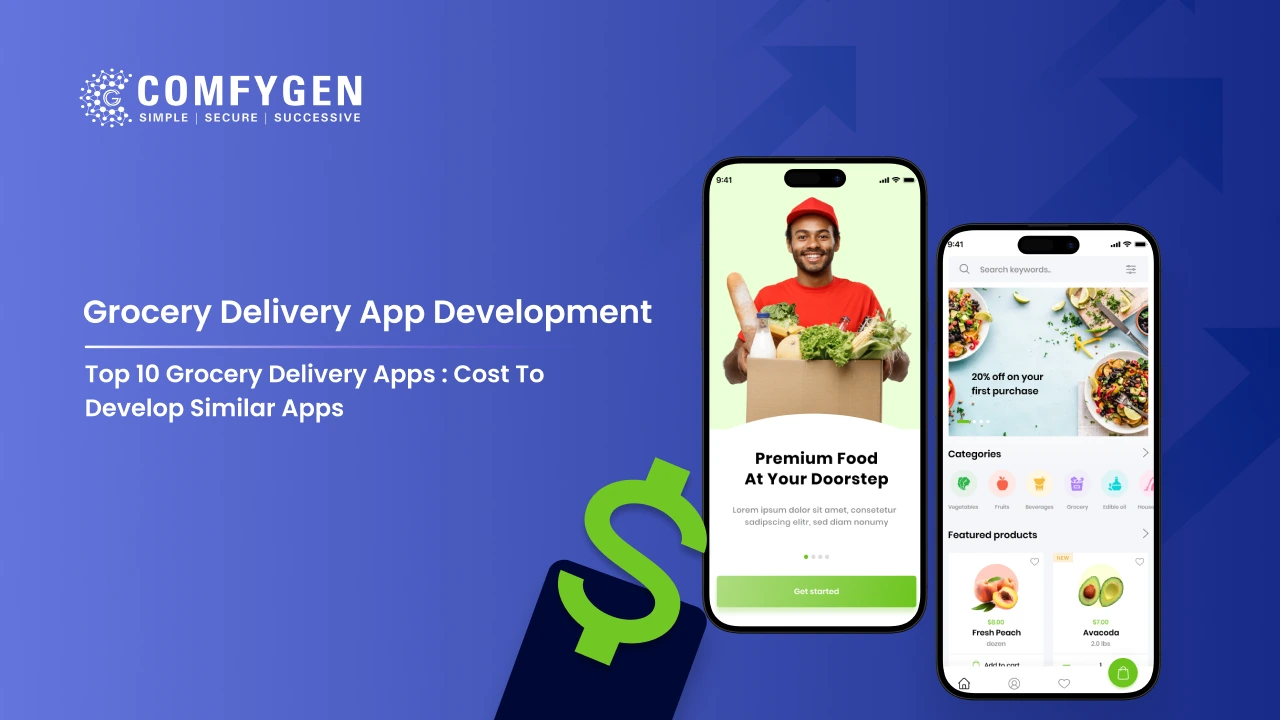





The top grocery delivery apps of 2026 run on four fulfilment models: marketplace, own-inventory, dark store, and crowdsourced. Instacart and InstaShop use partner stores. Amazon Fresh owns its stock. Blinkit and Zepto run dark stores for 10-minute delivery. Beelivery uses crowdsourced drivers. Building grocery delivery software on any of these models costs $15,000 to $120,000, or from $8,000 for a readymade grocery delivery app.
The global online grocery delivery services market is projected to grow from USD 391.59 billion in 2025 to USD 1.51 trillion by 2031, a CAGR of 25.26%, according to TechSci Research. Scheduled delivery still holds the larger share at 59.72% in 2025, while instant services grow at over 30% year on year, per Mordor Intelligence.
This guide covers the leading apps, the software model behind each one, and what it costs to build the same thing.
The Grocery Delivery App Market in 2026
| Measure | Figure | Source |
| Global market, 2025 | USD 391.59 billion | TechSci Research |
| Projected, 2031 | USD 1.51 trillion | TechSci Research |
| CAGR | 25.26% | TechSci Research |
| Scheduled delivery share, 2025 | 59.72% | Mordor Intelligence |
| Instant delivery growth | Over 30% year on year | Mordor Intelligence |
Two things follow from those numbers.
Growth at 25% compound means order volume roughly quadruples inside six years. Any grocery fulfillment platform sized for today’s volume will not hold, which is why architecture decisions matter more here than feature decisions.
And scheduled delivery is still the bigger market despite the attention instant delivery gets. A weekly shop booked three days ahead remains most people’s default. Instant is growing faster from a smaller base.
Top Grocery Delivery Apps in 2026
Fifteen grocery delivery apps worth studying, grouped by the fulfilment model underneath. The model matters more than the feature list, because it decides delivery speed, margin per order, and how much capital you need before the first order lands.
| App | Region | Model | Typical delivery |
| Instacart | USA, Canada | Marketplace | 1 to 4 hours |
| Shipt | USA | Marketplace | Same day |
| InstaShop | UAE, GCC | Marketplace | Under an hour |
| Beelivery | UK | Crowdsourced | Under an hour |
| Amazon Fresh | Global | Own inventory | Slot-based |
| Walmart | USA | Own inventory | Same day, pickup |
| BigBasket | India | Own inventory | Scheduled slots |
| Tesco, Sainsbury’s | UK | Own inventory | Slot-based, click and collect |
| Ocado | UK | Automated warehouse | Slot-based |
| Picnic | Netherlands, Germany | Fixed-route | Scheduled, free |
| Blinkit | India | Dark store | 10 minutes |
| Zepto | India | Dark store | Under 10 minutes |
| Swiggy Instamart | India | Dark store | 10 to 20 minutes |
| Flipkart Minutes | India | Dark store | 10 to 15 minutes |
| Gopuff | USA | Dark store | 15 to 30 minutes |
Marketplace Apps: No Stock, No Warehouses
Instacart (USA and Canada)
Instacart connects shoppers to supermarkets that already hold the stock. A personal shopper accepts the order, picks it in-store, and delivers it. Instacart owns no inventory and leases no warehouses, which is how it scaled across thousands of retail banners and tens of thousands of stores without building fulfilment infrastructure.
Revenue arrives from three directions: commission from retail partners, delivery and service fees from customers, and a large advertising business where brands pay for placement inside the app. The Instacart+ subscription removes delivery fees above a basket threshold, which lifts order frequency.
For anyone comparing grocery delivery apps as a model to copy, this is the cheapest serious entry point. The complication is the shopper layer, since a marketplace needs a picker app that handles substitution while the shopper stands in the aisle.
Model: marketplace.
Build implication: a grocery shopper app, a commission engine, vendor onboarding, and substitution approval in real time. Costs sit in the $35,000 to $70,000 band, and the Instacart clone app development cost breakdown covers where the money goes.
Shipt (USA)
Owned by Target, Shipt runs the same shopper-driven model across grocery and general retail, with a membership giving free delivery above a threshold. Its differentiator is retailer breadth rather than speed, so it competes on which stores you can order from rather than on minutes.
Model: marketplace with membership.
Build implication: subscription billing alongside per-order fees, and multi-retailer catalog reconciliation.
InstaShop (UAE and GCC)
Launched in Dubai in 2015 and acquired by Delivery Hero in 2020, InstaShop connects customers to local supermarkets, pharmacies, and pet shops across the UAE and neighbouring markets. Delivery often lands inside the hour, with no warehouses anywhere in the operation.
What makes it a regional build rather than a translated one: Arabic support means full right-to-left layout rather than swapped strings, cash on delivery remains common enough to be a first-class payment method, and Ramadan reshapes daily order volume for a month each year.
Model: marketplace.
Build implication: right-to-left layout, PayTabs or Telr, cash reconciliation in the rider app, and seasonal slot capacity. The full regional breakdown sits in our guide to building an instant delivery app like InstaShop.
Crowdsourced Delivery: Elastic Driver Supply
Beelivery (UK)
Beelivery uses crowdsourced drivers rather than an employed fleet. A driver nearby accepts the job, shops at a local store, and delivers, typically within the hour and around the clock rather than inside booked windows. No warehouses, no vans, and no fixed slots.
The model solves the hardest cost problem in online grocery delivery, which is paying drivers during quiet hours. Supply expands when demand appears and shrinks when it does not. The trade-off is quality control, since the person handling someone’s groceries is not your employee.
Nobody else in this space has written up the build properly, so it is worth being specific: crowdsourced models need driver vetting, live availability by postcode, and a payment flow that settles individual jobs rather than shifts.
Model: crowdsourced.
Build implication: driver supply matching by area, background check workflow, real-time availability instead of slot booking, and per-job settlement.
Own-Inventory Apps: Control at the Cost of Capital
Amazon Fresh (Global)
Amazon Fresh runs on owned inventory from Amazon’s own fulfilment network, with slot-based and same-day delivery tied into Prime. Owning the stock gives full control over catalog, pricing, and availability, which no marketplace can match.
The cost is everything that has to exist before the first order: warehouse space, inventory capital, and a fulfilment operation. For a startup asking how to build the best grocery app, this model is usually the wrong answer, because the software is the smaller half of the problem.
Model: own inventory.
Build implication: warehouse management, slot engine, route planning, and demand forecasting per fulfilment centre.
Walmart (USA)
Walmart combines online grocery with in-store pickup and same-day delivery, using its store estate as the fulfilment network rather than separate warehouses. Pickup is the quiet winner here, since it removes last-mile cost entirely while still bringing the shopper past the shelves.
Model: own inventory, store-based fulfilment.
Build implication: pickup staging boards, arrival check-in with bay numbers, and slot capacity measured by staging space rather than driver availability.
BigBasket (India)
Acquired by Tata Digital in 2021, BigBasket runs full-basket online grocery with scheduled slots, subscriptions for staples like milk and bread, and a catalog running past 20,000 items. It later added faster delivery alongside the scheduled service, so it now operates both models in one app.
Subscriptions do more work in grocery than in almost any other category, because the weekly shop repeats whether or not you market to it.
Model: own inventory with scheduled delivery.
Build implication: slot capacity per zone, large-catalog search that returns under a second, and recurring-order logic.
Tesco and Sainsbury’s (UK)
Both run supermarket-owned apps with click and collect alongside home delivery, delivery passes for frequent shoppers, and loyalty integration through Clubcard and Nectar. Loyalty here is not a bolt-on: prices differ for cardholders, so the discount has to apply at basket level as the customer shops rather than appearing at checkout.
Model: own inventory, multi-channel.
Build implication: pickup staging, coupon handling that survives substitution, and per-store slot capacity.
Ocado (UK)
Ocado is the outlier. It began as an online-only grocer and became a technology company, licensing its automated warehouse systems and software to retailers worldwide. Highly automated fulfilment centres pick orders using robotic grids rather than people walking aisles.
Worth understanding because it shows where the model ends: at sufficient scale, the grocery delivery software becomes the product and the groceries become the proof.
Model: automated own-inventory, plus technology licensing.
Build implication: warehouse robotics integration, which is outside the scope of an app build but shapes what the app can promise.
Picnic (Netherlands and Germany)
Picnic delivers on fixed routes, closer to a milk round than to on-demand delivery. Customers pick from set arrival windows, delivery is free, and the vans follow planned routes at planned times. App-only, with no website checkout for most of its history.
The model trades convenience for cost. By removing delivery choice, Picnic removes the expensive part of last-mile delivery.
Model: fixed-route own inventory.
Build implication: route-first slot generation, where the app offers windows the route already covers rather than letting customers pick freely.
Dark Store Apps: The 10-Minute Delivery Field
Dark stores are small warehouses holding a narrow, fast-moving range, positioned close enough to customers that a rider can complete a round trip in minutes. This is the model behind every 10 minute delivery app, and the store network is the product rather than the software.
Blinkit (India)
Formerly Grofers, rebranded as Blinkit in 2021 and acquired by Zomato, now Eternal, in 2022. Blinkit promises delivery in around ten minutes from dark stores holding roughly 1,500 to 3,000 items rather than the 10,000-plus a supermarket carries.
The narrow catalog is deliberate. Fewer items means faster picking, higher stock turnover, and forecasting that actually works at store level.
Model: dark store.
Build implication: dispatch logic measured in seconds, live stock per micro-warehouse, and picking sequenced by shelf position.
Zepto (India)
Founded in 2021, Zepto competes with Blinkit on dark store density across Indian metros, with order-to-door under ten minutes in core zones. Its growth came from opening stores faster than rivals in the same postcodes rather than from a software advantage.
Model: dark store.
Build implication: rider assignment inside seconds, per-store stock, and zone boundaries drawn tight enough to hold the promise. The cost to develop an app like Zepto reflects that dispatch complexity.
Swiggy Instamart (India)
Instamart is quick commerce built on top of an existing food delivery network, reusing rider supply across both services. When grocery demand dips at lunchtime, those riders take restaurant orders instead.
That shared pool is a genuine structural advantage, and it is the hardest thing on this page to copy without already running a second vertical.
Model: dark store on shared logistics.
Build implication: a rider pool allocated across verticals, with priority rules when both queues are busy.
Flipkart Minutes (India)
Flipkart’s quick commerce service, launched into an already crowded market and leaning on existing ecommerce logistics and customer base rather than building from zero.
Model: dark store on existing ecommerce infrastructure.
Build implication: integrating quick delivery into an established catalog and account system.
Gopuff (USA)
Gopuff runs micro-fulfilment centres stocking convenience items, snacks, drinks, and household essentials rather than a full weekly shop. Closer to a corner shop that comes to you than to a supermarket.
Model: dark store, convenience range.
Build implication: narrow high-turnover catalog, tight delivery radius, and age verification where alcohol is stocked.
Other Online Fast Delivery Apps Like Blinkit: What the Quick Commerce Field Looks Like
People searching for other apps like Blinkit are usually asking one of two things: which alternatives can I order from, or which model should I copy. Here is the field.
| App | Market | Promise | Notes |
| Zepto | India | Under 10 minutes | Closest direct rival on store density |
| Swiggy Instamart | India | 10 to 20 minutes | Shares riders with food delivery |
| Flipkart Minutes | India | 10 to 15 minutes | Built on existing ecommerce logistics |
| BigBasket | India | Scheduled plus fast | Runs both models in one app |
| Gopuff | USA | 15 to 30 minutes | Convenience range, not full grocery |
| Getir | Turkey | Minutes | Pulled back from several Western markets in 2024 |
What the retreat of some instant delivery apps tells you. Several well-funded quick commerce brands exited Western markets after finding the unit economics did not hold outside dense cities. Dark stores need enough orders per square kilometre to cover the lease, so the model works in Mumbai and central London and fails in a market town.
If you are planning an instant delivery app, run the density maths before the feature list. Orders per day per dark store is the number that decides whether the business works, and no amount of software fixes a thin catchment.
Which Grocery Delivery Apps Are the Most Innovative?
The most innovative grocery delivery apps are the ones that solved a supply problem rather than a design problem. Blinkit and Zepto proved dark stores make 10-minute delivery economically possible. Instacart proved a marketplace can scale without owning stock. Beelivery proved crowdsourced drivers remove the need for a fleet entirely. Amazon Fresh proved owned inventory gives price control nobody else has.
Feature innovation in grocery is largely settled. Every serious app now has live tracking, slot booking, and substitution. What still separates them is the fulfilment model underneath, because that decides delivery speed, margin, and how much capital you need before launch.
The genuinely new work in 2026 sits in three places:
- Substitution intelligence:Ranking replacements by what the customer actually accepted last time, rather than by price or category similarity.
- Demand prediction at store level: Forecasting per dark store rather than per region, which is what makes a 1,500-item catalog hold a 95% fill rate.
- Rider supply matching: Predicting how many drivers will be available in each zone two hours ahead, so slot capacity reflects reality rather than a roster.
Grocery Delivery Software: The Four Models Compared
| Factor | Marketplace | Own inventory | Dark store | Crowdsourced |
| Examples | Instacart, InstaShop | Amazon Fresh, BigBasket | Blinkit, Zepto, Gopuff | Beelivery |
| Who holds stock | Partner stores | You | You, per micro-warehouse | Partner stores |
| Delivery time | 30 to 60 min | Slot-based | 10 to 30 min | Under an hour |
| Warehouses needed | None | Yes, large | Yes, many small | None |
| Inventory capital | None | High | Moderate | None |
| Driver model | Employed or gig | Employed | Employed | Crowdsourced |
| Catalog size | Partner-set | 20,000+ | 1,500 to 3,000 | Partner-set |
| Build cost | $35,000 to $70,000 | $70,000+ | $70,000+ | $35,000 to $70,000 |
| Fastest to launch | Yes | No | No | Yes |
Marketplace and crowdsourced models launch cheapest because you own no stock. Dark store and own-inventory models cost more and deliver faster or cheaper per order once volume covers the fixed cost.
Building an On-Demand Grocery Delivery App Like Uber
The Uber comparison comes up constantly, and it is half right.
What transfers: Live driver tracking, dispatch by proximity, surge pricing at peak, ratings both ways, and in-app payment with a later capture.
What does not: Uber moves one thing from A to B. A grocery order involves 20 to 40 items that may not be on the shelf when the picker arrives. That single difference adds substitution logic, stock sync, weight-based pricing, and a picker workflow, none of which exist in a ride-hailing app.
Anyone quoting a grocery build as “Uber plus a catalog” has not shipped one. The dispatch layer is maybe a quarter of the work.
What a Grocery Delivery Solution Contains
Four connected panels, whatever the fulfilment model.
Customer app: Store or zone selection, catalog search, live stock, cart, slot or instant checkout, substitution preferences, multiple payment methods, live tracking, and one-tap reorder.
Grocery shopper app: The picker workflow: items in aisle order, scan to confirm, substitution prompts with ranked replacements, and weight capture for loose produce.
Grocery driver app: Assignment notifications, navigation, route sequencing for batched orders, proof of delivery, and cash reconciliation where cash on delivery applies.
Admin dashboard: Order triage, stock and catalog control, zone and slot capacity, commission and payouts, and reporting. An admin dashboard for grocery delivery usually takes longer to build than the customer app, because it is where the operation actually runs.
The full panel-by-panel breakdown, including what to build at launch and what can wait, sits in the grocery delivery app features list.
Readymade Grocery Delivery App or Custom Build?
| Factor | Readymade or white-label | Clone script | Custom build |
| Cost | From $8,000 | $12,000 to $25,000 | $35,000+ |
| Time to launch | 3 to 6 weeks | 6 to 10 weeks | 14 to 32 weeks |
| Source code | Licensed, buyout available | Yours | Yours |
| Change the flow later | Limited | Moderate | Unlimited |
| Best for | Testing one town or postcode | Copying a proven model | Chains with their own POS and rules |
A readymade grocery delivery app is the right call when the question is whether anyone in your area will order groceries online at all. Custom becomes right once you have store-specific rules, a POS to sync with, or a deli counter in the mix, because those are exactly what a script does not anticipate.
What Grocery Delivery Software Costs to Build
| Build type | Cost | Timeline |
| Single-store MVP | $15,000 to $30,000 | 8 to 12 weeks |
| Multi-vendor marketplace | $35,000 to $70,000 | 14 to 20 weeks |
| Dark store or enterprise platform | $70,000 to $120,000+ | 20 to 32 weeks |
| Readymade or white-label | From $8,000 | 3 to 6 weeks |
What moves the price:
- Number of panels. Customer only, or customer plus shopper plus driver plus admin
- Fulfilment model, since dark store dispatch costs more than marketplace routing
- POS or grocery inventory management integration, priced per system
- Payment gateways and the regions they cover
- AI features such as demand forecasting, which need order history before they work
The tier-by-tier breakdown with timelines sits in our grocery delivery app development guide.
Building Your Grocery Delivery Platform With Comfygen
Comfygen has delivered 550+ projects for 400+ clients across 30+ countries since 2019. Our team builds grocery platforms across all four fulfilment models, from marketplace apps to dark store quick commerce, working as a grocery delivery app development company for chains, independent grocers, and startups entering the market.
Substitution handling, POS sync, and zone-level slot capacity are built in rather than bolted on. Every project ships with the source code in your name and a signed NDA from the first call. Comfygen Technologies holds ISO 9001:2015, ISO/IEC 20000-1:2018, and ISO 27001 certification.
Frequently Asked Questions
What is the best grocery delivery software?
How big is the grocery delivery app market?
How much does an on-demand grocery delivery app cost?
Can I build a grocery delivery app like Uber?
What is a readymade grocery delivery app?
What is the difference between a grocery shopper app and a grocery driver app?
Which grocery delivery model is cheapest to launch?

Mr. Saddam Husen, (CTO)
Mr. Saddam Husen, CTO at Comfygen, is a renowned Blockchain expert and IT consultant with extensive experience in blockchain development, crypto wallets, DeFi, ICOs, and smart contracts. Passionate about digital transformation, he helps businesses harness blockchain technology’s potential, driving innovation and enhancing IT infrastructure for global success.