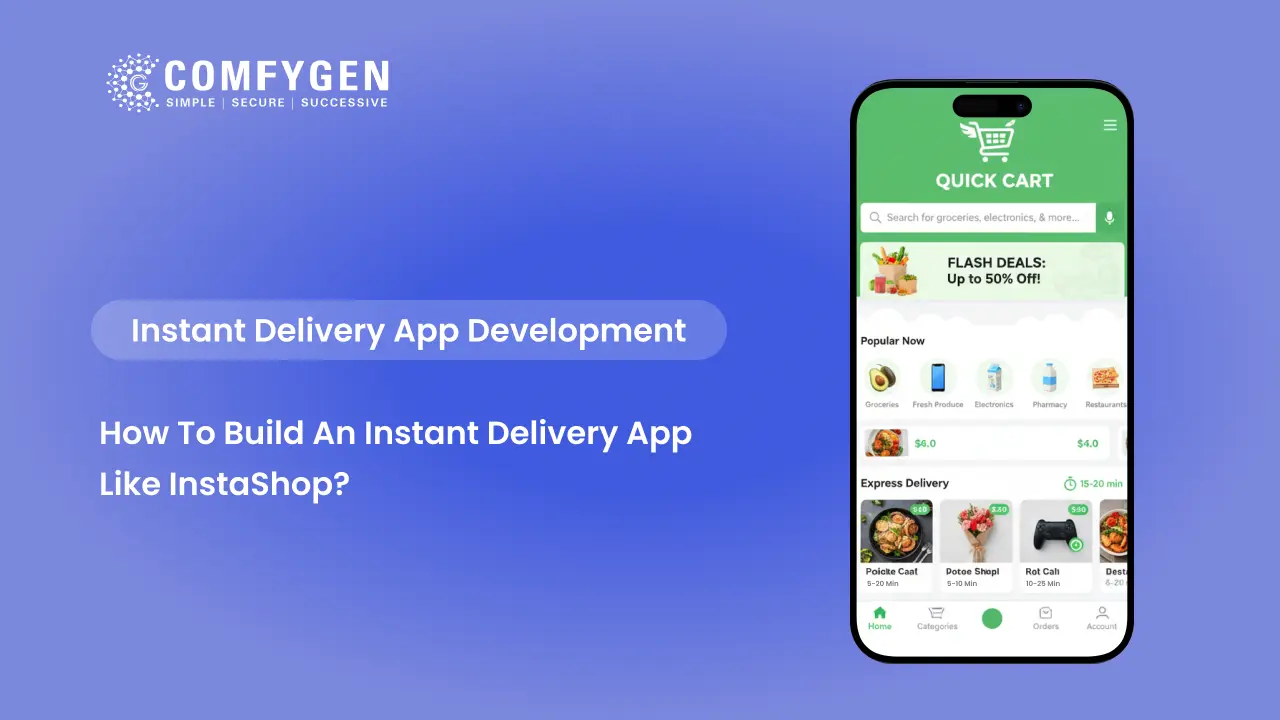





Building an instant delivery app like InstaShop costs $15,000 to $120,000 and takes 8 to 32 weeks. InstaShop runs a marketplace model, so it connects customers to local supermarkets and pharmacies that already hold the stock instead of operating its own warehouses. As a result, the model needs no dark stores and no inventory capital, which makes it the cheaper way to enter instant delivery.
InstaShop launched in Dubai in 2015 and now operates across the UAE, Qatar, Bahrain, Lebanon, and Egypt. Delivery Hero acquired it in 2020. Customers order from nearby supermarkets, pharmacies, and pet shops, and then a rider collects and delivers, often inside the hour.
Because that model works without warehouses, founders across the GCC keep asking how to build the same thing for their own city. This guide covers the build, including the regional decisions a general grocery article will not mention.
How Does the InstaShop Model Work?
InstaShop does not hold stock. That single fact shapes everything.
| Factor | InstaShop marketplace model | Dark store model (Blinkit, Zepto, Getir) |
| Who holds the stock | Partner stores | You do |
| Warehouse needed | None | Yes, per zone |
| Inventory capital | None | Significant |
| Catalog size | Whatever partners stock | 1,500 to 3,000 curated items |
| Delivery time | 30 to 60 minutes | 10 to 30 minutes |
| Margin source | Commission plus delivery fee | Product margin plus delivery fee |
| Upfront cost | Lower | Much higher |
In short, the marketplace model launches cheaper and slower. The dark store model costs more and delivers faster. InstaShop chose the first, which is why it scaled across five countries without building warehouses.
For anyone weighing the alternative, quick commerce app development covers the dark store side, where dispatch logic has to work in seconds rather than minutes.
What Changes When You Build an App Like InstaShop for the UAE?
This is the section a general grocery guide leaves out, and it is where a UAE build genuinely differs.
Arabic and Right-to-Left Layout
Arabic support is not a translation job. It changes the layout.
- The whole interface mirrors. Navigation, back buttons, progress bars, and cart flow all flip
- Numbers stay left-to-right inside right-to-left text, which breaks naive implementations
- Product names often need both Arabic and English, because shoppers search in either
- Text expands. Arabic strings run longer than English ones, so fixed-width buttons break
Build right-to-left support into the component library from the start. Retrofitting it means touching every screen.
Payment Gateways That Work Locally
Stripe and PayPal coverage is limited across the GCC. The gateways that matter here:
| Gateway | Coverage |
| PayTabs | UAE, Saudi, Egypt, Jordan |
| Telr | UAE, Saudi |
| Network International | UAE, wider Middle East |
| Checkout.com | UAE and regional |
| Tabby, Tamara | Buy now, pay later, widely used in the region |
Cash on delivery remains common, so the app needs it as a first-class payment method rather than an afterthought. That affects the rider app, which has to handle cash reconciliation at the end of shift.
Ramadan Changes Everything for a Month
Order volume does not just rise during Ramadan. It moves.
- Daytime orders drop sharply
- A large spike lands in the two hours before iftar
- A second spike follows late at night
- Basket contents shift toward dates, juices, and bulk staples
A platform sized for normal evening peaks will fail in that pre-iftar window. Build slot capacity and rider scheduling so both can be reconfigured seasonally, not hardcoded to a standard week.
Multi-Emirate and Multi-Country Zones
Each emirate has its own rules, and each country in the GCC has more.
| Variable | Why it matters |
| Delivery zones | Dense urban zones need tighter radii than Al Ain or Fujairah |
| VAT | 5% in the UAE, different elsewhere in the GCC |
| Restricted items | Alcohol and pork are restricted or licensed, varying by emirate |
| Language default | Arabic-first in some markets, English-first in others |
| Currency | AED, SAR, QAR, BHD, EGP |
Build all five as configuration, not code. Adding Qatar should be a settings change.
Ready to Launch Your InstaShop-Like App?
Get the right technology, features, and development strategy to build an instant delivery app that drives growth.
Get Started Today
How an Order Moves Through an InstaShop-Style App
- Location first: The app detects the emirate and area, then shows only stores that deliver there
- Store selection: Customers browse by store rather than by a single merged catalog, because each partner stocks different things
- Cart and checkout: Multiple payment methods, including cash and buy now, pay later
- Store accepts: The partner confirms availability and starts picking
- Rider assignment: Nearest available rider, or batch broadcast at peak
- Substitution if needed: Store suggests a replacement, customer approves through a push notification
- Delivery and proof: Photo, signature, or OTP. Cash collected and logged if applicable
- Reconciliation: Commission, delivery fee, and cash float settled at shift end
Step six is the one teams underestimate. Grocery baskets hold 20 to 40 items, and stock counts at a partner store drift constantly. Teams that manage inventory in grocery delivery apps well sync with the partner’s till rather than trusting a catalog that updates overnight.
Which Features to Build in an App Like InstaShop
Customer App
- Location detection with emirate and area selection
- Store discovery ranked by distance and delivery time
- Arabic and English interface with full right-to-left support
- Product search across a store’s catalog
- Cart with substitution preferences per item
- Cash on delivery, cards, wallets, and buy now, pay later
- Live rider tracking
- Order history with one-tap reorder
- In-app support in both languages
Store Partner Panel
- Catalog and price management
- Availability toggles per product, since partner stock changes hourly
- Order acceptance with a timer
- Substitution suggestions
- Daily settlement view
Rider App
- Assignment notifications with pickup and drop addresses
- Navigation, with support for the informal addressing common in parts of the region
- Cash collection logging and float reconciliation
- Proof of delivery
- Earnings and shift view
Admin Dashboard
- Store onboarding and commission rules
- Zone drawing with per-zone fees and minimums
- Rider dispatch and manual override
- Order triage for stuck and disputed orders
- Reporting by store, zone, and country
An admin dashboard for grocery delivery carries more work than most founders expect in a marketplace model, because commission rules and settlement run through it for every partner store.
InstaShop or Amazon Fresh: Which Model Fits You?
Both deliver groceries. They are almost opposite businesses, and the build differs completely.
| Business Dimension | InstaShop | Amazon Fresh |
| Model | Marketplace of local stores | Owned inventory and fulfilment centres |
| Stock | Partner stores hold it | Amazon holds it |
| Catalog control | Limited, set by partners | Full |
| Capital needed | Low | Very high |
| Delivery promise | 30 to 60 minutes | Same-day or next-day slots |
| Pricing control | Partners set prices | You set prices |
| Build complexity | Store panel, commission engine, rider app | Warehouse management, slot engine, route planning |
| Realistic for a startup | Yes | No, without significant funding |
In short, build the InstaShop model if you want to launch without owning stock. The Amazon Fresh model needs warehouses, inventory capital, and a fulfilment operation before a single order gets placed.
Most founders who ask about an Amazon Fresh clone actually want the marketplace model once they see the capital difference. The full comparison of single-store, marketplace, hyperlocal, and quick commerce models sits inside grocery delivery app development, where each one carries different costs and timelines.
How Much Does It Cost to Build an App Like InstaShop?
An InstaShop-style app costs $15,000 to $120,000 or more. A single-city MVP with a customer app, store panel, and admin runs $15,000 to $30,000. A full marketplace with a rider app, commission engine, and Arabic support runs $35,000 to $70,000. A multi-country platform starts at $70,000.
| Build type | Cost | Timeline |
| Single-city MVP | $15,000 to $30,000 | 8 to 12 weeks |
| Full marketplace | $35,000 to $70,000 | 14 to 20 weeks |
| Multi-country platform | $70,000 to $120,000+ | 20 to 32 weeks |
| White-label launch | From $8,000 | 3 to 6 weeks |
What moves the price on this model:
- Arabic and right-to-left support, which touches every screen
- Number of countries, because VAT, currency, and restricted items multiply
- Cash on delivery handling, which adds reconciliation to the rider app and the dashboard
- Commission and settlement logic, priced by complexity
- Buy now, pay later integrations, each one a separate gateway
- Number of partner stores at launch, which drives onboarding work
A marketplace costs more than a single-store app for the same feature count. The Instacart clone app development cost breaks down the same marketplace economics for the US market, where the commission engine and vendor onboarding account for most of the difference.
Which Tech Stack Suits an Instant Delivery App?
| Layer | Choice | Why |
| Mobile | Flutter or React Native | One codebase, and both handle right-to-left layout well |
| Web | React or Next.js | Store catalog pages that load fast |
| Backend | Node.js or Django | Concurrent orders across several stores |
| Database | PostgreSQL | Orders, commissions, settlements |
| Cache | Redis | Store availability, read constantly |
| Maps | Google Maps API | Zone polygons, rider tracking, address handling |
| Payments | PayTabs or Telr, plus Tabby or Tamara | Regional coverage that Stripe does not give you |
| Notifications | Firebase Cloud Messaging | Substitution approvals and rider updates |
| Localisation | i18n with right-to-left support | Built in from the first sprint |
One note on Flutter: its right-to-left handling is solid, which matters more here than in most markets. Verify your team has shipped an Arabic app before, not just a localised one.
Which Build Option Fits Your Budget?
| Option | Cost | Time to launch | Best for |
| White-label | From $8,000 | 3 to 6 weeks | Testing one emirate before committing |
| InstaShop clone app | $12,000 to $25,000 | 6 to 10 weeks | Copying a proven marketplace flow |
| Custom build | $35,000+ | 14 weeks up | Multi-country, or a vertical nobody serves yet |
A clone gets a working marketplace flow quickly. Custom becomes the right call once you need Arabic-first design, multi-country settlement, or a vertical the script does not anticipate.
How Does an App Like InstaShop Make Money?
- Commission per order: Typically 10 to 25% from partner stores
- Delivery fees: Often waived above a basket threshold
- Subscriptions: Monthly free delivery, which lifts order frequency
- Featured placement: Stores and brands pay for position in search and category pages
- Surge fees: Peak hours, and the pre-iftar window during Ramadan
Most platforms run three or four together. The commission does the heavy lifting in a marketplace model, because you carry no product cost.
Problems to Plan For Before You Launch
Three that hit marketplace models specifically.
Partner Stock is Not your Stock
You show what the partner says they have, and that number is often wrong. Sync with their till if they have one, and cache availability with a short expiry if they do not.
Partner Acceptance Times Vary
A store that takes eight minutes to accept an order breaks your delivery promise before a rider is even assigned. Build an auto-reassign rule.
Cash Handling Creates a Float Problem
Riders carrying cash need a reconciliation flow, a float limit, and a settlement cycle. This is operational rather than technical, and it needs building into the dashboard.
Several more surface only once real orders start flowing, and the grocery delivery app development challenges that cost the most to fix are the ones touching payment and substitution at the same time.
Why Build Your InstaShop Clone App With Comfygen
Comfygen has delivered 550+ projects for 400+ clients across 30+ countries since 2019, including work for clients in the UAE and wider Middle East. Our team builds marketplace and quick commerce platforms with Arabic support, regional payment gateways, and cash handling built in, working as a grocery delivery app development company for startups and retail groups across the GCC.
Every project ships with the source code in your name and a signed NDA from the first call. Comfygen Technologies holds ISO 9001:2015, ISO/IEC 20000-1:2018, and ISO 27001 certification.
Frequently Asked Questions
How much does it cost to build an app like InstaShop?
How long does it take to build an InstaShop clone app?
Does InstaShop own its own warehouses?
What is the difference between an app like InstaShop and one like Amazon Fresh?
Do I need Arabic support in an instant delivery app for the UAE?
Which payment gateways work in the UAE?
Can one app like InstaShop work across several countries?

Mr. Saddam Husen, (CTO)
Mr. Saddam Husen, CTO at Comfygen, is a renowned Blockchain expert and IT consultant with extensive experience in blockchain development, crypto wallets, DeFi, ICOs, and smart contracts. Passionate about digital transformation, he helps businesses harness blockchain technology’s potential, driving innovation and enhancing IT infrastructure for global success.