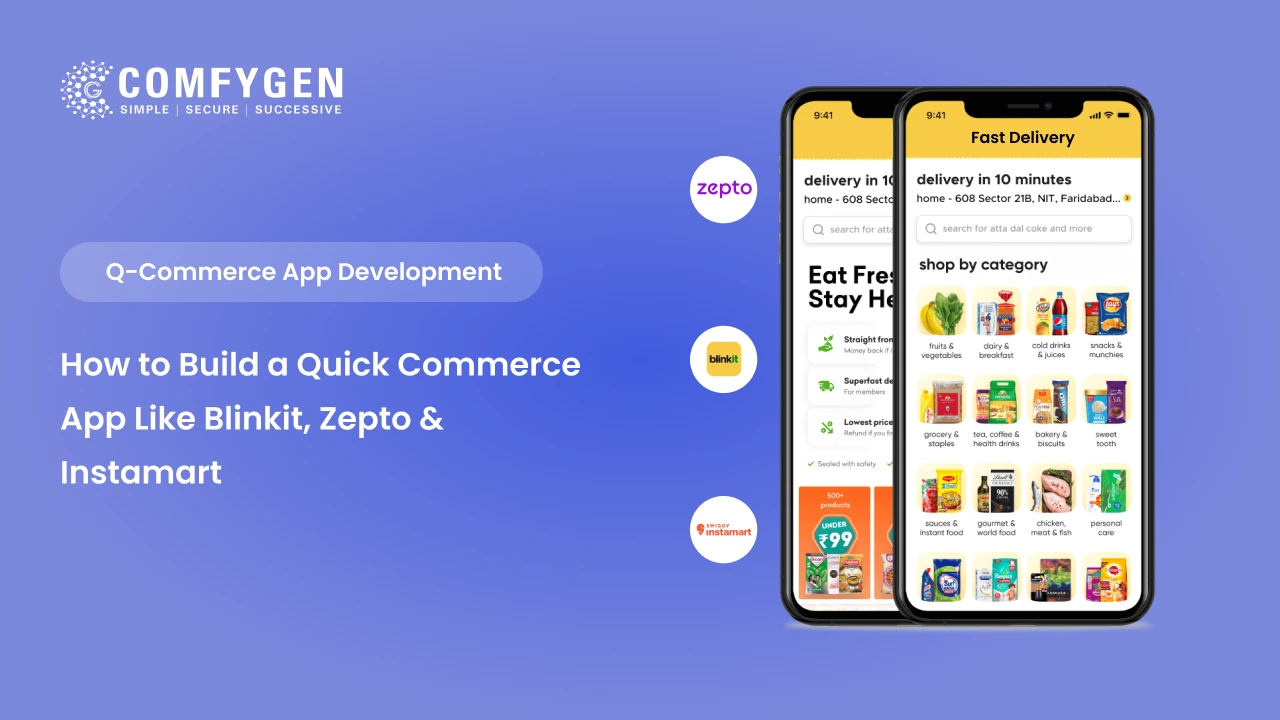





Quick Summary: The cost to develop an app like Zepto ranges from $25,000–$45,000 for a single-city MVP to $250,000 and above for a multi-city quick commerce platform. Most founders underestimate this because Zepto is not one app — it is an ecosystem of four to five connected applications. Your final number depends on how many of those you build, how much real-time load your backend carries, and where your development team sits.
Four years ago, ordering a single packet of coriander and receiving it before your tea finished brewing sounded ridiculous. Today it is routine in most Indian metros, and the company that made it routine has become the benchmark every founder in this space measures themselves against.
The numbers explain why. Zepto’s revenue from operations climbed to ₹22,624 crore in FY26, and the company now runs 1,139 dark stores across 66 cities while processing more than 23 lakh orders a day. It also lost ₹5,905 crore in FY26 doing it. Both halves of that sentence matter if you are planning to enter this market.
So when founders ask what it costs to build an app like Zepto, the honest answer is that this is a strategy question wearing a budget costume. Here are the real numbers.
How Much Does It Cost to Develop an App Like Zepto?
Here is the short version for people who scrolled straight down.
|
Build Tier |
Cost (USD) | Cost (INR) |
What You Get |
|---|---|---|---|
| MVP (single zone) | $25,000 – $45,000 | ₹21 – 38 lakh | One dark store, lean customer + rider + admin apps |
| Startup version | $45,000 – $85,000 | ₹38 – 72 lakh | Polished UX, live tracking, multiple payment rails |
| Growth-stage platform | $85,000 – $175,000 | ₹72 lakh – 1.5 crore | Multi-store inventory sync, route optimisation, analytics |
| Enterprise q-commerce | $200,000 – $400,000+ | ₹1.7 – 3.4 crore+ | Multi-city, warehouse management, AI forecasting, franchise tools |
Notice the jump between the third and fourth tiers. That gap is not extra screens — it is the engineering needed to keep inventory accurate across dozens of locations while thousands of orders move at once. A custom mobile app development partner who has shipped real-time logistics prices that risk honestly. One who has not quotes the MVP number for enterprise scope, and you find out eight months in.
Why Zepto Is Not One App — It Is Five
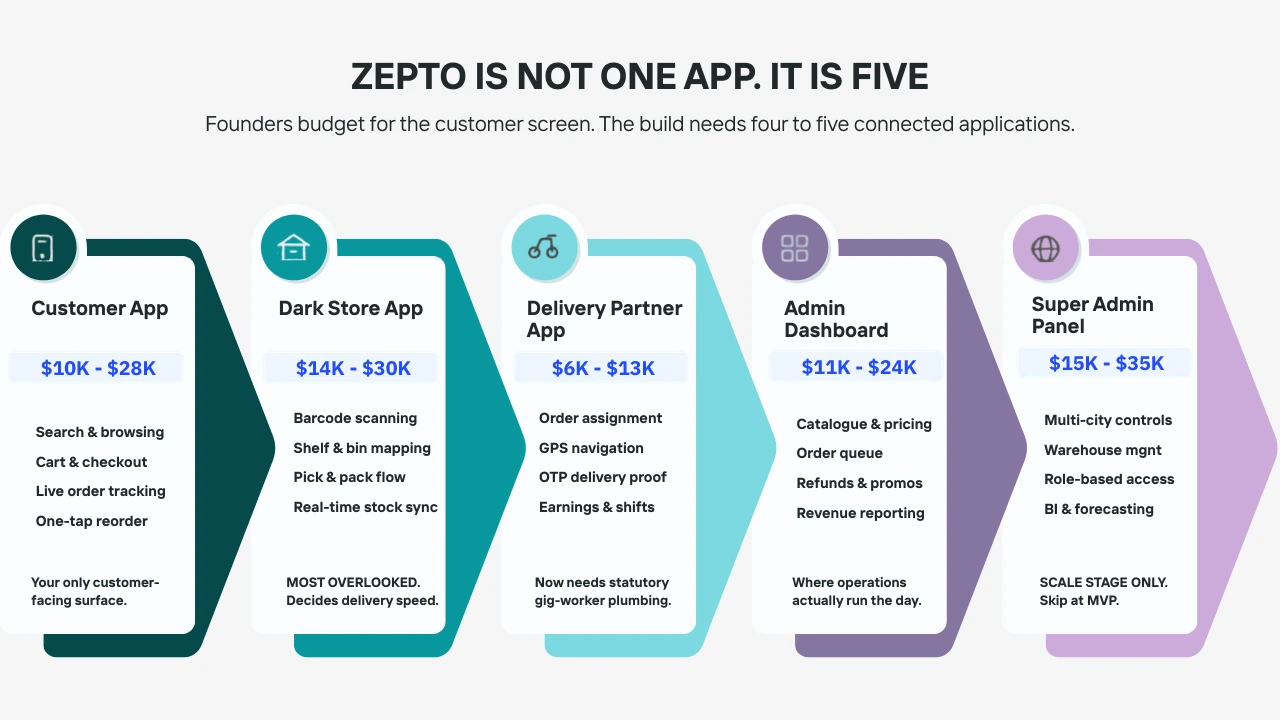
This misconception wrecks more budgets than any other. Founders picture the customer screen and budget for that. Then discovery starts and they find four more apps.
1. Customer App
Customer app the only piece your users ever see. Search, category browsing, cart, checkout, payments, live tracking, one-tap reorder. That reorder button deserves attention: groceries are habitual purchases, and making the weekly repeat effortless is your strongest retention lever.
Budget: $10,000 – $28,000.
2. Dark Store Management App
The one founders forget and the one that decides your delivery speed. Barcode scanning, shelf and bin mapping, pick lists, packing flow, real-time stock deduction, low-stock alerts. A customer places an order in fifteen seconds; if your picker spends four minutes hunting for items because the app does not tell them which aisle to walk to, your speed promise is already broken.
Budget: $14,000 – $30,000.
3. Delivery Partner App
Rider onboarding and verification, order assignment, GPS navigation, OTP-based delivery confirmation, earnings dashboard, shift management. Similar in spirit to a logistics app development build, but tuned for sub-thirty-minute cycles.
Budget: $6,000 – $13,000.
4. Admin Dashboard
Admin dashboard — operations control. Catalogue and pricing, order queues, refunds, promotions, rider monitoring, revenue reporting. We covered the specifics of this layer in our guide to building an admin panel for grocery delivery.
Budget: $11,000 – $24,000.
5. Super Admin Panel
Super admin panel — only needed once you cross cities or add franchise partners. Multi-city controls, warehouse management, role-based access, business intelligence, forecasting.
Budget: $15,000 – $35,000.
You do not need all five on day one. You do need to know all five exist before you sign a budget, because each is genuinely separate engineering work with its own testing and maintenance tail.
Ready to Build a Zepto-Like Grocery App?
Turn your grocery delivery idea into a high-performing mobile application with expert developers and proven solutions.
Start Your Project
Cost Breakdown by Development Stage
For a growth-stage platform built with an experienced India-based team, here is where the money actually goes.
|
Stage |
Cost (USD) |
What It Covers |
|---|---|---|
| Discovery & product planning | $2,500 – $7,000 | Market validation, feature prioritisation, architecture decisions |
| UI/UX design | $4,000 – $11,000 | Wireframes, prototypes, design system across all apps |
| Frontend development | $14,000 – $38,000 | Customer, rider and store app interfaces |
| Backend & APIs | $16,000 – $45,000 | Order engine, inventory sync, real-time infrastructure |
| Third-party integrations | $5,000 – $14,000 | Payments, maps, SMS, push, analytics |
| QA & testing | $7,000 – $17,000 | Functional, load, device-matrix and security testing |
| Deployment & DevOps | $3,000 – $8,000 | CI/CD, cloud setup, store submissions |
Add these and you land in the $85,000 – $175,000 band, which lines up with the growth tier above. An MVP compresses this by narrowing each app to essentials and serving a single catchment.
Geography moves the number more than anything else. Indian and APAC teams typically charge $20–$60 per hour; North American and Western European teams charge $100–$200 for comparable work. That is not a small delta on a 2,000-hour build — it is the difference between ₹40 lakh and ₹1.4 crore. It is also why most global founders in this category hire dedicated mobile app developers offshore.
Factors That Move Your Zepto App Development Cost
Number of Applications
Already covered, and worth repeating because it is the dominant variable. Going from one app to four does not double your cost. It roughly triples it.
Real-time Complexity
A catalogue-and-checkout app is straightforward. Live inventory that stays accurate across stores while orders deduct stock concurrently is not. Most of this cost is invisible to the user and lives entirely in the backend.
Platform Choice
Android-first makes sense in India given device share. Most startups pick cross-platform anyway — Flutter or React Native development covers both operating systems from one codebase at close to single-platform cost. Building both natively instead costs roughly 60–80% more upfront.
Design Depth
In a category where people decide in seconds, a cluttered home screen buries the products they came for. Sound UI/UX design shows up directly in conversion, which makes it a poor place to economise.
Integrations
Razorpay or Stripe for cards, a UPI payment integration for the majority of Indian transactions, Google Maps for routing, an SMS gateway for OTPs, Firebase for push and crash reporting. Each adds build time, and several carry per-transaction fees forever.
AI and Personalisation
Demand forecasting, personalised recommendations, dynamic ETA prediction. Adding AI development capability typically costs $8,000–$25,000 depending on depth, and it is genuinely optional at MVP stage.
Technology Stack and What It Adds to the Bill
You do not need to dictate the stack, but understanding it helps you evaluate a quote.
- Frontend: Flutter or React Native for cross-platform; Swift and Kotlin where native performance is non-negotiable
- Backend: Node.js suits event-driven real-time workloads well; Python is the usual choice when forecasting sits in scope
- Databases: PostgreSQL for orders and payments where consistency is critical, MongoDB for catalogue flexibility, Redis for cart state and inventory counters that must respond in milliseconds
- Cloud: AWS, GCP or Azure — elasticity matters because festival demand can be five times a normal Tuesday
- Analytics: A proper data analytics setup from day one, since unit economics in this business are decided by numbers you cannot see without instrumentation
Total tech spend usually lands between $45,000 and $130,000 depending on customisation.
Compliance Costs Nobody Budgets For in India
This section did not exist in guides written last year, and it is now one of the most consequential line items in your plan.
The 10-Minute Promise is no Longer a Marketing Asset
In January 2026, following nationwide gig worker strikes and sustained pressure from the Labour Ministry, major platforms withdrew “10-minute delivery” messaging. If you are designing your product around a countdown timer as the core differentiator, redesign it. Build for reliable windows and accurate ETAs instead — it is better product thinking anyway.
Gig Worker Social Security is Now Statutory
The Code on Social Security came into force on 21 November 2025, defining gig and platform workers in law and requiring aggregators to contribute 1–2% of annual revenue (capped at 5% of payments made to those workers) into a government-managed fund. That is a permanent operating cost, and your rider app needs the registration, ID and earnings-transparency plumbing to support it.
Dark Stores Need Food Licences
State FDAs have shut down unlicensed dark stores for hygiene and licensing failures. Every fulfilment location needs a valid FSSAI registration, and your admin system should track licence status and expiry per store rather than leaving it in a spreadsheet.
DPDP Act 2023 Applies to Everything You Collect
Location trails, purchase history, contact data — all of it. Consent capture, purpose limitation, deletion workflows and breach notification need to be architected in, not bolted on. Retrofitting consent management into a live platform costs several times what building it in costs.
Budget $6,000–$15,000 for compliance engineering across these areas. It is far cheaper than the alternative.
Development Timeline: How Long It Actually Takes
|
Phase |
Duration |
|---|---|
| Discovery & planning | 2 – 4 weeks |
| UI/UX design | 3 – 5 weeks |
| Core development | 4 – 7 months |
| QA (runs in parallel) | 4 – 6 weeks |
| Launch & store approval | 1 – 2 weeks |
A disciplined MVP ships in three to four months. A full multi-app platform takes six to ten months. The single biggest cause of overrun is scope creep — the steady drip of “can we just add one more thing” that turns a four-month build into a ten-month one.
Hidden and Recurring Costs After Launch
The development quote is the part everyone plans for. These are the ones that surprise people.
- Cloud hosting: roughly $700–$3,000 monthly for a growing platform, spiking during campaigns
- SMS and OTP: every login, order confirmation and delivery update can trigger a paid message. At 10,000 daily orders this becomes a serious line item
- Maps and geocoding API calls: priced per request, and route optimisation is request-hungry
- Maintenance: budget 15–20% of build cost annually. Our breakdown of app maintenance costs covers what that actually buys you
- Customer support operations: grocery generates steady refund and missing-item volume
- Customer acquisition: the big one. Most founders spend more on acquisition in year one than on the entire build
How Zepto Makes Money
Understanding the revenue side tells you which features are worth paying for.
Product margin is the base — these platforms own inventory and take roughly 15–20% on it. Delivery and handling fees apply below order thresholds.
Subscriptions (Zepto Pass sits near ₹99/month) lift order frequency.
Advertising has become the highest-margin stream in the category.
Private labels beat branded stock on margin, and adjacent verticals like café and prepared food extend basket value.
If your platform cannot support sponsored placements and subscription tiers by year two, you are leaving your best margin on the table. That directly affects what you should build into the grocery delivery app admin layer now rather than later.
MVP vs Full-Scale Platform
|
Aspect |
MVP |
Full Platform |
|---|---|---|
| Coverage | One zone, one dark store | Multi-city, many stores |
| Apps | Lean customer, store, rider, admin | Full ecosystem + super admin |
| Features | Ordering, payments, tracking | AI forecasting, BI, franchise tools |
| Timeline | 3 – 4 months | 6 – 10 months |
| Cost | $25K – $45K | $200K+ |
| Goal | Validate unit economics | Scale a proven model |
My advice to nearly every founder is the same: build the MVP, run it in one neighbourhood, and watch the numbers obsessively. This is a high-volume, thin-margin business. The operators who survive are the ones who validated the economics before scaling, not the ones who shipped every feature on day one.
Get Your Zepto App Cost Estimate Today
Receive a personalized development cost estimate based on your business goals, features, timeline, and scalability requirements.
Get Free Quote
How to Reduce Grocery Delivery App Development Cost
Start With One Zone
Every additional catchment multiplies operational complexity before it multiplies revenue.
Go Cross-Platform
One codebase for both operating systems cuts frontend cost substantially without meaningfully hurting the experience for a grocery use case.
Buy Commodity, Build Differentiator
Payments, SMS, maps and analytics should be integrations. Your inventory engine and fulfilment logic should be yours.
Consider a White-Label Base
A white label app solution gets you to market in weeks rather than months if speed matters more than differentiation early. You can migrate to custom later — many founders do.
Architect for Scale From the Start
This sounds like it adds cost and it does, marginally. Re-platforming a backend that cannot handle ten thousand daily orders is one of the most expensive mistakes in this category.
Pick a team that Has Shipped Real-Time Logistics
A cheaper team learning fleet management on your project costs more in rework than you saved on the hourly rate.
How Comfygen Builds Quick Commerce Platforms
Comfygen is a grocery delivery app development company that has spent years building on-demand and hyperlocal platforms — delivery app development across grocery, food and milk categories, plus dedicated quick commerce platforms. The hard parts of this build are not the screens — they are inventory accuracy, rider assignment under load, and a backend that holds during a festival surge.
We start from unit economics and scope discipline rather than a feature checklist. If you want a costed, sequenced plan for your market, talk to our team.
Final Thoughts
The cost to develop an app like Zepto runs from roughly $25,000 for a focused MVP to $250,000 and beyond for a full ecosystem. Where you land depends on how many applications you build, how much real-time load your backend carries, and how disciplined you stay about scope.
Three things are worth carrying away. You are building an ecosystem, not an app, and the dark store application you were tempted to skip is the one that determines your delivery speed. The development quote is a fraction of your real cost — cloud, compliance, support and acquisition are permanent. And India’s quick commerce market, projected by Mordor Intelligence to reach $6.64 billion by 2031, is entering a phase that rewards profitable density in a few catchments over hyper-expansion everywhere.
FAQs
How much does it cost to develop an app like Zepto?
How long does it take to build a grocery delivery app like Zepto?
How many apps do I need to run a quick commerce business?
What is the maintenance cost of a Zepto-like app?
Is quick commerce still a viable business in 2026?

Mr. Saddam Husen, (CTO)
Mr. Saddam Husen, CTO at Comfygen, is a renowned Blockchain expert and IT consultant with extensive experience in blockchain development, crypto wallets, DeFi, ICOs, and smart contracts. Passionate about digital transformation, he helps businesses harness blockchain technology’s potential, driving innovation and enhancing IT infrastructure for global success.