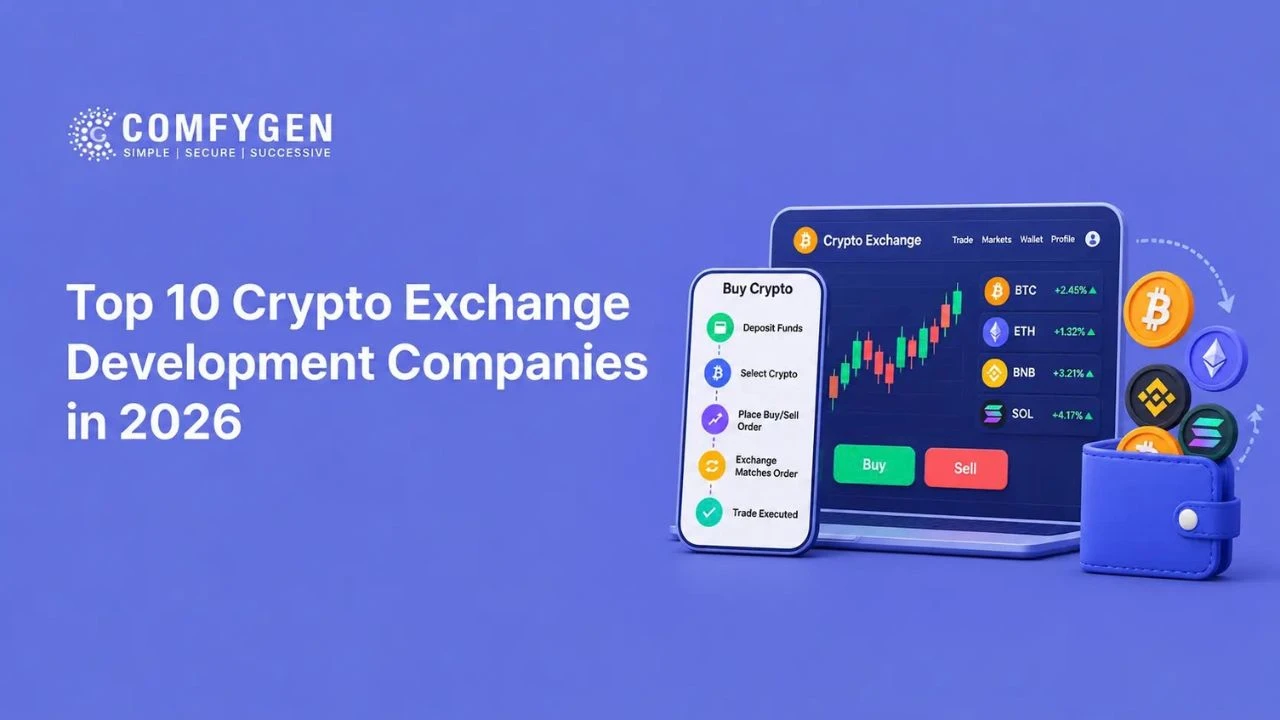





The cryptocurrency exchange industry has become a vital part of the global digital economy, enabling users to buy, sell, and trade digital assets like Bitcoin and Ethereum, as well as exchange fiat currencies such as U.S. dollars and Indian rupees for cryptocurrencies. According to Grand View Research, the global cryptocurrency exchange platform market is projected to exceed $264.32 billion by 2030. As the market evolves, businesses are investing in crypto exchange development to launch their own trading platforms, making it essential to choose a development company with expertise in trading engines, secure wallets, liquidity integration, and regulatory requirements.
However, selecting the right development partner is not just about comparing prices. Businesses must evaluate technical expertise, exchange architecture, security practices, third-party integrations, and post-launch support.
In this guide, we explore 10 crypto exchange development companies to consider in 2026, their service offerings, and the factors to evaluate before choosing a partner for your project.
How These Companies Were Picked
Each company on this list has public reviews on Clutch or GoodFirms, a portfolio that includes live exchange work, and clear pricing or published hourly rates. They were compared on five points: exchange types built (CEX, DEX, hybrid, P2P, white label), security and audit practice, compliance experience (KYC, AML, MiCA, FIU-IND), hourly rate, and team size. Rates and team sizes come from each company’s public profiles as of September 2026.
Crypto Exchange Development Companies Compared
| Company | Founded | Rate/hr | Speciality | Best for | HQ |
| Comfygen Technologies | 2019 | $25 – $49 | CEX, DEX, Hybrid, AI Exchange | Startups & mid- market | Jaipur, India |
| Trioangle | 2016 | $25– $49 | Full-stack crypto, ERP integrations | Budget-focused builds | Madurai, India |
| LeewayHertz | 2007 | $50 – $99 | Enterprise blockchain, dApps | Large enterprises | Gurgaon, India |
| Suffescom Solutions | 2013 | $25– $49 | White-label, P2P, OTC | Fast go-to-market | Punjab, India |
| Openxcell | 2009 | $25– $49 | KYC automation, liquidity APIs | Compliance-heavy builds | Ahmedabad, India |
| Antier Solutions | 2005 | $30– $60 | Atomic swaps, STO, crypto banking | Enterprises & institutions | Mohali, India |
| Instinctools | 2000 | $25– $49 | Token creation, wallet dev | Startups, affordable builds | Stuttgart, Germany |
| Nadcab Labs | 2017 | $30– $70 | P2P, DeFi, white-label | Fintech & DeFi projects | Prayagraj, India |
| PixelPlex | 2007 | $50 – $99 | MVP consulting, design-first DEX | decentralized exchange solutions | New York, NY, United States |
| SoluLab | 2014 | $50– $99 | Cross-chain, institutional UX | Retail & institutional | Ahmedabad, India |
The 10 Companies, Reviewed
Here is the list of leading cryptocurrency exchange development companies 2026 shown right below. If you are looking for skilled and talented crypto & blockchain developers, consider a call with the listed companies.
Comfygen Technologies
Comfygen’s crypto exchange development services specializing in centralized (CEX), decentralized (DEX), hybrid, and AI-powered exchange platforms. Since 2019, Comfygen has been delivering innovative blockchain solutions, combining enterprise-grade security architecture with startup-friendly pricing and fast turnaround times.
Their crypto exchange stack includes real-time order matching engines, multi-currency wallet integration (supporting Ethereum, Solana, BNB Chain, Polygon), KYC/AML compliance modules (Sumsub-integrated), smart contract development, and a fully customizable admin dashboard.
Comfygen is particularly strong for businesses needing rapid MVP deployment without sacrificing security — their white-label exchange model can go live in as little as 4 weeks.
Notable capability: AI-powered crypto exchange development with built-in fraud detection, algorithmic trading support, and predictive liquidity management — rare for an India-based firm at this price point.
Client trust signals: 400+ happy clients, NDA-protected engagements, fixed- price contracts available.
| Founded | Rate/Hour | Team Size | HQ |
| 2019 | $25 – $49 | 100-150 | Jaipur, India |
Specialty: CEX, DEX, Hybrid, AI Exchange, White-Label, Crypto Wallets, DeFi, Smart Contracts
Trioangle Technologies
Trioangle Technologies is one of the most experienced cryptocurrency exchange development firms in Madurai, India, operating since 2016 with experience blockchain developers. They specialize in high-performance exchange platforms modelled after Binance and Coinbase architecture, with deep expertise in ERP/CRM integrations into existing blockchain networks.
Their development process covers: smart contract development (Ethereum, Hyperledger), multi-currency wallet integration, KYC/AML compliance, liquidity management, and mobile exchange app development. They serve industries ranging from healthcare to logistics, making them strong for businesses building sector-specific exchanges.
| Founded | Rate/Hour | Team Size | HQ |
| 2016 | $25–$49 | 59+ | Madurai, India |
Specialty: Full-stack CEX/DEX, ERP integrations, Binance-clone development, mobile exchange apps
Leeway Hertz
LeewayHertz is a San Francisco-based blockchain powerhouse with 15+ years of emerging technology experience and a 250+ person team. They target enterprise clients who need production-grade, regulatory-compliant exchange platforms with complex cross-chain architecture. Their rate ($50 – $99/hr) reflects genuine senior-level blockchain expertise.
Key services include: enterprise blockchain consulting & strategy, smart contract development and audit, cross-chain dApp development, NFT marketplace development, and DeFi protocol engineering. Best suited for large enterprises with $200K+ budgets and 9–18 month development timelines.
| Founded | Rate/Hour | Team Size | HQ |
| 2007 | $50 – $99 | 150–250 | Gurgaon, India |
Specialty: Enterprise blockchain, cross-chain dApps, DeFi protocols, NFT marketplaces, smart contract audits
Suffescom Solutions
Suffescom Solutions is a New York-based crypto development firm in offering cutting-edge white label crypto exchange software solutions for startups and enterprises. Known for their secure cryptocurrency exchange development services, they build platforms with multi-currency support, KYC/AML compliance, liquidity integration, and advanced trading modules.
Their team delivers centralized and decentralized exchange development with a scalable and high-performance backend. Suffescom also specializes in crypto wallet integration, P2P and otc crypto exchange development service, ensuring full-stack delivery tailored to evolving blockchain needs. This is a reliable crypto exchange website development company for custom and high-end blockchain and crypto solutions.
| Founded | Rate/Hour | Team Size | HQ |
| 2013 | $25–$49 | 250+ | Punjab |
Specialty: White-label exchange, P2P, OTC exchange, KYC/AML compliance, crypto wallets
Openxcell
OpenXcell is a Ahmedabad-based technology firm delivering high-grade security and regulatory-compliant solutions. Their crypto exchange app development offerings include centralized, decentralized, and hybrid exchange models. Renowned for crafting scalable, user-centric digital currency exchange platforms, OpenXcell’s expertise extends to crypto wallet and exchange development, KYC automation, smart contract development, and liquidity APIs.
As one of the leading crypto exchange development solution, they help businesses gain a competitive edge with white label crypto exchange development tailored to market demands, ensuring speed, performance, and reliability.
| Founded | Rate/Hour | Team Size | HQ |
| 2009 | $25–$49 | 300+ | Ahmedabad, India |
Specialty: KYC automation, compliance-heavy exchanges, CEX/DEX/Hybrid, liquidity API integration
Antier Solutions
A globally recognized Antier Solutions a Mohali-based blockchain firm offering enterprise-grade blockchain solutions. They specialize in developing cryptocurrency exchange software with advanced features like atomic swaps, multi-currency wallets, order matching engines, and admin control panels.
Antier delivers both centralized and decentralized exchange application development and is considered one of the best white label cryptocurrency exchange software providers. Their services extend to STO platforms, smart contract development, and crypto banking solutions. With a focus on security and scalability, Antier remains a top choice for crypto exchange software development.
| Founded | Rate/Hour | Team Size | HQ |
| 2005 | $30–$60 | 500+ | Mohali, India |
Specialty: Institutional CEX/DEX, atomic swaps, STO platforms, crypto banking, white-label exchange
Instinctools
Instinctools is a Stuttgart, Germany-based blockchain development company offering strong value for startups seeking affordable, full-stack exchange development. Their team specializes in token creation, white-label cryptocurrency exchange software, and secure wallet development — covering P2P, CEX, and DEX models. Particularly well-suited for early-stage crypto projects looking for flexible engagement models (hourly or milestone-based) with a proven technical team.
| Founded | Rate/Hour | Team Size | HQ |
| 2000 | $25–$49 | 250 – 999 | Stuttgart, Germany |
Specialty: White-label exchange, token development, P2P/CEX/DEX, wallet development
Nadcab Labs
Nadcab Labs is a trusted name in the crypto exchange and blockchain development space. Specializing in P2P crypto exchange development and white-label crypto exchange solutions, they cater to businesses seeking speed and affordability. Their technical expertise spans smart contract creation, secure wallet development, and exchange platform architecture featuring KYC/AML compliance, liquidity tools, and multi-device compatibility.
Offering both decentralized and centralized solutions, Nadcab Labs has become a go-to cryptocurrency exchange development company for clients in fintech, DeFi, and tokenization sectors. With an agile development process and rapid turnaround times, they are recognized as top-rated digital currency exchange solution developers.
| Founded | Rate/Hour | Team Size | HQ |
| 2017 | $30–$70 | 150+ | Prayagraj, India |
Specialty: P2P exchange, DeFi platforms, white-label exchange, smart contracts, fintech
PixelPlex
PixelPlex has carved a niche as one of the top crypto exchange software development firms in New York, United States. They provide tailored blockchain and cryptocurrency exchange software development services, emphasizing security, regulatory readiness, and market agility. Their services span centralized platforms, decentralized exchanges, OTC crypto exchange development, and white label crypto exchange solutions.
Known for its modern tech stack and design-first approach, PixelPlex helps clients scale securely with wallet systems, trading engines, admin dashboards, and liquidity integration. Their strategic consulting and MVP support make them a good choice for clients to opt their services.
| Founded | Rate/Hour | Team Size | HQ |
| 2007 | $50 – $99 | 50 – 249 | New York, United States |
Specialty: Design-first DEX/CEX, MVP consulting, OTC exchange, SE Asia regulatory compliance
SoluLab
SoluLab is a full-service blockchain development company with 250+ engineers across offices in India and the US. Their crypto exchange practice covers white-label development, cross-chain support, institutional-grade UX, and crypto payment gateway integration. They serve both retail and institutional clients globally. SoluLab’s full-cycle service model — from ideation through maintenance — makes them a reliable long-term partner for businesses building complex, feature-rich exchange ecosystems.
| Founded | Rate/Hour | Team Size | HQ |
| 2014 | $50–$99 | 250+ | Ahmedabad, India |
Specialty: Cross-chain exchange, institutional UX, crypto payment gateway, white-label, full-cycle development
How Much Does It Cost To Build a Crypto Exchange?
The most common question from our clients: “How much does it cost to build a crypto exchange?” The answer depends on exchange type, feature depth, compliance requirements, delivery timeline and whether you choose white-label or custom development.
What drives the cost higher?
- Multi-chain support (Ethereum + Solana + BNB Chain + Polygon adds 20–40% to backend costs)
- AI-powered features (fraud detection, algorithmic trading, predictive liquidity): +$30K– $80K
- Third-party compliance integrations (Sumsub, Chainalysis, Jumio): $5K–$20K/year in licensing
- Security audit by independent firm (CertiK, Hacken): $10K–$50K per audit
- Mobile apps (iOS + Android): +$20K–$60K depending on feature parity with web
- Post-launch support SLA (12 months): typically 15–20% of initial development cost
Why Comfygen Is on This List
We have a conflict of interest in writing this section — we know that. So instead of adjectives, here are facts:
- Founded in 2019 in Jaipur, India, with offices in Toronto, Canada and Euskirchen, Germany
- 550+ projects for 400+ clients in 30+ countries, and 97% of clients come back for more work
- Builds CEX, DEX, hybrid, P2P and white label exchanges, plus wallets and smart contracts
- Recent exchange work includes a high-volume centralized exchange built in 16 weeks and ExchangeX OTC, a P2P and OTC platform with multi-currency escrow
- White label exchanges from $15,000, live in 6 to 8 weeks; custom CEX builds from $80,000
- ISO 9001, ISO/IEC 20000-1 and ISO 27001 certified
- Client reviews on Clutch and GoodFirms, with NDA-protected work from the first call
Key Takeaways
The global crypto exchange market is growing fast — but most new exchanges fail due to poor vendor selection, not poor market timing.
Choose a development partner based on verified portfolio, security depth, and compliance expertise — not just price or promises.
White-label exchanges ($15K–$55K, 4–8 weeks) are best for MVPs and market validation. Custom builds ($80K+, 6–9 months) are best when your competitive advantage is your platform’s unique architecture.
Centralized exchanges (CEX) offer speed and compliance ease. Decentralized exchanges (DEX) offer user privacy and self-custody. Hybrid exchanges offer both — at higher development cost.
Budget 25–30% above your initial quote for infrastructure, compliance tools, and post- launch support.
Always get a fixed-price contract with defined milestones, a post-launch SLA, and client references before signing.
Want a Second Opinion on Your Exchange Plan?
Comparing companies is easier when you know what your exchange should cost. Share your exchange type, target markets and launch date, and Comfygen team will send a component-level estimate within 48 hours. You’ll see what each module costs, how long the build takes, and which licence your market needs. It’s free, and your idea stays under NDA from the first call
FAQs
Which are the best crypto exchange development companies in 2026?
How much do crypto exchange development companies charge per hour?
Which crypto exchange development companies are based in India?
Which company is best for a white label crypto exchange?
Which company is best for enterprise or institutional exchanges?
LeewayHertz and Antier Solutions target large enterprise builds with bigger teams and higher budgets.
Is Comfygen a legitimate company?
Yes. Comfygen Private Limited is registered in Jaipur, India, founded in 2019, ISO 27001 certified, and has delivered 550+ projects for 400+ clients. Reviews are on Clutch and GoodFirms.

Mr. Saddam Husen, (CTO)
Mr. Saddam Husen, CTO at Comfygen, is a renowned Blockchain expert and IT consultant with extensive experience in blockchain development, crypto wallets, DeFi, ICOs, and smart contracts. Passionate about digital transformation, he helps businesses harness blockchain technology’s potential, driving innovation and enhancing IT infrastructure for global success.