



Fast Delivery App (Like Saucey)
ASAP delivery, often within the hour, plus scheduled slots for later. Speed depends on store coverage and driver supply, so zone planning matters most here.
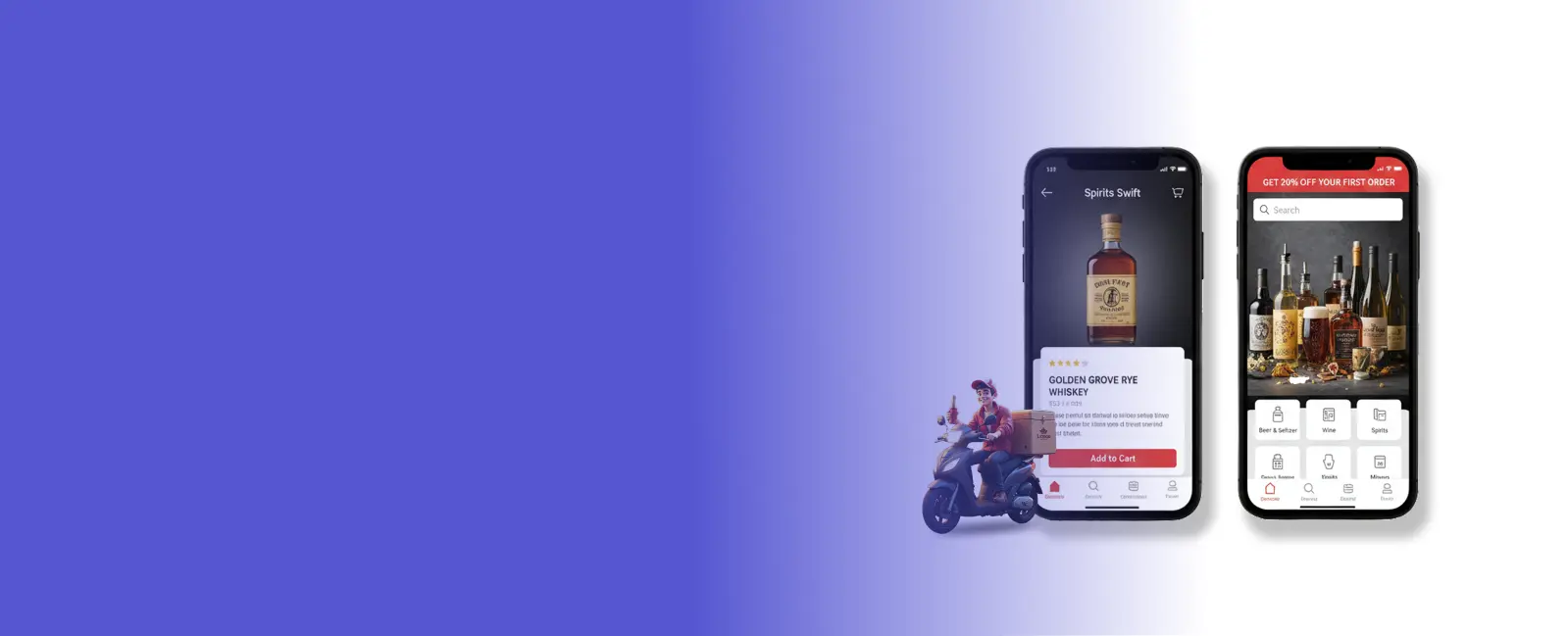
Comfygen is an alcohol delivery app development company that builds customer, store, driver and admin apps for liquor stores, bars, breweries and delivery startups. Every build checks age at signup and again at the door, limits orders to your licensed zones and shows live tracking. Since 2019, our team has shipped 550+ projects for 400+ clients in 30+ countries.


Comfygen's alcohol delivery app development services cover everything from a single-store app to a statewide marketplace. Pick the build that fits how you sell today, then add modules as you grow.
This is liquor delivery app development built from scratch around your workflow. It's the right choice when you have your own delivery rules, loyalty program or brand experience in mind.
Customer, driver, store and admin apps designed around your process
Two-step age check with ID scan and selfie match
Delivery zones, fees and hours set per location
Cloud backend that grows from one store to many

This is liquor delivery app development built from scratch around your workflow. It's the right choice when you have your own delivery rules, loyalty program or brand experience in mind.
Customer, driver, store and admin apps designed around your process
Two-step age check with ID scan and selfie match
Delivery zones, fees and hours set per location
Cloud backend that grows from one store to many
For stores that want their own app instead of sharing customers with a third-party marketplace. Customers browse your shelf, order for delivery or pickup, and come back to reorder.
Live stock synced with your point of sale (POS) system
In-store pickup and curbside options
Promo codes, bundles and loyalty points
Push alerts for new arrivals and restocks
Built for breweries, beer shops and distributors. Customers can order six-packs, cases or kegs, pick a delivery slot and track the driver.
Case, keg and deposit handling
Scheduled delivery for parties and events
Taproom and brewery direct sales where state law allows
Reorder in one tap
Wine shops, wineries and wine clubs need an app that helps people choose. Our wine on-demand app development work focuses on search and recommendations as much as delivery.
Filters by grape, region, price and food pairing
Tasting notes and ratings on every bottle
Gift orders with a message and scheduled date
Club plans with monthly or quarterly shipments
Recurring orders give you predictable revenue. Customers pick a plan for beer, wine or spirits, and the app handles billing and delivery dates.
Monthly, quarterly and custom plans
Skip, pause or swap a shipment from the app
Automatic billing with failed-payment reminders
Retention reports that show who is about to cancel
Distributors and wholesalers can take orders from bars, restaurants and retail stores in one app, without phone calls or order sheets.
Account-based pricing and credit limits
Bulk and repeat orders
Route planning for delivery trucks
Invoices and payment tracking
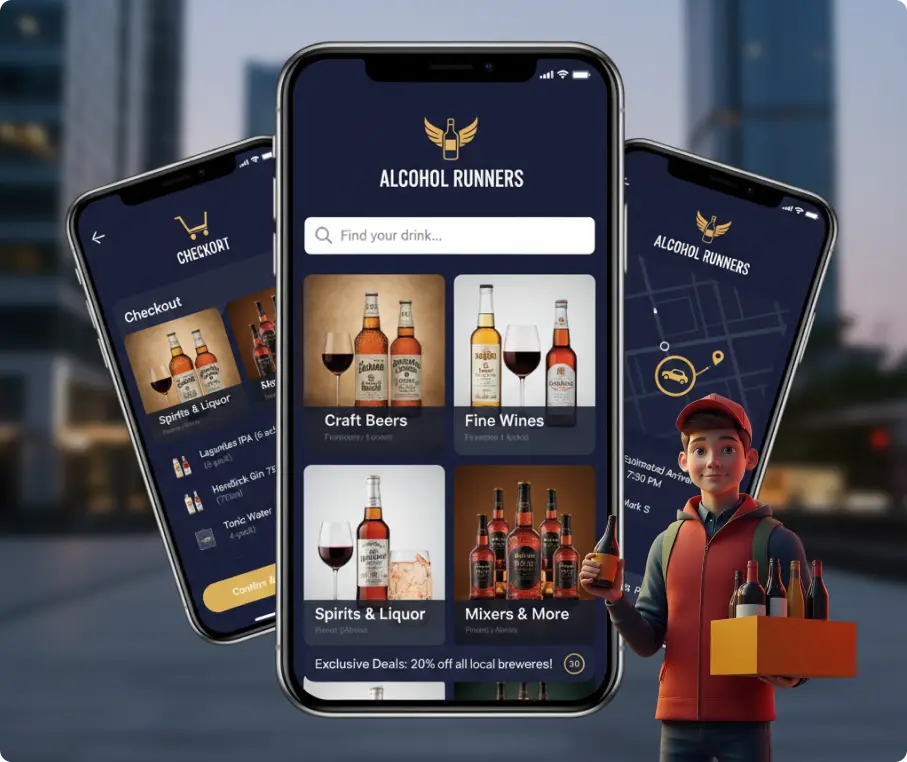
Shoppers still want a bottle for tonight's dinner or a case for Saturday's game. What's changed is where they start. Many now check an app first, compare prices and pick the store that can deliver within the hour.
The online alcohol market has also settled after the pandemic rush. IWSR, a drinks market research firm, reported that online alcohol sales dipped 1% in 2024. and expects about 14% value growth between 2024 and 2029 across 16 major markets. So growth is steady. The stores that win are the ones that run delivery well, with correct stock counts, quick handoffs and age checks that hold up when a regulator asks.
A good alcohol delivery app helps with all of that. It shows live stock, sends orders to the nearest driver and records every ID check. You get more orders from nearby customers without adding staff at the counter.
Want to start taking orders this season? Our ready-made liquor delivery app solution gives you a tested customer app, driver app, store panel and admin dashboard, all set up with your brand. It suits single stores and small chains that want to launch in weeks instead of months.
Ready made liquor delivery app development starts from a base product that's already been built and tested. Your team reviews a demo, picks the modules you need, and Comfygen adds your branding, delivery zones and payment setup. This is the same approach used for our white-label mobile app projects in other industries.
Many founders start with a known model and change it to fit their market. The models below are the ones our team builds most often.
ASAP delivery, often within the hour, plus scheduled slots for later. Speed depends on store coverage and driver supply, so zone planning matters most here.
Members answer a few taste questions, get a curated box and rate each bottle. The app learns from ratings and improves the next shipment.
Spirits and wine brands sell online while licensed retailers fulfill the orders. Good for brands that want customer data without holding a retail license in every state.
Online liquor delivery app development looks different for a corner store than for a statewide marketplace. The right setup depends on who holds the license, who owns the stock and who makes the delivery.
Your own branded app, your own customers. Orders go straight to your store panel, and your staff or partner drivers handle delivery in your licensed area.
Run many locations from one admin panel. Each store keeps its own stock, prices and delivery zone, and the head office sees sales across all of them.
Connect many licensed stores in one app. Customers compare prices across nearby shops, and you earn a commission on every order. The admin panel handles vendor onboarding, license checks and payouts.
Offer takeout and delivery of drinks with food where your state allows it. The app can require a food item in the cart and a sealed container label when local rules call for it.
Sell straight to customers where direct-to-consumer sales are allowed, or route orders through licensed retailers where they aren't. Limited releases can go to members first.
Take orders from bars, restaurants and stores with account pricing, credit terms and route planning for your trucks.
The cost of an alcohol delivery app depends on how many apps you need, how many stores you connect and how much of the build is custom.
| Build type | Best for | Typical cost | Launch time |
|---|---|---|---|
| Ready-made app | Single store or small chain | $8,000 to $15,000 | 3 to 6 weeks |
| Custom single-store app | Store with its own workflow and brand | $20,000 to $45,000 | 3 to 5 months |
| Multi-vendor marketplace | Startups connecting many stores | $50,000 to $150,000 | 6 to 8 months |
Ready-made app
Single store or small chain
$8,000 to $15,000
3 to 6 weeks
Custom single-store app
Store with its own workflow and brand
$20,000 to $45,000
3 to 5 months
Multi-vendor marketplace
Startups connecting many stores
$50,000 to $150,000
6 to 8 months
Partner with Comfygen Technologies, a trusted custom liquor delivery app development agency, to build an AI-powered and custom alcohol delivery solution.

Each alcohol delivery app has four parts: the user app, the store app, the driver app and the admin panel.
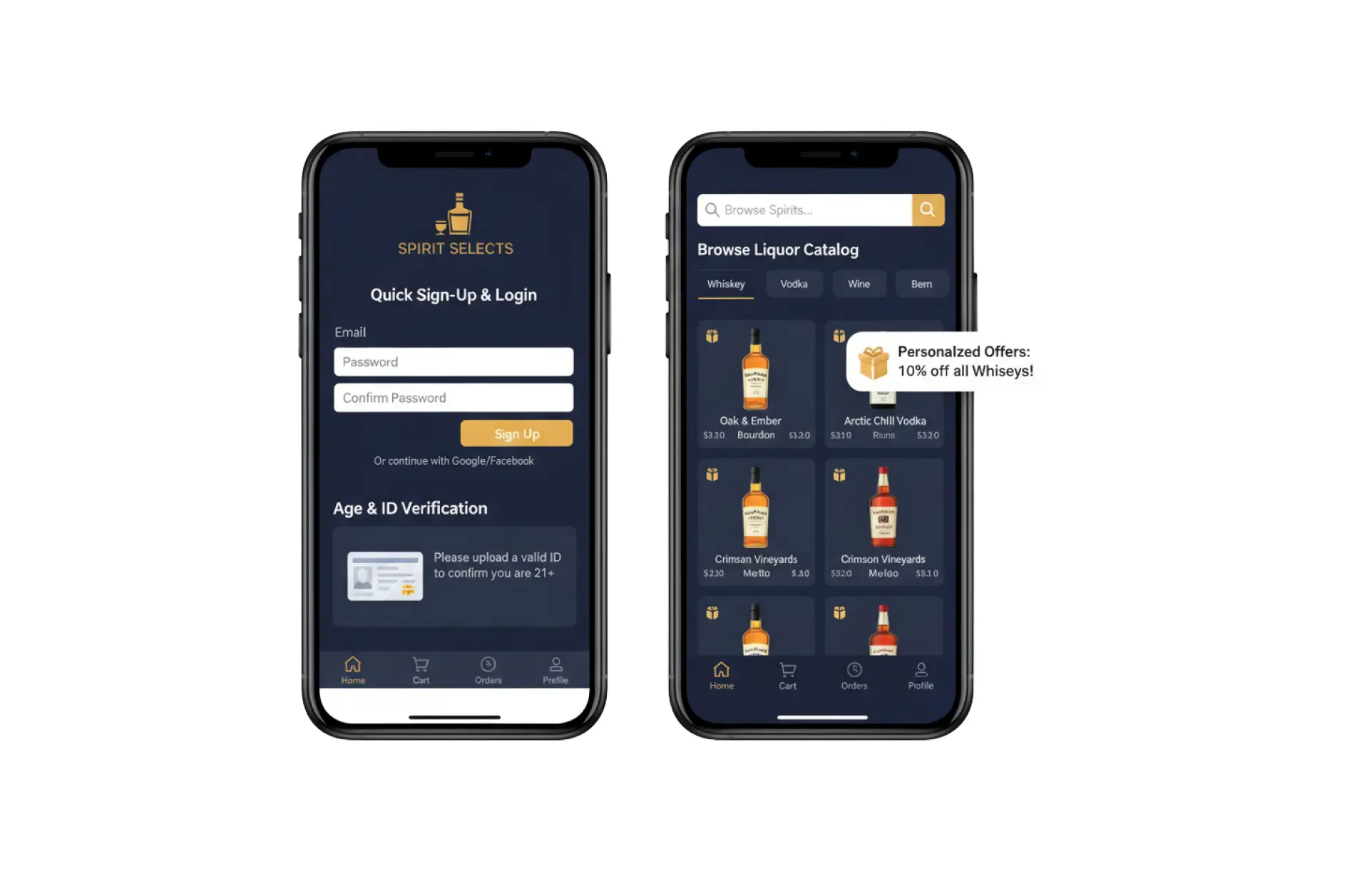
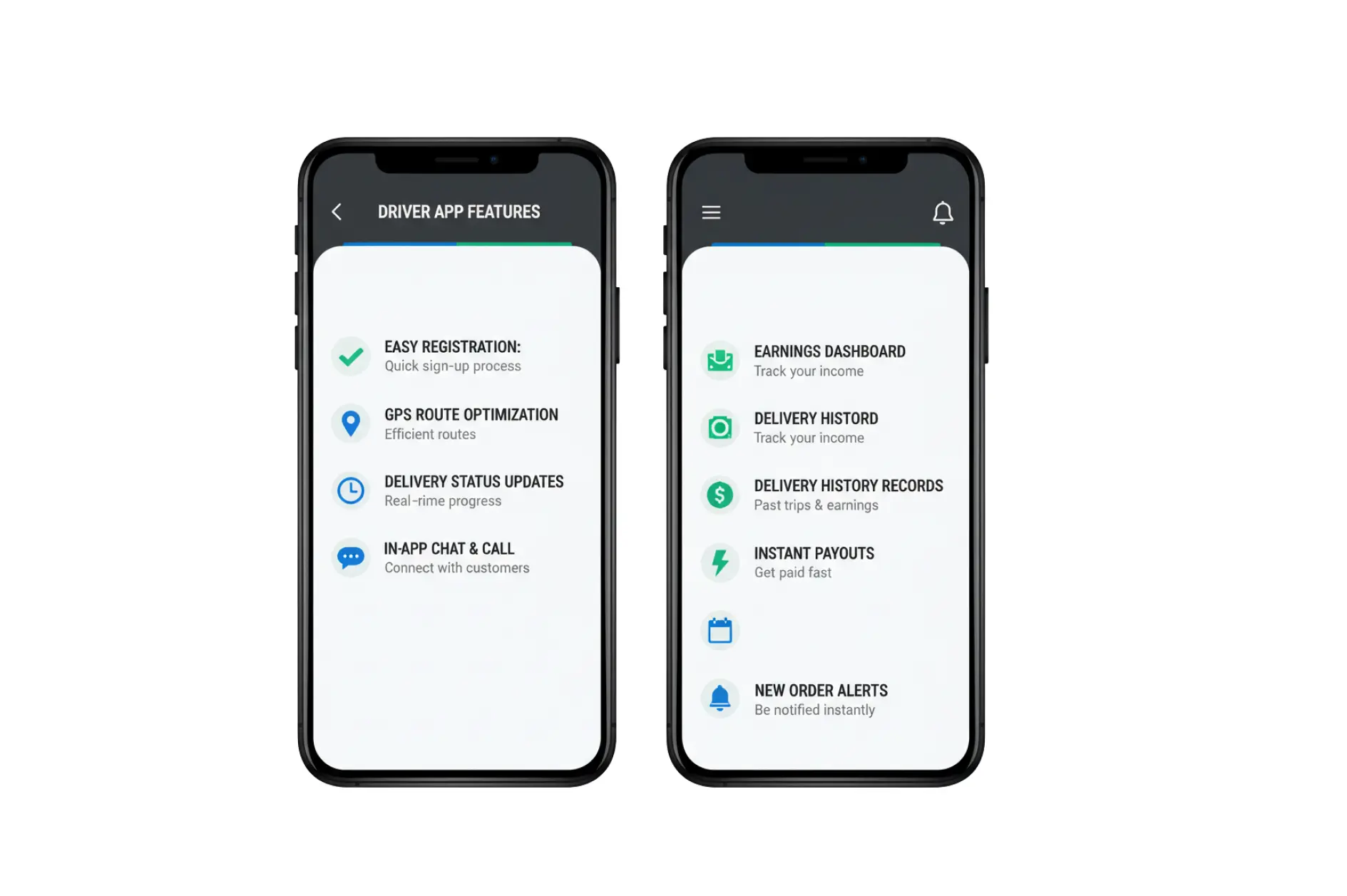
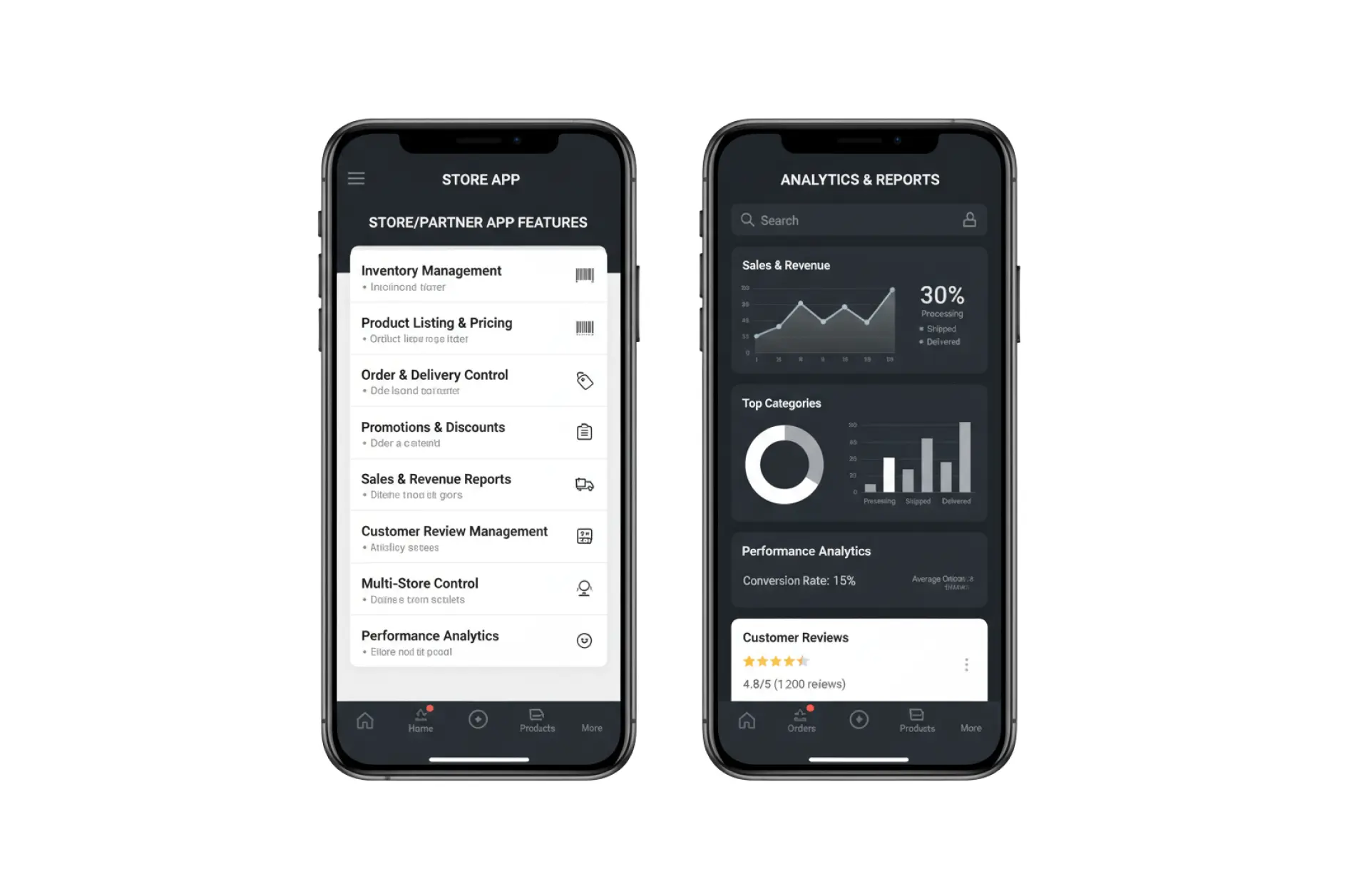
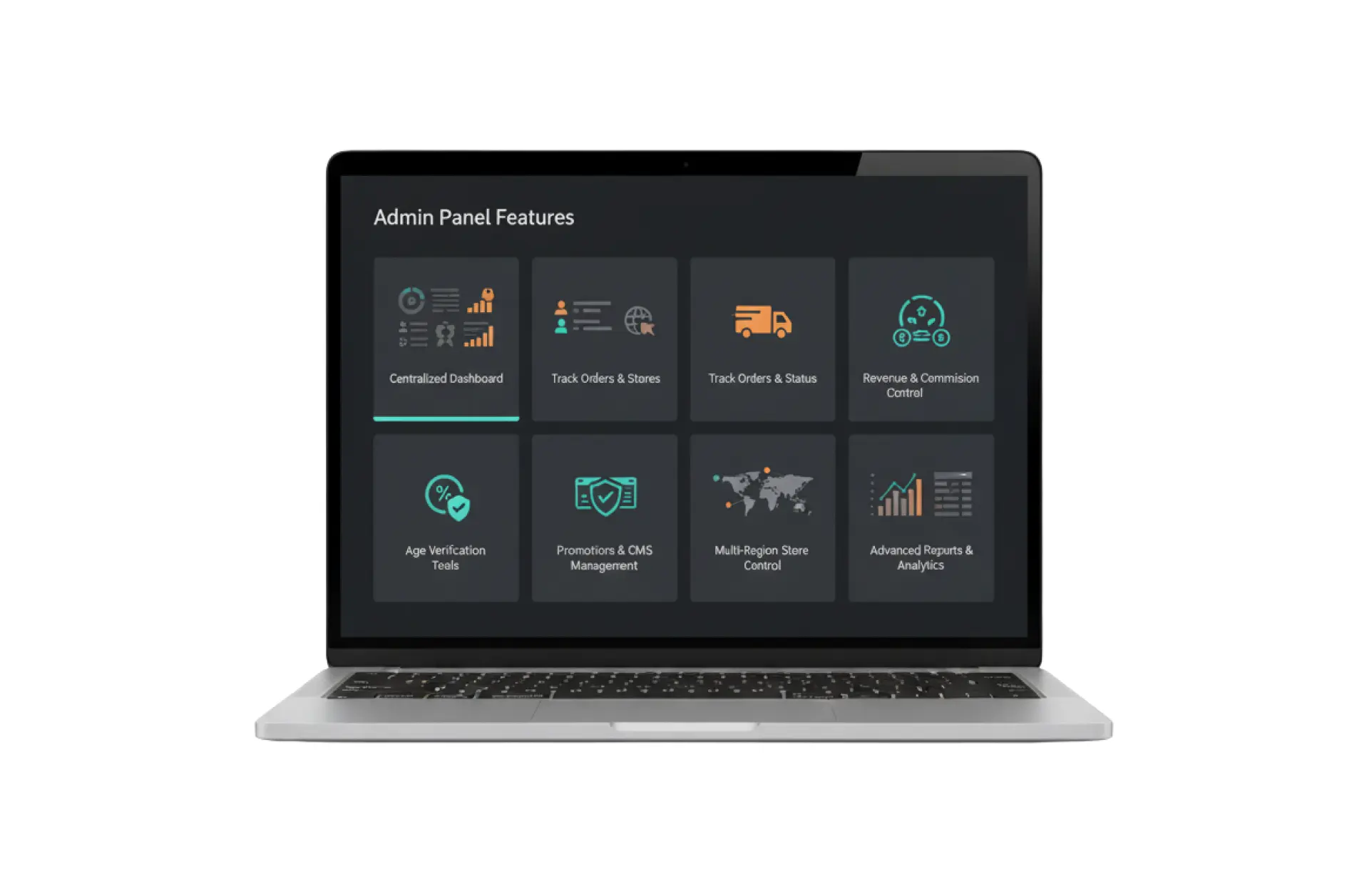
Selling alcohol online comes with more rules than selling food. Each US state decides who can deliver, when, and how the buyer's age gets checked, and some cities add their own limits. Comfygen builds these rules into the app, so your team doesn't have to track them by hand.
Customers scan a government ID and take a selfie at signup. The system matches the face to the photo on the ID and confirms the buyer is 21 or older. At the door, the driver scans the same ID again in the driver app before handing over the order.
Geofencing draws a digital boundary on the map. The app blocks orders from dry counties, campuses or any area outside your license.
Checkout closes outside legal sale hours for each state or city you serve. If Sunday sales end early in one county, the app follows that rule on its own.
Only drivers aged 21 or older who have finished alcohol delivery training can accept alcohol orders. The admin panel stores each driver's training record.
If the ID fails, doesn't match the buyer or the buyer appears intoxicated, the driver records the reason in the app and returns the order to the store. The customer gets a clear message, and the store sees the return in its panel.
Every ID check, refusal and handoff is time-stamped and saved. If your state alcohol control board asks for records, you can export them in minutes.
ID images and personal data are encrypted in storage and in transit, with access limited by role. Comfygen's processes are certified to ISO 27001 for information security, and payment flows follow PCI DSS rules through your payment provider.
Our team maps your business model, the states and cities you'll serve, and the license rules that apply in each one. These rules become the app's settings.
Designers create screens for customers, drivers, store staff and admins, then test them with real users before any code is written.
Our mobile app development team builds the apps for iOS and Android, along with the web admin panel and backend.
POS, payments, ID verification and maps get connected and tested with your real data.
Testers try underage IDs, expired IDs, out-of-zone addresses, and after-hours orders to ensure the app blocks each one, while testing POS integrations and ID verification providers like Jumio, Veriff, or Sumsub.
Comfygen submits the apps to the App Store and Google Play and helps your team go live store by store.
After launch, you get bug fixes, feature updates and help when state rules change.
We use reliable technologies to develop liquor delivery apps that are fast, easy to use, and built to support your business as it grows. Our technology stack covers app development, backend systems, databases, APIs, payments, and third-party integrations to ensure smooth day-to-day operations.
 nextjs
 React js
 Angular js
 Javascript
 Typescript
 React Native
 Flutter
 Swift (iOS)
 Kotlin (Android)
 Nodejs
 Express js
 Django
 Python
 Java (Spring Boot)
 PHP (Laravel)
 PostgreSQL
 MongoDB
 MySQL
MySQL Redis
Redis Google Maps API
 Mapbox
 Geolocation APIs
 AWS
AWS GCP
GCP Docker
 Microsoft Azure
 Kubernetes
 Razorpay
 Stripe
 PayPal
 Apple Pay
 PayTabs
 Klarna
 End-to-End Encryption
 OAuth Authentication
 JWT Authentication
Picking a liquor delivery app development company is a long-term decision, so the proof matters.

Since 2019, our delivery app development team has built food delivery apps, grocery delivery platforms and quick commerce apps. Dispatch, live tracking and store panels are problems we've already solved many times.
Alcohol isn't the only product with delivery rules. Our medicine delivery app builds check prescriptions before dispatch, which calls for the same kind of verification steps and audit trails.
Age checks, delivery zones, sale hours and audit logs are part of the first release. You won't pay extra later to add them.
Comfygen holds ISO 9001:2015, ISO/IEC 20000-1:2018 and ISO 27001 certifications, covering quality, IT service and information security.
With an office in Toronto, Canada, our team works in time zones that overlap with US business hours. Call or WhatsApp our US line at +1 (231) 310-5067.
400+ clients in 30+ countries and a 97% client retention rate. Read our client reviews on Clutch, DesignRush and Google.
Hear what our clients have to say about their experience working with us
📹 Video URL: https://www.youtube.com/watch?v=kedGnt6T-DI
🖼️ Thumbnail URL: https://www.comfygen.com/comfygen-images/comfygen/nitesh-rajput-testimonial.webp
Book My Tutor
📹 Video URL: https://www.youtube.com/watch?v=-AkHiORQTjA
🖼️ Thumbnail URL: https://www.comfygen.com/comfygen-images/comfygen/sayead-shadab-arif-testimonial.webp
Froge Flex
Already have a product team and need extra hands? You can hire dedicated mobile app developers from Comfygen who have worked on delivery apps.
Experience with age checks, ID scanning and geofencing
Payment, maps and POS integration skills
Full-time, part-time or hourly models
Daily standups in your time zone
Vietnam
My overall experience working with the company was very positive. The team demonstrated professionalism and strong technical skills throughout the project. Communication was clear and timely, which helped us stay on schedule. They were responsive to our feedback and flexible in adapting to changes. The final product met all our expectations and was delivered on time. Some minor improvements could be made in the testing phase, but overall, I am very satisfied with the collaboration.
Madison
Sonic Foundry Inc. noted that Confygen consistently fulfilled its commitments and demonstrated strong project management skills, keeping the app's development on track. The client was pleased with the final result.
Atlanta, Indiana
Comfygen Technologies developed and designed a blockchain and a web wallet for a cryptocurrency company. The team built a Proof of Authority blockchain based on Geth and a user-friendly web wallet.
Noida, India
An IT company hired Comfygen to design and build a dating app for both iOS and Android. The team also integrated features, including geolocation-based matching, swipe functionality, and a secure payment system
Jaipur, India
Comfygen Technologies developed and designed a food delivery app for a mobile app and website development company. The team was responsible for creating a user-friendly and scalable mobile app.
Dubai, United Arab Emirates
Comfygen provided software development services for an IT project management company. The team worked on three projects involving blockchain and e-commerce.
Denver, New York
Comfygen built a custom healthcare mobile app for a review writer company. The app included appointment scheduling, patient record management, and a telemedicine feature. The team also worked on its UI.
Denver, New York
I had a great experience working with Comfygen Technologies. The team is professional, responsive, and truly understands client requirements. Their technical expertise and timely delivery made the entire process smooth and stress-free. I’d definitely recommend Comfygen Technologies to anyone looking for reliable and quality IT solutions.
India
The team at Comfygen pvt ltd. is highly knowledgeable and professional. From the initial consultation to the final implementation, they were able to provide expert advice and guidance. Their commitment to excellence and customer satisfaction is truly impressive, and I look forward to working with them again in the future
Oman
Comfygen Private Limited is the best blockchain app development company in India that I have come across in recent years. They can deliver projects within the given timeline and as per our expectations. I recommend everyone to try Comfygen Private Limited services and products.
Germany
Very professional company. Everyone very friendly. The app we developed for us exceeded our expectations. I also think it's very good that the company also has a branch in Germany and that's why the overall communication was very good. We will develop the next project with you again.
A ready-made liquor delivery app with your branding usually costs $8,000 to $15,000. A custom app for one store, with customer, driver and admin apps, runs about $20,000 to $45,000. A multi-vendor marketplace with ID checks, POS sync and analytics often costs $50,000 to $150,000. The final price depends on features, platforms and integrations.
A ready-made app can go live in about 3 to 6 weeks because the core modules are already built. A custom app usually takes 3 to 5 months, and a full marketplace can take 6 to 8 months. App store review and license checks can add time, so plan for both.
In most states, yes, but the rules change from state to state and sometimes city to city. Under the three-tier system the sale usually has to come from a licensed retailer, and many states add delivery permits, delivery-hour limits and ID checks at the door. Your app should let you set these rules by zone. This is not legal advice, so confirm your model with a licensed alcohol attorney before launch.
Good apps check age twice. At signup, the customer scans a government ID and takes a quick selfie so the system can match the face to the ID. At the door, the driver scans the same ID again in the driver app before handing over the order. If the check fails, the app logs it and sends the order back to the store.
It depends on your model. If you run a marketplace that connects licensed stores with customers, the stores hold the liquor licenses, but some states also ask the delivery service to hold its own permit. If you sell your own stock, you need a retail license in each state you sell in. Check with the state alcohol control board before you build.
A ready-made liquor delivery app solution is a tested base product that gets your logo, colors and settings, so you launch faster and pay less. A custom app is built around your workflow from scratch, which suits chains, marketplaces and brands with special rules. Many clients start ready-made and add custom modules later.
Yes. A POS link keeps stock and prices in sync, so customers can't order bottles you've already sold in the store. Comfygen connects the app to retail POS systems through their APIs, or through a scheduled CSV sync for older systems.
Most major payment processors treat alcohol as a restricted category, so you'll need merchant approval before going live. PayPal, for example, lists alcohol sales among the items that need its approval. Comfygen helps you pick a processor that approves alcohol merchants in your market and sets it up before launch.
The common revenue streams are delivery fees, a markup on product prices, commission from partner stores, paid memberships for free delivery, and sponsored listings. Marketplaces usually mix three or four of these. Check your state's rules first, since some states limit how brands can pay for placement.

Abhishek Singh is a Project Manager at Comfygen Technologies, leading mobile app solutions for clients across 7 countries. He has managed 20+ end-to-end builds across delivery, healthcare, finance, education, and ecommerce platforms. His Python background gives him a solid technical grip on what he's managing, and he handles scoping, planning, and delivery to keep every project on track.
We have the knowledge and skills to work on diverse niches with high-performing solutions. Get insights about the tech revolutions and their significance through our updated blogs.
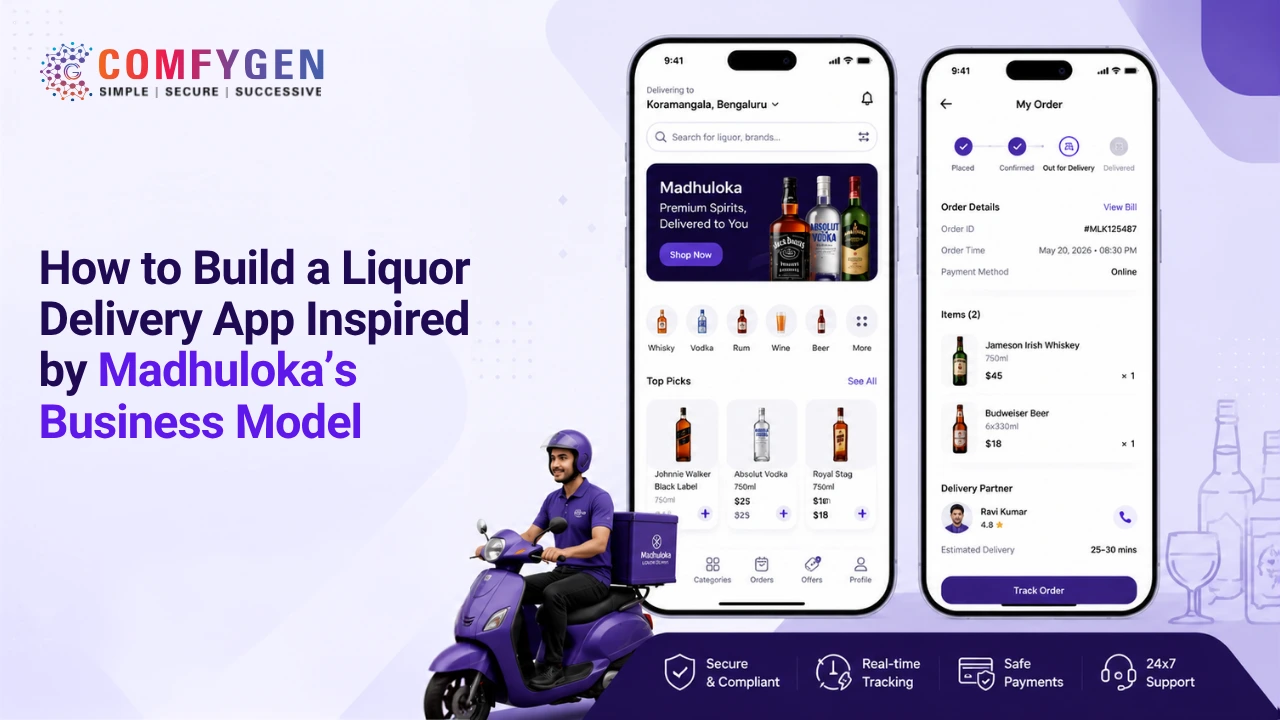
Building an alcohol delivery app on the Madhuloka model typically costs between $20,000 and $150,000 and takes 3 to 8 months, depending on how many features you need and whether you build custom or start with a white-label base. The bigger challenge isn’t the code. It’s building around India’s state-by-state liquor laws while still giving […]
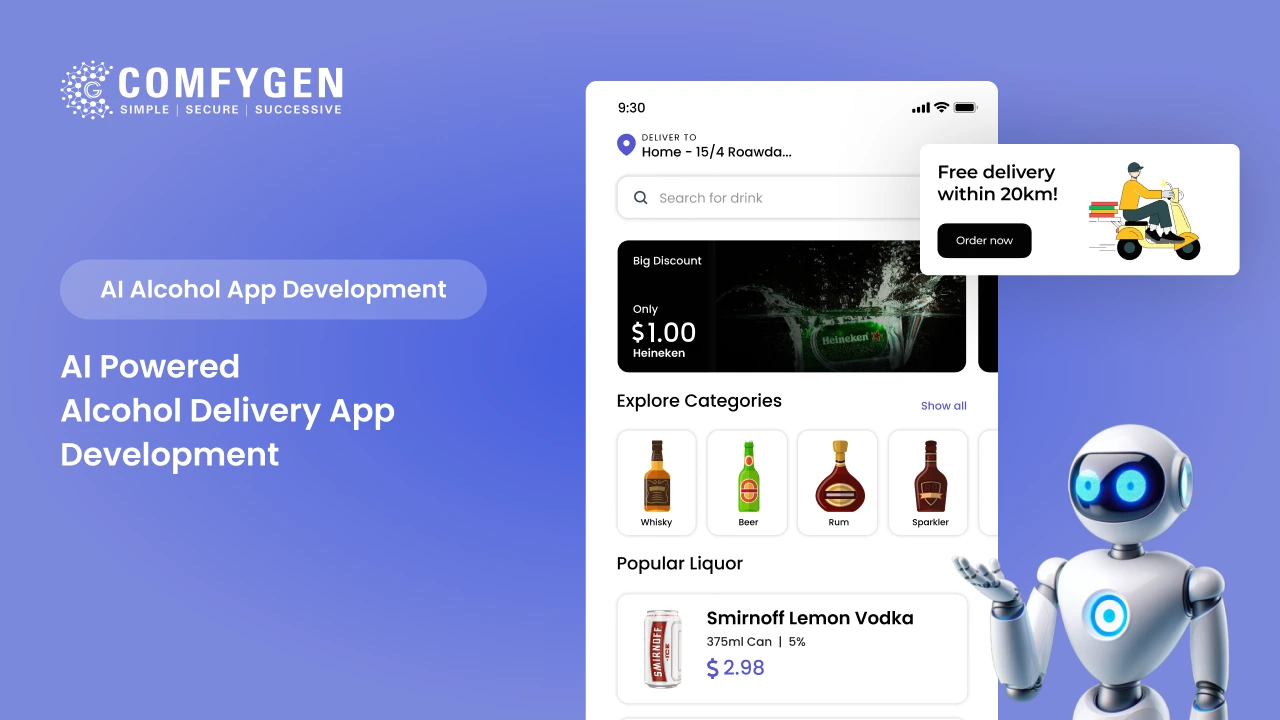
In 2023, the alcohol delivery service market size was valued at USD 10.33 billion. However, the estimated state market size will reach USD 23.3 billion by 2031, with a CAGR of 9.45% from 2024 to 2031. On the basis of the surging demand for on-demand alcohol delivery applications, entrepreneurs are driving their interest toward AI-powered […]
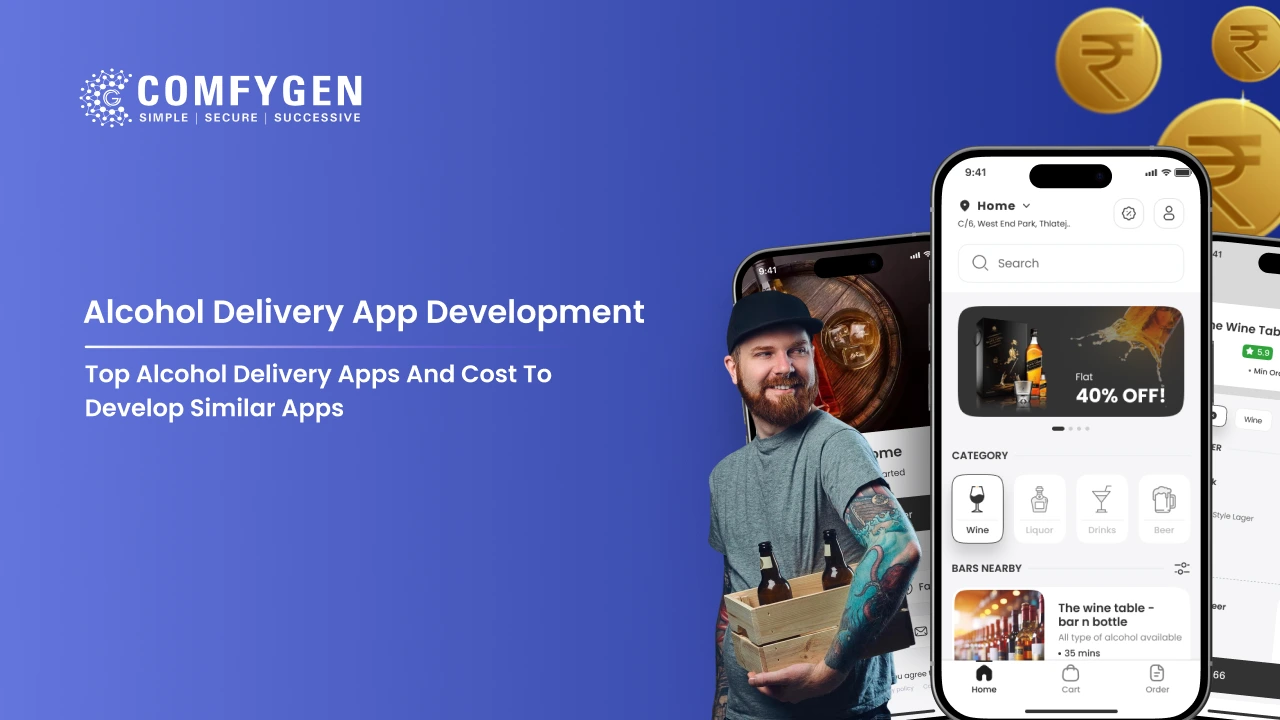
The alcohol delivery industry has changed rapidly in recent years. With smartphones, on-demand services, and changing customer habits, alcohol delivery apps have become highly popular across the globe. Customers now prefer ordering wine, beer, and liquor online and getting it delivered to their doorstep within minutes. This growing demand has created a big opportunity for […]