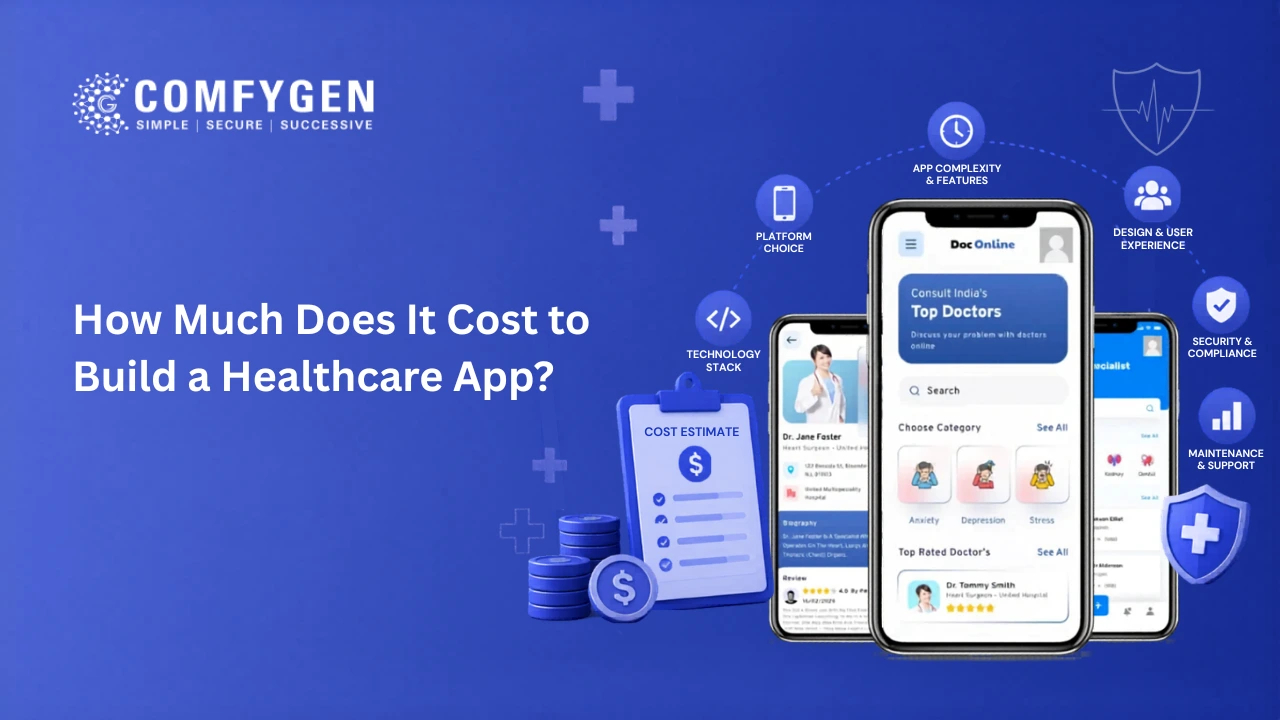





Healthcare app development costs $25,000 to $500,000+ in 2026. Where you land depends on three things: how many features you build, how much compliance work your market demands, and where your development team sits.
|
Build tier |
Cost |
Timeline |
|
Basic (booking, profiles, reminders, wellness tracking) |
$25,000 – $80,000 |
3 – 6 months |
|
Mid-range (telemedicine, EHR integration, remote monitoring) |
$80,000 – $200,000 |
6 – 9 months |
|
Advanced (AI, IoT, multi-platform, analytics) |
$200,000 – $350,000 |
9 – 12 months |
|
Enterprise (hospital platform, full EHR, SaaS, multi-region) |
$350,000 – $500,000+ |
12 – 18 months |
HIPAA compliance adds 20% to 30% on top. Annual maintenance runs 15% to 20% of build cost. Building in India costs 60% to 75% less than a US team at the same scope.
These ranges assume an offshore or hybrid team with healthcare delivery experience. A US-based team runs two to three times higher for identical scope. Most cost guides do not say which they are quoting, which is why the numbers you find online vary so wildly.
The rest of this guide breaks each of those variables down, including the costs that do not show up in a proposal until month four.
How to Estimate Healthcare App Development Costs
Every estimate comes down to one calculation.
Development hours × hourly rate = build cost
A team charging $40 an hour on a project needing 2,000 hours produces an $80,000 build. Change either number and the total moves. What most cost guides skip is that healthcare inflates both sides of that equation compared to a consumer app of similar visible complexity.
The hours go up because compliance is architectural. You are not adding a login screen, you are designing a data model where every field carrying patient information is encrypted, access-controlled, and logged. That work touches every feature.
The rate goes up because healthcare experience is a specialism. A developer who has shipped a HIPAA-compliant EHR integration charges more than one who has not, and the gap is worth paying. A team without domain experience gets the data model wrong, and architectural rework costs three to five times what building it correctly would have.
Grand View Research puts the global mHealth apps market at $49.9 billion in 2026, heading for $86.4 billion by 2030 at 14.8% annual growth. The money entering the category is real, and so is the compliance overhead that comes with it.
Need an Accurate Healthcare App Cost Breakdown?
From HIPAA compliance and EHR integrations to AI-powered features and cloud infrastructure, healthcare app costs depend on many factors.
Get Your Free Project Quote
Cost to Build a Healthcare App by App Type
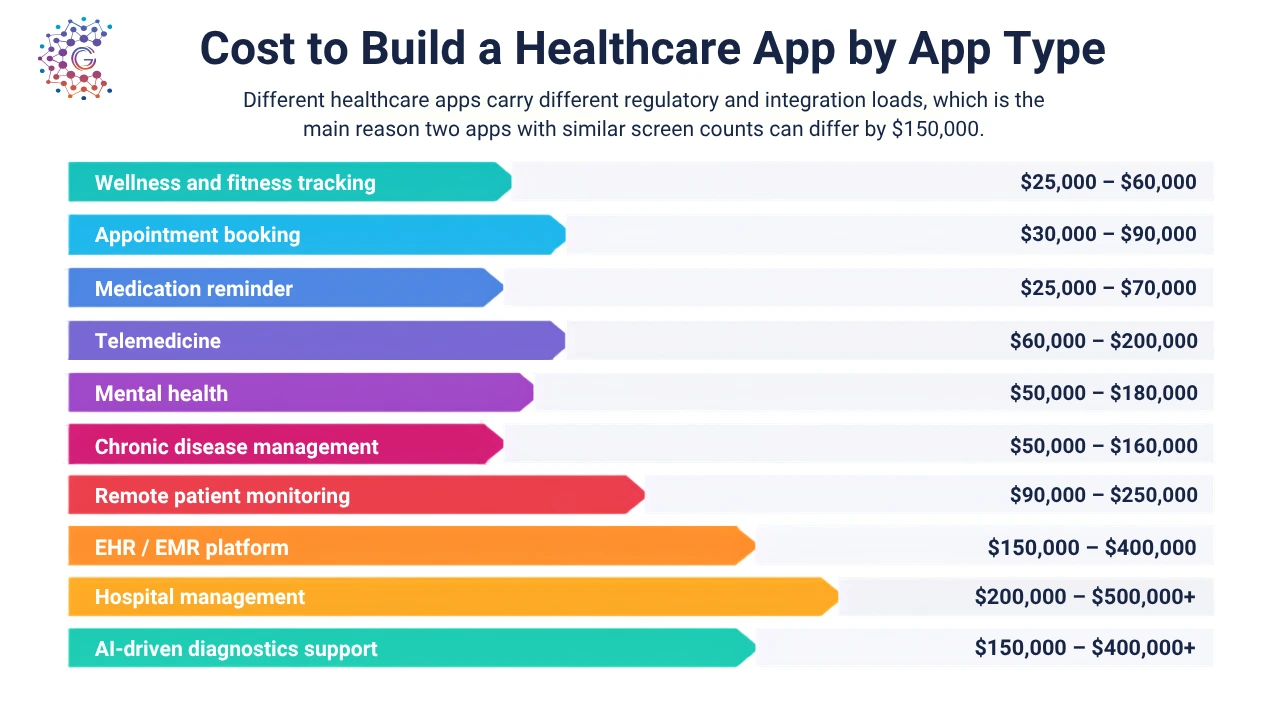
Different healthcare apps carry different regulatory and integration loads, which is the main reason two apps with similar screen counts can differ by $150,000.
|
App type |
Cost range |
Timeline |
What drives the cost |
|
Wellness and fitness tracking |
$25,000 – $60,000 |
3 – 5 months |
Usually outside HIPAA scope, which cuts overhead sharply |
|
Appointment booking |
$30,000 – $90,000 |
3 – 6 months |
Calendar logic, payment, notification infrastructure |
|
Medication reminder |
$25,000 – $70,000 |
3 – 5 months |
Drug database licensing, adherence logic |
|
Telemedicine |
$60,000 – $200,000 |
6 – 10 months |
Encrypted video infrastructure, ePrescribing, session recording |
|
Mental health |
$50,000 – $180,000 |
5 – 9 months |
Heightened privacy architecture, content licensing |
|
Chronic disease management |
$50,000 – $160,000 |
5 – 9 months |
Wearable sync, adherence logic, care-team messaging |
|
Remote patient monitoring |
$90,000 – $250,000 |
8 – 12 months |
Device integrations, real-time data pipelines, alert thresholds |
|
EHR / EMR platform |
$150,000 – $400,000 |
12 – 18 months |
HL7 and FHIR interoperability, vendor certification |
|
Hospital management |
$200,000 – $500,000+ |
12 – 18 months |
Multi-role access, billing, bed and staff management |
|
AI-driven diagnostics support |
$150,000 – $400,000+ |
9 – 15 months |
Model development, training data, clinical validation |
A note on scope creep between rows. Moving a telemedicine app from read-only EHR access to bidirectional sync mid-project adds $25,000 to $50,000 on its own. Decide that at the start, not in month five.
Two of these carry enough scope on their own to be priced separately. A telemedicine app development company will quote video infrastructure and ePrescribing as their own line items, and pharmacy and medicine ordering apps add inventory and prescription verification that a booking app never touches.
What It Costs to Build an App Like MyChart, Teladoc, or Calm
Buyers rarely describe a healthcare app from scratch. They name one. Here is what it realistically costs to build something comparable, at the scope a first release would actually ship.
|
App you want to build something like |
What it does |
Comparable build cost |
|
MyChart |
Patient portal on a connected record: results, messaging, refills, billing |
$180,000 – $400,000 |
|
Epic Systems |
Full enterprise EHR across departments |
$400,000 – $1,000,000+ |
|
Teladoc |
On-demand video consultation marketplace |
$90,000 – $250,000 |
|
Medisafe |
Medication reminders and adherence tracking |
$30,000 – $80,000 |
|
Apple Health |
Aggregated health dashboard pulling from multiple sources |
$80,000 – $180,000 |
|
Fitbit |
Wearable companion app with vitals and sleep tracking |
$60,000 – $160,000 |
|
MyFitnessPal |
Nutrition logging with a food database |
$70,000 – $150,000 |
|
Hevy |
Workout logging and progress tracking |
$30,000 – $70,000 |
|
Headspace |
Guided meditation and mental wellbeing content |
$50,000 – $130,000 |
|
Calm |
Sleep, relaxation and audio content library |
$45,000 – $120,000 |
Read these as scope benchmarks, not as a price to clone a product. The published apps have years of iteration behind them, and the number above is what a comparable first release costs, not what the original cost to reach its current state.
Two things move these figures more than anything else. Content-heavy apps like Headspace and Calm spend a large share of budget on producing or licensing audio, not on engineering. Record-connected apps like MyChart spend theirs on interoperability, which is why the same visible feature set costs three times more once a hospital EHR is on the other end of it.
What Your Budget Actually Buys
Most cost guides answer “what does it cost.” This is the more useful version of the question.
Single-Purpose MVP: $25,000 to $50,000
A focused single-purpose app on one platform, or cross-platform with a simple interface. Booking, profiles, notifications, basic payment. Cloud hosting on a standard tier. No EHR integration. Suitable for a single clinic digitising appointments, or an MVP built to prove patients will use a digital channel at all.
What you will not get: telemedicine video, EHR connection, AI features, or a full HIPAA compliance package with independent audit.
Compliant Patient App: $50,000 to $100,000
Everything above, plus secure messaging, ePrescription, a proper payment and invoicing layer, and either basic telemedicine video or read-only EHR access. HIPAA architecture built in properly. This is the realistic floor for anything patient-facing that handles clinical data in the US market.
Full Telemedicine Platform: $100,000 to $200,000
A real telemedicine platform. Bidirectional EHR integration via FHIR, encrypted video at scale, a working provider panel, an admin panel with audit logging and role-based access, and wearable sync. Independent penetration testing before launch.
AI-Powered Healthcare App: $200,000 to $350,000
Everything above, plus AI. Symptom assessment, predictive analytics, or clinical decision support. Multi-platform native builds where performance requires it. Multiple EHR vendor integrations rather than one. Multi-language and full WCAG 2.1 accessibility.
Enterprise Hospital Platform: $350,000 and Above
Hospital management across departments, multi-region compliance covering HIPAA and GDPR and DPDP simultaneously, SaaS multi-tenancy, and a support and maintenance contract sized for clinical uptime requirements.
The pattern worth noticing: the jump from $50,000 to $100,000 buys more capability than the jump from $250,000 to $350,000. Early money buys features. Later money buys scale, redundancy, and regulatory reach.
Planning a Healthcare App?
Avoid costly mistakes and get a clear understanding of your project’s budget, timeline, and technical requirements before development begins.
Book a Free Consultation
Cost of Developing a Healthcare App: USA vs India
This is the comparison most buyers are actually running. Here it is directly.
|
Build scope |
USA team |
India team |
Difference |
|
Basic app (booking, profiles, reminders) |
$90,000 – $180,000 |
$25,000 – $50,000 |
65% – 72% lower |
|
Mid-range (telemedicine + EHR integration) |
$200,000 – $400,000 |
$50,000 – $120,000 |
70% – 75% lower |
|
Advanced (AI, IoT, multi-platform) |
$400,000 – $700,000 |
$120,000 – $250,000 |
64% – 70% lower |
|
Enterprise (hospital platform, SaaS) |
$700,000+ |
$250,000 – $450,000 |
~60% lower |
The gap is almost entirely hourly rates. US healthcare developers charge $150 to $300 an hour. Indian app development teams with healthcare experience charge $25 to $60. The hours required do not change.
Three Costs That Do Not Get Cheaper Offshore
Budgeting as if everything scales with the hourly rate is where offshore healthcare projects go wrong.
Compliance
HIPAA implementation costs $15,000 to $40,000 wherever the code is written, because the work is architectural rather than geographic. Annual audits still run $5,000 to $20,000.
Liability
HIPAA enforcement is US-based. If a US-market app is built offshore without a proper Business Associate Agreement and documented data-handling protocols, the covered entity carries the liability, not the vendor. IBM’s Cost of a Data Breach Report puts the average healthcare breach at $9.77 million, which dwarfs anything saved on rates.
Rework
A team without healthcare domain experience gets the data model wrong. The saving is real when the partner has verifiable healthcare delivery history. It disappears when they do not.
When Each Option Makes Sense
Choose a US or Western European team when you need on-site clinical workshops with your own staff, when your buyer specifically requires a domestic vendor, or when you are building an FDA-regulated medical device rather than a health app.
Choose an Indian medical app development team for almost everything else, provided you verify three things: HIPAA or GDPR projects actually delivered, willingness to sign a BAA, and a named security lead on your project rather than a shared resource.
Healthcare Developer Hourly Rates by Region
|
Region |
Healthcare developer rate |
|
United States |
$150 – $300 |
|
United Kingdom |
$90 – $170 |
|
Western Europe |
$85 – $160 |
|
Canada |
$90 – $180 |
|
UAE |
$60 – $120 |
|
Eastern Europe |
$40 – $90 |
|
India |
$25 – $60 |
Healthcare App Development Cost in India: DPDP and ABDM
If you are building for the Indian market rather than just building in India, the compliance picture is different and most cost guides ignore it completely.
DPDP Act 2023 Compliance
Any app handling personal health data in India needs a consent management architecture, not a checkbox at signup. Budget ₹2 lakh to ₹6 lakh depending on how granular your consent model needs to be.
ABDM Integration
If your app needs to exchange records with India’s public health system, you need ABHA ID linking and FHIR-based health record exchange. This typically adds ₹3 lakh to ₹8 lakh depending on integration depth. It is the piece most offshore vendors subcontract, which adds both cost and risk.
Build cost in Rupees
A basic app runs ₹20 lakh to ₹42 lakh. A mid-range telemedicine app with EHR integration runs ₹42 lakh to ₹1 crore. An enterprise hospital platform starts around ₹2 crore.
The Ayushman Bharat Digital Mission has issued more than 93.95 crore ABHA health IDs and linked over 105 crore health records, with 5.33 lakh health facilities on the national registries. An app built to ABDM standards plugs into that. One built without it sits in a silo.
Healthcare App Development Cost by Feature
|
Feature |
Cost |
Development hours |
|
User registration and profiles |
$2,000 – $6,000 |
40 – 100 |
|
Appointment booking and scheduling |
$5,000 – $15,000 |
100 – 250 |
|
Push notifications and reminders |
$2,000 – $5,000 |
40 – 80 |
|
Secure messaging |
$6,000 – $18,000 |
120 – 300 |
|
Video consultation |
$12,000 – $35,000 |
200 – 500 |
|
ePrescription |
$8,000 – $20,000 |
150 – 320 |
|
Payments and invoicing |
$6,000 – $15,000 |
100 – 250 |
|
Insurance claim submission |
$10,000 – $30,000 |
180 – 450 |
|
EHR integration (read-only) |
$10,000 – $25,000 |
180 – 400 |
|
EHR integration (bidirectional) |
$30,000 – $80,000 |
450 – 1,000 |
|
Wearable device sync |
$8,000 – $25,000 |
150 – 400 |
|
AI symptom checker |
$25,000 – $70,000 |
400 – 900 |
|
Analytics dashboard |
$8,000 – $22,000 |
150 – 350 |
|
Multi-language and accessibility |
$6,000 – $18,000 |
120 – 300 |
|
Admin panel with audit logging |
$10,000 – $28,000 |
200 – 450 |
Feature scope is the single biggest lever you control. Which features patients actually open every week is a shorter list than most first-release plans assume, and cutting the rest is the cheapest decision available to you.
mHealth App Development Cost by Technology
|
Technology |
Added cost |
What it buys |
|
AI and machine learning |
$40,000 – $150,000 |
Symptom assessment, predictive analytics, clinical decision support |
|
IoT and medical device integration |
$30,000 – $120,000 |
Continuous vitals monitoring, automated alerts |
|
Blockchain records |
$50,000 – $150,000 |
Tamper-evident audit trail, decentralised consent |
|
AR/VR |
$60,000 – $200,000 |
Surgical simulation, clinical training |
|
Advanced cloud architecture |
$15,000 – $60,000 |
Multi-region, high availability, disaster recovery |
AI is where budgets most often break. A symptom checker built on an existing model API costs a fraction of one requiring custom model training on clinical data. Establish which you are buying before signing anything.
Each of these carries a different kind of risk, not only a different price. AI in healthcare returns the most when the model supports a clinician rather than replacing one, because clinical validation is what takes the time.
IoT in healthcare is cheap to prototype and expensive to keep running, since every supported device is a compatibility surface you own permanently.
Blockchain in healthcare earns its cost only where you need a tamper-evident audit trail a database cannot give you. Cloud computing in healthcare is the opposite case, cheap to start and growing with your user base rather than your build.
Healthcare Mobile App Development Cost by Stage
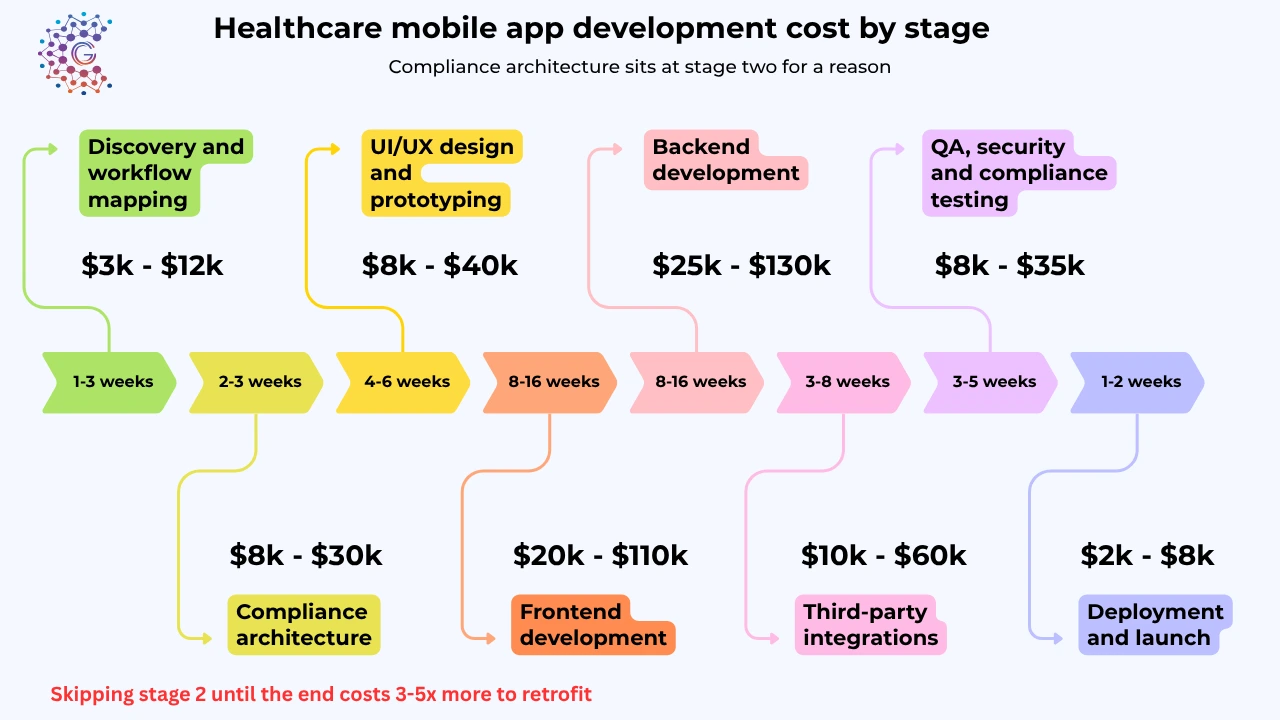
|
Stage |
Cost |
Timeline |
|
Discovery and clinical workflow mapping |
$3,000 – $12,000 |
1 – 3 weeks |
|
Compliance architecture |
$8,000 – $30,000 |
2 – 3 weeks |
|
UI/UX design and prototyping |
$8,000 – $40,000 |
4 – 6 weeks |
|
Frontend development |
$20,000 – $110,000 |
8 – 16 weeks |
|
Backend development |
$25,000 – $130,000 |
8 – 16 weeks |
|
Third-party integrations |
$10,000 – $60,000 |
3 – 8 weeks |
|
QA, security and compliance testing |
$8,000 – $35,000 |
3 – 5 weeks |
|
Deployment and launch |
$2,000 – $8,000 |
1 – 2 weeks |
Compliance architecture sits at stage two for a reason. Teams that push it to the end pay three to five times more to retrofit it, and it is the most common expensive mistake in healthcare development. The full development process covers why that ordering matters.
How Much HIPAA and GDPR Compliance Add to Your Cost
|
Item |
Cost |
Frequency |
|
HIPAA implementation |
$15,000 – $40,000 |
One-time |
|
GDPR implementation |
$10,000 – $30,000 |
One-time |
|
DPDP Act consent architecture |
₹2 – ₹6 lakh |
One-time |
|
ABDM / ABHA integration |
₹3 – ₹8 lakh |
One-time |
|
Penetration testing |
$5,000 – $20,000 |
Pre-launch, then annually |
|
Security audit |
$5,000 – $20,000 |
Annually |
|
BAA legal review |
$2,000 – $8,000 |
Per vendor |
Across a typical build, compliance lands at 20% to 30% of total cost. It is not a line item you can negotiate down, because the alternative is an app you cannot legally launch.
Hidden Costs You Should Plan For
The costs that do not appear in a proposal but do appear in your bank account.
EHR vendor API Access Fees
$10,000 to $20,000 for onboarding and certification with a major EHR vendor, separate from the integration work itself. Epic and Cerner both charge for programme access.
Third-Party Service Subscriptions
Twilio HIPAA-eligible video and SMS, drug database licensing, payment processing. Budget $500 to $5,000 a month depending on volume, and note that these scale with users, not with build cost.
Cloud Hosting
$200 to $500 a month for a small app, $500 to $2,000 for a mid-sized telemedicine platform, $2,000 to $5,000+ for an enterprise system. BAA-covered service tiers cost more than standard tiers.
App Store and Certificates
Apple $99 a year, Google Play $25 one-time, SSL certificates $50 to $300 a year.
Marketing and User Acquisition
An app nobody downloads has an infinite cost per user. Budget $5,000 to $20,000 for launch and $10,000 to $50,000 a year ongoing if you are acquiring patients rather than serving an existing panel.
The Cost of Getting it Wrong
IBM puts the average healthcare data breach at $9.77 million, the highest of any industry for fourteen consecutive years. Compliance spend is insurance, and it is cheap insurance.
Healthcare App Maintenance Cost and Three-Year Ownership
Nobody publishes this, and it changes the comparison completely.
|
Healthcare App Cost |
Mid-range app |
Enterprise platform |
|
Year 1 build |
$150,000 |
$400,000 |
|
Year 1 hosting and services |
$12,000 |
$48,000 |
|
Year 2 maintenance (17.5%) |
$26,000 |
$70,000 |
|
Year 2 hosting and services |
$14,000 |
$55,000 |
|
Year 3 maintenance |
$26,000 |
$70,000 |
|
Year 3 hosting and services |
$16,000 |
$62,000 |
|
3-year total |
$244,000 |
$705,000 |
Maintenance runs 15% to 20% of build cost annually and it is not optional. Healthcare apps need OS compatibility updates, security patches, compliance changes as regulations move, and EHR integration fixes when upstream APIs change, which costs 40 to 80 hours a year on its own.
A build quote is roughly 60% of what you will actually spend over three years. Plan for the whole number.
Custom Build or White-Label: Which Costs Less?
|
Cost & Feature |
White-label |
Custom build |
|
Upfront cost |
$5,000 – $25,000 |
$25,000 – $500,000+ |
|
Ongoing |
$500 – $5,000/month |
15% – 20% of build, annually |
|
Launch time |
2 – 8 weeks |
3 – 18 months |
|
Workflow fit |
Your staff adapt to it |
It adapts to your staff |
|
Data ownership |
Vendor terms |
Yours |
|
Resale or SaaS |
Usually prohibited |
Yours to license |
White-label wins on speed and upfront cost, and loses on the two things that matter most at scale: you cannot integrate with an arbitrary EHR, and you do not own the product.
The middle path worth knowing about: launch white-label solution to validate demand, then build custom once you know what patients actually use. It costs more in total and it removes most of the risk from a large first commitment.
How to Reduce Healthcare App Development Cost
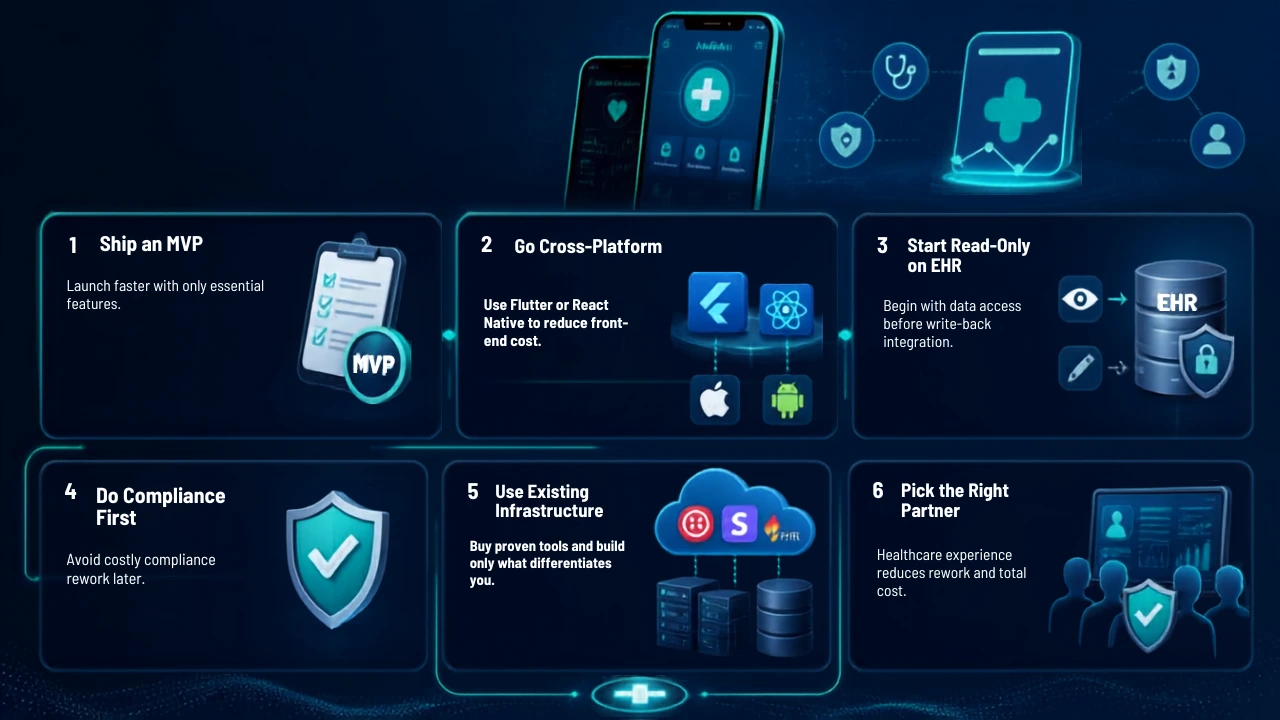
Ship an MVP
Cutting to a genuine minimum viable scope saves 40% to 60% and reaches the market in 3 to 6 months instead of 12 to 18. The test for whether a feature belongs in release one: if you removed it, could a patient still complete the single job the app exists to do?
Go Cross-Platform Healthcare App
Flutter or React Native cuts front-end cost 30% to 40% against dual-native builds. Go native only when you need deep hardware access or clinical-grade real-time performance.
Start Read-Only on EHR
Read-only integration costs $10,000 to $25,000. Bidirectional costs $30,000 to $80,000. Most first releases do not need to write back.
Do Compliance First, Not Last
This saves more than every other item on this list combined, because it avoids the rework multiplier entirely.
Use Existing Infrastructure
Twilio for HIPAA-eligible communications, Stripe for payments, a managed FHIR server rather than a custom one. Build what makes your product different and buy everything else.
Pick the Right Development Partner
A $20-an-hour team with no healthcare experience is more expensive than a $45-an-hour team with it, once rework is counted.
How to Calculate ROI on a Healthcare App
ROI (%) = [(Revenue or savings − Total investment) ÷ Total investment] × 100
An app costing $150,000 that generates $250,000 in new revenue or operational savings in year one returns 66.7%.
For providers, the savings side is usually larger than the revenue side. No-show reduction, lower administrative load, fewer phone calls into reception, and reduced readmissions all convert to money. A clinic cutting no-shows from 20% to 12% across 4,000 annual appointments recovers a meaningful share of the build cost in the first year alone.
Healthcare App Monetization: How These Apps Make Money
- Subscription: Recurring monthly or annual access. The best fit for telemedicine, chronic disease management, and wellness.
- Per-consultation fees: A cut of each virtual visit. Straightforward for telemedicine marketplaces.
- Freemium: Free core, paid advanced features. Builds a user base quickly and converts slowly.
- B2B licensing: Sell the platform to clinics and hospitals rather than to patients. Higher contract values, longer sales cycles, and the model where provider-side features determine whether you renew.
- Commission: A percentage on pharmacy orders, lab bookings, or diagnostic tests placed through the app.
- Sponsored placement: Health brands, insurers, and diagnostic chains paying for visibility. Use carefully, since ads in a clinical context can cost more in trust than they earn in revenue.
How to Get an Accurate Estimate for Your Project
Every range on this page is a range because the honest answer depends on your scope. To get a real number, a development partner needs to know four things: which users you serve and what job the app does for them, which markets you launch in and therefore which regulations apply, whether you need EHR integration and with which systems, and whether you are launching an MVP or a full platform.
Comfygen has been building healthcare software since 2019, with 550+ projects delivered to 400+ clients across 30+ countries and 97% client retention. Choosing a healthcare app development company with delivered HIPAA and FHIR projects behind it costs more per hour and less per project, which is the trade most buyers get backwards. For Indian-market apps our team handles ABDM and DPDP compliance in house rather than subcontracting it.
A 30-minute discovery call gets you a fixed-price breakdown against your actual requirements instead of a range.
Frequently Asked Questions
How much does it cost to develop a healthcare app?
Healthcare app development costs $25,000 to $500,000+. A basic app runs $25,000 to $80,000, a mid-range telemedicine app with EHR integration runs $80,000 to $200,000, and an enterprise hospital platform runs $350,000 and up.
Is it cheaper to build a healthcare app in India or the USA?
India costs 60% to 75% less. A mid-range telemedicine app runs $50,000 to $120,000 in India versus $200,000 to $400,000 in the USA. Compliance costs stay the same in both, and HIPAA liability stays with the US covered entity regardless of where it was built.
How much does HIPAA compliance add to app development cost?
HIPAA implementation costs $15,000 to $40,000, which works out to roughly 20% to 30% of total build cost once encryption, audit logging, access control, and testing are included. Annual security audits add $5,000 to $20,000.
What does a healthcare app cost to maintain each year?
Annual maintenance runs 15% to 20% of the original build cost. A $150,000 app costs roughly $26,000 a year to maintain, plus hosting and third-party services. Over three years, total ownership is about 60% higher than the build quote.
How much does ABDM integration cost in India?
ABDM integration costs ₹3 lakh to ₹8 lakh depending on depth. It covers ABHA ID linking and FHIR-based health record exchange. DPDP Act consent architecture is separate and runs ₹2 lakh to ₹6 lakh.
How much does EHR integration cost?
Read-only EHR integration costs $10,000 to $25,000. Bidirectional sync costs $30,000 to $80,000. Major EHR vendors also charge $10,000 to $20,000 for API programme access, which is separate from the development work.
How much does it cost to implement AI into healthcare apps?
Basic AI such as a symptom checker or chatbot built on an existing model API costs $25,000 to $70,000. Custom model training on clinical data costs $100,000 to $250,000. Enterprise diagnostic AI needing clinical validation runs $250,000 and up.
Should I build a native or cross-platform healthcare app?
Cross-platform using Flutter or React Native cuts front-end cost 30% to 40% and suits most healthcare MVPs. Choose native only when you need deep hardware access, clinical-grade real-time performance, or heavy medical device integration.
How long does it take to build a healthcare app?
A basic app takes 3 to 6 months. A mid-range app with telemedicine and EHR integration takes 6 to 9 months. An enterprise platform takes 12 to 18 months. Compliance architecture adds 2 to 3 weeks before development starts.
Can I build a healthcare app for under $30,000?
Yes, for a focused single-purpose app such as appointment booking or medication reminders, cross-platform, without EHR integration. Anything handling clinical data in the US market realistically starts at $50,000 once HIPAA architecture is built properly.
What is the cheapest way to build a healthcare app?
Ship an MVP with cross-platform development and read-only EHR access, using existing infrastructure for video, payments, and messaging. That combination cuts cost 40% to 60% against a full first release without cutting compliance, which is the one thing you cannot cut.
Why do healthcare app cost estimates vary so much online?
Most guides do not state whether they are quoting US, European, or offshore rates, and the gap between them is three-fold at identical scope. Always ask which the number assumes before comparing two estimates.

Mr. Saddam Husen, (CTO)
Mr. Saddam Husen, CTO at Comfygen, is a renowned Blockchain expert and IT consultant with extensive experience in blockchain development, crypto wallets, DeFi, ICOs, and smart contracts. Passionate about digital transformation, he helps businesses harness blockchain technology’s potential, driving innovation and enhancing IT infrastructure for global success.