




Healthcare industry has brought significant change in its operations and boosted its efficiency impeccably with the implementations with several advanced technologies implementations. One of the most impactful advanced technologies was machine learning in healthcare, which challenged all the loopholes left and brought revolutionary changes into that.
With the help of machine learning (ML); the researchers could make the drug discoveries easier, patients can get better outcomes from treatments, healthcare professionals can treat patients with more accuracy, the data collection and storage have become much more convenient, et cetera. ML helped the industry in several ways, and still the industry hoped to see some more evolutions with the help of this dynamic technology.
This blog is going to explain whole scenarios around ML in the Healthcare Industry. We will tell you about its impact, its evolutions, the top-notch running applications, benefits, and more. Let’s stick to the blog, and gain knowledge that is good for everyone.
What Is Machine Learning in Healthcare?
Machine learning in healthcare refers to using algorithms that learn from medical data patient records, diagnostic images, lab results, genomic data to detect patterns and support clinical decisions. Unlike rule-based software that follows pre-set logic, ML systems improve as they process more data. The more cases they see, the more accurate their outputs become.
At a practical level, this means a radiologist gets an alert flagging a suspicious region on a lung CT scan. A hospital system predicts which patients are at high risk of sepsis before symptoms escalate. A pharmaceutical company narrows 50,000 potential drug candidates to 200 worth testing in a day rather than in three years.
Machine learning does not replace clinicians. It gives them better information faster. In specialties where data volumes have outpaced human review capacity, that difference is significant.
How Big Is the ML Healthcare Market in 2026?
The numbers put the scale of adoption in clear terms. The global AI in healthcare market was valued at $37.98 billion in 2025 and is projected to reach $928.18 billion by 2035, growing at a CAGR of 37.66%. In the US alone, the market stood at $15.85 billion in 2026 and is forecast to reach $268.90 billion by 2035.
Machine learning holds the largest share within healthcare AI accounting for roughly 41% of the total market driven by predictive analytics, personalized treatment planning, and large-scale medical data processing.
The adoption trend mirrors this growth. Currently, 72% of healthcare organizations use AI and machine learning to analyze medical data. Epic’s sepsis prediction module is already deployed across major US health systems to monitor vitals in real time. The NHS in England completed nationwide rollout of an ML-powered stroke diagnosis tool across all 107 stroke centers by mid-2024.
This is no longer an emerging technology. It is becoming a standard part of hospital infrastructure.
How Machine Learning Actually Works in a Clinical Setting
Before examining use cases, it helps to understand what makes ML systems reliable or unreliable in healthcare environments.
Data Types
Healthcare generates structured data (lab values, vital signs, billing codes) and unstructured data (clinical notes, radiology images, pathology slides). ML models consume both. Structured data is easier to process; unstructured data requires additional preprocessing — NLP for text, computer vision for images.
Training and Validation
A model learns from historical examples. A diagnostic model might be trained on 500,000 annotated chest X-rays. After training, it is validated on a separate dataset it has never seen. Only after external validation should a model be considered for clinical use. A 2024 paper published in Health Care Science (Duke-NUS Medical School) notes that most published ML models in healthcare never make it to real deployment because they skip external validation.
Explainability
Clinicians will not act on a recommendation they cannot interrogate. Explainable AI techniques, such as SHAP values or attention maps, show which features drove a prediction. Without explainability, clinician trust remains low regardless of model accuracy.
Regulatory Compliance
In the US, AI-enabled diagnostic tools require FDA clearance (typically through the 510(k) pathway). The FDA issued comprehensive draft guidance for AI medical device developers in January 2025, covering the full product lifecycle — development, validation, deployment, and monitoring.
Data Standards
Healthcare data is fragmented. HL7 and FHIR standards help normalize records across systems. Without these, ML models trained on data from one hospital may fail on data from another.
Getting these foundations right determines whether ML delivers results in practice or stays a research project.
Key Applications of Machine Learning in Healthcare
1. Medical Imaging and Diagnostics
This is the most mature ML application in healthcare. Convolutional neural networks can analyze MRI scans, CT images, pathology slides, and X-rays at a level that matches or exceeds average radiologist performance in controlled studies.
The UVA University Hospital deployed an ML tool that analyzes biopsy images of children to differentiate between celiac disease and environmental enteropathy — with accuracy comparable to experienced pathologists. Google’s DeepMind demonstrated in 2019 that its model detected over 50 eye conditions from retinal scans with 94.5% accuracy.
Where ML helps most: detecting small anomalies that fatigue affects in human reviewers, flagging cases that need urgent escalation, and maintaining consistency across large image volumes.
2. Early Disease Detection and Predictive Analytics
ML models trained on electronic health records (EHRs) can calculate a patient’s probability of developing a condition months before clinical symptoms appear. Hospitals use these risk scores for conditions including heart failure, sepsis, diabetes complications, and hospital-acquired infections.
Brigham and Women’s Hospital in Boston deployed an ML-powered prescription error detection system that identified 10,668 potential errors over a year. Of these, 79% were clinically significant. The hospital estimated savings of $1.3 million in associated healthcare costs.
A 2025 study in internal medicine found that integrating ML-based decision support reduced diagnostic error rates from 22% to 12%, with a 45% reduction in errors among complex cases.
3. Drug Discovery and Development
Traditional drug discovery takes 10-15 years and costs over $2.5 billion on average to bring a single drug to market. ML compresses the early stages significantly.
Atomwise used its deep learning platform to scan millions of molecular structures and identified two existing drugs that could be repurposed to reduce Ebola infection risk — in under 24 hours. The same process would have taken years through conventional screening.
Microsoft’s Project Hanover applies machine learning to develop personalized drug combinations for acute myeloid leukemia (AML), analyzing how patients respond to different therapy pairings based on molecular profiles.
4. Personalized Treatment Planning
Standard clinical guidelines are built on population-level data. They describe what works for the average patient, which means any individual patient may respond differently. ML allows clinicians to incorporate a patient’s specific genomic markers, medication history, comorbidities, and lifestyle factors into treatment decisions.
In oncology, this means selecting a chemotherapy protocol based not just on cancer type but on the patient’s tumor genetics. In cardiology, it means adjusting medication dosages based on predicted pharmacogenomic response rather than standard weight-based calculations.
This type of precision medicine is one of the fastest-growing ML applications in healthcare, particularly in cancer treatment and chronic disease management.
5. Disease Outbreak Prediction
ML models ingest data from hospital admission records, pharmacy transactions, social media patterns, and international travel logs to identify early signals of disease spread. This is faster and more comprehensive than traditional surveillance systems that rely on reported cases.
During the COVID-19 pandemic, BlueDot’s ML system flagged the cluster of unusual pneumonia cases in Wuhan on December 31, 2019 — nine days before the WHO issued its first public statement. The model detected the anomaly by processing news reports in 65 languages alongside airline ticketing data and animal disease reports.
6. Fraud Detection in Healthcare Billing
Healthcare fraud costs the US healthcare system an estimated $300 billion annually, according to the National Health Care Anti-Fraud Association. ML models analyze billing patterns, cross-reference claim histories, and flag statistically improbable submissions for human review.
Harvard Pilgrim Health deploys ML-based fraud detection to identify suspicious claim patterns in real time. The system flags claims before payment is processed — preventing loss rather than recovering it after the fact.
7. Robot-Assisted Surgery
ML enhances surgical robotics by providing real-time spatial awareness, motion stabilization, and procedural guidance. The Da Vinci Surgical System by Intuitive Surgical uses machine learning to assist surgeons with minimally invasive procedures, reducing blood loss, complication rates, and recovery time.
Maastricht University Medical Center demonstrated robotic suturing of blood vessels as small as 0.03 millimeters using ML-guided precision. Procedures at this level of detail are not consistently achievable by hand.
8. Virtual Nursing and Patient Monitoring
ML-powered virtual assistants handle medication reminders, post-discharge follow-ups, and triage support. For hospitals managing high patient volumes, these tools reduce the administrative burden on nursing staff while keeping patients engaged in their care plans.
Remote patient monitoring systems use ML to process continuous data from wearables and home devices. Instead of waiting for a patient to deteriorate and return to the emergency department, the system sends an alert when readings begin trending in a concerning direction.
9. Clinical Research and Trial Optimization
Clinical trials fail at a high rate, often because the patient selection criteria are too broad or the data analysis is done too late. ML improves this by identifying ideal trial candidates from EHR populations, analyzing interim data for early signals of efficacy or harm, and reducing protocol deviations through automated compliance monitoring.
This is one area where ML has clear financial value for pharmaceutical companies, given that a Phase III clinical trial failure can cost $800 million to $1 billion.
10. Administrative Workflow Automation
ML processes discharge summaries, codes clinical encounters, schedules appointments, and generates prior authorization requests — tasks that consume a significant portion of a physician’s day. The Cleveland Clinic estimated that physicians spend nearly 34% of their time on documentation. ML-assisted transcription and coding tools can reduce this substantially.
Accelerate Healthcare Innovation with AI
Leverage machine learning to improve diagnostics, streamline workflows, reduce costs, and deliver better patient experiences. Our healthcare technology specialists are ready to help you build impactful AI-powered applications.
Talk to Our AI Experts
Benefits of Machine Learning in Healthcare
Faster and More Accurate Diagnoses
ML does not get tired at the end of a 12-hour shift. It applies consistent criteria across every case it evaluates. For imaging-heavy specialties, that consistency translates into lower miss rates and fewer unnecessary follow-up procedures.
Earlier Intervention
The shift from reactive to preventive care is the single biggest operational value ML provides. Catching a patient’s deterioration 24 hours earlier changes both clinical outcomes and resource utilization. Fewer ICU admissions, shorter hospital stays, lower readmission rates.
Lower Operational Costs
Automating routine tasks — scheduling, billing, coding, documentation — frees clinical staff to spend time on direct patient care. Hospitals report material efficiency gains when ML handles the paperwork volume that currently falls on physicians and administrative staff.
More Personalized Patient Care
When a treatment plan reflects the individual patient rather than a population average, adherence improves and outcomes improve. Patients who feel their care is tailored to them are more likely to follow through on recommendations.
Faster Drug Discovery
Bringing a drug to market faster is not just commercially valuable. It means patients with serious conditions get access to effective treatments sooner. ML shortens the early-stage screening phase from years to months.
Improved Patient Engagement
ML-powered tools give patients clearer information about their conditions, their medications, and their care plans. Patients who understand what is happening are better equipped to manage their own health between clinical encounters.
Reduced Medical Errors
Automated prescription checking, drug interaction alerts, and dosage verification catch errors that humans miss under high workload conditions. In the US, 7,000 to 9,000 patients die each year from prescription errors alone. ML-based checking systems address a preventable portion of that figure.
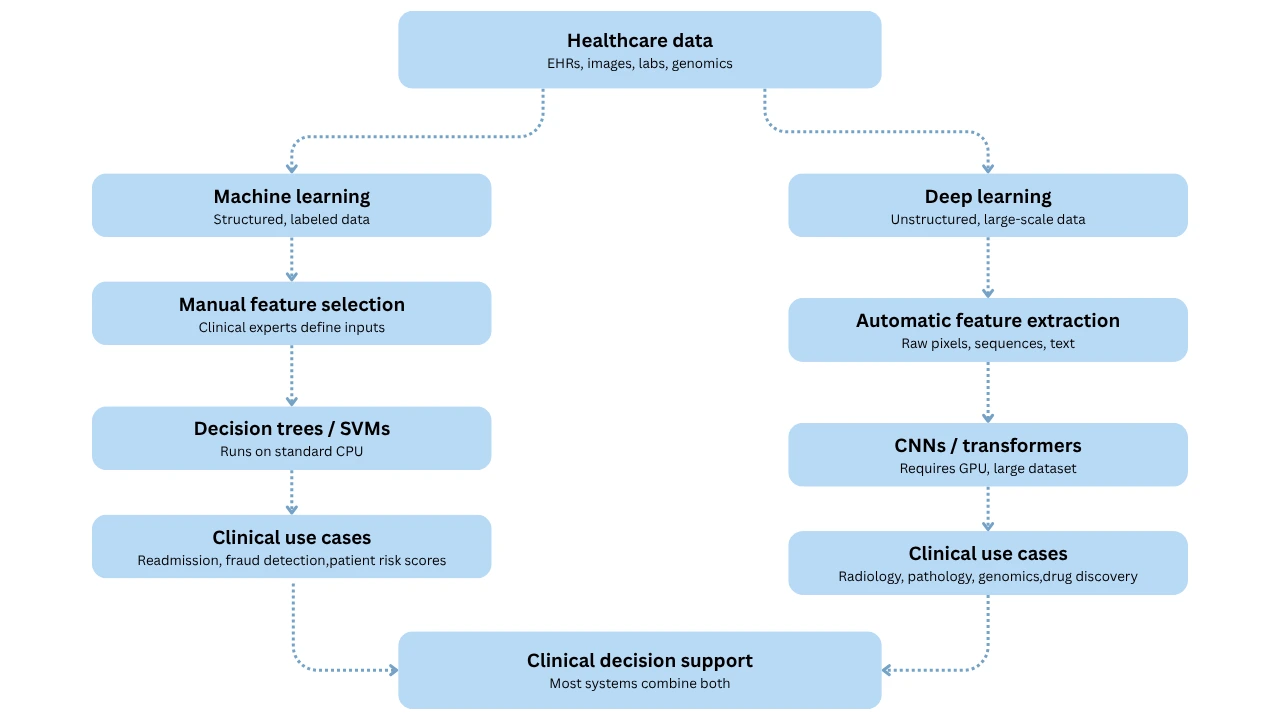
Machine Learning vs. Deep Learning in Healthcare: Key Differences
| Feature | Machine Learning (ML) | Deep Learning (DL) |
|---|---|---|
| Data Requirements | Performs well with smaller, labeled datasets | Requires large datasets to perform reliably |
| Model Complexity | Decision trees, SVMs, regression models — fewer parameters | Neural networks with multiple layers, millions of parameters |
| Feature Engineering | Requires manual selection of input features by domain experts | Learns features automatically from raw data |
| Processing Power | Runs on standard CPUs | Typically requires GPUs for training |
| Healthcare Applications | Readmission prediction, risk scoring, fraud detection, patient flow optimization | Medical imaging analysis, genomics, drug discovery, pathology |
| Interpretability | More interpretable; clinicians can understand the reasoning | Often described as a black box; harder to explain decisions |
| Training Time | Faster | Much longer due to architecture complexity |
| Best Use When | Data is structured, labeled, and moderate in volume | Data is unstructured (images, text, genomic sequences) and volume is high |
Both have a place in healthcare. Most production healthcare ML systems combine classical ML for structured clinical data and deep learning for imaging and genomics.
Real-World Examples: Healthcare Apps Using ML
Viz.ai
Viz.ai applies computer vision to CT scans to automatically detect large vessel occlusions — the type of stroke that requires immediate intervention. When the model detects a match, it alerts the stroke team in real time, reducing the time from scan to treatment decision. Deployed across hundreds of hospitals in the US and Europe.
Deep Genomics
Deep Genomics uses ML to analyze genetic mutations and identify how they drive disease. Their platform screens millions of potential drug candidates computationally, allowing researchers to focus on the most promising candidates before any lab work begins.
PathAI
PathAI supports pathologists by analyzing tissue samples using ML. The system flags regions of interest in slides and helps pathologists prioritize cases based on predicted severity — useful in high-volume labs where manual review bottlenecks diagnostic timelines.
Oncora Medical
Oncora Medical collects data from medical records, imaging, and cancer registries to evaluate treatment effectiveness in radiation oncology. Their ML models help radiation oncologists compare historical outcomes across similar patient profiles before selecting a treatment plan.
Intuitive Surgical (Da Vinci System)
Intuitive Surgical (Da Vinci System) uses ML to assist surgeons in minimally invasive procedures with real-time motion stabilization and procedural guidance, reducing complication rates compared to open surgery for the same indications.
If you are building a healthcare app or a telemedicine platform, integrating ML at the right points in the user journey — not everywhere at once — is what separates useful products from overpromised ones.
How to Implement Machine Learning in a Healthcare App
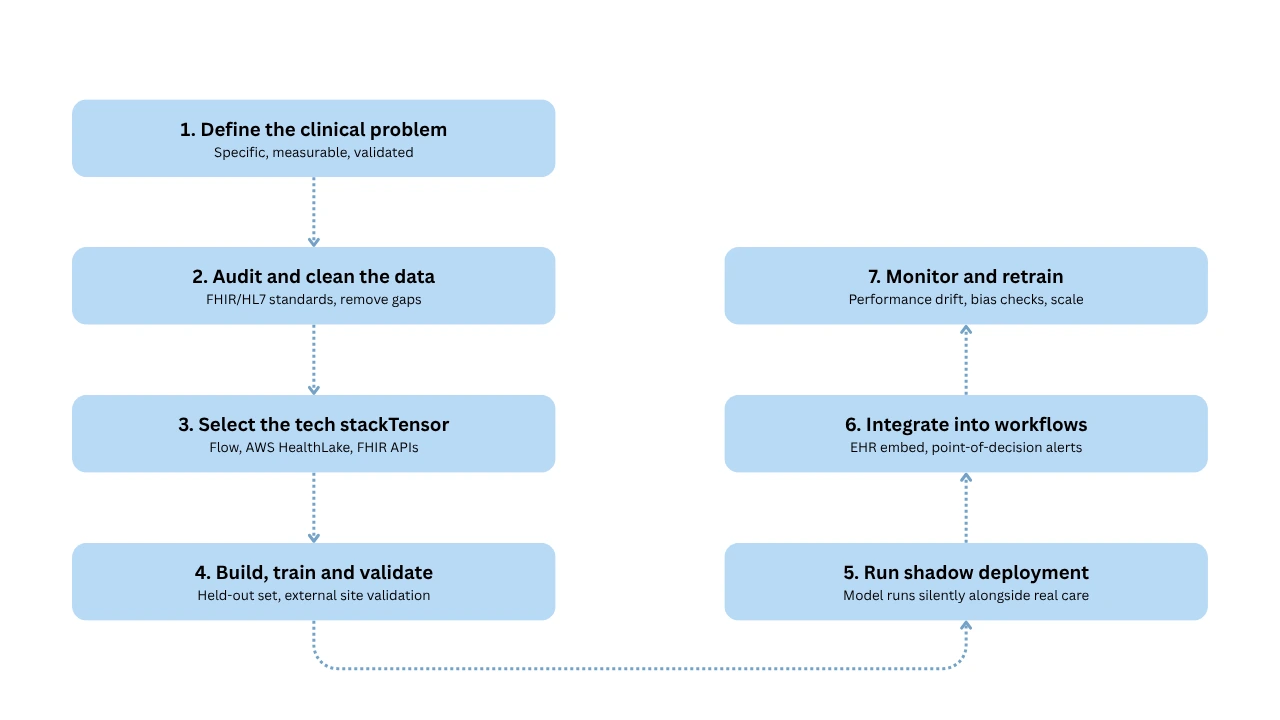
Building ML into a healthcare app is different from building ML into a fintech or e-commerce product. The stakes are higher, the regulatory requirements are specific, and the integration with legacy systems is rarely straightforward. Here is a realistic picture of the process:
Step 1: Define the Clinical Problem First
Start with a specific, measurable clinical problem. “Improve patient outcomes” is not a problem statement. “Reduce 30-day readmissions among heart failure patients by identifying high-risk cases at discharge” is. The more specific your goal, the more tractable your data and model requirements become.
This is also where you determine whether ML is actually the right tool. Some problems are solved more reliably with simpler rule-based logic. ML adds complexity; apply it where the complexity is justified.
Step 2: Audit and Clean Your Data
Healthcare data is messy. Records are incomplete, formats vary across systems, and historical data may reflect care biases that you do not want to reproduce in your model. Before any model development begins, assess your data quality honestly. What percentage of records have complete values for the variables you need? Where are the gaps?
Plan for this step to take longer than expected. Poor data quality is the most common reason ML healthcare projects fail in production.
Step 3: Select Your Technology Stack
Common choices include TensorFlow and PyTorch for model development; AWS HealthLake, Google Cloud Healthcare API, or Azure Health Data Services for HIPAA-compliant storage and processing; and FHIR-compatible APIs for EHR integration. Your tech stack must accommodate both the ML infrastructure and the compliance requirements simultaneously.
If you are building a clinical application, the EHR integration layer deserves as much engineering attention as the model itself. A model with no reliable data feed is not usable in practice.
Step 4: Build, Train, and Validate the Model
Train on your historical dataset, then validate on a held-out dataset the model has never seen. If you have data from multiple sites, test on data from a different site than you trained on — this tests whether the model generalizes or only works for one hospital’s patient population.
Document your validation methodology. Regulators, hospital procurement committees, and clinical leaders will ask for it.
Step 5: Run a Shadow Deployment
Before putting the model in front of clinicians, run it in shadow mode alongside normal operations. The model generates outputs, but no one acts on them. Compare its recommendations to what actually happened. This identifies failure modes before they reach patients.
Step 6: Integrate Into Clinical Workflows
ML value only materializes when it integrates into the workflow at the point of decision. An alert that fires outside of the EHR is easy to ignore. A risk score embedded in the discharge checklist gets reviewed. Design for integration from the beginning, not as an afterthought.
For a doctor appointment app or a health tracking app, this might mean embedding ML-based risk summaries into the physician’s pre-consultation view rather than a separate dashboard that requires additional navigation.
Step 7: Monitor, Audit, and Retrain
ML models are not static. Patient populations change, clinical practices evolve, and data quality drifts over time. A model that was accurate at deployment may degrade six months later. Establish monitoring pipelines that track model performance on live data and trigger review or retraining when metrics fall below acceptable thresholds.
This is especially important for any application that influences medication decisions or diagnosis. The FDA’s 2025 lifecycle guidance for AI medical devices makes ongoing monitoring a formal requirement, not a best practice.
Ready to Build a Healthcare AI Solution That Makes a Real Impact?
Turn healthcare data into actionable insights with custom machine learning solutions. From predictive analytics and clinical decision support to patient engagement platforms, our experts help you build AI healthcare applications.
Discuss Your Project
Challenges of Machine Learning in Healthcare
Data Quality and Availability
ML models are only as good as the data they train on. In healthcare, that data is often incomplete, inconsistently formatted, or siloed across systems that do not communicate. Building a reliable training dataset in a clinical environment is not a data science problem — it is an organizational one, requiring coordination across IT, clinical, legal, and compliance teams.
Bias and Fairness
Training datasets reflect historical care patterns. If a hospital historically underserved certain patient populations, an ML model trained on its records will reproduce that gap. Bias in clinical ML can manifest as lower diagnostic sensitivity for underrepresented groups, which has direct health consequences.
Addressing bias requires actively diversifying training data, testing model performance across demographic subgroups, and maintaining ongoing monitoring for disparities in output.
Privacy and Regulatory Compliance
Healthcare data is among the most sensitive categories of personal information. Any ML development process that involves patient data must comply with HIPAA in the US, GDPR in Europe, and equivalent regulations in other markets. This includes data storage, access controls, audit logging, and vendor agreements.
De-identification and federated learning training models without moving raw patient data off-premises — are two approaches that reduce privacy risk during model development.
Integration with Legacy Systems
Most hospitals run on EHR systems, laboratory systems, and imaging systems that were not designed with API-first architectures. Integrating ML tools with these systems requires custom interfaces, extensive testing, and ongoing maintenance as the underlying systems update. This is routinely the most expensive and time-consuming part of any healthcare ML project.
If you work with a healthcare app development company, evaluating their experience with HL7 and FHIR integration is as important as evaluating their ML expertise.
Clinician Trust and Adoption
A technically accurate model that clinicians ignore provides no value. Building clinician trust requires transparent documentation of model performance, explainable outputs, and involving clinical staff in the design and testing process from the beginning. Deploying ML without clinical co-design almost always results in low adoption.
Regulatory Approval
In the US, diagnostic ML tools that influence clinical decisions are regulated as medical devices. The FDA 510(k) clearance process requires clinical evidence of safety and efficacy. This is appropriate — but it adds time and cost to the development timeline. Organizations that treat regulatory approval as an afterthought rather than a design constraint routinely face delays.
How Much Does It Cost to Build an ML-Powered Healthcare App?
Cost varies significantly by scope and complexity. These ranges reflect current 2026 market rates:
| App Type | Estimated Cost Range |
|---|---|
| Simple healthcare MVP (basic monitoring, appointment booking) | $40,000 – $80,000 |
| Mid-complexity app (EHR integration, AI chatbot, basic ML features) | $100,000 – $200,000 |
| Full ML-powered platform (predictive analytics, imaging AI, custom model) | $200,000 – $400,000+ |
| AI/ML feature integration added to existing app | $20,000 – $60,000 |
| Annual maintenance and compliance costs | $5,000 – $30,000/year |
Adding machine learning features — predictive analytics, diagnostic support tools, NLP-based note summarization — typically adds $20,000 to $60,000 to the base development cost, depending on the complexity of the model and the data pipeline required.
For regulatory-grade ML tools targeting FDA clearance in the US market, clinical validation studies add to the budget and timeline substantially.
Cost is also affected by team location. Indian AI development teams (where Comfygen operates) typically deliver at rates 50-70% lower than US or Western European equivalents, with no compromise on technical capability for the right partner.
Want a detailed estimate for your specific project? Contact our team and we will scope it based on your actual requirements.
The Future of Machine Learning in Healthcare
The most significant near-term changes are not in the models themselves — they are in how those models connect to the systems clinicians already use every day.
Ambient Clinical Intelligence
ML that runs in the background of a clinical encounter, transcribing the consultation, generating a draft note, and pre-populating the billing code — without the physician stopping to type anything. Microsoft and Nuance have deployed early versions of this via DAX Copilot in several US health systems.
Federated Learning at Scale
Training models on distributed data across hospital networks without centralizing sensitive patient records. This enables larger, more generalizable models while maintaining data residency compliance.
Wearable-Driven Predictive Care
Continuous data from consumer wearables (heart rate variability, blood oxygen, activity patterns) feeds ML models that detect early signals of deteriorating chronic conditions. Apple’s partnership with health systems for cardiac monitoring using Apple Watch data is the clearest current example.
Multimodal Models
Single models that process clinical notes, lab values, imaging, and genomic data simultaneously — rather than separate models for each data type. This more closely reflects how a clinician reasons about a complex patient.
Tighter Regulatory Frameworks
The FDA’s 2025 lifecycle guidance is the start of a more formal approach to monitoring deployed AI systems. Healthcare organizations building ML products should design compliance infrastructure in from the beginning rather than retrofitting it.
What is not changing: the need for clinical validation, the importance of explainability, and the reality that a well-built healthcare app still requires skilled development, domain expertise, and a disciplined integration process.
If you are planning to build or upgrade a healthcare app, telemedicine platform, laboratory app, or medicine delivery app with ML capabilities, the time to start building that foundation is now — before the regulatory and infrastructure expectations get more complex.
Get in touch with Comfygen’s healthcare development team to discuss what is right for your product.
Contact Us:
WhatsApp: +91 9587867258
Email: sales@comfygen.com
Final Verdict
Machine learning is set to revolutionize healthcare, offering unprecedented opportunities for personalized care, improved diagnostics, and operational efficiency. By harnessing the power of AI, healthcare providers can deliver more accurate and timely treatments, enhance patient outcomes, and streamline administrative processes.
Despite the challenges such as data privacy, biased datasets, and regulatory hurdles, the potential benefits far outweigh the drawbacks. As technology advances and ethical considerations are addressed, the integration of machine learning into healthcare systems will become more seamless and widespread. The future promises a more proactive, patient-centric approach to medical care, where technology and human expertise work hand-in-hand to deliver optimal health outcomes.
Embracing machine learning in healthcare is not just an innovation—it’s a necessary evolution towards a smarter, more efficient, and compassionate healthcare system.
FAQ
What is the most common application of machine learning in healthcare today?
Medical imaging analysis and predictive analytics are the two most widely deployed applications. Imaging ML is particularly mature in radiology, pathology, and ophthalmology. Predictive models for sepsis, readmission risk, and deterioration detection are deployed across major hospital systems globally.
Can machine learning replace doctors?
No. ML tools improve the speed and accuracy of specific tasks — reading scans, flagging risk, analyzing lab trends. They do not replicate clinical judgment, the patient relationship, or the ability to reason across ambiguous, incomplete information. Experienced clinicians remain essential, and will for the foreseeable future. ML shifts what they spend their time on, not whether their expertise is needed.
How do you ensure patient data is protected when using ML?
Healthcare ML development must comply with applicable regulations (HIPAA in the US, GDPR in Europe). In practice, this means encrypted storage, strict access controls, audit logging, business associate agreements with any vendors processing patient data, and in some contexts, de-identification or federated learning approaches that avoid centralizing raw records.
How long does it take to integrate ML into a healthcare app?
A focused ML feature — such as a risk score or an AI-based triage tool — typically takes four to eight months from concept to clinical deployment when data is reasonably clean and EHR integration is not highly complex. Full ML-powered platforms with custom model development can take twelve to eighteen months or longer.
What should I look for in a healthcare app development company with ML capabilities?
Check whether they have experience with HIPAA-compliant architecture, HL7/FHIR EHR integration, and model validation methodology — not just general ML experience. Ask for specific examples of healthcare projects they have completed. The technical skills for building an ML retail recommendation engine are not the same as those required for a clinically validated diagnostic tool.
What is the difference between AI and machine learning in healthcare?
AI is the broader field covering any system that mimics human-like reasoning. Machine learning is a subset of AI in which systems learn from data without being explicitly programmed for each task. In healthcare, AI often refers to the overall application (an AI diagnostic tool), while machine learning describes the underlying method (the model that trained on thousands of images to make the diagnosis). Deep learning is a further subset of ML used for complex tasks like imaging and genomics.
How much does machine learning integration add to healthcare app development costs?
Adding ML features to a healthcare app typically adds $20,000 to $60,000 to the base development budget for standard features like predictive risk scores or NLP-based note processing. Custom model development with clinical validation can push this figure to $100,000 or higher, depending on the data requirements and regulatory pathway.
Is machine learning in healthcare regulated?
Yes, in most markets. In the US, ML tools that influence clinical decisions are classified as Software as a Medical Device (SaMD) and may require FDA clearance. The FDA issued comprehensive lifecycle guidance for AI-enabled medical devices in January 2025. Healthcare organizations developing ML tools should engage regulatory strategy early in the product design process.

Mr. Saddam Husen, (CTO)
Mr. Saddam Husen, CTO at Comfygen, is a renowned Blockchain expert and IT consultant with extensive experience in blockchain development, crypto wallets, DeFi, ICOs, and smart contracts. Passionate about digital transformation, he helps businesses harness blockchain technology’s potential, driving innovation and enhancing IT infrastructure for global success.