




Food delivery apps have fundamentally changed how Americans eat. What started as a convenience for rainy days and lazy Sundays is now a daily habit for tens of millions of people. You can have a restaurant-quality meal, a grocery order, or a pint of ice cream at your door in under 30 minutes — often without ever speaking to a human being.
The numbers tell the story. The United States online food delivery market size was valued at USD 34.9 Billion in 2025. Looking forward, the analyst estimates the market to reach USD 75.4 Billion by 2034, growing at nearly 9% annually. Americans now order food delivery roughly once every 6.7 days — that’s more than once a week on average — and the average American spends a staggering $1,850 per year on food delivery alone.
Yet with so many apps competing for your wallet, choosing the right one can feel overwhelming. DoorDash, Uber Eats, Grubhub, Instacart, GoPuff, Caviar — each one promises the best prices, fastest delivery, and widest restaurant selection. Not all of them can be right.
I’ve analyzed every major platform in 2026 — their fees, strengths, weaknesses, and who they’re actually best for. By the end, you’ll know exactly which app to open the next time hunger strikes.
What to Look for in a Food Delivery App
Before comparing individual apps, it helps to know what actually matters when picking a food delivery service. Here are the six factors that separate a great experience from a frustrating one.
Delivery Speed and Coverage Area
Speed matters most when you’re hungry, and coverage determines whether the app is even useful where you live. Some apps like DoorDash have nationwide suburban reach; others like Seamless are strong only in specific cities. Always check whether your favorite local restaurants are listed before committing to a subscription.
Service Fees, Delivery Fees, and Hidden Costs
This is where most users get burned. Every major app charges multiple layers of fees — a delivery fee, a service fee (typically 10–15% of your subtotal), a possible small order surcharge, and taxes, all before tip. According to 2026 research, the total cost of a single delivery order can run 30–40% higher than the listed menu price. The FTC is actively investigating hidden fees in 2026 — Instacart settled for $60 million and Grubhub for $25 million over deceptive pricing practices — so transparency matters more than ever.
Restaurant Variety and Cuisine Options
DoorDash partners with over 590,000 restaurants and grocery shops. Grubhub covers 415,000+ retailers in 4,000+ U.S. cities. The more options on an app, the better your chances of finding exactly what you want on any given night.
User Experience and App Interface
A clean, fast, intuitive app saves you time and frustration. DoorDash consistently earns high marks for its polished interface. Smaller apps sometimes lag in design. Read App Store reviews for your specific city — experiences vary widely by market.
Subscription and Membership Plans
If you order more than twice a month, a subscription almost always pays for itself. DashPass ($9.99/month), Uber One ($9.99/month), and Grubhub+ ($9.99/month — free with Amazon Prime) each eliminate or significantly reduce delivery fees. With 62% of all food delivery app users now paying for a premium subscription, this has become a standard part of the delivery economy.
Customer Support Quality
Things go wrong — orders get cold, drivers get lost, items go missing. How an app handles these moments matters. Look for apps with live chat, quick refunds, and responsive support. This is an area where many apps, including Grubhub, have drawn criticism in user reviews.
List Of Top Food Delivery Apps in the USA
1. DoorDash — Best Overall
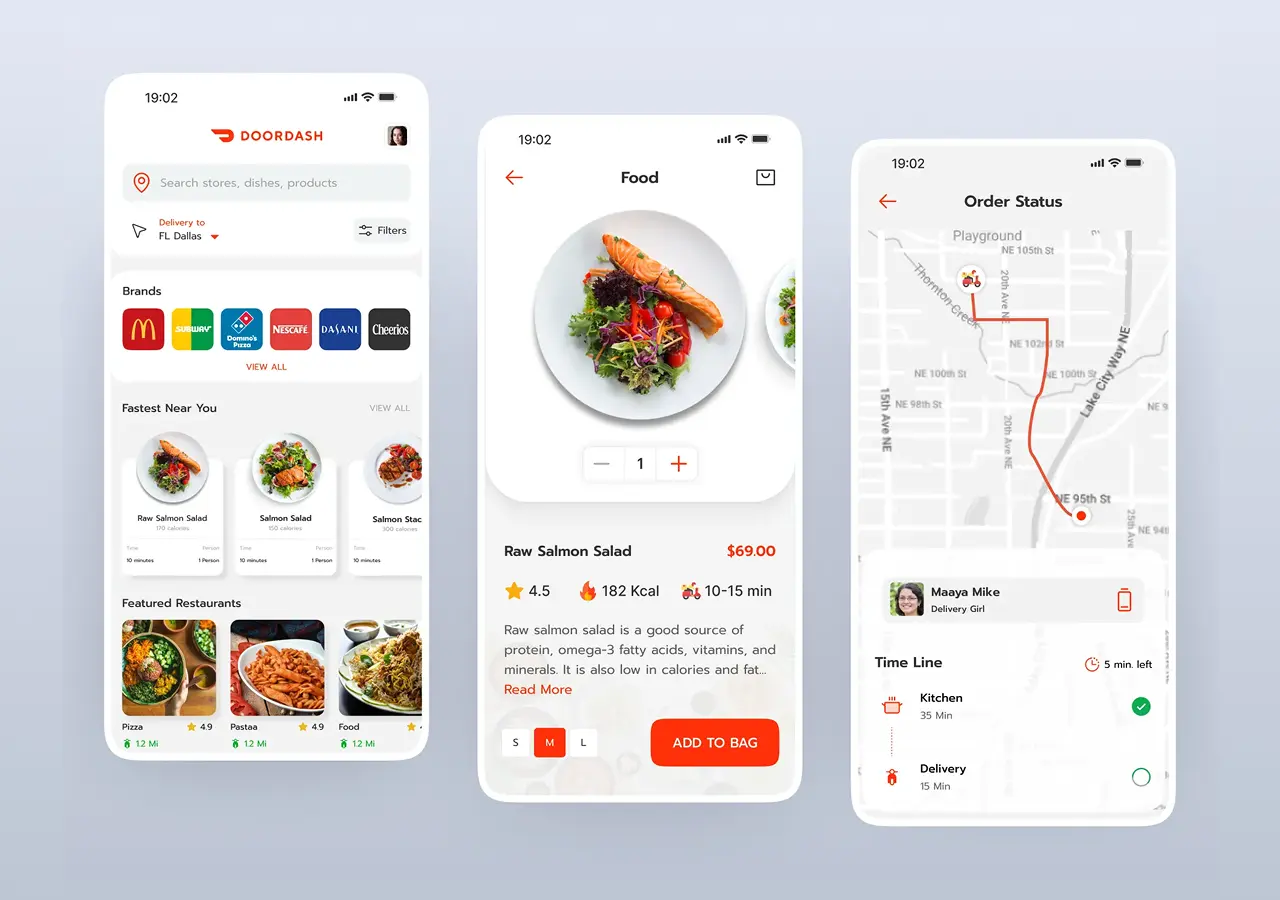
Market Share: 56–68% | Active Users: 46.3 million | Subscription: DashPass ($9.99/month)
DoorDash is the undisputed king of food delivery in America. It holds more than half the entire U.S. market — a lead so dominant that in San Francisco alone, it commands 74% of all delivery sales. With 590,000+ restaurant and grocery partners, $11.9 billion in trailing revenue, and delivery available in virtually every U.S. city and suburb, there is no close second.
What makes DoorDash stand out in 2026 is its suburban reach. While competitors cluster around dense urban cores, DoorDash expanded aggressively into smaller towns and suburban zip codes — a move that paid off enormously. If you live outside a major metro, DoorDash is often your only real option.
DashPass is one of the best values in the subscription game — $9.99/month for $0 delivery fees and reduced service fees on all eligible orders. DoorDash also offers pickup cashback credits, so if you’re nearby, you can grab your food and save.
Pros: Widest coverage, huge restaurant selection, excellent app UX, competitive DashPass value, and suburban and rural availability.
Cons: Service fees apply on non-subscription orders; delivery fees can hit $6.99–$10.99 without DashPass; surge pricing during peak hours.
Best for: Most Americans, especially suburban users and anyone who orders more than once a week.
2. Uber Eats — Best in Major Cities
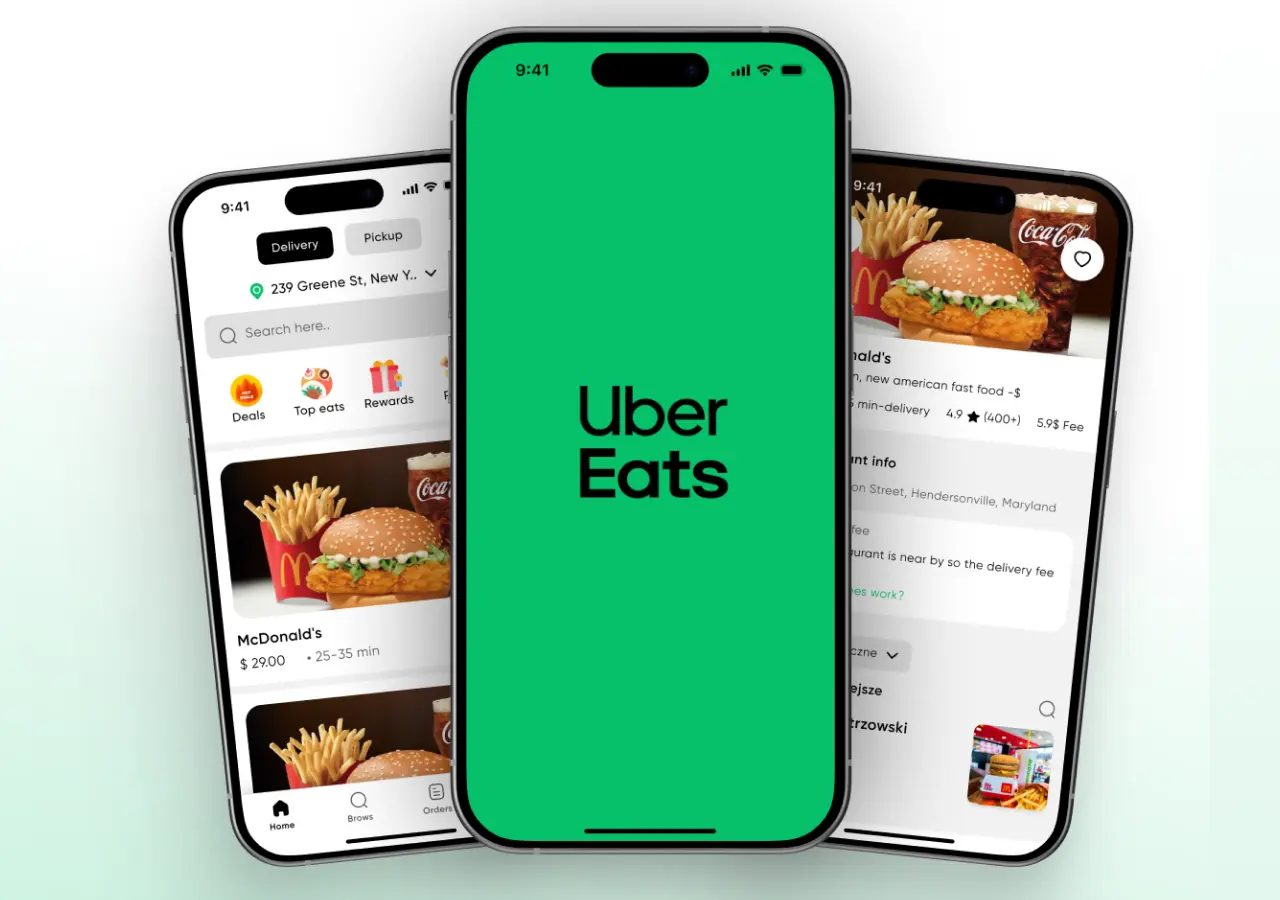
Market Share: ~23% | Global Users: 88 million | Subscription: Uber One ($9.99/month)
Uber Eats is DoorDash’s most formidable rival and the clear winner in several major urban markets. It dominates Miami with 55% of delivery sales and leads internationally, making it the most popular food delivery app in the world by user count. In 2026, Uber Eats operates in 45 countries across 11,500+ cities.
The Uber One membership bundles food delivery perks with Uber ride discounts — a unique advantage for city dwellers who use both services. At $9.99/month, you get up to 10% off eligible orders and $0 delivery fees. Students get it for $4.99/month after a free trial, making it an exceptional deal for college users.
Uber Eats also benefits from its Instacart partnership, which routes grocery orders through the Uber courier network, adding to its versatility.
Pros: Fastest delivery times in dense cities, massive international footprint, bundled Uber ride discounts, strong restaurant selection.
Cons: Higher fees than competitors in some markets; can be slower in suburban areas; limited advantage outside major metros.
Best for: City dwellers, frequent Uber riders, international travelers, and college students.
3. Grubhub — Best for East Coast Users and Amazon Prime Members
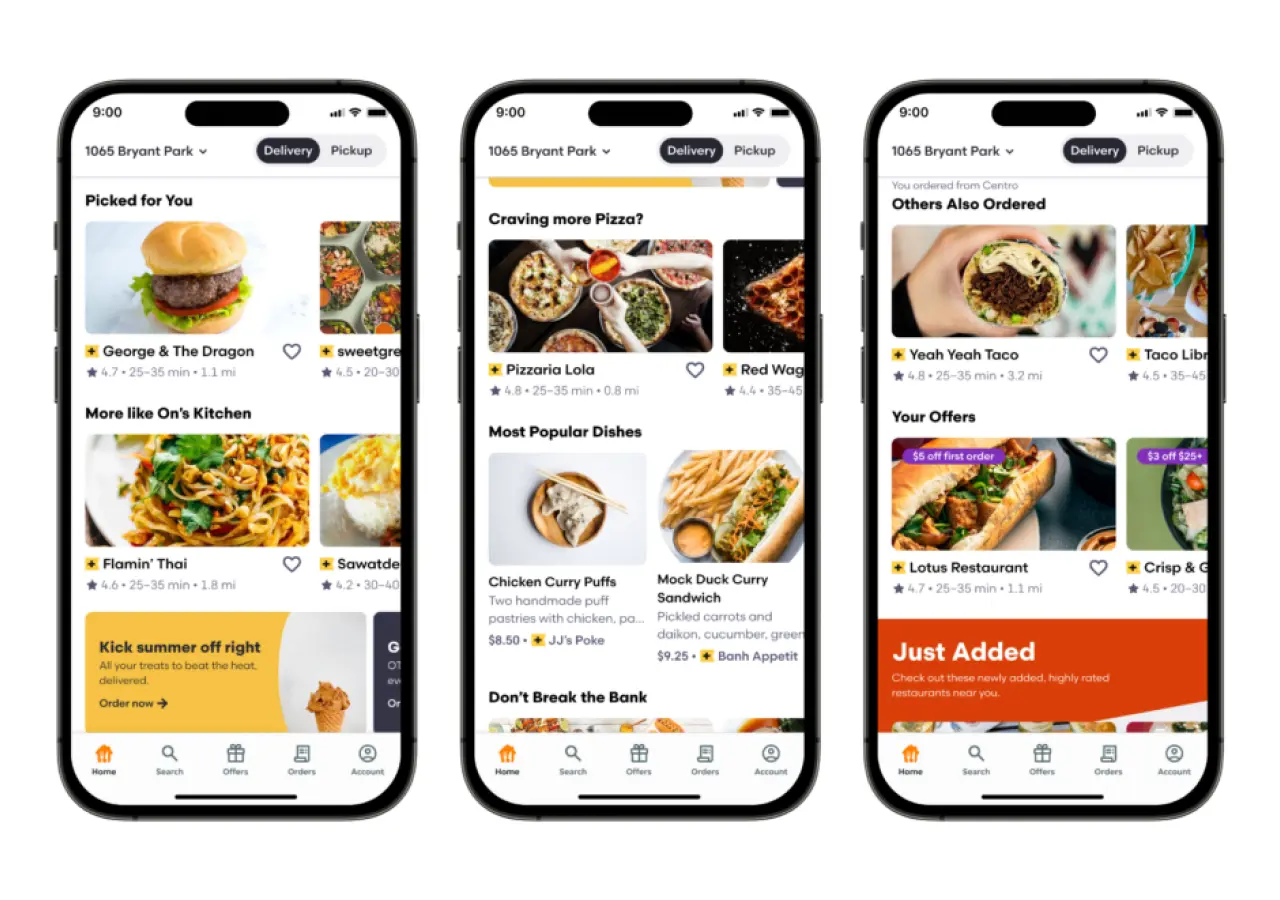
Market Share: ~16% | Restaurants: 415,000+ in 4,000+ U.S. cities | Subscription: Grubhub+ ($9.99/month — free with Amazon Prime)
Grubhub is the oldest major food delivery platform in America and still one of the most valuable — especially for Amazon Prime members. Prime users get Grubhub+ completely free, which eliminates delivery fees and provides 10% cashback on pickup orders. This is the single best food delivery perk bundled into any existing subscription service in 2026.
Now owned by Wonder Group (acquisition finalized in Q1 2025), Grubhub has been revitalized with new energy and investment. It’s also partnered with Instacart for grocery delivery, meaning Grubhub+ members get $0 delivery fees on grocery orders of $25+ from participating retailers — a genuinely useful cross-platform perk.
Grubhub remains particularly strong in New York City, where Seamless (its sister app) has deep roots, and across major East Coast metros. According to 2026 state-by-state price analysis, Grubhub is the cheapest food delivery option in 24 U.S. states.
Pros: Free with Amazon Prime (Grubhub+), strong East Coast presence, grocery delivery via Instacart, cashback on pickup, competitive pricing in many markets.
Cons: Losing market share nationally; customer support has drawn criticism; less competitive in West Coast and suburban markets.
Best for: Amazon Prime subscribers, East Coast users, budget-conscious orderers.
4. Instacart — Best for Grocery Delivery
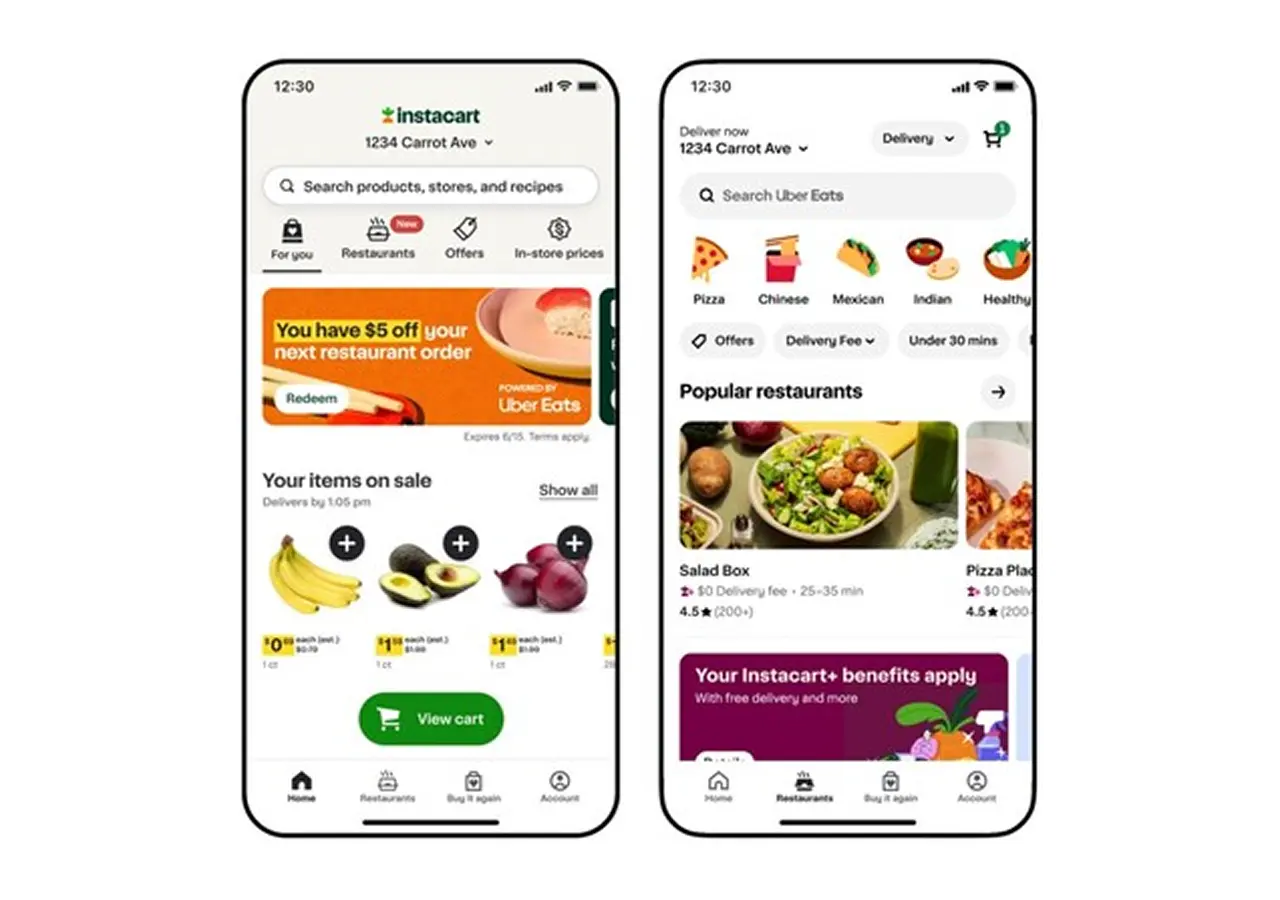
Coverage: Nationwide | Partners: 1,800+ retail banners, 100,000 stores | Subscription: Instacart+ ($9.99/month)
Instacart built its empire on grocery delivery, and in 2026 it remains the gold standard for getting your weekly shopping delivered. It partners with over 1,800 national, regional, and local grocery banners — from Costco and Kroger to local specialty stores — covering nearly 100,000 stores across North America.
What’s new in 2026: Instacart now offers restaurant delivery in many markets through its Uber Eats partnership, making it a hybrid platform for households that want one app for both groceries and dinner. Instacart+ members ($9.99/month) get free delivery on grocery orders over $35 and reduced service fees.
In 2025, Instacart settled with the FTC for $60 million over advertising claims — a reminder to read the fee structure carefully before assuming an order is “free delivery.”
Pros: Unmatched grocery selection, real-time order tracking, personal shopper model, expanding into restaurants via Uber Eats partnership.
Cons: Restaurant delivery is secondary to groceries; fees can be confusing; best value is realized on larger grocery orders.
Best for: Families, households doing weekly grocery shopping, people who want one app for groceries and restaurants.
5. GoPuff — Best for Convenience and Late-Night Essentials
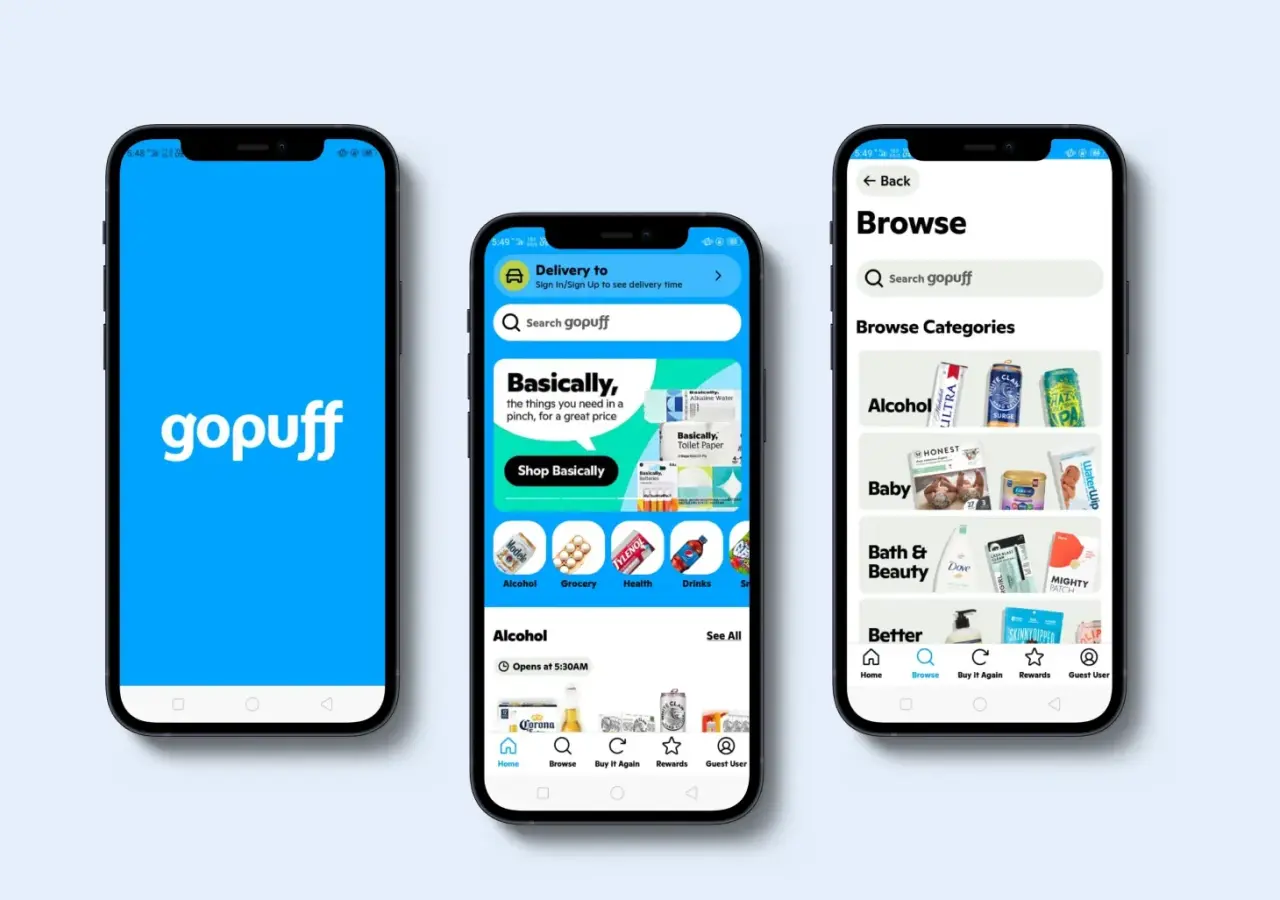
Coverage: 1,000+ U.S. cities | Delivery Fee: Flat $3.95 | Subscription: Fam ($7.99/month)
GoPuff occupies a unique niche in the food delivery world — it’s not primarily a restaurant delivery app, but rather an ultra-fast convenience store. It operates its own micro-fulfillment centers stocked with 4,000+ items including snacks, drinks, over-the-counter medicine, baby supplies, cleaning products, and alcohol (where available).
The pitch is simple: anything you’d grab from a 7-Eleven, delivered to your door in roughly 20–30 minutes for a flat $3.95 delivery fee. With GoPuff’s Fam membership ($7.99/month), that delivery fee disappears entirely.
In 2026, GoPuff has been piloting GoPuff Kitchen — its own prepared food concept — and partnerships with brands like Starbucks. It’s expanding beyond snacks into a broader convenience ecosystem.
Pros: Flat delivery fee, ultra-fast delivery, 24/7 availability in supported cities, wide convenience item selection.
Cons: Not a restaurant delivery app; limited coverage vs. DoorDash or Uber Eats; fewer food options for full meals.
Best for: Late-night cravings, convenience items, alcohol delivery, household essentials.
6. Caviar — Best for Fine Dining and Upscale Restaurants
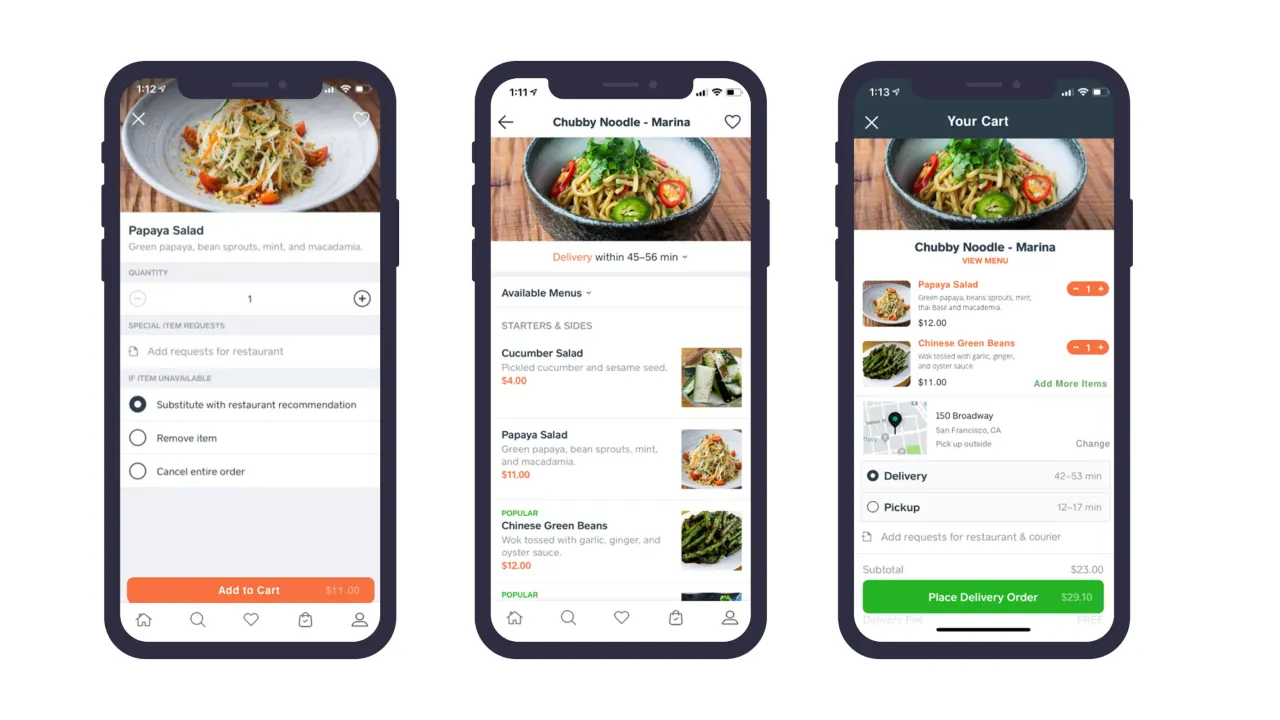
Coverage: 24 U.S. cities | Owner: DoorDash | Subscription: DashPass compatible
Caviar carved out a premium niche in the food delivery market by focusing exclusively on high-end, chef-driven restaurants — many of which refuse to list on mainstream apps. Operating in 24 cities as of 2026 and owned by DoorDash, Caviar is the go-to choice when you want delivery from a Michelin-starred spot or a buzzy restaurant that wouldn’t otherwise deliver.
DashPass members get access to Caviar as well, which is a nice bonus if you already subscribe to DoorDash’s plan. The interface mirrors DoorDash’s clean design, and real-time GPS tracking is standard.
Pros: Exclusive access to high-end restaurants, clean UX, DashPass integration, curated selection.
Cons: Only available in 24 cities; fees tend to be higher given the premium positioning; limited for everyday casual dining.
Best for: Food enthusiasts, date nights, special occasions, fine dining fans in major cities.
7. Seamless — Best for New York City
Coverage: Select major U.S. cities | Owner: Grubhub/Wonder Group | Subscription: Grubhub+ compatible
Seamless and Grubhub are essentially the same platform — same restaurant database, same checkout, same support. The key difference is geography: Seamless is built for select cities including New York City, Boston, Philadelphia, Washington D.C., Chicago, Miami, Houston, Austin, Seattle, San Francisco, and Los Angeles.
For New Yorkers in particular, Seamless is an institution — it predates the modern food delivery era and has deep local roots. Grubhub+ works across both platforms, so if you’re already subscribed, there’s no reason not to use Seamless in its supported cities.
Pros: Deep NYC and urban coverage, Grubhub+ compatible, reliable in select markets.
Cons: No value outside its covered cities; functionally identical to Grubhub elsewhere.
Best for: New York City residents and commuters.
8. Walmart+ Delivery — Best for Groceries on a Budget
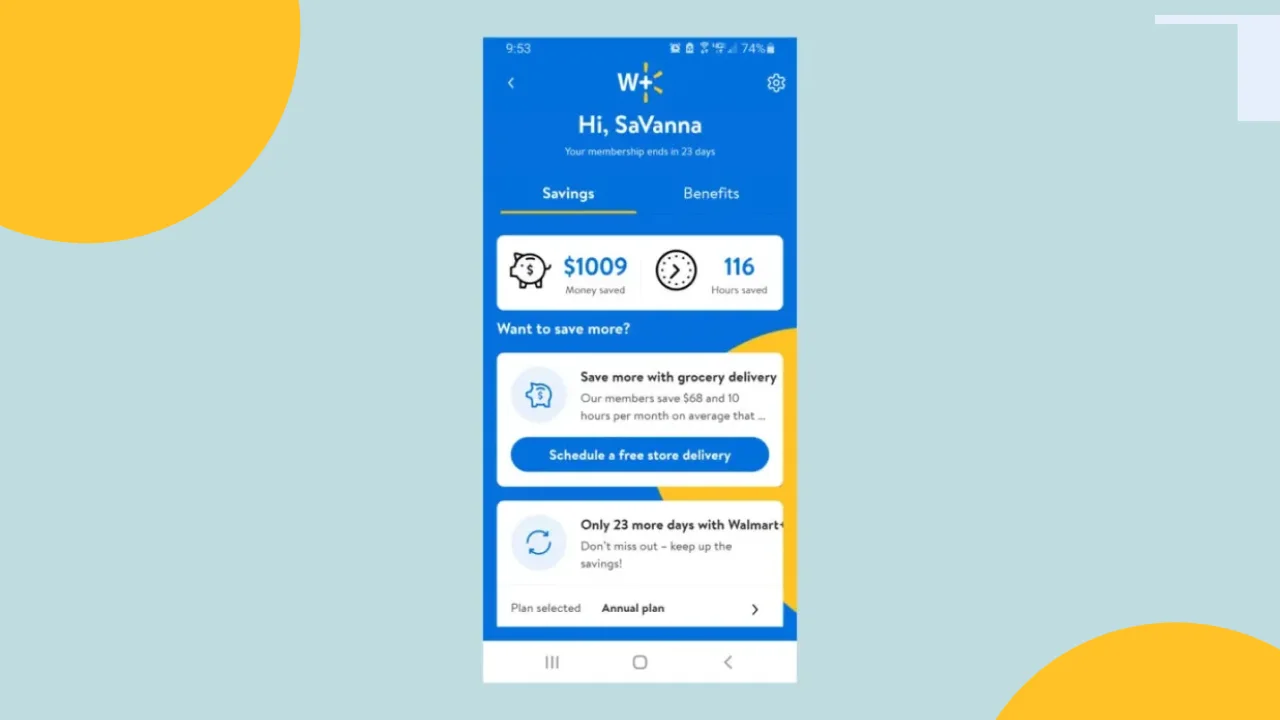
Coverage: Nationwide (Walmart store locations) | Subscription: Walmart+ ($12.95/month)
Walmart is not a traditional food delivery app, but in 2026 it deserves a spot on this list for one reason: value. At $12.95/month, Walmart+ includes free same-day grocery delivery from Walmart stores, plus Paramount+ streaming, fuel discounts, and member pricing on prescriptions.
For households spending heavily on groceries, Walmart+ often delivers better per-item cost than any restaurant delivery app. If your goal is saving money on everyday food while getting the convenience of delivery, Walmart+ is unbeatable.
Pros: Best value for grocery delivery, wide Walmart coverage, included Paramount+ streaming, fuel discounts.
Cons: Limited to Walmart store inventory; not for restaurant delivery; membership required.
Best for: Budget-conscious families, weekly grocery shoppers.
9. Amazon Fresh / Whole Foods Delivery — Best for Premium Grocery Delivery
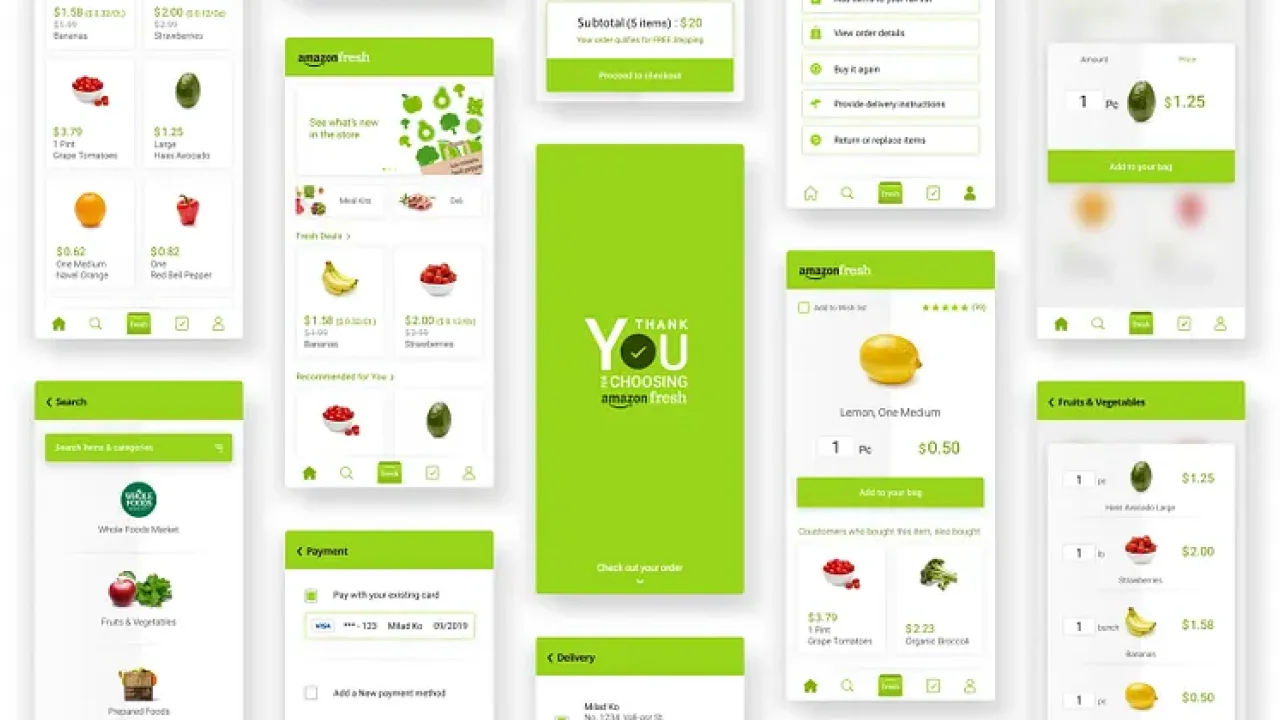
Coverage: Select markets | Subscription: Amazon Prime ($14.99/month — includes delivery)
Amazon Prime members can get free same-day or next-day delivery from Whole Foods and Amazon Fresh in supported markets. For health-conscious shoppers and organic food buyers, this is a compelling alternative to Instacart’s premium-tier pricing.
In 2026, Amazon continues to expand Fresh and Whole Foods delivery coverage, and the integration with Grubhub (via Amazon Prime perks) means Prime members can access Grubhub+ for restaurant delivery as well — creating a full-service food delivery ecosystem under one subscription.
Pros: Included with Prime, premium organic grocery selection, fast delivery in supported markets, Grubhub+ bundled for restaurant delivery.
Cons: Limited market coverage; not a restaurant delivery app; Whole Foods pricing is inherently premium.
Best for: Amazon Prime subscribers, Whole Foods shoppers, health-conscious grocery buyers.
Food Delivery Trends in the USA: What’s Shaping 2026 and Beyond {#trends}
The food delivery industry isn’t standing still. Here are the five biggest trends shaping where the market is headed.
AI-Powered Ordering and Personalization
In 2026, artificial intelligence is no longer a background process — it’s the engine powering the entire user experience. Platforms like DoorDash and Uber Eats analyze past orders, time of day, weather patterns, and local events to recommend meals before users even search. Behavior-based menus adjust in real time based on dietary history and preferences. For users, this means a faster, more personalized ordering experience. For restaurants, it means visibility is increasingly algorithm-driven.
Drone and Autonomous Delivery
DoorDash has announced plans to expand drone deliveries and sidewalk robot deliveries to make last-mile delivery more efficient and eco-friendly. Uber Eats is piloting similar programs. While still limited in geographic scope, these technologies are moving from experiment to reality in 2026, particularly in suburban and campus environments.
Ghost Kitchens and Virtual Restaurants
The global cloud kitchen market is valued at $91.70 billion in 2026 and is forecast to reach $225 billion by 2034. Ghost kitchens — commercial cooking spaces with no dining room — operate exclusively for delivery and allow restaurant brands to test new concepts without the overhead of a physical location. A single ghost kitchen might run five different branded menus targeting completely different customer segments. This trend benefits app users by expanding restaurant options and keeping prices competitive.
Quick Commerce: Delivery in Under 20 Minutes
The race for faster delivery has defined the last two years of the industry. What began as 45-minute windows is now a 10–20 minute sprint. Quick commerce platforms rely on networks of dark stores — small fulfillment centers positioned close to dense residential areas. GoPuff pioneered this model; major platforms are racing to catch up.
Market Consolidation and Regulatory Scrutiny
The U.S. food delivery market is consolidating. DoorDash’s $3.9 billion acquisition of Deliveroo expanded its reach into the UK, France, Singapore, and the Middle East. Grubhub was acquired by Wonder Group in Q1 2025. Meanwhile, the FTC is actively investigating hidden fees across the industry, with major settlements already reached against Instacart and Grubhub. Expect more transparency requirements — and possibly price regulation — in the years ahead.
Cost to Develop a Food Delivery App
The cost to develop a food delivery app in the USA depends on several factors, including the features of food delivery app development, design complexity, tech stack, and team location. On average, building a basic food delivery app with core functionalities like user login, menu browsing, ordering, payment integration, and tracking can range from $15,000 to $35,000. A more advanced app with real-time tracking, loyalty programs, AI-based suggestions, and multi-restaurant management may cost between $50,000 and $100,000+.
| App Type | Estimated Cost (USA) |
|---|---|
| Basic App | $15,000 – $35,000 |
| Mid-Level App | $35,000 – $60,000 |
| Advanced App | $50,000 – $100,000+ |
| Enterprise-Level App | $100,000 – $250,000+ |
Key Cost Factors:
- App platforms (iOS, Android, or both)
- Number of features and APIs
- Admin dashboard & restaurant panel
- UX/UI design complexity
- Integration with payment gateways and GPS
- App testing, deployment, and maintenance
To get an accurate cost estimate, it’s best to consult with an experienced food delivery app development company that can tailor the app to your goals and budget.
How Comfygen Can Help in Food Delivery App Development?
At Comfygen, we specialize in delivering scalable, secure, and feature-rich on-demand food delivery app development services. Whether you’re a startup, a restaurant chain, or a solo entrepreneur, we help you build custom food delivery apps that reflect your brand and streamline the delivery experience.
Our Offerings Include:
- Custom UI/UX design tailored to food industry trends
- Restaurant, driver, and admin panels
- Real-time GPS tracking & route optimization
- Secure payment gateway integration
- Loyalty programs & in-app offers
- Post-launch maintenance & support
As a trusted food delivery app development firm in the USA, we deliver mobile apps that not only look great but perform flawlessly. We use the latest tech stacks, ensure fast time-to-market, and offer 100% transparency throughout the development cycle.
Conclusion
Food delivery apps in 2026 are faster, smarter, and more competitive than ever. Whether you choose DoorDash, Uber Eats, Grubhub, or Instacart depends on your location, budget, and delivery needs.
If you’re planning to build a food delivery app like these platforms, partnering with the right development company is essential. Comfygen Technologies helps startups and businesses create custom food delivery apps with features like real-time tracking, secure payments, multi-vendor management, and scalable solutions.
Let’s turn your food delivery app idea into a profitable reality.
Get in touch with Comfygen today!
Frequently Asked Questions
What is the most popular food delivery app in the USA in 2026?
Which food delivery app has the lowest fees
Which food delivery app is free?
Is a food delivery subscription worth it?
Is DoorDash or Uber Eats better?

Mr. Saddam Husen, (CTO)
Mr. Saddam Husen, CTO at Comfygen, is a renowned Blockchain expert and IT consultant with extensive experience in blockchain development, crypto wallets, DeFi, ICOs, and smart contracts. Passionate about digital transformation, he helps businesses harness blockchain technology’s potential, driving innovation and enhancing IT infrastructure for global success.
Based on Interest
Blockchain Development Process: How to Develop a Blockchain Application
The blockchain development process runs through eight phases: use case validation, requirements definition, platform selection, architecture design, smart contract development, testing and…