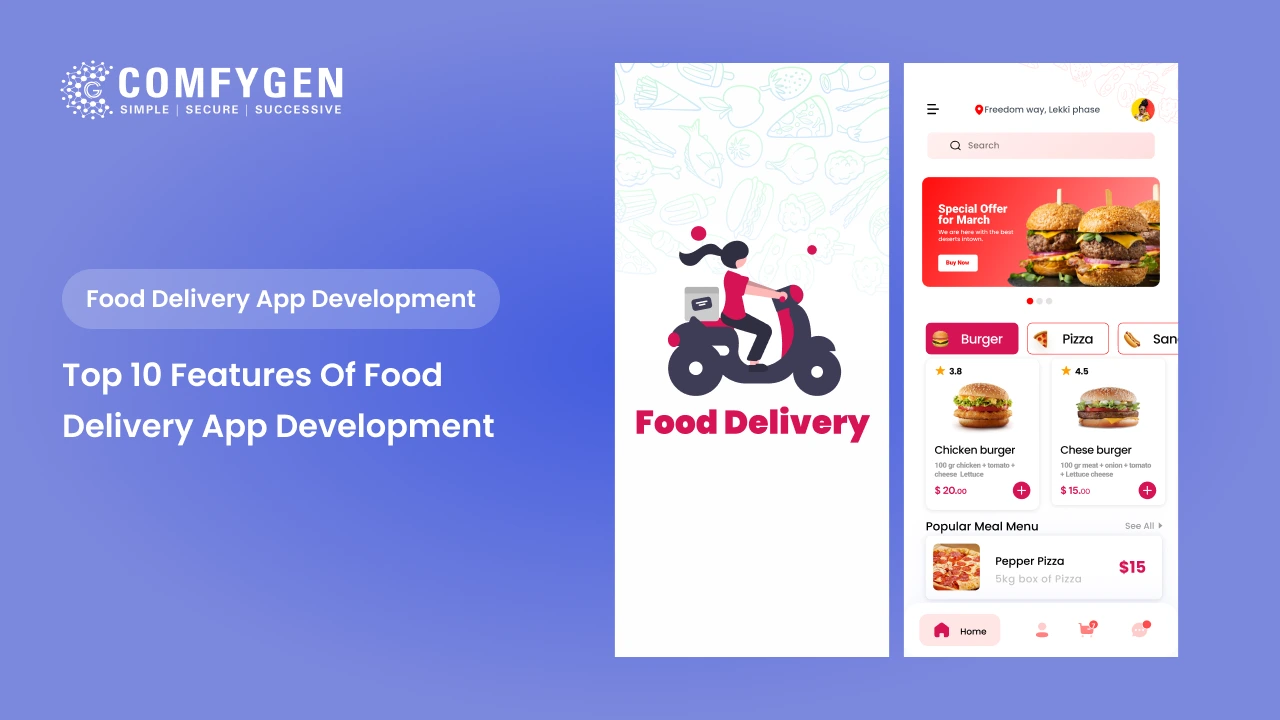





The fastest way to overspend on a food delivery app is to build version three first. The must-have features for a launch-ready platform come to about a dozen across four apps. Most feature lists you’ll find online run to forty or fifty, and building all of them before you have a single paying customer is how projects run 40% over budget.
This guide sorts food delivery app features by when you should build them, not by what exists. Three tiers: what ships at launch, what to add around 500 orders a month, and what only makes sense at scale.
Start With Four Apps, Not One
A working platform is four connected apps, not one:
- Customer app for browsing and ordering
- Restaurant partner app for accepting and preparing
- Delivery driver app for pickup and delivery
- Admin panel for running the whole thing
An order has to move cleanly through all four. That’s the test for version one. A customer app with AI recommendations and no way for the kitchen to accept an order is not a product, and a quote covering only the customer app looks 60% cheaper than a complete one without being comparable to it.
Everything below assumes all four apps exist. The question is what goes inside them.
Tier 1: Build These at Launch
Everything below is an MVP feature for a food delivery app. Each one earns its place for the same reason: an order cannot complete without it.
If a feature isn’t on this list, it can wait. This set costs roughly $15,000 to $50,000 depending on whether you start white-label or custom.
Customer App
| Feature | Why it can’t wait |
| Registration and login | Phone or social login. Long signup forms lose orders before the first one is placed |
| Restaurant and menu browsing | With basic filters for cuisine, price and delivery time |
| Item customization | Sizes, extras, removals. Skip it and you get support calls instead of orders |
| Cart and checkout | Under a minute from menu to confirmation |
| Payment gateway | One gateway, the methods your market actually uses |
| Real-time order tracking | Customers stopped treating this as a bonus years ago |
| Order status notifications | Accepted, preparing, out for delivery, delivered |
Restaurant App
| Feature | Why it can’t wait |
| Order acceptance | The order has nowhere to go without it |
| Kitchen queue view | What’s cooking, what’s next, what’s ready |
| Item availability toggle | Sold-out items generate cancellations and refunds, which is the fastest way to lose a customer |
| Order-ready signal | Triggers driver pickup |
Driver App
| Feature | Why it can’t wait |
| Order notifications | Accept or decline |
| Navigation | To restaurant, then to customer |
| Live location sharing | This is what powers customer-side tracking |
| Status updates | Picked up, en route, delivered |
Admin Panel
| Feature | Why it can’t wait |
| Live order view | Across every restaurant and driver |
| Restaurant and driver management | Onboard, verify, deactivate |
| Manual intervention | Reassign a driver, cancel an order, issue a refund. Something will go wrong in week one |
That’s it: Roughly 18 features across four apps. Ship this, take real orders, and let the data decide what comes next.
Turn Essential Features Into a Winning App
Build a scalable food delivery solution with the right features to attract users, streamline orders, and drive growth
Get Started Today
Tier 2: Add These at 500 Orders a Month
Once you have settled what features to build first, the harder question is what comes second. These food ordering app features start paying for themselves once you have order volume and history behind them.
These earn their cost once you have volume and history. Adding them earlier means paying for features that can’t yet function.
Ratings and reviews: Useless with ten orders. Valuable with a thousand, because they give you a quality signal on restaurants and drivers.
Promo codes and coupons: Once you know your average order value and repeat rate, you can design an offer that doesn’t lose money. Before that, you’re guessing.
Loyalty program: Needs enough repeat customers for the mechanics to matter. Typically the highest-return Tier 2 feature for a single-restaurant app.
Scheduled and repeated orders: Genuinely useful once you can see recurring patterns in real order data.
Analytics dashboard: Basic reporting can wait a few months, but not much longer than that. You need to know your peak hours and top items before you can plan anything.
Driver earnings dashboard: Retention matters more once you’re managing more than a handful of couriers.
In-app chat or call: Reduces support load once order volume makes phone support impractical.
POS integration: The exception to the timing rule. If your kitchen already runs a POS, build this at launch instead, because without it staff re-key every app order by hand, which is exactly the error source the app was meant to remove. Retrofitting POS sync later costs considerably more than scoping it in from the start.
Tier 3: Wait Until You Scale
These features are real, they work, and they’re the wrong thing to buy early.
AI Recommendations
The practical problem isn’t cost, it’s data. Recommendation engines need order history to function. On launch day you have none, so you’d be paying for something that can’t work yet. Build the data collection correctly from day one, then add the engine when there’s something to learn from. AI in a food delivery app does more than recommendations, covering demand forecasting and dispatch as well, and all of it runs on the same order history you don’t have yet.
Demand Forecasting
Same constraint. Needs months of order data across locations.
Dynamic Pricing
Only makes sense with a driver network large enough for supply and demand to actually diverge.
Automated Dispatch and Route Optimization
Manual or simple nearest-driver assignment works fine up to a few dozen concurrent orders. Sophisticated dispatch is a real cost and it solves a problem you don’t have yet.
Subscriptions
Needs proven order frequency. Launch one too early and you sell free delivery to people who’d have paid.
Multi-City and Multi-Language
Expand once one city runs profitably on its own. Launching a second market before the first works doubles every problem you have not solved yet.
Voice Ordering and AR Menus
Genuinely interesting, almost never the reason a customer picks one app over another.
Features People Skip and Regret
Four things that aren’t exciting and cause real damage when missing:
Refund and cancellation handling in the admin panel: Something goes wrong in week one. Without a way to fix it, your support process is someone editing the database.
Item availability toggles: A restaurant that can’t mark a dish sold out generates cancelled orders and refund requests all evening.
Order history for customers: Reorder is one of the highest-converting actions in any food app, and it’s cheap to build.
Crash reporting and analytics installed before launch: Adding these after launch means the first month of real user behavior, the most informative month you’ll ever have, is invisible.
What Each Tier Costs
| Tier | Roughly what it adds | When |
| Tier 1 | The build itself: $15,000 to $50,000 | Launch |
| Tier 2 | $8,000 to $25,000 across several releases | Month 3 to 9 |
| Tier 3 | $15,000 to $60,000+ depending on scope | Year 2 onward |
Building all three tiers at once doesn’t just cost more. It delays launch by months, and every month before launch is a month with no order data telling you which Tier 2 features you actually need.
Those Tier 1 numbers are the standard food delivery app development cost tiers, split across design, development, testing and four separate app builds.
Three Questions to Ask About Any Feature
For any feature someone proposes, ask three questions:
- Can an order complete without it? If not, it’s Tier 1.
- Does it need data I don’t have yet? If yes, it’s Tier 3 regardless of how good it sounds.
- Would I notice it missing at my current order volume? If not, it waits.
Most feature lists fail this test on two thirds of their entries.
Why Work With Comfygen
Comfygen has delivered 550+ projects for 400+ clients across 30+ countries since 2019, with a 97% client retention rate. Every food delivery build ships all four apps, and scoping starts with what belongs in version one rather than a feature list handed over as a quote.
Projects run in two-week sprints with a working demo at the end of each, and full source code ownership transfers at delivery. Teams working out which food delivery app features belong in their first release usually start by scoping a custom food ordering platform against their own operating model. Feature selection is only one stage of that, sitting between validating demand and launching, both of which creating a food delivery app walks through in order.
Final Thoughts
To succeed in the competitive food delivery market, businesses must focus on building apps that are feature-rich, intuitive, and performance-driven. A well-designed app enhances user satisfaction, increases engagement, and drives more orders. Prioritizing user experience through smart navigation, real-time tracking, and seamless payment options is key to standing out.
Partnering with a trusted food delivery app development company ensures your application is equipped with modern features and robust technology. From UI/UX to backend support, the right mobile application development team can help you launch a scalable and profitable food delivery app solution tailored to your business goals.
Frequently Asked Questions
What are the must-have features of a food delivery app?
What features does a food delivery app need at minimum?
How many apps does a food delivery platform need?
Should I build AI recommendations at launch?
When should I add a loyalty program?
Is POS integration a launch feature?
What's the most commonly skipped feature?
How much do the later feature tiers cost?
Does real-time tracking belong in version one?

Mr. Saddam Husen, (CTO)
Mr. Saddam Husen, CTO at Comfygen, is a renowned Blockchain expert and IT consultant with extensive experience in blockchain development, crypto wallets, DeFi, ICOs, and smart contracts. Passionate about digital transformation, he helps businesses harness blockchain technology’s potential, driving innovation and enhancing IT infrastructure for global success.