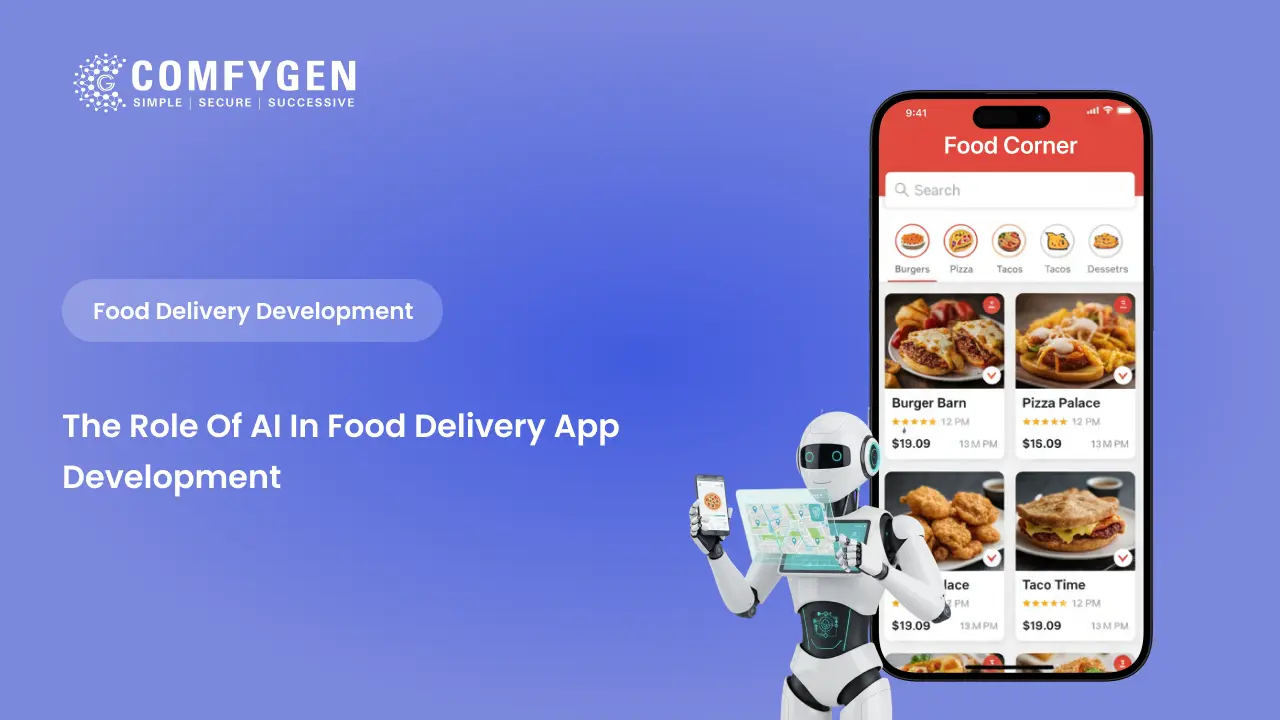





The food delivery industry runs on speed, personalization, and precision – and none of that is possible at scale without Artificial Intelligence. Platforms like Zomato, Swiggy, and Uber Eats don’t just deliver food; they use AI to predict what you want, when you want it, who should deliver it, and how to get it there faster than you expect.
But AI in food delivery isn’t reserved for billion-dollar platforms. Startups, cloud kitchens, and restaurant chains are now building AI-powered food delivery apps from the ground up — and this guide explains exactly how it works, what it costs, and what Comfygen builds for our clients.
What Does ‘AI in Food Delivery’ Actually Mean?
Before going into use cases, it’s worth being specific about what AI means in this context — because the term gets used loosely.
In a food delivery app, AI refers to systems that learn from data and make decisions automatically — without a human configuring each response. Three types of AI are most relevant:
| AI Type | What It Does in Food Delivery |
| Machine Learning (ML) | Learns patterns from historical order data to make predictions — what dishes to recommend, when demand will spike, which driver to assign. |
| Natural Language Processing (NLP) | Understands human language — powers chatbots, voice ordering, and review sentiment analysis. |
| Computer Vision | Analyses images — Zomato’s food image search, visual dish recognition, and automated menu photo tagging all use computer vision. |
| Predictive Analytics | Uses historical patterns plus external signals (weather, time, local events) to forecast future demand and prepare resources accordingly. |
| Route Optimisation Algorithms | Calculates the fastest, most fuel-efficient delivery path in real time — accounting for traffic, multiple drops, and driver location. |
The difference from simple automation: automation follows fixed rules (‘send SMS when order confirmed’). AI learns and improves — a recommendation engine trained on 1 million orders is smarter than one trained on 10,000. The more orders your platform processes, the better the AI gets.
7 Key Roles of AI in Food Delivery App Development
Artificial Intelligence (AI) has become the secret ingredient of food delivery apps today that makes them smart, fast, and customer-centric. With a food delivery app development company like Comfygen Technologies, AI is used not just for automation but to build intelligent systems that learn, adapt, and evolve over time.
Here are the key roles of AI in food delivery app development:
1. Personalised Recommendations Engine
The recommendation engine analyses a user’s order history, browsing behaviour, time of day, dietary patterns, and location to suggest the most relevant restaurants and dishes — before the user even searches.
| Factor | Detail |
| What it analyses | Past orders, search history, saved favourites, time of day, weather, similar user patterns |
| What it outputs | Ranked restaurant list, ‘Order Again’ prompts, ‘You Might Like’ dish suggestions |
| Business impact | Increases average order value by 15–25%; reduces time-to-order from average 4 minutes to under 90 seconds |
| How Comfygen builds it | Collaborative filtering model in Python (TensorFlow) trained on order history data; integrated via REST API into the app backend |
2. Smart Delivery Route Optimisation
Manual delivery assignment is slow and inefficient. AI route optimisation assigns the nearest available driver, calculates the most efficient multi-stop route, and re-routes in real time when traffic changes.
- Google Maps Routing API + Mapbox for base navigation
- ML model for ETA prediction (accounts for restaurant prep time, traffic patterns, driver speed)
- Dynamic re-routing when traffic incidents are detected via Google Maps real-time data
- Result: average delivery time reduction of 18–25% vs manual assignment
3. Demand Forecasting for Restaurants
AI predicts order volume by hour, day, and location — allowing restaurants to prepare in advance, reducing both food waste and order cancellations due to stockouts.
| Factor | Detail |
| Training data used | Past order history, time of day, day of week, local events, weather, public holidays |
| Output for restaurants | Predicted order volume per dish per hour; suggested prep quantities; low-stock alerts |
| Output for platform | Driver availability pre-positioning; dynamic surge pricing triggers |
| Real example | During IPL matches in India, food delivery demand spikes 3–5x in specific cities. Demand forecasting allows restaurants to prepare 2 hours in advance. |
4. AI Chatbot & Customer Support Automation
An AI chatbot handles the most common support queries — order status, refund requests, estimated time, restaurant contact — without a human agent. This reduces support costs by 40–60% and provides instant 24/7 responses.
- NLP model (GPT API or fine-tuned model) trained on your support ticket history
- Handles: order tracking, cancellation requests, refund initiation, menu queries, delivery address changes
- Escalates to human agent only for complex cases (payment disputes, legal complaints)
- Multilingual support — Hindi, Arabic, English, Tamil — without separate agent teams
Comfygen integrates OpenAI’s API for conversational AI, with a custom knowledge base trained on your platform’s policies, menus, and FAQ data.
5. Fraud Detection in Payments
AI monitors every transaction in real time for anomalous patterns — multiple high-value orders from the same device, unusual card behaviour, fake account creation for promo abuse — and flags or blocks them instantly.
| Fraud Type | How AI Catches It |
| Fake order detection | Multiple orders from same IP with different accounts; new accounts using promo codes repeatedly |
| Payment fraud detection | Card-not-present fraud; stolen card patterns; unusual location vs billing address mismatches |
| Driver fraud detection | Fake delivery confirmations; route deviation without delivery; collusion patterns |
| Implementation | Anomaly detection ML model on transaction stream; rule-based layer for known patterns; human review queue for edge cases |
6. Dynamic Pricing Engine
AI adjusts delivery fees and menu pricing based on real-time demand, driver availability, time of day, and weather — maximising revenue during peaks and driving orders during off-peak hours with discounts.
- Surge pricing when driver availability drops below threshold during peak hours
- Off-peak discount triggers when order volume is below forecast
- Restaurant-specific pricing adjustments based on their real-time capacity
- Transparent pricing display to the user — surge label shown clearly to avoid churn
7. Customer Retention & Predictive Re-engagement
AI identifies users who are at risk of churning — haven’t ordered in 14 days, declining frequency, last session ended without an order — and triggers a personalised re-engagement campaign before they’re lost.
| Element | Detail |
| Churn prediction model | Trained on order frequency, session behaviour, last order date, complaint history |
| Re-engagement trigger | Personalised push notification or email with a relevant offer — not a generic discount |
| Personalisation example | User’s last 3 orders were biryani. Churn alert triggers → push: ‘Your favourite Biryani Palace is offering 20% off today only’ |
| Result | Personalised re-engagement converts at 3–5x the rate of generic promotional blasts |
Build the Future of Food Delivery with AI
Launch an AI-powered food delivery app that increases orders, streamlines operations, and delights every customer.
Talk to Our Experts
Real Examples: How Leading Platforms Use AI
Here is how four major food delivery platforms use AI — with specific, verified examples rather than general claims:
Zomato – Food Image Recognition & Hyperlocal Targeting
Zomato’s visual search feature allows users to upload a photo of any dish and the AI identifies similar dishes available from nearby restaurants. The underlying model uses computer vision trained on millions of food images. Separately, Zomato uses ML to personalise the restaurant ranking each user sees — the same search for ‘pizza’ returns different restaurant orderings for different users based on their history.
Business takeaway: Visual search increases discovery and time spent in-app. Personalised rankings increase conversion rate from search to order.
Swiggy – Predictive ETA & Smart Driver Dispatch
Swiggy’s ETA prediction model accounts for restaurant preparation time, real-time traffic, driver current location, and historical delivery time for that specific route. The model is retrained continuously as new delivery data comes in. Their smart dispatch system assigns orders to drivers who are closest AND whose route will intersect the restaurant’s location — not just the nearest driver geographically.
Business takeaway: Accurate ETAs reduce cancellations and build trust. Smart dispatch reduces average delivery time without hiring more drivers.
Uber Eats – Demand Forecasting & Surge Pricing
Uber Eats uses demand forecasting to pre-position drivers in areas where order volume is predicted to spike — based on time of day, day of week, weather, and local events. This reduces the surge pricing frequency (which causes customer churn) by ensuring driver supply meets demand before the surge happens. When surge pricing does activate, the AI calculates the minimum increment needed to attract more drivers — not a flat multiplier.
Business takeaway: Proactive driver positioning reduces customer-facing surge pricing and improves platform efficiency.
Founder Insight: AI-driven logistics drastically cut operational costs as the platform scales.
DoorDash – Batched Delivery Optimisation
DoorDash’s ‘Batched Delivery’ feature uses ML to identify when two orders from nearby restaurants can be fulfilled by the same driver in a sequence that keeps both deliveries within acceptable time limits. The model optimises for total driver efficiency while respecting per-order ETA commitments — a complex multi-constraint optimisation problem that would be impossible to solve manually at scale.
Business takeaway: Batching reduces delivery cost per order, allowing platform to offer lower fees without reducing driver earnings.
Founder Insight: Predictive analytics prevent bottlenecks during rush hours—critical for customer retention.
Grubhub
Grubhub implements AI recommendation capabilities, including menu recommendations based on cuisine type, historical order patterns, and user behavior based on location. Grubhub has also invested in machine learningenabling menu intelligence (for customer targeting) and accurate ETA.
Business Impact: Increased basket size and improved user engagement.
Founder Insight: Personalization is the strongest lever for long-term customer loyalty.
These examples show that AI is not just an add-on—it is the core of every successful Food Delivery App Development Company.
Where AI Pays Off Fastest: Tier 2 and Tier 3 Cities
Smaller Indian cities are where AI-led delivery has the clearest advantage, for three practical reasons.
Thinner driver networks: Route optimization matters more when you have twenty riders in a city, not two thousand. Better assignment is the difference between 30-minute and 50-minute delivery.
Less predictable demand: Metro order patterns are well understood. Tier 2 demand is lumpier and more seasonal, which is exactly where forecasting earns its cost.
Regional taste variation: Recommendation engines trained on metro data perform poorly outside metros. A platform that learns local preference has a real edge over a national aggregator applying one model everywhere.
The constraint is connectivity: AI features that depend on constant cloud calls degrade on patchy networks, so anything user-facing needs an offline fallback.
How Comfygen Integrates AI in Food Delivery Apps
We don’t offer AI as an optional add-on. For clients building competitive food delivery platforms, AI integration is built into the core architecture from the start. Here’s exactly how we implement it:
| AI Feature | How We Build It |
| Recommendation Engine | Python (TensorFlow / Scikit-learn) collaborative filtering model. Trained on order history data. Outputs personalised restaurant + dish ranking per user. REST API integration with React Native / Flutter frontend. |
| Route Optimisation | Google Maps Platform Routes API + custom ML model for ETA prediction. Real-time driver location via Firebase. Dynamic re-routing on traffic change. Accuracy improves as delivery data accumulates. |
| Demand Forecasting | Time-series forecasting model (Prophet / LSTM) trained on historical order data + external signals (weather via OpenWeatherMap API, public holidays). Outputs per-restaurant demand forecast per hour. |
| AI Chatbot | OpenAI GPT API with custom system prompt trained on client’s policies, menu data, and FAQ content. Integrated via WebSocket for real-time chat. Escalation logic routes unresolved queries to human agent queue. |
| Fraud Detection | Anomaly detection model (Isolation Forest) running on transaction stream. Rule-based layer for known fraud patterns (promo abuse, fake accounts). Flagged transactions routed to manual review queue. |
| Dynamic Pricing | Pricing model reads real-time driver availability + order demand. Outputs surge multiplier or off-peak discount. Transparent display to user in checkout — surge amount shown separately. |
| Churn Prediction | Classification model (XGBoost) trained on user behaviour signals. Outputs churn probability score per user daily. Integrates with push notification / email system for automated re-engagement campaigns. |
Tech stack for AI layer: Python, TensorFlow, PyTorch, OpenAI API, Scikit-learn, Apache Kafka (real-time data streams), AWS SageMaker (model deployment), Redis (caching prediction outputs for fast API response).
Make Every Food Order Smarter with AI
Develop intelligent delivery solutions that enhance user experiences, optimize workflows, and increase your competitive advantage today.
Get Started Now
Challenges in AI Integration – Honest Assessment
AI integration comes with real challenges that any app development company should tell you upfront:
| Challenge | Solution |
| Cold start problem | A new platform has no order history to train recommendation models on. Solution: start with rule-based recommendations (most popular dishes in your city), collect data for 60–90 days, then switch to ML-based personalisation. |
| Data quality | AI models are only as good as the data they’re trained on. Inconsistent menu data, duplicate restaurant records, and incorrect order tags all degrade model performance. Solution: data cleaning and standardisation before model training. |
| Model retraining | User behaviour changes — seasonal patterns, new restaurants, new cuisines. Models need regular retraining (monthly minimum) to stay accurate. Solution: automated retraining pipeline using AWS SageMaker or Google Cloud AI. |
| Regulatory compliance | User behaviour data used for AI training must comply with GDPR (EU), DPDP Act 2023 (India), and CCPA (USA). Solution: data anonymisation pipeline before model training; user consent management built into app. |
| Cost vs ROI timing | AI infrastructure costs money before it generates returns. A new platform should prioritise the 2–3 AI features with fastest ROI (chatbot, fraud detection, basic recommendations) before investing in complex forecasting models. |
Conclusion
AI is making the food delivery industry smarter, faster, and personalized. From predictive recommendations to optimized delivery routes, AI enhances the customer experience and makes restaurant and delivery partner operations efficient. Businesses that integrate AI gain a competitive edge, improved operational efficiency, and higher customer satisfaction.
Comfygen Technologies specializes in building AI-powered and automation-driven food delivery apps that are perfect for today’s dynamic market. Partnering with us will make your app future-ready, user-friendly, and scalable, such that startups and enterprises can compete effectively with industry leaders like Zomato, Swiggy, and Uber Eats.
FAQs
How much does it cost to build an AI-powered food delivery app in India?
Which AI technology does Comfygen use for food delivery apps?
Can a food delivery startup compete with Zomato and Swiggy using AI?
How long does AI integration take in a food delivery app?
Does Comfygen provide post-launch AI model maintenance?

Mr. Saddam Husen, (CTO)
Mr. Saddam Husen, CTO at Comfygen, is a renowned Blockchain expert and IT consultant with extensive experience in blockchain development, crypto wallets, DeFi, ICOs, and smart contracts. Passionate about digital transformation, he helps businesses harness blockchain technology’s potential, driving innovation and enhancing IT infrastructure for global success.