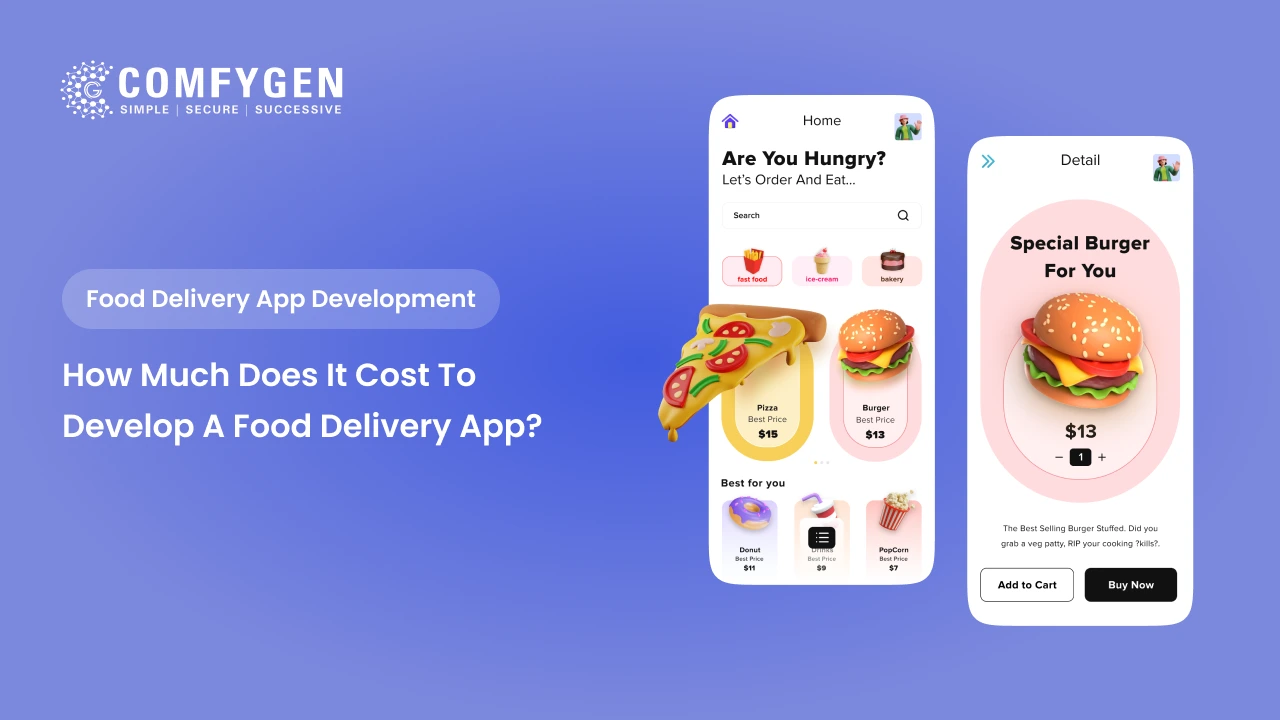





Food delivery app development cost runs $15,000 to $50,000 or more. A white-label launch costs $15,000 to $25,000 and goes live in 2 to 4 weeks. A custom MVP costs $25,000 to $50,000 over 8 to 12 weeks. A full multi-vendor marketplace with AI features starts around $50,000 and takes 16 to 24 weeks.
The number moves based on how many apps you build, whether you go native or cross-platform, and how much real-time infrastructure your model needs. This guide covers the full food delivery app development cost breakdown, including the expenses most founders find out about after they’ve already signed.
| Build type | What you get | Cost | Timeline |
| White-label launch | Pre-built customer, restaurant and driver apps, rebranded, plus admin dashboard | $15,000 to $25,000 | 2 to 4 weeks |
| Custom MVP | Four apps built to your model, live GPS tracking, multi-payment, admin panel | $25,000 to $50,000 | 8 to 12 weeks |
| Enterprise platform | Full multi-vendor marketplace, AI features, commission engine, multi-city | $50,000+ | 16 to 24 weeks |
Most first-time founders land in the first two bands. The enterprise figure applies when you’re running several cities or countries from launch.
Why food delivery app cost estimates vary so much
Search this question and you’ll get answers between $10,000 and $300,000. That spread isn’t dishonesty. It’s usually two different things being priced.
A working platform is four products, not one:
- A customer app for iOS and Android
- A restaurant app for accepting and managing orders
- A driver app for pickup, navigation and delivery
- A web admin panel for running the whole thing
A quote that covers only the customer app will look 60% cheaper than one covering all four. It isn’t cheaper. It’s incomplete. When you compare estimates, the first question is always how many panels are in scope.
The second reason is that some quotes price a from-scratch build while others price a pre-built platform being rebranded. Those are genuinely different products at genuinely different prices, which is why the tier table above separates them.
Turn Your Food Delivery Idea Into Reality
Discover the right development approach, budget, and technology to launch a scalable food delivery app successfully.
Get a Free Consultation
Food delivery app development cost breakdown by phase
This is what the development cost of a food delivery app looks like when you split a custom MVP by stage. Figures assume a cross-platform build with all four panels.
| Phase | Timeline | Cost |
| Discovery and planning | 1 to 2 weeks | $1,000 to $3,000 |
| UI/UX design and prototyping | 2 to 3 weeks | $3,000 to $7,000 |
| Customer app development | 3 to 4 weeks | $6,000 to $12,000 |
| Restaurant app development | 2 to 3 weeks | $4,000 to $8,000 |
| Driver app development | 2 to 3 weeks | $4,000 to $8,000 |
| Admin panel development | 2 to 3 weeks | $4,000 to $8,000 |
| QA and testing | 1 to 2 weeks | $2,000 to $5,000 |
| Deployment and launch | 1 week | $1,000 to $2,000 |
| Total | 8 to 12 weeks | $25,000 to $50,000 |
Phases overlap in practice. Design on the restaurant app happens while the customer app is being built, which is how a project totalling 14 weeks of work ships in 10.
Factors affecting food delivery app development cost
Number of panels
Covered above, and it’s the single biggest variable. Four apps is not twice the cost of two. It’s closer to three times, because each panel needs its own design, its own testing cycle and its own store submission.
Food delivery app UI-UX design cost
Design runs $3,000 to $7,000 for a custom MVP and covers wireframes, clickable prototypes and final screens for all four panels. It’s tempting to cut here, and it’s usually a mistake. Food ordering is a high-frequency, low-patience interaction. If a customer can’t find a dish and check out in under a minute, they go back to the app that lets them.
Approve designs before development starts. Changing a screen in Figma takes an hour. Changing it after it’s built takes a week, and that time comes straight out of your food delivery app development budget.
Food delivery app backend development
The backend is where order state lives, and it’s the part that decides whether your platform survives a dinner rush. It handles order routing between four parties, driver assignment, menu and stock sync, commission calculation and reporting.
Backend work is typically 35% to 45% of total build cost. Teams that have only built listing apps consistently underestimate it, because a food app’s backend has to hold a live, changing state rather than just serve records.
Food delivery app API integration
Every food platform depends on external services, and each one adds scope. The standard set covers maps and geocoding, SMS and push notifications, email, and analytics.
Using established APIs is almost always cheaper than building equivalents in-house, and they work better. The cost sits in the integration work and the ongoing usage billing, not in the licence.
Payment gateway integration
Payment gateway integration typically adds $1,500 to $4,000 depending on how many providers and payment methods you support. One gateway with cards and UPI sits at the low end. Multiple gateways, wallets, split payments to restaurants and cash on delivery all push it up.
Split payments are the part people underestimate. Paying a restaurant its share and a driver theirs from a single customer transaction is genuinely complex, and it’s worth scoping properly rather than discovering it mid-build.
GPS and real-time tracking
GPS and real-time tracking is the most expensive feature in any food app, at roughly $3,000 to $8,000. Driver location has to update every few seconds without draining a phone battery, and order status has to stay in sync across the customer app, restaurant app, driver app and admin panel at the same time.
Customers now treat live tracking as standard rather than a bonus, so this is one of the few advanced features that genuinely belongs in version one.
Native or cross-platform
React Native and Flutter build one codebase that runs on both iOS and Android. That cuts frontend cost by 30% to 40% against two separate native builds. Native still wins on very heavy animation or deep hardware access, but a food delivery app rarely needs either.
Where the team sits
Food delivery mobile app development cost varies widely by region:
| Region | Cost per hour |
| India and South Asia | $15 to $40 |
| Eastern Europe | $50 to $60 |
| UAE | $60 to $65 |
| Australia | $70 to $90 |
| Western Europe | $80 to $90 |
| United States | $95 to $105 |
The same build costs 60% to 70% less with an Indian team than a US one. The trade-off is that you have to vet more carefully, since quality varies more widely at the low end.
Add-on technology costs
These sit on top of the tiers above, not instead of them. Add them to your base number if you want the feature at launch.
| Feature | What it does | Cost |
| AI and machine learning | Personalised recommendations, smart search, demand forecasting | $4,000 to $15,000 |
| Real-time GPS tracking | Live order and driver tracking with predictive ETAs | $3,000 to $8,000 |
| Chatbot support | Automated answers for tracking, ETA, refund and cancellation queries | $2,000 to $6,000 |
| Voice ordering | Ordering through Alexa, Siri or Google Assistant | $5,000 to $12,000 |
| Augmented reality | Dish or restaurant visualisation | $8,000 to $20,000 |
| Predictive analytics | Reorder prompts and customer segmentation | $3,000 to $10,000 |
| Gamification | Points, badges, streaks and challenges | $2,000 to $7,000 |
Most of these belong in version two. Real-time tracking is the exception, since customers now treat it as standard rather than a bonus.
Food App Costs founders forget
Four items that show up after the build quote is signed:
- App store fees: Google charges $25 once. Apple charges $99 every year, forever.
- API usage: Google Maps, payment gateways and push notification services bill on volume. These start near zero and grow directly with your order count, which means they’re smallest exactly when you’re paying attention to them.
- POS partner approval: Some POS platforms require partner sign-off before they’ll open an API. That can add two to four weeks before a single line of integration code gets written.
- Maintenance: Budget 15% to 20% of build cost every year, permanently. Operating systems update, payment providers deprecate endpoints, and libraries need patching. This isn’t optional.
How to reduce your food delivery app development budget
Go cross-platform
Flutter or React Native cuts frontend cost 30% to 40% with almost no downside for this category of app.
Start white-label
If your model fits a pre-built platform, you go live in weeks for $15,000 and find out whether demand exists before spending $50,000.
Ship four panels, not forty features
A customer app, restaurant app, driver app and admin panel with basic ordering beats a customer app with AI recommendations and no way for the kitchen to accept orders.
Use existing APIs
Stripe or Razorpay for payments, Google Maps for location, Firebase for notifications. Building any of these yourself costs more and works worse.
Delay AI to version two
Recommendations and demand forecasting need order history to work. On day one you don’t have any, so you’re paying for a feature that can’t function yet.
Define scope in writing before quoting
Vague scope is the most expensive thing in software. Two vendors quoting different assumptions produces numbers you can’t compare and a project that runs over.
Build a Food Delivery App That Drives Growth
Partner with experienced developers to turn your concept into a powerful, user-friendly food delivery solution
Discuss Your App
White-label, custom or clone: which costs less
White-label is a tested platform rebranded as yours. Cheapest and fastest at $15,000 to $25,000 in 2 to 4 weeks. You control branding and layout but not the underlying structure.
Clone is a production-tested codebase modelled on a known platform like Zomato or DoorDash, then customised. Sits between the other two on both cost and flexibility. If you’re pricing this route specifically, the cost of building a Zomato-style platform covers what’s different about that model.
Custom is built from scratch around how your business actually runs. $25,000 to $50,000 over 8 to 12 weeks, with no structural limits.
All three should include full source code ownership. If a vendor won’t assign IP in the contract, that’s a reason to walk.
What Comfygen Food Delivery App Development Charges
Comfygen has delivered 550+ projects for 400+ clients across 30+ countries since 2019, with a 97% client retention rate. Pricing is published rather than quote-only, and it matches the tiers above: $15,000 to $25,000 white-label, $25,000 to $50,000 custom MVP, $50,000+ for a full multi-vendor platform.
Every build ships all four panels. Projects run in two-week sprints with a working demo at the end of each one, and full source code ownership transfers at delivery with no ongoing licence fee. Teams that want to price a custom food ordering platform against their own operating model usually start with a scoping call before anything gets built.
Frequently asked questions
How much does it cost to build a food delivery app?
How long does development take?
What are the main factors affecting food delivery app development cost?
How much does a food delivery app UI UX design cost?
Why do cost estimates online vary so widely?
What's the cheapest way to launch a food delivery app?
Do I own the source code?
How much does maintenance cost each year?
Does POS integration cost extra?
Is a food delivery app worth building in 2026?

Mr. Saddam Husen, (CTO)
Mr. Saddam Husen, CTO at Comfygen, is a renowned Blockchain expert and IT consultant with extensive experience in blockchain development, crypto wallets, DeFi, ICOs, and smart contracts. Passionate about digital transformation, he helps businesses harness blockchain technology’s potential, driving innovation and enhancing IT infrastructure for global success.