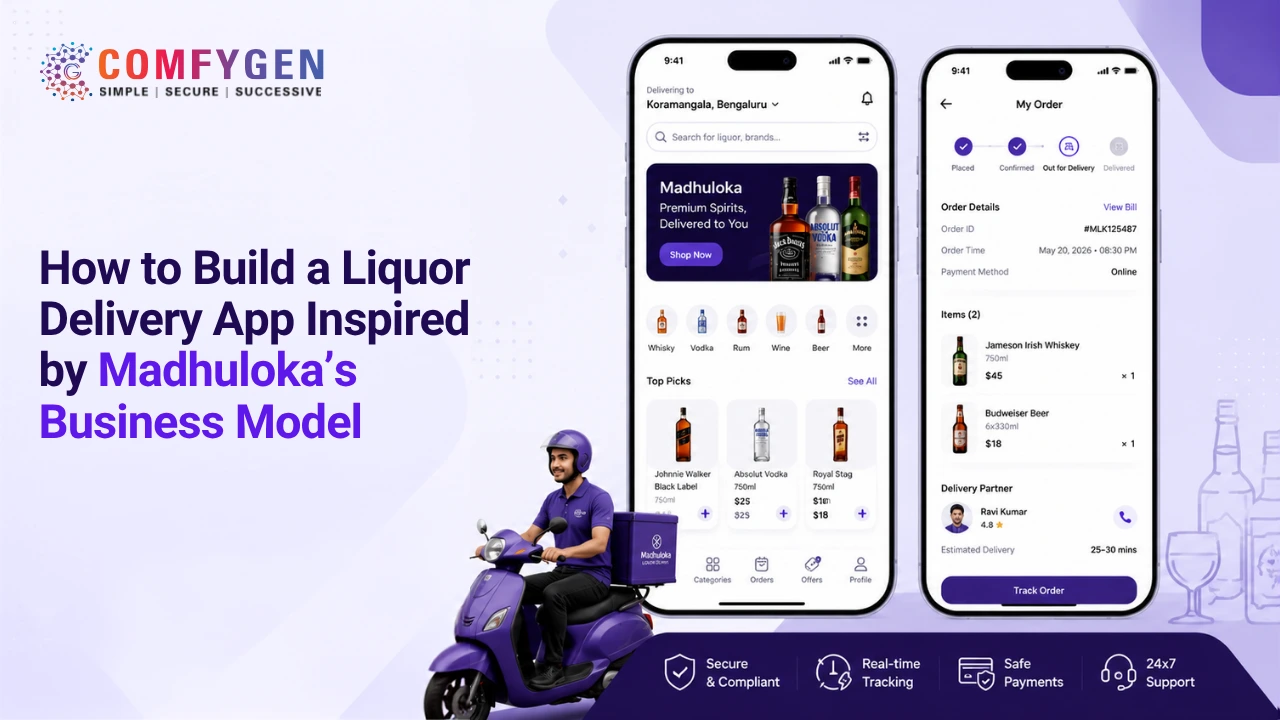





Building an alcohol delivery app on the Madhuloka model typically costs between $20,000 and $150,000 and takes 3 to 8 months, depending on how many features you need and whether you build custom or start with a white-label base. The bigger challenge isn’t the code. It’s building around India’s state-by-state liquor laws while still giving customers a fast, Zomato-style ordering experience.
This guide breaks down what Madhuloka does right, what features an app version needs, what it costs at each tier, and how long each phase takes.
What Is Madhuloka?
Madhuloka is a well-known liquor retail chain based in Karnataka, with a dense network of physical stores across Bengaluru. It doesn’t run as a dedicated mobile app. Its presence is a website plus phone or WhatsApp ordering, coordinated with its store network for delivery in the areas it serves. It’s not a pan-India delivery app in the way Swiggy or Zomato are national food platforms.
Its model is still worth studying if you’re building an app, though, because the delivery logic works by operating inside a single state’s excise framework instead of trying to solve alcohol delivery everywhere at once. That’s the part to copy: pick your state, understand its rules cold, then build the app around them. Turning that same model into a proper app, with real order tracking and in-app ID verification instead of a phone call, is the opportunity this guide is scoped around.
Alcohol Delivery Market Snapshot
The online alcohol delivery space is growing fast, both globally and in India. The global online alcohol delivery market is projected to surpass $173 billion by 2032, and demand keeps climbing as customers get used to ordering everything from groceries to medicine on demand. In India specifically, the shift toward app-based ordering plus rising urban disposable income is creating an opening for regional players who can navigate compliance well. The catch: this is one of the few on-demand categories where legal complexity matters more than feature count.
Legal and Licensing Requirements (Read This Before You Build Anything)
This is the section most “how to build an app like X” articles skip, and it’s the one that actually determines whether your app can operate.
Alcohol is a state subject under India’s Constitution, which means there’s no single national rulebook. Each state sets its own policy on sale, delivery, drinking age, and licensing, and the alcohol laws of India vary sharply as a result. A few things to know before you write a single line of code:
- Delivery legality varies by state. Karnataka permits licensed retailers to deliver. Delhi allows home delivery of beer and wine by private vendors. Tamil Nadu runs alcohol sales through TASMAC and doesn’t support mainstream third-party delivery apps. Bihar, Gujarat, Nagaland, Mizoram, and Lakshadweep are fully or largely dry.
- Legal drinking age isn’t uniform. It ranges from 18 in states like Goa and Rajasthan to 25 in Maharashtra for spirits and wine, according to a breakdown of drinking-age rules by state.
- You need a state excise license before you need a developer. Whatever tech stack you choose, it’s irrelevant if you don’t hold the retail and delivery licenses your state excise department requires.
- Age verification has to be real, not cosmetic. A checkbox that says “I’m 21+” isn’t verification. You need ID capture at checkout and ID confirmation at the doorstep, since the person receiving the order has to prove their age at delivery, not just at signup.
If you’re building for a single state like Madhuloka does, budget real time for a compliance consultation with an excise lawyer before development starts. It’s cheaper to fix scope on paper than to rebuild a shipped app because a feature violates state rules.
Must-Have Features
An alcohol delivery app is really three apps working together: what the customer sees, what the delivery agent sees, and what your team uses to run the business.
Customer app
- Account registration with mandatory age and ID verification
- Product catalog with category browsing (beer, wine, spirits) and search
- Real-time order tracking once the order is out for delivery
- Multiple payment options (UPI, cards, wallets, cash on delivery where legal)
- Delivery time slot selection
- Order history and reordering
- Ratings and reviews
Delivery partner app
- Order assignment and route display
- ID scan or photo capture at the doorstep as delivery proof
- Earnings and payout dashboard
- Delivery status updates (picked up, en route, delivered)
Admin panel
- Inventory and stock management by store or warehouse
- License and compliance tracking (renewal dates, delivery-zone restrictions)
- Order and delivery analytics
- Delivery zone management, since your legal delivery radius may not match your customer demand map
Tech Stack
| Layer | Common choice |
| Frontend (customer + delivery apps) | Flutter or React Native (single codebase for iOS and Android) |
| Backend | Node.js or Laravel |
| Database | PostgreSQL or MySQL |
| Payments | Razorpay or Stripe |
| Maps and tracking | Google Maps Platform |
| Notifications | Firebase Cloud Messaging |
Cross-platform frameworks like Flutter cut mobile development time by roughly 30-40% compared to building separate native iOS and Android apps, which matters more here than in most app categories since you’re already funding three separate interfaces.
Development Process and Timeline
- Discovery and compliance mapping (2-4 weeks). Define your state, confirm licensing requirements, and lock your MVP feature list around what’s actually legal to build.
- UI/UX design (3-5 weeks). Wireframes and interface design for all three apps.
- MVP development (8-14 weeks). Core ordering, ID verification, payments, and tracking.
- Compliance and payment integration testing (2-3 weeks). This is where age-verification and licensing logic get stress-tested, not just the payment gateway.
- QA and testing (3-4 weeks). Functional testing, security testing, and device compatibility.
- Launch and post-launch support (ongoing). App store deployment plus monitoring, bug fixes, and updates.
Total timeline for a single-state MVP: roughly 3 to 5 months. A multi-state or multi-city build with more advanced features can run 6 to 9 months.
Cost Breakdown
| Tier | What’s included | Estimated cost |
| White-label | Pre-built core, rebranded, fast launch | $15,000 – $30,000 |
| Custom MVP | Ordering, ID verification, tracking, payments, single state | $25,000 – $60,000 |
| Mid-range | Multi-store inventory, loyalty program, advanced admin panel | $60,000 – $100,000 |
| Full-featured | Multi-state compliance logic, AI-based demand forecasting, advanced analytics | $100,000 – $150,000+ |
Team location changes these numbers significantly. Developers in India typically charge $20-$45 an hour compared to $100-$200 an hour in the US, which is why most alcohol delivery apps, including many built for US and UK brands, are developed by Indian teams without a drop in build quality.
Common Challenges
- Regulatory fragmentation. What’s legal in Karnataka may be illegal in Tamil Nadu. A multi-state launch means multiple parallel compliance tracks, not one ruleset applied everywhere.
- Age verification fraud. Fake IDs and shared accounts are a real risk category unique to this vertical, so verification needs to happen at both signup and doorstep.
- Delivery logistics for a restricted product. Delivery agents need training on ID checks and refusal protocols, which most food or grocery delivery apps never have to think about.
- Advertising restrictions. Direct alcohol advertising is restricted in India, which limits how you can market the app once it’s live.
Why Work With Comfygen
Comfygen has built on-demand delivery app development solutions across grocery, medicine, and quick commerce, along with dedicated alcohol delivery app development work for liquor retailers looking to launch apps inspired by platforms like Madhuloka, Drizly, and Saucey. That cross-vertical experience with compliance-heavy, real-time delivery apps is exactly what this category needs.
FAQ
Is alcohol delivery legal in India?
How much does it cost to build an alcohol delivery app on the Madhuloka model?
Does Madhuloka have its own app?
How long does it take to build an app on the Madhuloka model?
What features are required for age verification compliance?
Can I add alcohol delivery to an existing on-demand app?

Mr. Saddam Husen, (CTO)
Mr. Saddam Husen, CTO at Comfygen, is a renowned Blockchain expert and IT consultant with extensive experience in blockchain development, crypto wallets, DeFi, ICOs, and smart contracts. Passionate about digital transformation, he helps businesses harness blockchain technology’s potential, driving innovation and enhancing IT infrastructure for global success.