




Quick answer: Cloud kitchen management software development costs $20,000 to $250,000 and takes 3 to 7 months. It pulls orders from Swiggy, Zomato, Uber Eats, Deliveroo and your own channels into one dashboard, then automates kitchen display routing, inventory deduction, dispatch and analytics. Before it can go live, you need FSSAI registration in India or an FSA-rated kitchen in the UK.
A cloud kitchen operator we worked with last quarter was running four brands out of one 900-square-foot space, taking orders from six tablets duct-taped to a shelf above the pass. Every ticket got copied by hand onto a paper docket. On a Friday night, that isn’t a workflow. It’s a countdown to a mistake.
That’s the practical reason cloud kitchen management software has stopped being an upgrade and started being infrastructure.
Key Takeaways
- A cloud kitchen management system replaces the tablet farm with one dashboard covering orders, inventory, kitchen display and analytics.
- Build cost runs $20,000 for an MVP to $250,000 for multi-brand enterprise, with most serious operators landing between $50,000 and $130,000.
- FSSAI licensing is mandatory in India before any aggregator will onboard you, and one license covers all brands at a single kitchen address.
- ONDC charges roughly 3–5% commission against 18–28% on Swiggy and Zomato, which makes it worth building in rather than adding later.
- UK and London kitchens need a 4- or 5-star FSA hygiene rating for programs like Deliveroo Editions, plus allergen display built into the menu module.
- India-based development runs $25–$60 an hour against $80–$180 in the US and Western Europe.
What is Cloud Kitchen Management Software?
delivery apps, inventory tracking, kitchen display routing and analytics into one dashboard. It removes the manual coordination that breaks down as soon as a kitchen runs more than one brand.
You’ll see it called a cloud kitchen management system, ghost kitchen management software, a virtual kitchen management system, or just CKMS. Same product.
The four things it has to do:
- Unified order aggregation: Every platform, one queue.
- Kitchen display system (KDS): Digital tickets, station routing, prep tracking.
- Real-time inventory: Stock levels, low-stock alerts, waste tracking.
- Analytics and reporting: Sales trends, peak hours, menu performance, per-dish cost.
Rebel Foods runs 45+ brands across 300+ locations on this category of software. That scale is only possible because the coordination is automated rather than managed by people watching screens.
How Does a Cloud Kitchen Order Management System Work?
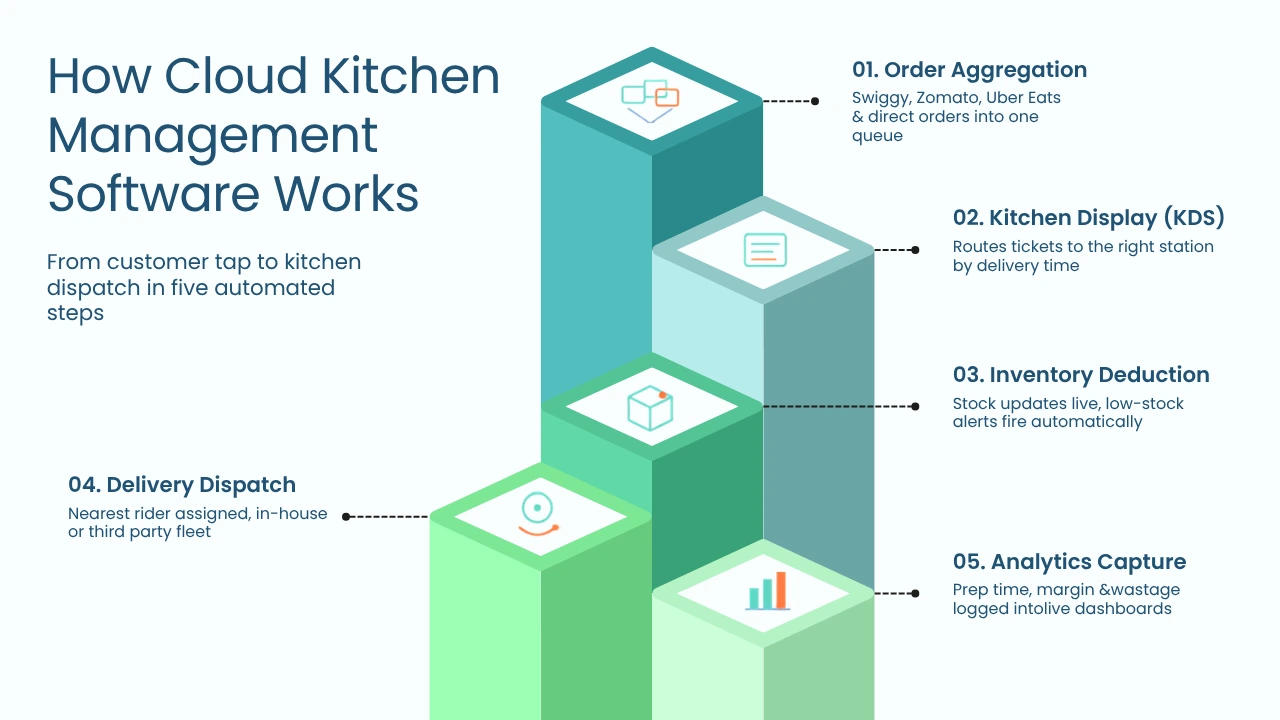
Most first-time buyers picture it as an app that shows orders. It’s closer to a relay race with five handoffs, each automated so nothing gets dropped mid-rush.
Order Aggregation
A customer orders through Swiggy, Zomato, Uber Eats, Deliveroo or your own site. The software pulls all of these into one normalized queue rather than five separate tablet screens.
Kitchen Display System (KDS)
The order routes to the correct station (grill, fryer, packing) with a digital ticket, sequenced by promised delivery time rather than arrival order.
Inventory Deduction
As the dish is prepared, ingredient quantities come off stock automatically, triggering low-stock alerts and updating cost of goods sold per dish in real time.
Delivery Dispatch
Once packed, the system assigns the order to the nearest available rider, in-house or third-party, and tracks the last mile.
Analytics Capture
Prep time, delivery time, wastage and margin all get logged and rolled into dashboards covering every brand and location.
Skip one link in this chain and the whole thing drops back to manual coordination.
Types of Cloud Kitchen Software
The right starting point depends on how many brands and locations you run today, and how fast that number is likely to change.
Single-Brand Cloud Kitchen Software
Built for one food brand operating from a single location. Lean feature set: order management, inventory, and basic reporting.
Multi-Brand Cloud Kitchen Management System
Several virtual brands under one roof, sharing ingredient inventory but with separate menus, pricing and packaging per concept.
Franchise-Based Cloud Kitchen Software
Centralized control across franchise locations, with standardized recipes and portion sizes enforced from one admin panel.
White-Label Cloud Kitchen Software
A pre-built base you brand as your own, with the option to move to custom development once volume justifies it.
Launch Your Cloud Kitchen Software with Expert Development
Partner with experienced developers to create compliant, scalable software that streamlines operations and boosts restaurant profitability.
Start Your Project
Why Operators Are Investing in Cloud Kitchen Software
Three forces are pushing operators toward dedicated software rather than spreadsheets and tablets:
Order Volume is Compounding
The global cloud kitchen market was valued at roughly $80 billion in 2025 and is on track to cross $200 billion by 2033, growing at around 12.6% CAGR, according to Grand View Research. Asia Pacific holds close to half of that.
Fortune Business Insights projects the India cloud kitchen market alone to reach roughly $2.9 billion in 2026, growing at a CAGR near 14.6%, faster than the global average.
Aggregator Commissions Keep Climbing
Swiggy and Zomato commissions in 2026 typically run 18–28% per order once payment gateway charges, platform fees and mandatory discounts are added in. That pushes serious operators toward cost control through software rather than accepting thinner margins.
Multi-brand Operations Are The Default, Not The Exception
Running 5–20 virtual brands from one physical kitchen is now a standard growth strategy, and it’s unmanageable without a shared inventory and order layer underneath.
Quick Commerce is Blurring The Lines
As quick commerce app development reshapes delivery expectations across food and grocery, cloud kitchens face the same pressure to shrink prep-to-dispatch time.
Must-Have Features to Build a Custom Cloud Kitchen Management Software
Uber Eats, DoorDash, Zomato, Swiggy and Talabat all rely on this category of backend software to keep partner kitchens synchronized. A serious build needs:
| Feature | What it does |
| Unified order dashboard | Aggregates Swiggy, Zomato, Uber Eats, Deliveroo and direct orders into one view |
| Kitchen display system | Digital tickets with automatic station routing and prep-time sequencing |
| Inventory and recipe management | Real-time stock tracking, ingredient-level deduction, low-stock alerts |
| Multi-brand management | Separate menus, pricing and packaging per brand with shared inventory |
| CRM and customer feedback | Ratings, repeat-order behavior, loyalty data per customer |
| Delivery and fleet integration | Assigns in-house or third-party riders, tracks last-mile status live |
| Billing and accounting sync | Automates GST, settlements and reconciliation without spreadsheet exports |
| Analytics dashboard | Sales trends, peak hours, menu performance, per-dish cost analysis |
| AI demand forecasting | Predicts next-day order volume using history, weather and local events |
| Dynamic pricing engine | Adjusts pricing during peak or slow hours to protect margins |
| IoT integration | Automated temperature monitoring and equipment-health alerts |
| Automated vendor reordering | Triggers purchase orders before ingredients run out |
Third-Party Integrations You’ll Need
- Aggregators: Swiggy, Zomato, Uber Eats, Deliveroo, Just Eat, ONDC-enabled buyer apps
- Payment gateways: UPI via PhonePe or GPay, Razorpay, Stripe, PayU
- Accounting: QuickBooks, Zoho Books, Tally
How to Create Cloud Kitchen Management Software: The Process
Know the cloud kitchen management software development process that will help in planning for the timelines, budget, launch, and realistic expectations.
Discovery & Planning
Development begins with understanding how the kitchen actually runs: where orders come from, what causes delays, where waste happens. Competitive analysis and a written project roadmap come out of this stage. Vague scope is the most expensive problem in software and this is the one point where fixing it is free.
UI/UX Design
Kitchen staff use this during a rush, often with wet hands and no time to read. The interface has to work at a glance: large touch targets, high contrast, order status readable from two feet away. Design that looks elegant in a portfolio and fails on a Friday night is the most common expensive mistake in this category.
Approve clickable prototypes before development starts. Changing a screen in Figma takes an hour. Changing it after it’s built takes a week.
Development
Backend APIs, frontend dashboards, kitchen display interfaces, and mobile apps for staff or riders where needed. Sprints run in two-week cycles with a working demo at the end of each, so progress stays visible rather than promised.
Integrations
This stage connects the software to Swiggy, Zomato, Deliveroo, Talabat, Herfy, payment gateways, accounting tools and kitchen hardware. Each aggregator has its own rate limits, webhook behavior and documentation gaps, which is why integration work is consistently underestimated.
Testing & QA
Peak-hour load simulation, every user scenario, and security audits. Lunch and dinner rushes are the only traffic patterns that matter, so testing happens against those rather than average load.
Deployment & Training
Cloud infrastructure setup, production deployment, staff training and complete documentation handover.
Technology Stack for Cloud Kitchen Platform Development
The stack determines how the platform handles peak load and how easily it scales to new brands or cities.
| Layer | Tech and tools |
| Frontend (web and dashboard) | React, Vue.js, Angular |
| Mobile app stack | Flutter, React Native |
| Backend | Node.js, Python (Django, Flask), Java |
| Database and storage | PostgreSQL, MySQL, MongoDB, Redis |
| Cloud hosting and DevOps | AWS, Azure, Google Cloud, Docker, Kubernetes |
| Third-party integrations | Swiggy/Zomato APIs, payment gateways, SMS and email |
Redis is worth calling out. It’s what keeps order-status updates instant during a 300-order Friday rush instead of lagging by a few seconds, which is exactly when a kitchen can least afford it.
Transform Your Cloud Kitchen into a Technology-Driven Success
Empower your business with intelligent software built for seamless management, faster deliveries, and long-term scalability today.
Schedule a Consultation
Cloud Kitchen Management Software Development Cost
Cloud kitchen management software development costs $20,000 to $250,000+, depending on complexity, integrations and platform choice.
| Tier | What’s included | Cost |
| MVP / Basic | Core ordering, single-brand support, basic inventory, simple analytics | $20,000 – $50,000 |
| Standard | Multi-brand support, aggregator integrations, KDS, advanced analytics | $50,000 – $130,000 |
| Enterprise | AI forecasting, IoT monitoring, multi-location, franchise management, fleet integration | $130,000 – $250,000+ |
These figures sit above standard food delivery app development, and the difference is real rather than a markup. A delivery app moves orders between four parties. Cloud kitchen software has to reconcile live inventory across several brands sharing one stockroom, hold open connections to multiple aggregator APIs with their own rate limits, and route tickets to physical kitchen stations. If a marketplace is what you actually need, the food delivery app development cost breakdown covers the simpler build.
What Moves the Price
Number of Integrations
Every aggregator, payment gateway and accounting tool adds API work, testing and ongoing maintenance. A build with three integrations costs meaningfully less than one connecting to ten or more, including ONDC buyer apps.
Platform Choice
Web-only dashboards stretch a budget further than native mobile apps alongside them. Cross-platform frameworks like Flutter or React Native lower cloud kitchen app development costs, though high-volume mobile use still performs better native.
UI/UX Depth
A functional dashboard costs less than a fully branded one, but the branded version tends to pay for itself in fewer training hours and fewer order-entry mistakes.
Scalability Architecture
Single-location software uses a simpler architecture. Multi-location, multi-brand systems need distributed databases and load balancing, adding 30–50% to development cost and being essential for growth.
Team location
| Region | Hourly rate |
| US and Western Europe | $80 – $180 |
| Eastern Europe | $40 – $90 |
| India and South Asia | $25 – $60 |
The same build can vary by two to three times on region alone, which matters a great deal across a four to seven month project.
AI integration
Demand forecasting or dynamic pricing on top of the MVP tier increases cost, but it’s usually the highest-return addition for kitchens running more than one brand.
Ongoing Costs After Launch
- Cloud hosting and storage: roughly $200–$1,500 per month depending on order volume
- Maintenance and version updates: typically 15–20% of initial build cost per year
- API and aggregator fees: payment gateways, delivery tracking, notification services
- Compliance renewals: annual FSSAI renewal in India, or FSA hygiene re-inspection in the UK
White-Label or Custom?
A white-label platform launches faster and costs less upfront, but customization is limited and scaling past a certain order volume often means hitting a ceiling the vendor controls. Custom cloud kitchen management software costs more initially and gives full control over data, integrations and the exact workflow your kitchen runs. That control tends to matter once you’re operating more than two or three brands.
How Long Does It Take to Build?
| Tier | Timeline |
| MVP / Basic | 3 – 4 months |
| Standard | 4 – 6 months |
| Enterprise | 6 – 7 months |
Phases overlap. Design on the inventory module runs while the order dashboard is being built.
Need a Custom Cloud Kitchen Management Solution?
Partner with experienced developers to build scalable software tailored for operational excellence and exceptional customer experiences.
Request a Free Consultation
India Compliance: FSSAI Licensing and ONDC
This is the section most cloud kitchen software guides skip entirely, and it’s usually what stalls a launch rather than the software.
FSSAI Licensing Tiers
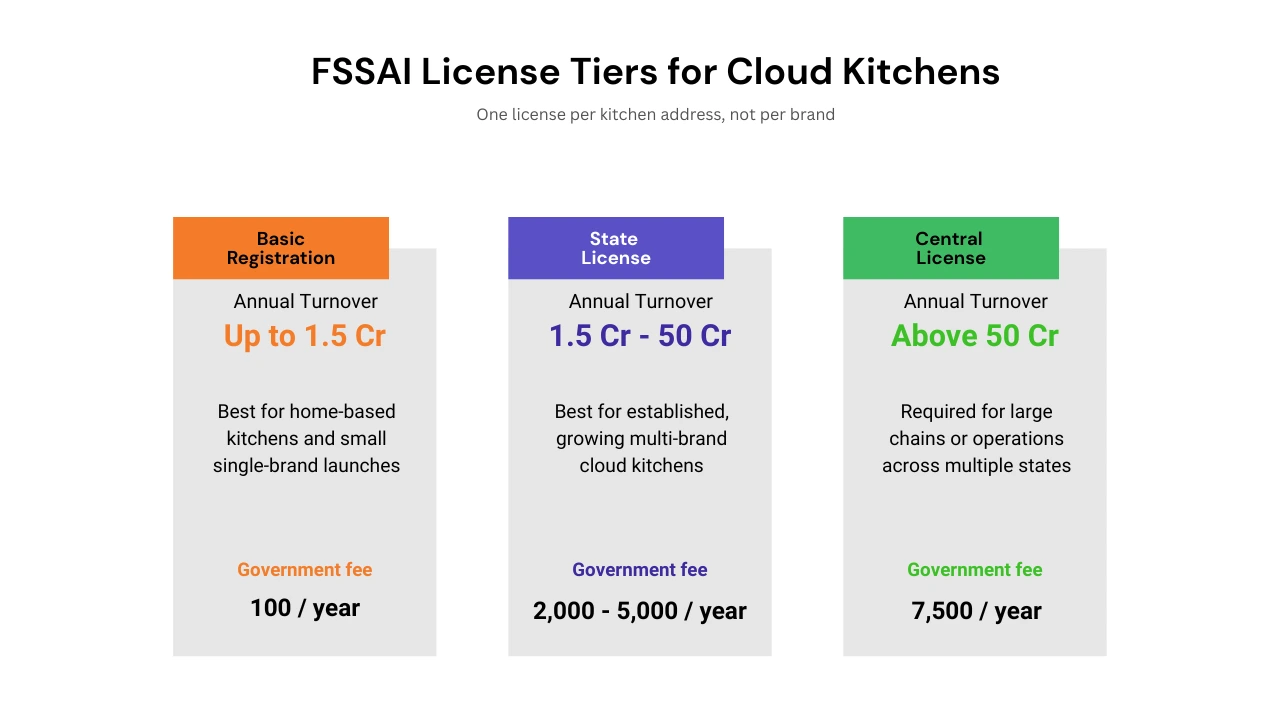
Every cloud kitchen in India is legally a food business under the Food Safety and Standards Act and needs one of three FSSAI tiers before onboarding onto Swiggy or Zomato, since both reject applications without a valid FSSAI number.
| Tier | Annual turnover | Best for |
| Basic Registration | Up to ₹1.5 crore | Home-based kitchens, single small-brand operations |
| State License | ₹1.5 crore – ₹50 crore | Established, growing cloud kitchen businesses |
| Central License | Above ₹50 crore or multi-state | Large cloud kitchen chains |
Confirm current thresholds on the FSSAI portal before applying, since turnover bands have been revised before.
Why This Matters for the Software
A cloud kitchen management system should store and surface FSSAI numbers, GST details and trade license data per kitchen location, because aggregators validate these during onboarding and re-verification. Building it into the admin panel from day one avoids a scramble when you open a second or third location.
ONDC Integration
The Open Network for Digital Commerce charges roughly 3–5% commission against the 18–28% typical of Swiggy and Zomato once platform fees and mandatory discounts are counted. Brands including Rebel Foods and Domino’s are already active on the network.
Any cloud kitchen management software built in 2026 should treat ONDC as a first-class integration rather than a bolt-on. The margin difference is too large to leave for later.
Cloud Kitchen Management Software Development for London and the UK
Comfygen builds cloud kitchen software well beyond India, and London is one of the more active markets. The compliance context there is different enough to handle separately.
In the UK, delivery-only kitchens are recognized as technology-enabled commercial kitchens operating primarily for delivery, and roughly one in seven food businesses on major delivery platforms in England now fits that description.
Aggregators set a higher bar than many operators expect. Deliveroo requires kitchens in its Editions program to hold a 4- or 5-star Food Hygiene Rating from the Food Standards Agency before onboarding.
For software built for the London market, three things follow:
Allergen and calorie display belongs in the menu module, not patched on later, since FSA guidance increasingly expects this at the point of sale.
Shared kitchen zoning matters for multi-brand hubs. The software should support separate stock and prep logging per brand to keep cross-contamination risk and hygiene records clean for each one.
Hygiene rating visibility belongs in the operator dashboard. A dropping score on a shared site affects every brand operating from that address, so it needs to be visible before it becomes a delisting.
If you’re scaling a delivery kitchen brand in London or elsewhere in the UK, this is the kind of compliance-aware architecture that should be built in from the start rather than retrofitted after an inspection.
Common Cloud Kitchen Software Challenges
| Challenge | What goes wrong | Solution |
| Multi-brand operations | Ingredient usage, staffing and order routing compete for the same resources | Unified backend allocating capacity dynamically across brands based on real-time demand |
| Order synchronization | Inconsistent timestamps, duplicates, missing entries when a connection drops | Middleware merging every channel into one queue with normalized timestamps |
| Inventory and wastage | Overestimating spoils stock, underestimating causes failed orders | AI-augmented demand prediction using order history, seasonal patterns and live signals |
| Quality control across sites | Deviations in ingredient ratios or cook times erode brand trust | Standardized digital recipes and portion specs with centralized version control |
| Delivery and dispatch | Traffic and rider availability erase the speed advantage | Dynamic routing factoring live traffic and prep time, reassigning mid-journey |
| Data fragmentation | POS, delivery dashboards, vendor portals and CRM in silos hide margin leakage | Unified analytics layer ingesting every feed into one dashboard |
Technology Trends Worth Building For
AI Demand Forecasting
Weather, peak hours, order history, repeat-customer patterns and local events combine to forecast next-day demand, letting kitchens pre-prep and staff correctly instead of guessing.
IoT Equipment Monitoring
Connected sensors track freezer temperatures and equipment health continuously, catching problems before they become spoiled inventory or a failed inspection.
Kitchen Automation and Robotics
Robots handle chopping, frying and repetitive prep with consistent precision, pushing more orders through without adding headcount.
Cloud-Based Multi-Location Sync
Menu, pricing and recipe updates made once reflect everywhere instantly. Past three or four locations, manual updates stop working.
Sustainability Analytics
Food waste, energy use and packaging impact tracked automatically, cutting operating cost while building a brand customers respond to.
ONDC-First Architecture
For India, treating ONDC as native rather than a bolt-on is quickly becoming standard.
Why Brands Choose Comfygen
Most agencies quoting on this work price the software. The part they leave out is the layer that decides whether you can actually launch: FSSAI tiers and license data stored per location, ONDC treated as a real integration, allergen fields in the menu module for UK kitchens, and hygiene rating visibility for shared London sites.
Comfygen builds both halves. Since 2019 that has produced 550+ projects for 400+ clients across 30+ countries, with a 97% client retention rate.
What that looks like on a cloud kitchen project:
- Aggregator integration experience: Swiggy, Zomato, Uber Eats and Deliveroo across multi-brand builds, including the rate limits and webhook quirks that aren’t in the documentation.
- Compliance-aware architecture: FSSAI-ready admin panels for India, FSA-conscious menu and hygiene modules for UK and London operators, built in from day one.
- A genuine cost advantage: India-based development at $25–$60 an hour against $80–$180 in the US and Western Europe, at the same architecture standards.
- Sprint-based delivery: A dedicated project manager and a working demo every two weeks, so you see the software evolve rather than waiting for a reveal.
- Post-launch support: 90 days of complimentary support after launch, with maintenance packages that keep pace with aggregator API changes and new compliance requirements.
Pricing a cloud kitchen build against your own operation, rather than a template, starts with a scoping call. If you also need a customer-facing ordering app alongside it, food delivery app development covers that side.
Frequently Asked Questions
How much does cloud kitchen management software development cost?
How long does it take to build?
What license do I need to run a cloud kitchen in India?
Does one FSSAI license cover multiple virtual brands?
What is ONDC and should my software integrate with it?
Can you build cloud kitchen management software for London operators?
What hygiene rating do UK delivery kitchens need?
What ongoing costs should I budget after launch?
Should I build custom or use white-label cloud kitchen software?
How do I choose a cloud kitchen software development company?

Mr. Saddam Husen, (CTO)
Mr. Saddam Husen, CTO at Comfygen, is a renowned Blockchain expert and IT consultant with extensive experience in blockchain development, crypto wallets, DeFi, ICOs, and smart contracts. Passionate about digital transformation, he helps businesses harness blockchain technology’s potential, driving innovation and enhancing IT infrastructure for global success.