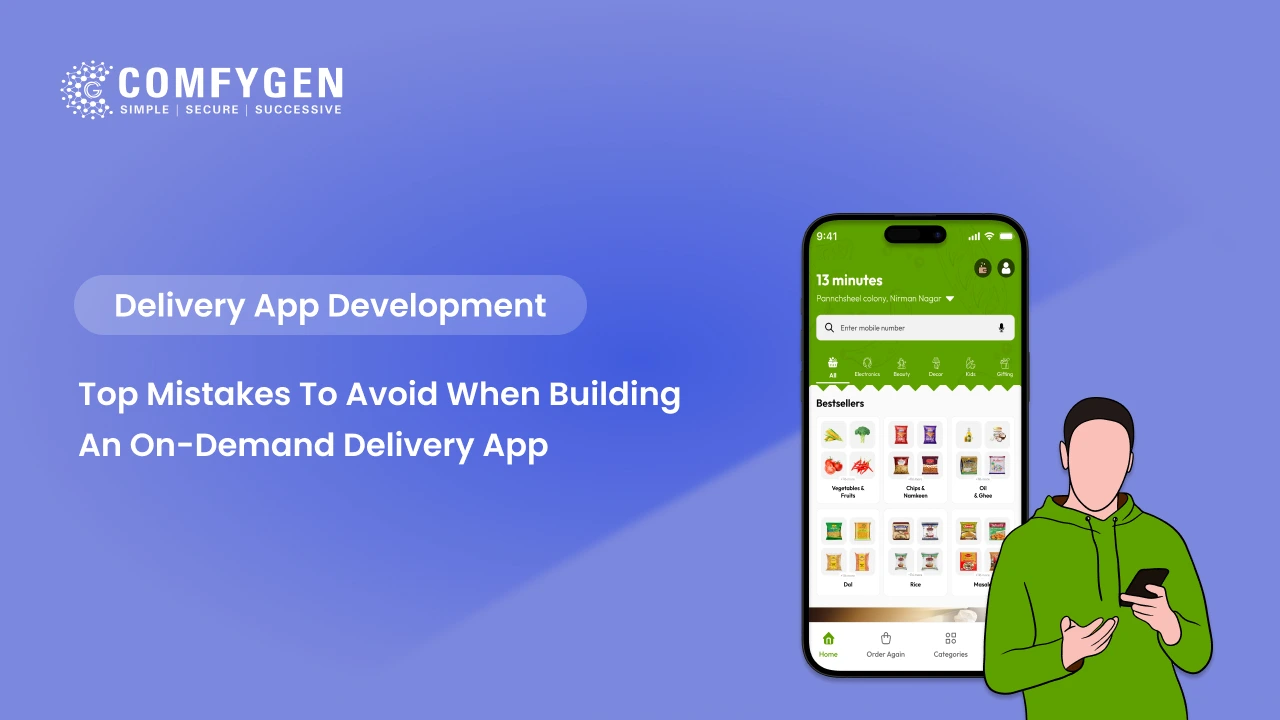





Most delivery apps fail for the same four reasons: too many features at launch, too few vendors, riders who are not paid enough to stay, and no plan for what happens when an order goes wrong. Fixing these before you build costs almost nothing. Fixing them after launch costs weeks of development and, worse, the customers who already tried your app once.
Below, you will find 15 mistakes grouped by stage, with what each one looks like in real use and what it costs to fix later.
Planning Mistakes in Delivery App Development
1. Launching Your Delivery App Citywide Too Soon
However, covering a whole city on day one spreads your riders thin, so delivery times slip everywhere at once.
How you will know: Average delivery time above your promise in most areas, and riders driving long distances between orders.
The fix: Launch in one zone, hit your delivery-time target consistently, then expand outward.
2. Signing Up Customers Before Delivery Vendors
Customers open an app, see four restaurants and never come back. Moreover, vendor supply takes months to build, so you cannot rush it after launch.
How you will know: Sign-ups look fine, but first-order conversion is low.
The fix: Sign vendors before development finishes. For a food marketplace, 20 to 50 restaurants in one zone is a common starting point.
3. Copying a Big Delivery App’s Feature List
For example, Swiggy, Talabat and DoorDash have hundreds of engineers and years of data. Copying their full feature set triples your build and delays your launch by months.
Cost of the mistake: Easily $20,000 to $40,000 of extra development on features nobody uses in year one.
The fix: Build the core order loop first, then add features your own data asks for.
4. Skipping the Manual Demand Test
Meanwhile, plenty of founders build an app before proving that anyone wants the service.
The fix: Take orders by phone or WhatsApp for a month first. If you cannot get 50 to 100 real orders manually, the app will not create demand on its own.
5. Choosing the Wrong Delivery Business Model
Running an aggregator when you hold your own stock creates work that does not match your business. Similarly, a single-brand app struggles when you carry no inventory.
The fix: Compare the aggregator, single-brand and hybrid options against your supply and budget before you write a feature list. The trade-offs between delivery app business models decide your commissions, your team and your app structure.
Delivery App Build Mistakes to Avoid
6. Treating the Delivery Rider App as an Afterthought
The rider app decides your delivery times. Nevertheless, it usually gets the least design attention.
How you will know: Riders keep calling dispatch, miss order alerts, or use WhatsApp instead of the app.
The fix: Design for one-handed use, loud repeating alerts, big buttons and a clear next action. Test it on the cheap Android phones your riders actually own.
7. Building a Rider App With No Offline Mode
Basements, lifts and rural roads all drop the signal. As a result, delivery records disappear without offline support.
Cost of the mistake: Lost proof of delivery leads to refund disputes you cannot win.
The fix: Queue actions locally and sync when the signal returns.
8. Ignoring Failure Cases in the Order Flow
Most teams build only for the happy path. Then a store rejects a paid order, an item goes out of stock, or nobody accepts a delivery.
The fix: Write down every failure case before development, decide who pays in each one, and test them all before launch. The full order-state list sits in the delivery app launch checklist.
9. Adding Role-Based Access Too Late
Unfortunately, retro-fitting permissions for admins, zone managers, dispatchers and support agents touches every screen.
Cost of the mistake: Weeks of rework, plus security gaps while staff share one login.
The fix: Plan roles and permissions in the first design sprint.
10. Buying AI Before Your Delivery App Has Data
Machine-learning ETAs and demand forecasts need order history to learn from. Buying them at launch means paying for a model with nothing to learn from.
The fix: Launch with a maps API and simple rules, log every order timestamp, then add models once you have a few thousand completed orders. The realistic order for adding AI features to a delivery app is staged over a year, not switched on at launch.
Delivery App Launch Mistakes
11. Skipping the Soft Launch
In addition, opening to your whole market at once means every problem hits every customer, and those customers are the hardest to win back.
The fix: Run live orders with a small group in one zone for two to four weeks first.
12. Running Uncapped Launch Offers
“50% off, no limit” attracts coupon hunters and one-time users, and a few will farm free accounts.
Cost of the mistake: Thousands of dollars in discounts with almost no repeat orders.
The fix: Cap the discount amount, limit one first-order coupon per phone number and device, and pay referral rewards only after a completed order.
13. Underpaying Delivery Riders
Rider pay set too low looks efficient in a spreadsheet. In practice, however, it fails quickly. Riders leave for better-paying platforms, and your delivery times collapse during peak hours.
How you will know: Orders sitting unassigned at dinner time, and high rider churn in the first month.
The fix: Check local rates before launch and budget peak-hour incentives.
Growth Mistakes That Make Delivery Apps Fail
14. Pricing That Loses Money on Every Delivery
When delivery fees do not cover rider cost and distance, growth simply makes the losses bigger.
The fix: Work out your contribution per order before scaling: average order value, minus rider pay, payment fees and discount cost. Adjust delivery fees, minimum order values and commissions until each order contributes something.
15. Planning No Maintenance Budget for Your App
Apps break whenever Android and iOS update, map APIs change pricing, or payment gateways update their SDKs.
Cost of the mistake: An app that stops working on new phones, with no budget to fix it.
The fix: Budget 15% to 20% of the build cost every year for maintenance, and plan an update every two to three months. That cost belongs in your first budget, alongside the development cost itself.
Pre-Launch Checklist to Avoid These Delivery App Mistakes
Finally, run through this list before you go live:
- One zone chosen, with delivery-time targets agreed
- Enough vendors signed for real customer choice
- Riders recruited, trained and paid at market rates
- Every failure case tested, including refunds
- Offline mode tested in weak-signal areas
- Roles and permissions in place
- Launch offers capped and abuse rules set
- Contribution per order calculated
- Maintenance budget approved
How Comfygen Avoids These Delivery App Development Mistakes
Comfygen’s delivery projects start with a scoping session that maps the order flow, the failure cases and the supply plan before any code is written. Since 2019, the team has delivered 550+ projects for 400+ clients in 30+ countries, with 97% client retention, across food, grocery, medicine, courier and multi-service delivery apps. If you are planning a launch, you can walk through your order flow with the team before before you commit to a build, ensuring your delivery app development process is aligned with your business goals..
Frequently Asked Questions
What is the biggest mistake in delivery app development?
Why do delivery apps fail?
How can I avoid delivery app development mistakes?
How much does it cost to fix mistakes after launch?
Should I launch a delivery app with all features?

Mr. Saddam Husen, (CTO)
Mr. Saddam Husen, CTO at Comfygen, is a renowned Blockchain expert and IT consultant with extensive experience in blockchain development, crypto wallets, DeFi, ICOs, and smart contracts. Passionate about digital transformation, he helps businesses harness blockchain technology’s potential, driving innovation and enhancing IT infrastructure for global success.