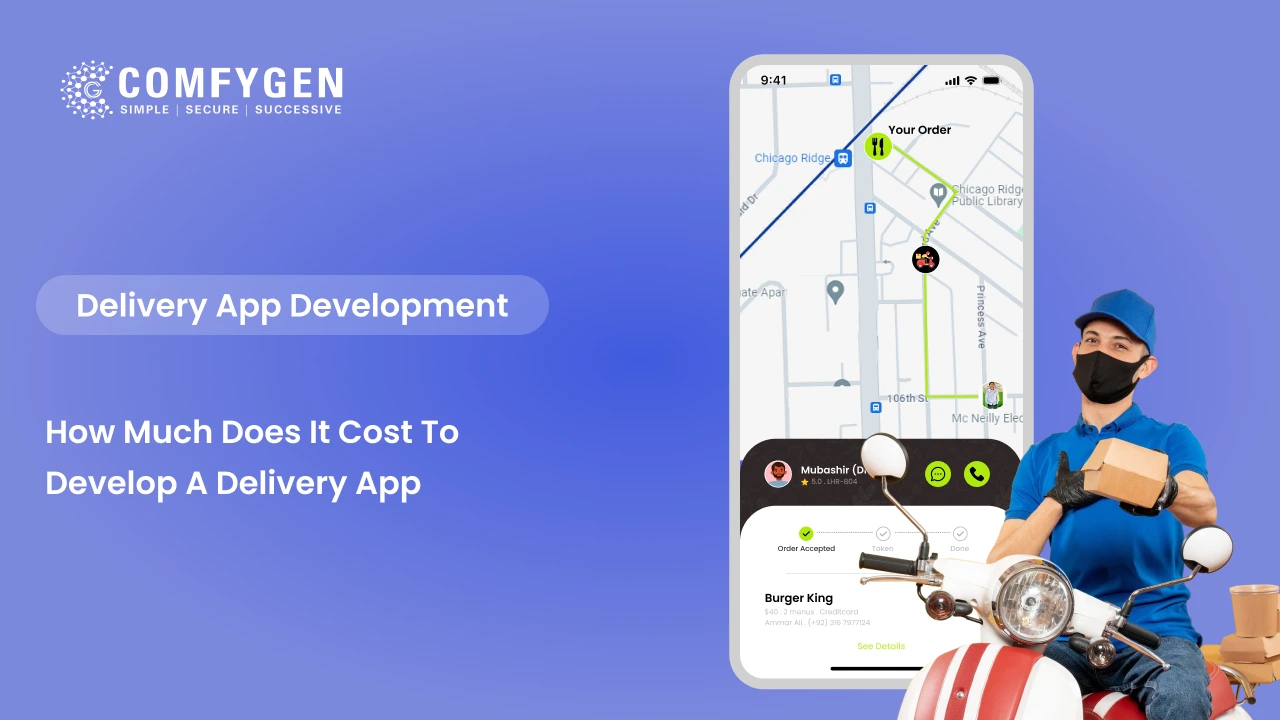





A delivery app costs $10,000 to $100,000+ to build. An MVP with a customer app, rider app and basic admin panel costs $10,000 to $25,000, and it takes 8 to 12 weeks. A mid-level app with a vendor panel, offers and analytics costs $25,000 to $50,000. Meanwhile, an advanced multi-city platform with AI dispatch and integrations costs $50,000 to $100,000+.
The biggest single factor is who builds it. For example, the same app costs three to five times more with a US team than with an Indian one. Therefore, this guide breaks the cost down by feature, panel, delivery type and region. It also covers what you pay every month after launch.
Delivery App Development Cost by Build Level
First, find the build level that matches your plan. Most businesses start at the MVP level and grow from there.
| Build Level | What’s Included | Cost | Time |
| MVP | Customer app, rider app, basic admin, payments, live tracking | $10,000 to $25,000 | 8 to 12 weeks |
| Mid-level | Adds vendor panel, offers and coupons, analytics, scheduled orders | $25,000 to $50,000 | 3 to 5 months |
| Advanced | Adds AI dispatch and ETAs, multi-city zones, ERP or POS integrations, memberships | $50,000 to $100,000+ | 6+ months |
Delivery App Cost by Panel
Second, remember that a delivery platform is really four products. As a result, your budget splits roughly like this:
| Panel | Share of Budget | Typical Cost |
| Customer app (Android and iOS) | 30% to 35% | $4,000 to $30,000 |
| Rider app | 20% to 25% | $3,000 to $20,000 |
| Vendor or store panel | 15% to 20% | $2,000 to $15,000 |
| Admin dashboard and backend | 25% to 30% | $4,000 to $25,000 |
However, single-store businesses can skip the vendor panel. That usually cuts 15% to 20% from the total.
Delivery App Development Cost by Feature
Next, look at the features themselves. Each one adds to the budget, so it helps to see the price of each before you agree on a scope.
| Feature | Typical Cost |
| Sign-up, OTP login and profiles | $800 to $2,500 |
| Catalogue or menu with search and filters | $1,500 to $5,000 |
| Cart and checkout | $1,000 to $3,000 |
| Payment gateway integration | $1,000 to $3,000 |
| Live GPS tracking | $2,000 to $6,000 |
| Push, SMS and WhatsApp notifications | $800 to $2,500 |
| Rider assignment and dispatch rules | $2,000 to $6,000 |
| Route optimization through a maps API | $3,000 to $10,000 |
| Proof of delivery (photo, OTP, signature) | $800 to $2,500 |
| Ratings and reviews | $600 to $2,000 |
| Offers, coupons and loyalty | $1,500 to $5,000 |
| Subscriptions and scheduled orders | $2,000 to $6,000 |
| Wallet and refunds | $2,000 to $6,000 |
| Admin analytics and reports | $2,000 to $8,000 |
| Multi-language and multi-currency | $1,500 to $5,000 |
| AI ETA prediction or demand forecasting | $6,000 to $25,000 |
Several AI features together can change the budget quickly. In addition, the order you add them in matters, because most AI features for delivery apps only work well once you have thousands of completed orders.
How Delivery Type Changes the Cost to Build a Delivery App
Different verticals need different work. Therefore, the same MVP price does not apply everywhere. Food, medicine and quick commerce each have their own full cost guide, linked in the table below.
| Delivery Type | Extra Cost Drivers | MVP Range |
| Food delivery | Menus with options, prep-time sync, short delivery windows | $12,000 to $28,000 |
| Grocery delivery | Large catalogues, stock sync, slot booking, substitutions | $15,000 to $35,000 |
| Medicine delivery | Prescription upload and checks, pharmacy licence handling, privacy controls | $15,000 to $35,000 |
| Courier and parcels | Two-stop routes, parcel sizes, labels and scanning, rate cards | $12,000 to $30,000 |
| Quick commerce | Live stock per dark store, batching, tight dispatch | $20,000 to $45,000 |
| Milk, water and subscriptions | Schedules, pause and skip, monthly billing, route plans | $10,000 to $22,000 |
Delivery App Development Cost by Region
Above all, your development partner’s location changes the price more than any feature does.
| Region | Hourly Rate | MVP Cost | Advanced Platform |
| India | $20 to $50 | $10,000 to $25,000 | $50,000 to $100,000+ |
| Eastern Europe | $40 to $99 | $25,000 to $50,000 | $80,000 to $180,000 |
| UK and Western Europe | $80 to $180 | $40,000 to $80,000 | $120,000 to $250,000 |
| USA and Canada | $100 to $250 | $50,000 to $100,000 | $150,000 to $300,000+ |
For this reason, many businesses in the US, UK and Gulf work with delivery app development teams in India. Most of them keep a product owner in their own time zone as well.
How to Estimate Your Own Delivery App Cost
Cost = development hours × hourly rate
A typical MVP takes 500 to 900 hours across design, development, QA and project management. At $25 an hour, that’s $12,500 to $22,500. At $120 an hour, the same work costs $60,000 to $108,000.
To sanity-check a quote, ask for the hours behind each panel. Any team that can’t break the number down by panel and phase is guessing.
How Platform Choice Affects Your App Development Budget
Besides features, your choice of platform moves the price, sometimes by a third.
| Approach | Effect on Cost |
| Android only | Lowest cost, but you lose iOS users, which matters in the US, UK and Gulf |
| iOS only | Similar cost to Android only, suits premium markets |
| Cross-platform (Flutter or React Native) | One codebase for both, usually 30% to 40% cheaper than two native apps |
| Native on both platforms | Highest cost, best for heavy animation or deep device features |
Most delivery apps use Flutter or React Native, since rider and customer apps rarely need native-only features.
Monthly Running Costs After Launch
The build cost is only part of your delivery app budget. In addition, plan for these every month:
- Maps and routing APIs: billed by usage, so they grow with your order volume
- SMS, OTP and WhatsApp messages: billed per message
- Cloud hosting: roughly $100 to $1,000+ a month, depending on volume
- Payment gateway fees: usually about 2% to 3% per transaction
- App store accounts: $99 a year for Apple, plus a one-time $25 for Google Play
- Maintenance: 15% to 20% of the build cost each year for OS updates, fixes and small features
Hidden Costs That Raise Your Delivery App Budget
In practice, most overruns come from the same few places. Therefore, agree on them before you sign.
- Design revisions beyond the agreed number of rounds
- Third-party integrations with an ERP, POS or accounting system
- App store rejections that need rework, especially around privacy details
- Content work such as menu photography, catalogue data and translations
- Rider and vendor onboarding, including training and support in week one
- Marketing to win your first thousand orders, which often costs more than a feature
How to Reduce Delivery App Development Cost
There are safe savings, but there are false ones too.
Safe to cut:
- Launch on one platform if your market is clearly Android-heavy
- Use cross-platform development instead of two native apps
- Start with a maps API for routing and add machine learning later
- Skip the vendor panel if you’re a single store
- Use a ready payment gateway and SMS provider instead of custom work
- Launch in one zone, which cuts testing and rider onboarding work
Not safe to cut:
- QA and real-world testing
- Offline mode in the rider app
- Role-based access in the admin panel
- Refund and failure handling
- Maintenance budget for year one
When Does a Delivery App Pay Back Its Cost?
If you pay aggregator commissions today, then the maths is simple. If commission is 20% and your average order is $20, then every order you move to your own app keeps about $4.
| Monthly Orders Moved to Your App | Commission Saved per Month |
| 500 | $2,000 |
| 1,500 | $6,000 |
| 5,000 | $20,000 |
At 1,500 orders a month, for example, a $25,000 app pays for itself in roughly four to five months, provided volume holds. On top of that, you own your customer data. Still, use your own commission rate and order value, and subtract rider and marketing costs for a realistic figure.
Fixed Price or Time and Material?
| Model | How It Works | Best For |
| Fixed price | One price for an agreed scope | MVPs with a clear, locked feature list |
| Time and material | You pay for hours used | Projects where scope will change |
| Dedicated team | Monthly rate for developers working only on your product | Long builds with your own product lead |
Fixed price protects your budget, but every change costs extra. Time and material is flexible if you have someone managing scope. Whichever you pick, tie payments to working software you can test.
What Comfygen Charges for Delivery App Development
Comfygen builds delivery platforms across food, grocery, medicine, courier and quick commerce from its team in Jaipur, with offices in Toronto and Euskirchen for clients in North America and Europe. Since 2019, the team has delivered 550+ projects for 400+ clients in 30+ countries, with 97% client retention.
Every quote starts with a scoping session that maps your delivery model, panels and integrations. After that, the cost comes back split by panel and phase, so you can see exactly what you are paying for. Finally, you can get a scoped estimate for your delivery app with a feature-level breakdown.
Frequently Asked Questions
How much does it cost to develop a delivery app?
How long does it take to build a delivery app?
What is the cost of delivery app development in India?
What is the maintenance cost of a delivery app?
Which features increase delivery app cost the most?
Can I build a delivery app for under $10,000?
Does a cross-platform app cost less than native apps?

Mr. Saddam Husen, (CTO)
Mr. Saddam Husen, CTO at Comfygen, is a renowned Blockchain expert and IT consultant with extensive experience in blockchain development, crypto wallets, DeFi, ICOs, and smart contracts. Passionate about digital transformation, he helps businesses harness blockchain technology’s potential, driving innovation and enhancing IT infrastructure for global success.