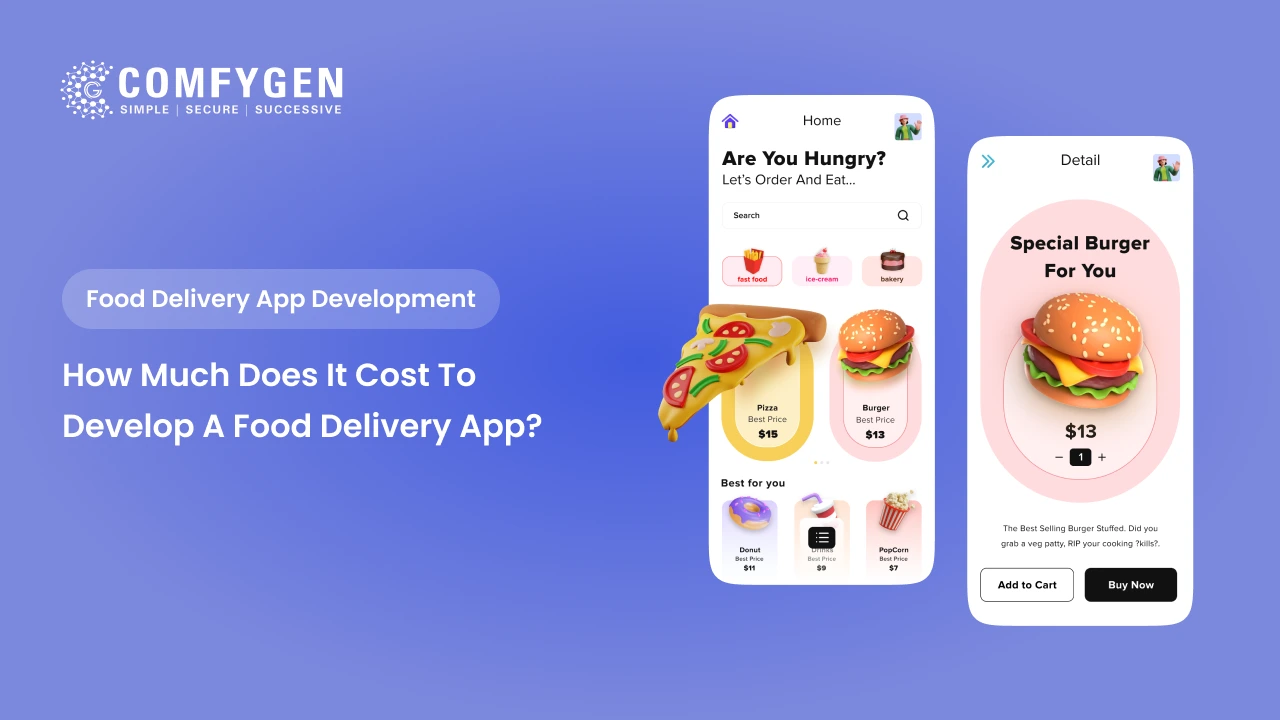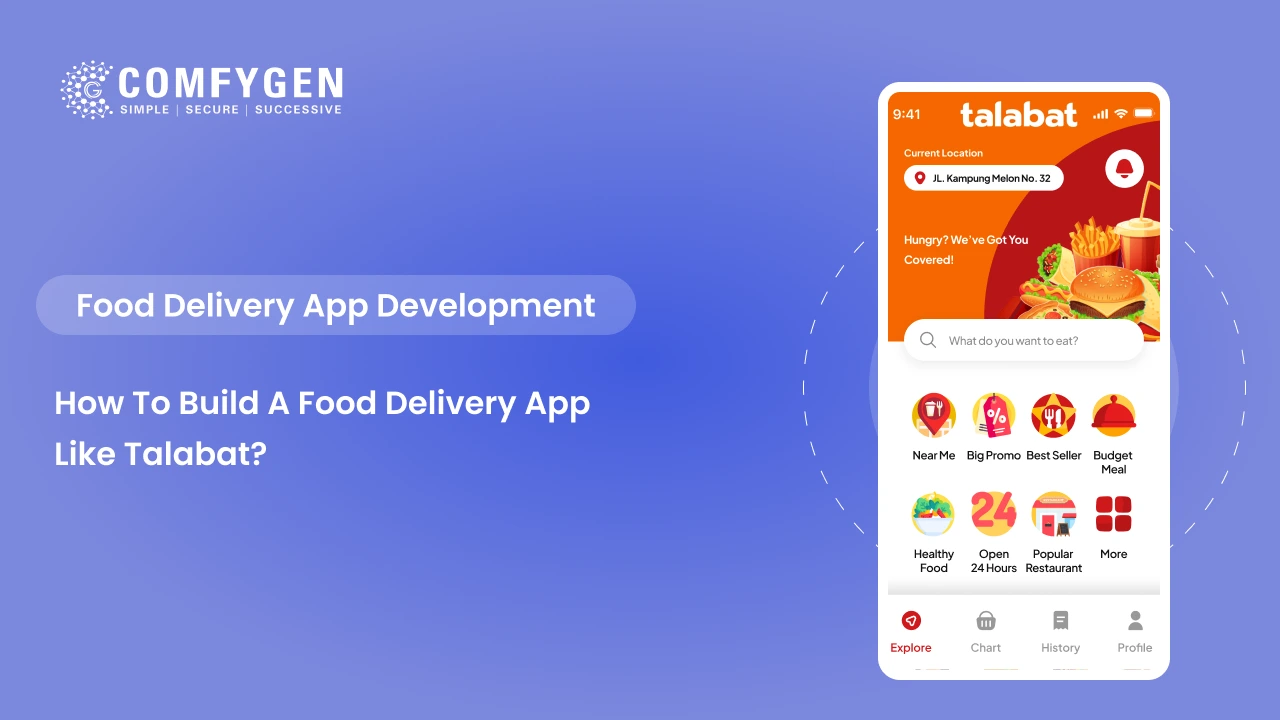





Building a food delivery app like Talabat costs AED 55,000 to AED 184,000 or more, which is about $15,000 to $50,000 and above. The timeline runs from two weeks for a rebranded platform to twenty four weeks for a full marketplace. UAE compliance work adds AED 20,000 to AED 55,000 on top, and it is not optional.
This guide prices the build in dirhams rather than dollars, with a feature breakdown, real timelines, and the UAE rules most cost guides skip: VAT across food and delivery, trade licensing, rider permits, Arabic right-to-left design, and the payment methods customers here actually use.
How Much Does It Cost to Build a Food Delivery App Like Talabat?
| Build type | What you get | Cost (AED) | Approx. USD | Timeline |
| White-label launch | Pre-built customer, restaurant and rider apps rebranded as yours, plus admin dashboard | 55,000 to 92,000 | $15,000 to $25,000 | 2 to 4 weeks |
| Custom MVP | Four apps built to your model, live tracking, multi-gateway payments, admin panel | 92,000 to 184,000 | $25,000 to $50,000 | 8 to 12 weeks |
| Enterprise platform | Full marketplace, AI dispatch, POS integration, multi-country | 184,000+ | $50,000+ | 16 to 24 weeks |
| UAE compliance layer | VAT logic, Arabic RTL, licensing support, payment gateways, data handling | +20,000 to 55,000 | +$5,500 to $15,000 | runs in parallel |
Read those tiers as alternatives rather than steps. Each one is a complete, launchable product at a different level of ambition.
Treat the compliance layer as its own line. It applies whichever build type you pick, and it is the item founders find out about last.
What Sits Inside Each Tier
These percentages are shares of the totals above, not extras to add on top.
| Component | Share of build |
| Backend and APIs | 35% to 45% |
| Customer app | 20% to 25% |
| Rider app | 12% to 18% |
| Restaurant panel | 8% to 12% |
| Admin panel | 8% to 12% |
| UI and UX design | 10% to 15% |
| QA and testing | 8% to 12% |
If a quote looks unusually cheap, check what it covers. A price for the customer app alone comes in around 60% below a four-app build, and it leaves you with nothing for restaurants or riders to use.
What Changes the Price
Four things move the number more than the feature list does:
- Whether you run an aggregator or a single-brand app, which is the next section
- How many payment gateways you support, since each one is a separate integration and test cycle
- Whether riders are yours or contracted, which changes the rider app and the payout logic
- How many cities or countries you open in, because each one brings its own rules and rails
When the Cost Goes Above AED 184,000
Some UAE agencies quote up to AED 1 million for a build like this. That is a real number, but it buys something different from what most founders need, so it helps to know what sits in that range.
Costs climb past AED 184,000 when you add your own rider fleet with rostering and payroll, dark stores or your own kitchens with stock and waste tracking, several countries at once, deep POS integration across hundreds of partners, or machine learning for dispatch and pricing trained on your own order history.
None of that makes sense before you have order volume. A first launch does not need it, and paying for it early is the most common way founders run out of money before the model is proven.
Should You Build an Aggregator or a Single-Restaurant App?
Answer this before you look at any feature list, because it moves your budget more than anything else on this page.
Talabat is an aggregator. Thousands of restaurants list on it, riders fulfil the orders, and Talabat takes a cut of each one. That model needs four things a single-restaurant app never needs:
- Restaurant sign-up, document checks and an approval queue
- A commission engine with per-partner rates, payouts and reconciliation
- A dashboard for every partner to manage menus, hours and orders
- Rider supply management, covering onboarding, assignment and payouts
A single-restaurant app serves one menu from your own branches. No partner onboarding, no commission engine, no rider marketplace. The build is simpler, and it lands in the lower tiers.
Most people asking about an app like Talabat actually want the second one. They own a restaurant group and want to stop paying commission to someone else. If that is you, the aggregator features above are cost with no return. The same four-app structure priced in Saudi Riyal for a single-brand restaurant chain shows how far the budget drops once you take them out.
Is the UAE Food Delivery Market Still Growing in 2026?
Yes, though the shape of the growth matters more than the headline.
Syrve MENA tracked the same UAE restaurants across the first half of 2026 and the first half of 2025. Delivery orders rose 15.2%. Over the same period total restaurant orders fell 4%, gross revenue fell 5.5%, and dine-in orders fell 10.5% (Khaleej Times, July 2026).
So delivery is not growing because people eat more. It is growing because people eat out less. Delivery took 30.5% of restaurant orders in the first half of 2026, up from 25.4%, and 22.5% of revenue, up from 18.6%.
Two figures from that data are worth planning around:
- The average delivery order is AED 76.97. Dine-in averages AED 115.81. A delivery order is worth about two thirds of a table order, and the delivery figure slipped slightly year on year. Build your unit economics on a flat basket, not a rising one.
- About 1,940 delivery orders a month per restaurant that offers delivery. That is roughly 65 a day, which tells you what order volume your dispatch needs to handle at launch.
On market size, IMARC puts UAE online food delivery at USD 793.9 million in 2025, reaching USD 1,820.1 million by 2034, a 9.37% annual rate (IMARC Group). Be careful with pages that quote only the 2034 figure. The base year is what tells you the size of the market you are entering today.
How Does Talabat Make Money, and How Big Is It?
Talabat started in Kuwait in 2004 and is now the largest food delivery platform across the Middle East and North Africa. It serves about 6 million active customers and runs in five of the six GCC countries plus Egypt, Iraq and Jordan. It does not operate in Saudi Arabia, where Jahez and HungerStation lead instead.
In December 2024 Delivery Hero floated roughly 20% of Talabat on the Dubai Financial Market at AED 1.60 a share. The offer raised about USD 2 billion and valued the company near USD 10 billion, making it the biggest UAE listing of that year. The shares then fell 7.5% on their first day. Analysts put that down to pricing, since the offer went out at about 28 times earnings against a Dubai Financial Market average closer to nine.
That detail is useful if you plan to raise money. The market will pay for a Gulf delivery platform, but it priced this one for growth and corrected inside a day. Investors are going to ask about your unit economics before they ask about your order count.
Talabat earns from five streams, and a new platform can run all five:
- Restaurant commission, the core of the model, taken on every order
- Delivery fees charged to the customer, often waived above a minimum basket
- Subscriptions such as Talabat Pro, trading free delivery for predictable monthly revenue
- Advertising, where restaurants pay for placement in search and category pages
- Surge pricing at peak hours and in bad weather
Commission alone rarely covers costs in year one. Pick your second stream early, because subscriptions and advertising both need design work from the start rather than a feature bolted on later.
What Licences and Rules Apply to a UAE Food Delivery App?
This is where generic guides fall short. Skip these and you risk fines, a rejected licence, or a rebuild.
Mainland or Free Zone
Where you register changes what you are allowed to do. A mainland licence from the Department of Economy and Tourism lets you trade directly with UAE customers and restaurants, which is what a delivery platform needs. Free zones such as DIFC and ADGM bring other benefits but restrict onshore trading. Get this reviewed by a UAE legal adviser before you incorporate, because changing it later means restructuring the company.
Budget AED 5,000 to 15,000 for setup support.
VAT on Food and Delivery
UAE VAT is 5%, and registration becomes mandatory once taxable turnover passes AED 375,000 a year. For a marketplace the hard part is not the rate. It is who accounts for the tax on each line: the restaurant on the food, you on the delivery fee and on your commission. Your invoicing and payout logic has to handle all three separately on the same order. Confirm the current rules with the Federal Tax Authority.
Budget AED 8,000 to 20,000.
Rider Permits and Employment Status
Delivery riders need the right permits, and UAE labour rules since the 2022 reforms set out how contract and part-time work is classified. Whether you employ riders or contract them changes your licensing, your insurance and the onboarding flow inside your rider app. Platforms that treated this as an operations detail have had to rebuild rider onboarding after launch.
Data Protection and Where Data Lives
The UAE data protection framework governs consent, retention and how you handle customer records. Plan for consent flows in the app and for hosting in a nearby region, since some data is expected to stay in or close to the country. Picking a far-off cloud region to save money early turns into a migration bill later.
Budget AED 6,000 to 18,000.
Build the Next Big Food Delivery App
Stay ahead in the competitive food delivery market with a scalable app built for growth, convenience, and profitability.
Start Your Project
What Does a Gulf App Need That a Western One Does Not?
This is where copying a Western delivery app goes wrong. Five things matter here that never come up in London or Chicago.
Arabic With Full Right-to-Left Layout
Translating text is not enough. Menus, carts, maps, receipts and buttons all have to mirror properly, and switching between Arabic and English must not break a single screen. Treat it as a design job from the first wireframe. Arabic keywords in your app store listing matter too, and most new apps skip them.
Budget AED 8,000 to 25,000.
Halal Filtering
Customers expect to filter and sort by halal status, and they expect it to be right. That means a verified field on the restaurant record, not a tag any partner can set freely. Get it wrong once and the customer does not come back.
Ramadan Behaviour
Order patterns change completely during Ramadan. Demand drops through the day and spikes hard just before Iftar. Apps that handle it well publish Iftar and Suhoor menus, let customers schedule an order to land at sunset, and adjust dispatch for the evening surge. Apps that do not handle it fail on the busiest nights of the year.
Addresses That Work in the Gulf
Street addressing across much of the UAE does not work the way delivery apps assume. Customers navigate by building name, tower and landmark. Support pin dropping on a map, saved landmarks and shared locations, and make it easy for a rider to call or message. Weak address capture is the single biggest cause of failed deliveries in the region.
Payment Methods Customers Actually Use
Cards alone will cost you orders. UAE customers expect Apple Pay and Google Pay, cash on delivery in many areas, and buy-now-pay-later through Tabby or Tamara. An in-app wallet lifts repeat orders. Each gateway is a separate integration with its own certification and testing, so settle the full list before development starts rather than adding them one at a time.
What Features Does a Talabat-Like App Need?
A platform like this is four connected products, not one app. Comfygen builds all four as one food delivery platform with a shared backend, which is the only way the order status stays consistent across them.
Customer App
Sign-up by phone with OTP, restaurant and cuisine browsing, search with filters for halal, price and delivery time, menu and item pages, cart and checkout, multiple saved addresses, live order tracking on a map, order history and reordering, ratings, promo codes, wallet and payment methods, and push notifications.
Restaurant Partner App
Accept or reject incoming orders, manage menus and item availability, set opening hours and busy mode, mark orders ready for pickup, view payouts and commission statements, and run partner-funded offers.
Rider App
Shift availability, order assignment with accept and decline, pickup and drop navigation, proof of delivery, cash collection and reconciliation, earnings and payout history, and support contact.
Admin Panel
Partner onboarding and approval, commission rates per partner, rider management, live order board, dispute and refund handling, delivery zones and pricing, promotions, and reporting across orders, partners and cities.
A longer breakdown of each layer sits in the guide to food delivery app features and the order to build them in, which is worth reading before you sign off a scope.
Which Technology Stack Suits a UAE Food Delivery App?
| Layer | Common choices |
| Cross-platform frontend | Flutter, React Native |
| Native frontend | Swift for iOS, Kotlin for Android |
| Backend | Node.js, Python, Laravel |
| Database | PostgreSQL, MongoDB |
| Cloud and hosting | AWS, Google Cloud, Firebase |
| Real-time tracking | Firebase, WebSockets |
| Maps and routing | Google Maps API |
| Payments (UAE) | Checkout.com, PayTabs, Network International, Apple Pay, Tabby, Tamara |
| Notifications | Firebase Cloud Messaging |
For most UAE builds, Flutter on the front with Node.js on AWS gives fast delivery and room to scale. Cross-platform cuts frontend cost by 30% to 40% against building native twice, which matters most when you are shipping four apps rather than one.
How Long Does It Take to Build an App Like Talabat?
| Build type | Discovery | Design | Development | QA | Total |
| White-label | 3 days | 1 week | 1 to 2 weeks | 3 days | 2 to 4 weeks |
| Custom MVP | 1 to 2 weeks | 2 to 3 weeks | 5 to 7 weeks | 1 to 2 weeks | 8 to 12 weeks |
| Enterprise | 2 to 3 weeks | 4 to 6 weeks | 10 to 16 weeks | 2 to 4 weeks | 16 to 24 weeks |
Compliance work runs alongside development, not after it. VAT handling and Arabic layout both shape the backend and the design system, so raise them in week one.
What Does It Cost to Run the App After Launch?
| Cost item | Frequency | Cost (AED/year) |
| Hosting and cloud | Monthly | 10,000 to 50,000 |
| Bug fixes and updates | Ongoing | 18,000 to 60,000 |
| OS compatibility updates | Yearly | 10,000 to 30,000 |
| Payment gateway fees | Per transaction | 1% to 2.9% per order |
| App Store and Play fees | Yearly / one-time | ~365 (Apple), ~90 (Google) |
| Partner and rider support | Monthly | varies with order volume |
Plan for 15% to 20% of build cost per year, permanently. A marketplace sits at the upper end, because you are supporting restaurants and riders as well as customers.
What Mistakes Do New Gulf Delivery Apps Make?
Launching in Dubai only: Dubai is the most crowded market in the region. Sharjah, Ajman and the Northern Emirates have real demand, far less competition, and they are cheaper places to prove your dispatch works.
Treating Arabic as a second phase: Retrofitting right-to-left layout means revisiting every screen. It costs several times what building it in costs.
Signing too many restaurants: Twenty partners who fulfil reliably beat two hundred who cannot keep up. Partner count costs you operations rather than code, and a slow partner damages your rating, not theirs.
Ignoring the rider experience: Riders leave platforms with bad apps, and they leave at peak hours, which is exactly when you need them. Clear assignment, fair routing and fast payouts keep supply on the road.
Leaving loyalty until last: Delivery baskets across the UAE are flat right now. Repeat rate is what makes the numbers work, and loyalty or subscription features are what drive it.
Budgeting the build but not the year after: Running costs come to 15% to 20% of build cost every year, not once.
Building for Kuwait, Qatar, Oman or Saudi Arabia?
The build underneath is the same four apps. What changes is the currency, the language handling and the rulebook.
Talabat leads in Kuwait, Qatar, Bahrain and Oman, so a platform launching there competes with the same incumbent on different terms. Payment rails differ by country, including KNET in Kuwait and Benefit in Bahrain, and each one is its own integration and test cycle.
Saudi Arabia is the exception worth knowing about. Talabat does not operate there. That market belongs to Jahez and HungerStation, and the compliance layer is heavier, with Mada, ZATCA e-invoicing and Arabic-first design all mandatory. Anyone pricing a Saudi launch should start from what a Jahez-style marketplace costs in Saudi Riyal rather than from UAE numbers, because the two markets are not interchangeable.
Strip the local rules out altogether and you are back to the base food delivery app development cost, which is where every one of these country figures starts.
How Do You Choose a Development Partner?
Ask for Gulf work specifically, not general app work. The questions that matter:
- Which payment gateways have you certified in this region, and can you name the projects?
- Show me an Arabic right-to-left screen you shipped, not a translated mockup
- How do you split VAT across food, delivery fee and commission on one order?
- Who owns the source code at the end, and is there a licence fee?
- What does month thirteen cost me?
The same shortlisting process and red flags that apply to any food delivery build apply here, with the Gulf questions added on top.
Why Build With Comfygen?
Comfygen has delivered 550+ projects for 400+ clients across 30+ countries since 2019, with 97% client retention.
For Gulf delivery work specifically, the team has shipped Arabic-first interfaces laid out right to left from the wireframe rather than translated afterwards, multi-gateway checkout covering Apple Pay, cash on delivery and buy-now-pay-later, and VAT logic that splits tax across food, delivery fee and commission on the same order.
Every build ships four connected products: a customer app, a restaurant app, a rider app and a web admin panel. Projects run in two-week sprints with a working demo at the end of each one. Full source code ownership transfers on delivery, with no licence fee. Founders and restaurant groups scoping a Gulf launch usually start with a call about which emirate to open in before any code gets written.
Frequently Asked Questions
How much does it cost to build a food delivery app like Talabat?
How long does it take to develop a Talabat-like app?
Can I build a white-label Talabat clone app?
Should I build an aggregator or a single-restaurant app?
What licence do I need to run a food delivery app in the UAE?
Do I need to handle VAT in the app?
What payment methods should a UAE food delivery app support?
Does a UAE food delivery app need Tabby or Tamara?
Does the app need Arabic support?
How do I handle Ramadan in a food delivery app?
Does Talabat operate in Saudi Arabia?

Mr. Saddam Husen, (CTO)
Mr. Saddam Husen, CTO at Comfygen, is a renowned Blockchain expert and IT consultant with extensive experience in blockchain development, crypto wallets, DeFi, ICOs, and smart contracts. Passionate about digital transformation, he helps businesses harness blockchain technology’s potential, driving innovation and enhancing IT infrastructure for global success.