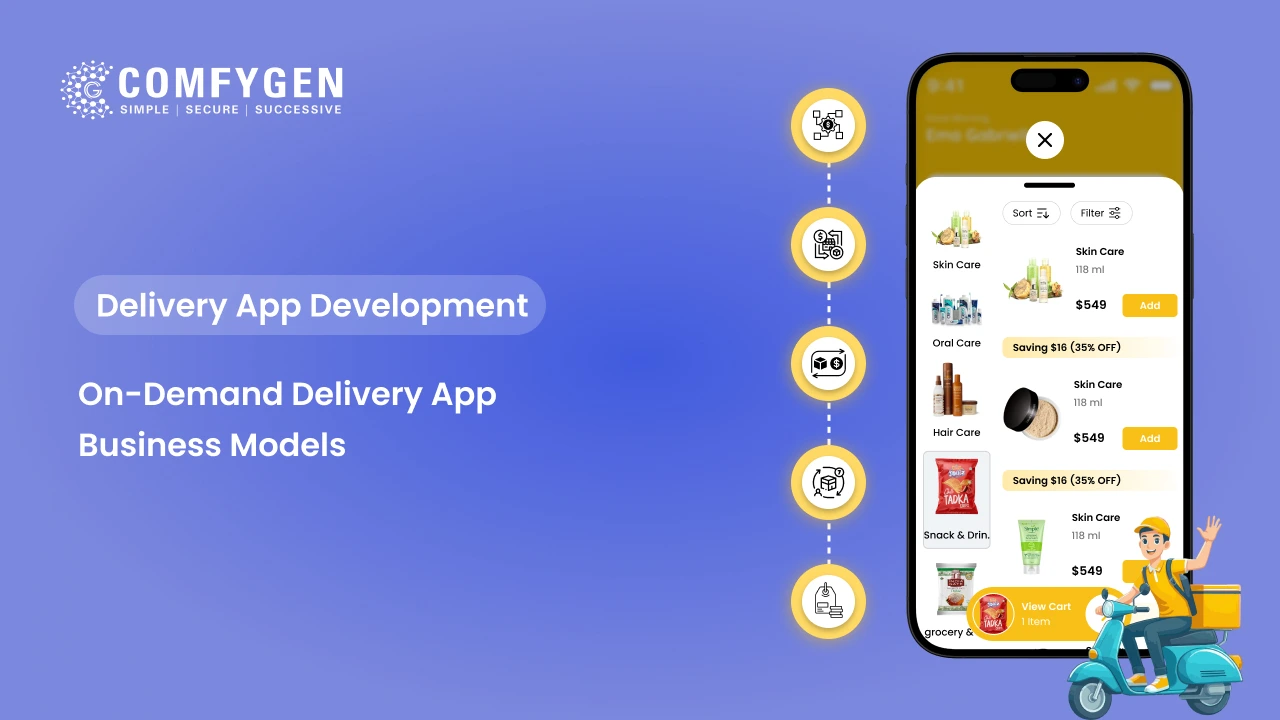





There are seven main delivery app business models: aggregator, single brand, hyperlocal marketplace, dark store or quick commerce, subscription, courier on demand, and hybrid. For example, aggregators earn commissions from partner stores without holding stock. Meanwhile, single-brand apps keep the full margin on their own products. By contrast, dark store models hold stock for speed, so they need the most capital. Therefore, your choice decides your margins, your app features and how much money you need before launch.
Below, this guide compares all seven models, shows how each makes money, and works through the numbers on a single order so you can see where the profit actually sits.
The 7 Delivery App Business Models at a Glance
| Model | Who Owns the Stock | Capital Needed | Margin | Speed to Launch | Best For |
| Aggregator | Partner stores | Low | Commission only | Fast | Startups with partner relationships |
| Single brand | You | Medium | Full product margin | Fast | Restaurants, retail chains, D2C brands |
| Hyperlocal marketplace | Local stores | Low | Commission plus fees | Medium | City-focused startups |
| Dark store / quick commerce | You | High | Product margin, thin at first | Slow | Funded teams targeting 10 to 30 minute delivery |
| Subscription | You or partners | Low to medium | Predictable recurring margin | Fast | Milk, water, meals, pharmacy refills |
| Courier on demand | Nobody (you move goods) | Low | Delivery fee only | Fast | Logistics startups and parcel services |
| Hybrid | Mixed | Medium to high | Mixed | Medium | Businesses scaling across categories |
1. Aggregator Delivery Model
In this model, you list other businesses in your app and take a commission on each order. Riders are either yours or hired from a third-party fleet.
How it earns: Commission per order, delivery fees, sponsored listings.
Strengths: No stock, no warehouses, and you can add categories quickly.
Weaknesses: Margins per order stay thin. In addition, partner stores control quality and prep times.
App needs: Vendor panel, commission settings, payouts, ratings, dispute handling.
2. Single-Brand Delivery Model
Here, you sell your own products through your own app, whether you run a restaurant chain, supermarket, pharmacy or D2C brand.
How it earns: Full product margin, plus delivery fees.
Strengths: You keep the customer relationship, the data and the margin that an aggregator would take.
Weaknesses: You carry all stock and delivery cost. Furthermore, demand depends entirely on your own marketing.
App needs: Catalogue, offers, loyalty, rider app and a simpler admin panel. No vendor panel needed.
This is why many restaurants build their own food ordering and delivery app alongside the aggregators, and why supermarkets run branded grocery delivery platforms for repeat shoppers.
3. Hyperlocal Marketplace Delivery Model
This is a neighbourhood version of the aggregator model. Local kirana stores, bakeries, butchers and pharmacies sit in one app, and delivery stays inside a few kilometres.
How it earns: Commission, delivery fees, small-order fees, local ads.
Strengths: Short distances keep delivery cheap, and local stores rarely have their own apps.
Weaknesses: Small stores often lack stock data. Consequently, out-of-stock items cause cancellations.
App needs: Simple vendor app for small shops, substitution flows, zone-level catalogues.
4. Dark Store and Quick Commerce Delivery Model
In this model, you hold your own stock in small local warehouses, known as dark stores, and promise delivery in 10 to 30 minutes.
How it earns: Product margin, delivery fees, membership plans, brand placement fees from suppliers.
Strengths: Full control over stock and speed, which builds daily habits.
Weaknesses: This is the most capital-heavy model, because each dark store needs rent, stock, staff and riders before it earns anything.
App needs: Live stock sync per store, fast checkout, order batching and tight rider dispatch. These are the core of any q-commerce app development.
5. Subscription Delivery Model
Customers pay for repeat delivery, such as daily milk, weekly water cans, monthly pharmacy refills or meal plans.
How it earns: Recurring payments, top-up orders, low customer acquisition cost after the first sale.
Strengths: Predictable demand makes routing efficient, since riders follow the same route daily.
Weaknesses: Order values stay lower. Besides that, pausing and skipping must be effortless, otherwise customers cancel.
App needs: Schedules, pause and skip, wallet top-ups, monthly billing and route plans per rider. Apps for daily milk delivery and water can delivery are built around exactly this.
6. On-Demand Courier Delivery Model
Here, you move parcels and packages for people and businesses, although you sell no products of your own.
How it earns: Delivery fees by distance, weight and speed, plus business contracts and returns handling.
Strengths: No stock and no vendor management, and B2B contracts bring steady volume.
Weaknesses: Price competition is heavy. Additionally, each order needs two stops rather than one.
App needs: Pickup scheduling, parcel size and weight, proof of pickup and delivery, and rate cards, all standard in courier and parcel apps.
7. Hybrid Delivery Business Model
Finally, in the hybrid model you sell your own products and host partner stores in the same app.
How it earns: Product margin on your items, commission on partner items, plus fees and ads.
Strengths: More categories without buying more stock, and your own products protect margin.
Weaknesses: Partners may complain that you favour your own listings, particularly in search results.
App needs: Everything from the single-brand and aggregator models, plus clear ranking rules.
Choose the Right Delivery App Business Model
Explore the right delivery model for your goals and build a scalable platform designed around your target customers.
Discuss Your Business Model
How Delivery Apps Make Money
In practice, most apps combine several of these streams:
| Revenue Stream | How It Works | Fits Best With |
| Vendor commission | 10% to 30% of each order, depending on market and category | Aggregator, hyperlocal, hybrid |
| Delivery fee | Charged by distance, order value or time slot | Every model |
| Small-order fee | Flat fee below a minimum basket size | Hyperlocal, quick commerce |
| Membership plan | Monthly fee for free or cheaper delivery | Quick commerce, single brand |
| Sponsored listings | Stores pay for higher placement | Aggregator, hyperlocal |
| Peak pricing | Higher fees in rush hours or bad weather | Every model |
| Supplier placement fees | Brands pay for shelf space in your app | Dark store, grocery |
| B2B contracts | Fixed monthly rates for business clients | Courier, logistics |
However, check commission rates in your own market before setting yours. Rates differ widely by country and category, and undercutting on commission is often the fastest way to win vendors from a big aggregator.
Delivery App Unit Economics: Where the Money Goes
A model only works if a single order contributes something. For example, take a food aggregator with an average order value of $20 and a 20% commission. The numbers then look like this:
| Line | Amount |
| Commission from vendor (20% of $20) | $4.00 |
| Delivery fee from customer | $2.00 |
| Total revenue per order | $6.00 |
| Rider payout | $3.00 |
| Payment gateway fee (about 2%) | $0.40 |
| Support and app running costs | $0.30 |
| Discount or coupon cost | $1.00 |
| Total cost per order | $4.70 |
| Contribution per order | $1.30 |
Treat these numbers as an example rather than a benchmark. Instead, use your own rates, and run this calculation before you scale. Growth multiplies whatever this number is, so a negative contribution per order gets worse with every new customer.
The levers that fix a weak contribution:
- Raise average order value with minimum basket sizes and bundles
- Cut rider cost per order through batching and better routing
- Reduce discounts once launch offers end
- Add a membership plan for repeat customers
- Move riders between categories, which is the main advantage of a multi-service delivery platform
How to Pick the Right Delivery App Business Model
To choose well, ask yourself three questions:
- Do you own stock? Yes points to single brand, subscription or dark store. No points to aggregator, hyperlocal or courier.
- How much capital do you have before revenue? Dark stores need the most. Aggregator and courier models need the least.
- How fast must delivery be? Promising 10 to 30 minutes means holding stock nearby, which rules out a pure aggregator setup.
Moreover, most businesses start with one model and grow into another. A restaurant chain starts single brand, then adds nearby partner brands to become a hybrid. A hyperlocal aggregator opens its own dark store for fast-selling items. Plan for that shift in your app structure, since adding a vendor panel and commission engine later is far more expensive than designing for it from the start.
Which Delivery Business Model Needs Which App Setup?
| Model | Customer App | Rider App | Vendor Panel | Stock Management |
| Aggregator | Yes | Yes | Yes | Vendor side only |
| Single brand | Yes | Yes | Optional | Yes |
| Hyperlocal | Yes | Yes | Yes (simple) | Basic |
| Dark store | Yes | Yes | Internal only | Yes, live per store |
| Subscription | Yes | Yes | Optional | Yes |
| Courier | Yes | Yes | Business portal | No |
| Hybrid | Yes | Yes | Yes | Yes |
As a result, build cost follows this table closely. A courier app with no catalogue costs less than a dark store platform with live stock sync, and the full range sits in the cost breakdown for delivery apps.
How Comfygen Builds Apps for Each Delivery Business Model
Comfygen expert in delivery app development for every one of these models, from single-store apps for restaurants to multi-vendor marketplaces and subscription platforms. Since 2019, the team has delivered 550+ projects for 400+ clients in 30+ countries, with 97% client retention. Each project starts by matching the model to your supply, budget and delivery promise, and you can run your model past the delivery team before committing to a build.
Frequently Asked Questions
What are the main on-demand delivery app business models?
How do delivery apps make money?
Which delivery business model is most profitable?
What commission do delivery apps charge vendors?
What is the dark store model?
Can I change my delivery business model later?

Mr. Saddam Husen, (CTO)
Mr. Saddam Husen, CTO at Comfygen, is a renowned Blockchain expert and IT consultant with extensive experience in blockchain development, crypto wallets, DeFi, ICOs, and smart contracts. Passionate about digital transformation, he helps businesses harness blockchain technology’s potential, driving innovation and enhancing IT infrastructure for global success.