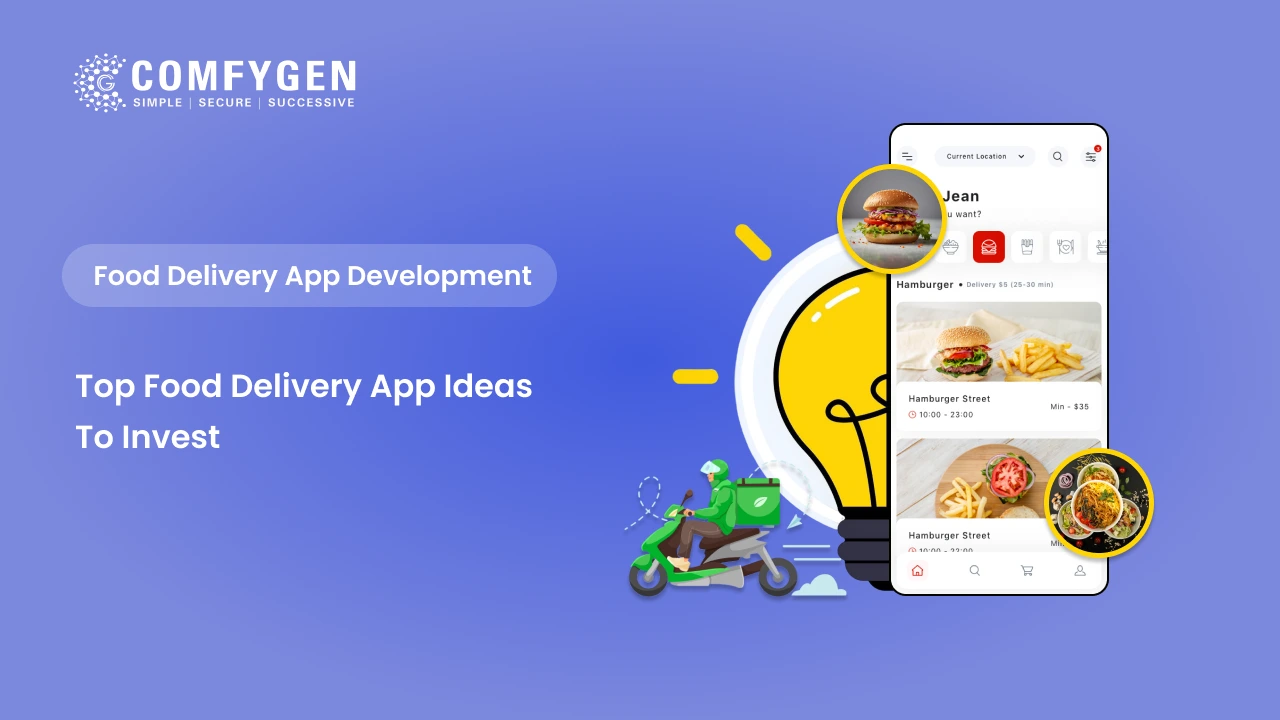





The most capital-efficient food delivery ideas in 2026 are corporate catering, homemade food marketplaces and subscription meal plans. Each launches for $15,000 to $30,000, earns predictable repeat revenue, and avoids competing with the platforms that already own general restaurant delivery.
The ideas that look most exciting are usually the hardest to fund. Drone delivery and farm-to-table need capital and operational scale before the app matters at all. This guide gives each idea an honest investment profile: what it costs, how it earns, and how hard it is to get in.
Investment Comparison: All 10 Ideas
| Idea | App build cost | Other capital needed | Revenue model | Entry difficulty |
| Corporate catering | $15,000–$25,000 | Low | Bulk orders, contracts | Low |
| Homemade food marketplace | $20,000–$35,000 | Low | Commission 10–20% | Low |
| Subscription meal plans | $20,000–$35,000 | Medium (kitchen) | Monthly subscription | Medium |
| Multi-cuisine marketplace | $25,000–$50,000 | High (acquisition) | Commission 15–25% | High |
| AI recommendation platform | $30,000–$50,000 | Medium | Commission plus data | Medium |
| Zero-waste redistribution | $20,000–$35,000 | Low | CSR partnerships, small fees | Medium |
| Diet and nutrition delivery | $30,000–$50,000 | Medium | Subscription, partnerships | Medium |
| Farm-to-table hyperlocal | $25,000–$45,000 | High (logistics) | Commission, delivery fees | High |
| Eco-friendly delivery platform | $25,000–$45,000 | High (EV fleet) | Commission, green premium | High |
| Drone-enabled delivery | $50,000+ | Very high (hardware, licensing) | Delivery fees | Very high |
“Other capital” is the line most founders underestimate. The app is rarely the largest cost.
Is Food Delivery Still Worth Investing In?
Two figures get quoted for this market, and they measure different things.
Statista puts the wider online food delivery market, including grocery delivery and meal kits, at US$1.51 trillion in 2026, growing at 6.24% a year to around US$2.05 trillion by 2031 (Statista).
Restaurant delivery alone is a smaller segment, valued at $319.99 billion in 2025 and projected to reach $350.63 billion in 2026, growing at roughly 9.58% a year (Fortune Business Insights).
If you’re building a restaurant delivery app, plan against the narrower number. The trillion-dollar figure includes groceries, which is a different business with different economics.
What matters more than market size is concentration. In most countries two platforms hold the majority of restaurant delivery. A new general-purpose app rarely wins. Every idea below succeeds by serving something those platforms handle badly.
What Are the Best Food Delivery App Ideas for 2026?
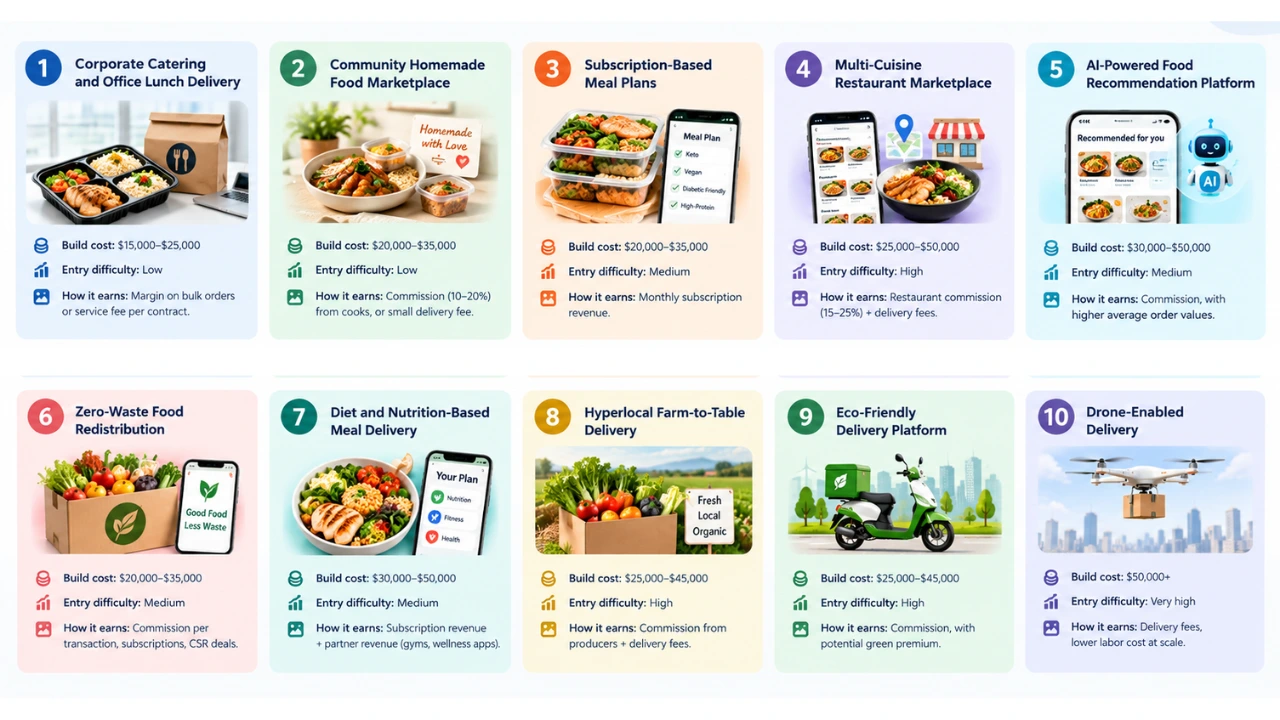
1. Corporate Catering and Office Lunch Delivery
Build cost: $15,000–$25,000 · Entry difficulty: Low
Companies order lunch for teams on a recurring schedule. Orders are large, predictable, placed by an administrator rather than an individual, and repeat weekly without marketing spend.
How it earns: margin on bulk orders, or a service fee per contract. Corporate clients accept invoicing, so you avoid consumer payment friction entirely.
Why it’s the best starting point: demand is contractual rather than impulse-driven. Ten corporate accounts can produce steadier revenue than a thousand consumer users, and you can sign your first accounts before the app exists.
The risk: losing one large client hurts far more than losing one consumer. Concentration cuts both ways.
2. Community Homemade Food Marketplace
Build cost: $20,000–$35,000 · Entry difficulty: Low
Home cooks sell to neighbors. Customers get food the big platforms don’t list, and cooks get income without a commercial kitchen.
How it earns: commission of 10% to 20% from cooks, sometimes with a small customer delivery fee.
Why it works: supply is cheap to acquire. Home cooks have no existing platform relationship to break, unlike restaurants already listed on two aggregators.
The risk: food safety regulation varies sharply by country and city. Some jurisdictions require licensing for home food businesses. Check local rules before you build, because this can determine whether the model is legal where you operate.
3. Subscription-Based Meal Plans
Build cost: $20,000–$35,000 · Entry difficulty: Medium
Customers pay monthly for meals delivered on a schedule. Keto, vegan, diabetic-friendly, high-protein, or regional tiffin service.
How it earns: monthly subscription revenue, which is the most predictable model on this list.
Why it’s attractive: you know tomorrow’s order volume today. That transforms kitchen planning, procurement and delivery routing, and it means recurring revenue from month one.
The risk: churn. Subscription meal businesses live or die on retention past month three. Budget for menu variety, because the most common cancellation reason is boredom rather than price.
4. Multi-Cuisine Restaurant Marketplace
Build cost: $25,000–$50,000 · Entry difficulty: High
The classic aggregator: many restaurants, one app, customers browse and order.
How it earns: restaurant commission of 15% to 25%, plus customer delivery fees.
Be honest about this one: it’s the hardest idea here and the most commonly attempted. You need enough restaurants for customers to download the app, and enough customers for restaurants to join. Solving that in a market where two incumbents already have both is the actual challenge, and the app is a small part of it.
When it works: in a single city or region the incumbents serve poorly, with local relationships they don’t have. Not as a national play.
5. AI-Powered Food Recommendation Platform
Build cost: $30,000–$50,000 · Entry difficulty: Medium
Order history, time of day, weather and dietary preferences drive what each customer sees first.
How it earns: commission, with higher average order values from better recommendations.
One practical constraint: recommendation engines need order history to produce anything useful. On launch day you have none. Build the data capture properly from day one and switch the engine on in year two. Understanding what AI actually does inside a food delivery platform before you scope helps you avoid paying for a feature that can’t function yet.
6. Zero-Waste Food Redistribution
Build cost: $20,000–$35,000 · Entry difficulty: Medium
Restaurants and supermarkets list surplus edible food at a discount near closing time, rather than discarding it.
How it earns: small commission per transaction, freemium subscriptions for business users, and CSR partnerships with corporates that need sustainability reporting.
Why it’s more viable than it sounds: supply costs the restaurant nothing, so commission resistance is low. Too Good To Go has shown the model works commercially rather than only as a charitable venture.
The risk: unit economics are thin because order values are deliberately low. Volume and density matter more here than anywhere else on this list.
7. Diet and Nutrition-Based Meal Delivery
Build cost: $30,000–$50,000 · Entry difficulty: Medium
Meal plans built around a customer’s actual health data, fitness metrics or dietitian guidance.
How it earns: subscription revenue, plus revenue-share partnerships with gyms, wellness apps and clinics.
A serious constraint: processing health data triggers data protection obligations in most jurisdictions, and making nutrition claims can attract regulatory attention. Take legal advice before you handle anything that looks like medical information. Partnering with qualified dietitians is both a compliance measure and a marketing asset.
8. Hyperlocal Farm-to-Table Delivery
Build cost: $25,000–$45,000 · Entry difficulty: High
Local farmers sell direct to households and restaurants, with transparent sourcing.
How it earns: commission from producers, plus delivery fees.
Where the difficulty sits: fresh produce logistics. Cold chain, short shelf life, variable supply, and farmers who often lack the technical setup to manage inventory in an app. The software is the easy part.
When it works: a defined region with a cluster of producers and a customer base that pays a premium for provenance.
9. Eco-Friendly Delivery Platform
Build cost: $25,000–$45,000 · Entry difficulty: High
Electric vehicle fleets, compostable packaging and carbon-neutral delivery as the core proposition rather than a badge.
How it earns: commission, with the possibility of a small green premium.
Be realistic: sustainability influences choice but rarely overrides price and speed. The capital requirement is the problem. An EV fleet and a packaging supply chain cost far more than the app, and customers who say they’ll pay more for green delivery frequently don’t.
Better as a feature than a business. Adding EV routing and packaging options to another model on this list is usually a stronger play than building a platform on sustainability alone.
10. Drone-Enabled Delivery
Build cost: $50,000+ · Entry difficulty: Very high
Aerial last-mile delivery for short distances.
How it earns: delivery fees, with lower per-delivery labor cost at scale.
Why it’s last on this list: aviation regulation, hardware, maintenance, insurance and airspace permissions dominate the cost, and the app is a rounding error against them. Commercial drone delivery operates in selected corridors rather than at general scale.
The practical move: if you believe in this, build a conventional delivery platform now and design your dispatch layer so drone integration is a configuration change later rather than a rebuild.
Build the Next Big Food Delivery App
From niche delivery to AI-powered ordering, turn your unique concept into a profitable food delivery platform.
Discuss Your Idea
How Do You Pick Between These Ideas?
Four questions, in order:
How much capital do you actually have, including operations? The app is often a quarter of what a first-year launch needs. If your total budget is the app quote, pick from the low-difficulty rows.
Do you already have supply? An existing restaurant, kitchen, farm network or corporate relationship removes the hardest problem in this business. Build around what you have.
Is demand contractual or impulse-driven? Contractual demand, meaning corporate accounts and subscriptions, is far more forgiving of a small marketing budget.
Can you prove it in one neighborhood? Every idea here should be testable in a single area with ten suppliers and five drivers. If it can’t be, the capital requirement is higher than it looks.
What Should You Build First?
Whichever idea you choose, the platform underneath is the same four apps: a customer app, a supplier or restaurant app, a driver app and an admin panel. An order has to move through all four in real time, and a quote covering only the customer app isn’t comparable to one covering all four.
Most of the advanced features attached to these ideas belong in version two. Sorting your food delivery app features into launch, month-six and year-two tiers is the cheapest planning work available before you sign a scope.
How Much Does It Cost to Build?
A white-label launch costs $15,000 to $25,000 and goes live in 2 to 4 weeks. A custom MVP runs $25,000 to $50,000 over 8 to 12 weeks. A full multi-vendor platform starts around $50,000.
Which tier fits depends on whether a pre-built platform can accommodate your model. Corporate catering and homemade marketplaces often can. Diet-based and AI-led models usually can’t. The full food delivery app development cost breakdown covers how those figures split across design, development and testing.
Budget 15% to 20% of build cost annually for maintenance, permanently.
Which Technology Actually Matters at Launch?
Seven technologies get listed in most articles like this. Three of them matter before you have customers.
Real-time infrastructure: Live order status and driver location across four apps at once. This is the hardest and most expensive part of any delivery build, and it’s not optional.
Payments: One gateway covering the methods your market uses. Cards plus the dominant local method, whether that’s UPI, Mada or Apple Pay.
Cloud hosting that scales with peaks: Order volume triples at lunch and dinner. Infrastructure sized for average load falls over on a festival weekend.
Everything else, meaning AI, IoT sensors, blockchain traceability, AR menus and voice ordering, is a version-two decision. Each is genuinely useful at scale and genuinely a waste of money at launch.
Choose Comfygen to Build a Powerful Food Delivery App
Choosing between these ten ideas is a business decision, not a technical one. The part worth getting technical help with is what happens after: whether your model fits a white-label platform or needs custom work, which features to defer, and what the four-app build actually costs for the model you picked.
That’s the conversation Comfygen starts with. Since 2019 it has produced 550+ projects for 400+ clients across 30+ countries, and 97% of those clients came back for more work. Every delivery build ships all four apps, runs in two-week sprints with something you can open at the end of each, and hands over full source code with no license attached.
Founders usually book a call to price their own food delivery app model rather than a template, and that scoping conversation costs nothing.
Conclusion
The food delivery revolution is evolving, where customer expectations shift toward speed, personalization, and sustainability. Businesses that act now can define the next era of convenience.
Investing in future-ready food delivery app ideas isn’t just about meeting demand; it’s about owning the ecosystem that connects restaurants, technology, and consumers.
Ready to innovate?
Collaborate with Comfygen to build an AI-driven, scalable, and profitable food delivery app that sets your business apart in 2026 and beyond.
Contact Now
Email: sales@comfygen.com
WhtasApp No.: +91-9587867258

Mr. Saddam Husen, (CTO)
Mr. Saddam Husen, CTO at Comfygen, is a renowned Blockchain expert and IT consultant with extensive experience in blockchain development, crypto wallets, DeFi, ICOs, and smart contracts. Passionate about digital transformation, he helps businesses harness blockchain technology’s potential, driving innovation and enhancing IT infrastructure for global success.