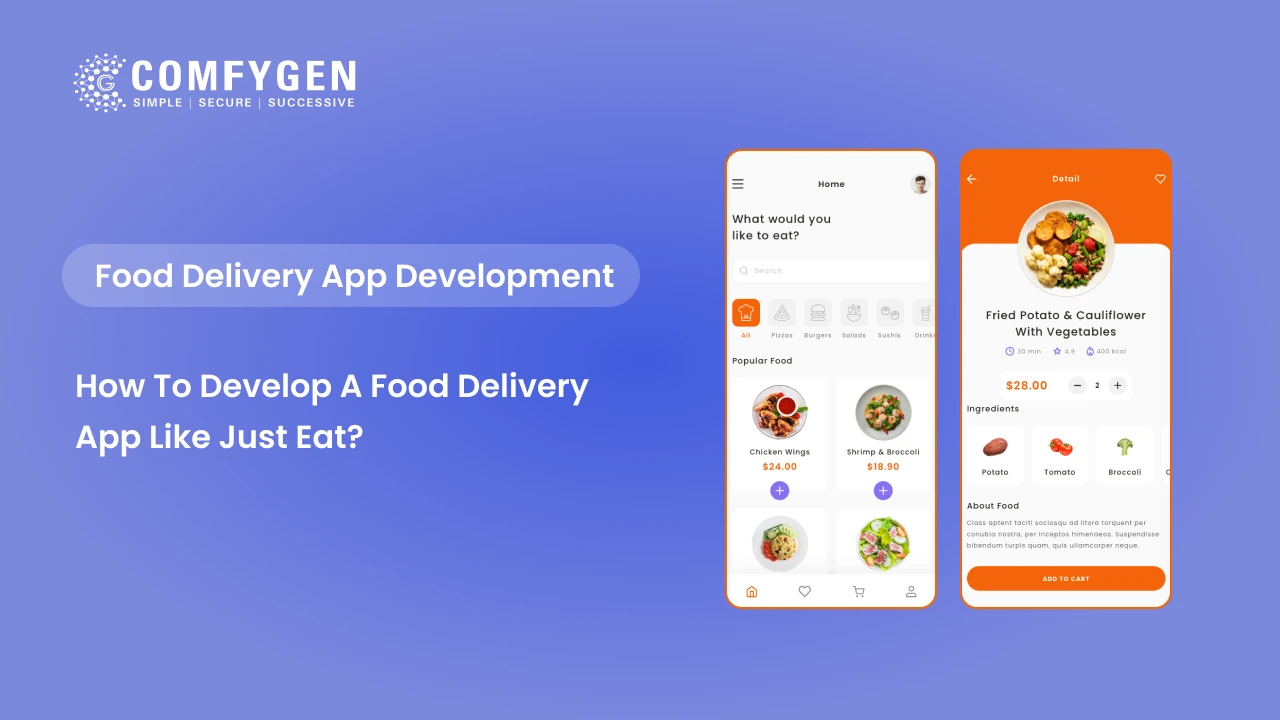





To develop a food delivery app like Just Eat costs £12,000 to £40,000 or more and takes 2 to 24 weeks depending on approach. A white-label launch runs £12,000 to £20,000 and goes live in a month. A custom marketplace MVP runs £20,000 to £40,000 over 8 to 12 weeks.
Anyone planning to build a food delivery app in the UK should start with the model rather than the features. Just Eat operates an aggregator marketplace: restaurants list, customers order, and delivery is handled either by the restaurant or by Just Eat’s own courier network. Building something similar means building four connected apps and, in the UK, getting three compliance areas right that most guides skip entirely.
What It Costs to Build an App Like Just Eat
| Build type | What you get | Cost (GBP) | Approx. USD | Timeline |
| White-label launch | Pre-built customer, restaurant and driver apps rebranded as yours, plus admin panel | £12,000 to £20,000 | $15,000 to $25,000 | 2 to 4 weeks |
| Custom marketplace MVP | Four apps built to your model, live tracking, multi-payment, commission engine | £20,000 to £40,000 | $25,000 to $50,000 | 8 to 12 weeks |
| Enterprise platform | Multi-city marketplace, AI features, courier fleet management, full analytics | £40,000+ | $50,000+ | 16 to 24 weeks |
Most UK founders launching in one city land in the first two bands. The enterprise figure applies if you’re opening several cities at once or running your own courier network from day one.
What Changes the Price
Food delivery app development cost in the UK moves on four things, and only one of them is the feature list.
How many apps you build: A working marketplace is four products: customer, restaurant, driver and admin. A quote covering only the customer app looks far cheaper and isn’t comparable.
Native or cross-platform: React Native or Flutter builds iOS and Android from one codebase and cuts frontend cost by 30% to 40%.
Whether you run couriers: An aggregator where restaurants deliver their own orders is meaningfully cheaper than one where you dispatch a fleet. The driver app and dispatch logic are a large chunk of the build.
Team location: UK agencies charge £70 to £120 an hour. Indian teams charge £12 to £32. The same build can differ by a factor of four on rate alone.
UK Rules You Cannot Skip
This is where a generic food delivery guide will cost you money.
UK GDPR and Data Protection
You’ll be processing names, addresses, order history and location data. That means a lawful basis for processing, working consent flows, data subject access request handling, and a retention policy you can actually execute. It shapes your backend design, not just your privacy page.
Get this wrong and you’re exposed to ICO enforcement, so build it in rather than bolting it on.
VAT on Food and Delivery
VAT treatment in the UK is genuinely fiddly. Hot takeaway food is standard-rated, most cold food is zero-rated, and delivery charges follow the liability of what’s being delivered. Your platform needs to calculate this correctly per line item, not apply a flat rate to the basket.
This is a real engineering requirement and it’s the item UK food platforms most often get wrong at launch. Check current rules on GOV.UK before you scope it.
Rider Employment Rules
The status of delivery riders in the UK has been through the courts repeatedly, and the distinction between worker and self-employed contractor carries real obligations around minimum wage and holiday pay. If you plan to run your own fleet rather than relying on restaurants, take legal advice before you design your driver onboarding.
Payment Methods UK Customers Expect
UK customers expect cards, Apple Pay, Google Pay and increasingly buy-now-pay-later at checkout. Stripe or Adyen cover most of this in one integration. UPI, UPI wallets and cash on delivery are not relevant to this market.
Build the Next Big Food Delivery Platform
Create a Just Eat-inspired food delivery app with powerful features, intuitive design, and a scalable technology foundation
Build Your App
The Four Apps You Need to Build
A working marketplace is four connected apps.
Customer App Features
- Registration and login by email, phone or social
- Restaurant browsing with cuisine, rating, price and delivery-time filters
- Menu viewing with item customization
- Cart and checkout with multiple payment methods
- Real-time order tracking with courier location on a map
- Order history and one-tap reorder
- Push notifications for order status and offers
- Ratings and reviews
Restaurant App Features
- Order acceptance and kitchen queue
- Menu and pricing control, including sold-out toggles
- Order-ready notification to trigger pickup
- Sales and order analytics
- Payout and settlement view
Driver App Features
- Order and pickup notifications
- Turn-by-turn navigation to restaurant, then customer
- Live location sharing
- Earnings and delivery history
- Availability toggle
Admin Panel Features
- Live view across orders, restaurants and drivers
- Restaurant onboarding and approval
- Commission and payout management
- Promo and coupon management
- Analytics and reporting
Deciding which of these features make the first release is where most budgets are won or lost. Ratings, loyalty and AI recommendations all sound essential in a planning meeting, but most food delivery app features belong in version two or three rather than at launch.
Which Technology to Use
| Layer | Common choices |
| Customer, restaurant and driver apps | React Native or Flutter; Swift and Kotlin if native |
| Backend | Node.js, Python (Django), Java (Spring Boot) |
| Database | PostgreSQL or MongoDB |
| Real-time layer | WebSockets or Firebase for live tracking |
| Maps and routing | Google Maps Platform |
| Payments | Stripe or Adyen |
| Notifications | Firebase Cloud Messaging |
| Hosting | AWS, Google Cloud or Azure, with UK or EU region selection |
Pick your hosting region deliberately. UK and EU data residency is a reasonable default for a British platform and it simplifies your GDPR position.
How Just Eat Makes Money
Just Eat’s model rests on commission from restaurants plus delivery fees from customers, with additional revenue from paid placement.
For a new entrant, the realistic revenue lines are:
Commission from restaurants: The main line for a marketplace. Set it low enough that restaurants prefer you to the incumbents.
Delivery fees: Charged to the customer, usually varying with distance or basket size.
Subscriptions:. Free delivery and member pricing for a monthly fee. Needs order frequency to work.
Paid placement: Restaurants pay for visibility in search. Only viable once you have volume, so treat it as a later revenue line.
The strategic point worth understanding is that you almost certainly won’t beat Just Eat or Deliveroo on selection. New platforms win by owning something the incumbents serve badly: one town, one cuisine, a university campus, or a restaurant group that’s tired of paying commission.
Step-by-Step Guide to Developing an Online Food Ordering App Like JustEat
Just Eat clone app development follows the same six stages as any four-app build. The UK compliance work runs alongside stages 2 and 4 rather than being bolted on at the end.
Step 1. Discovery and scoping, 1 to 2 weeks: Written feature list, tech stack, timeline, fixed scope. Vague scope is the most expensive problem in software and this is the stage where it’s free to fix.
Step 2. Design, 2 to 3 weeks: Wireframes and clickable prototypes for every screen, signed off before development starts.
Step 3. Development in sprints, 6 to 10 weeks: Two-week sprints with a working build at the end of each. If a vendor disappears for eight weeks and returns with a finished app, you’ve lost every chance to steer it.
Step 4. Integration: Payments, maps, notifications, SMS. If restaurants run a POS, this is where it connects, and some POS platforms need partner approval first, which can add two to four weeks.
Step 5. Testing, 1 to 2 weeks: Functional, load testing at expected peak, real payment transactions including refunds, and location testing on actual roads.
Step 6. Launch: Store submission for both platforms, server setup, monitoring. Apple review takes several days and can reject first time round.
Start With One Small Area
One town or one borough, roughly ten to fifteen restaurants, five couriers. Whatever breaks at fifty orders a day breaks far more expensively at five hundred.
Restaurant supply is the hard part, not the software. Sign your first restaurants before the build finishes, not after.
Building for Another Country?
The figures above are a UK build in GBP, and most of what makes them UK-specific is compliance rather than code. Swap GDPR and VAT for ZATCA and PDPL and you get the same platform priced in SAR for Saudi Arabia. Swap them again for the Gulf market and you get a Talabat-style build in AED. Underneath all three sits the same food delivery app development cost split across design, development and testing.
Why Work With Comfygen
Comfygen has delivered 550+ projects for 400+ clients across 30+ countries since 2019, with a 97% client retention rate, including UK-facing on-demand platforms.
Every build ships all four apps. Projects run in two-week sprints with a working demo at the end of each one, and full source code ownership transfers at delivery with no license fee. Founders scoping a custom food ordering marketplace around their own operating model usually start with a call before any code is written.
Conclusion
Developing a food delivery app like Just Eat offers immense potential in the growing online food delivery industry. By understanding the Just Eat business model, including essential and advanced features, and following a structured food delivery app development process like Just Eat, you can launch a successful, scalable, and profitable platform.
Start your Just Eat clone app development today with Comfygen Technologies and enter the booming online food delivery market!
Frequently Asked Questions
What does Just Eat clone app development involve?
How much does it cost to build an app like Just Eat?
How long does it take?
Do I need to handle VAT differently for food?
Does UK GDPR apply to a food delivery app?
Do I need my own courier fleet?
How many apps do I need?
Can I compete with Just Eat and Deliveroo?
What payment methods do UK customers expect?

Mr. Saddam Husen, (CTO)
Mr. Saddam Husen, CTO at Comfygen, is a renowned Blockchain expert and IT consultant with extensive experience in blockchain development, crypto wallets, DeFi, ICOs, and smart contracts. Passionate about digital transformation, he helps businesses harness blockchain technology’s potential, driving innovation and enhancing IT infrastructure for global success.