




The digital health revolution in the UAE and the broader Middle East is no longer a trend — it is the new standard. Platforms like HealthHub by Al-Futtaim have demonstrated that combining a physical network of clinics with a smart mobile app and telehealth capabilities creates a healthcare experience patients genuinely value. With HealthHub now operating across 19 clinic locations in Dubai and earning Platinum Accreditation from Accreditation Canada, the benchmark for a modern healthcare platform is clear.
If you are a healthcare entrepreneur, hospital group, or investor asking “how much does it cost to build something like this?” — this guide gives you a transparent, detailed answer. We cover every dimension: features, compliance, technology, team structure, realistic budgets, and how to structure a phased build that protects your capital.
What Is HealthHub by Al-Futtaim?
HealthHub by Al-Futtaim is a multi-specialty healthcare platform owned by the Al-Futtaim Group — one of the UAE’s largest conglomerates, operating in more than 20 countries across the Middle East, Africa, and Southeast Asia. Launched as an integrated primary and specialist care network, HealthHub has grown from 10 clinics to a network of 19 facilities across Dubai, with a flagship Day Surgery Centre at Dubai Festival City and plans for a full Greenfield Hospital.
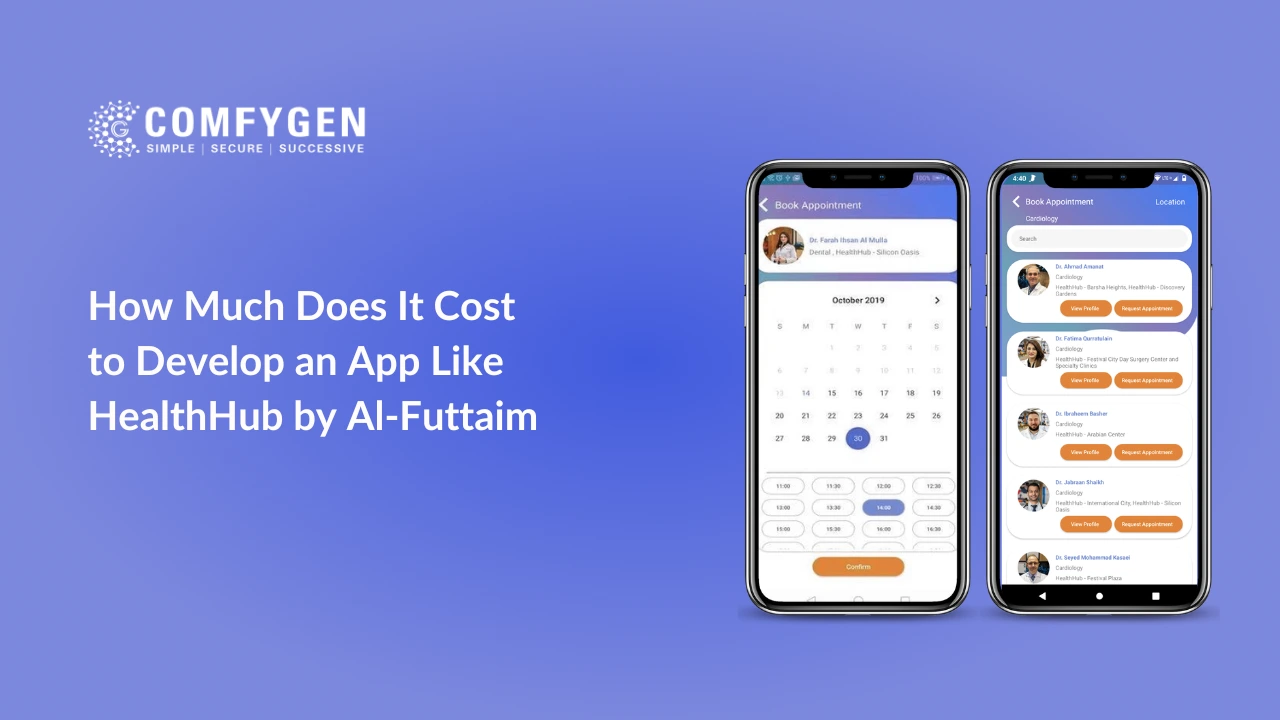
The HealthHub patient app is the digital backbone of this ecosystem. Patients can:
- Create a personal profile using a unique SMS registration ID
- Locate clinics across Dubai, with maps and real-time hours
- Browse specialist doctor profiles and their expertise areas
- Book, reschedule, or cancel appointments
- Access teleconsultation without leaving home
- View lab results and medical reports in-app
- Track past visit history
- Receive personalized care reminders and follow-ups
The app has accumulated over 130,000 downloads with a 4.17-star rating, making it one of the more-used healthcare apps in the UAE market. Its January 2025 update added medication refill requests, urgent care booking, and expanded family health management — features that raise the bar significantly for any competitor building in this space.
Healthcare App Market Overview
The numbers behind mobile health are difficult to ignore. The global mHealth market is valued at $45.14 billion in 2026 and is projected to reach $113.2 billion by 2034, growing at a CAGR of 11.80%. The broader digital health market is even larger — expected to grow from $491.62 billion in 2026 to $2.35 trillion by 2034.
In the UAE specifically, the government’s investment in smart healthcare and preventive care has fuelled strong adoption of health apps. The country’s relatively young, tech-savvy, and health-conscious population, combined with high smartphone penetration, makes it an ideal market for a HealthHub-type platform. The Dubai Health Authority’s strategic plan actively encourages private-sector investment in digital health — exactly the environment in which Al-Futtaim launched HealthHub.
Key demand drivers for healthcare apps in 2026 include:
- Post-pandemic shift toward proactive health management and teleconsultation
- Growing chronic disease burden (diabetes, hypertension) in the GCC
- Insurance mandates driving demand for integrated claims management
- AI and wearable technology creating richer, more personalized health data
- Government-led digital health initiatives (UAE Vision 2031, Saudi Vision 2030)
Why Build a Healthcare App Like HealthHub?
Benefits for Patients
Convenient Appointment Booking
Patients can find the right specialist and book in minutes — without phone queues or waiting rooms. Rescheduling and cancellation are self-serve.
Accessible Healthcare Anywhere
With teleconsultation, patients in remote areas or with mobility challenges can access the same quality of care as those near a clinic.
Centralized Health Records
Lab results, prescriptions, visit summaries, and imaging reports are stored in one place — accessible any time.
Better Health Engagement
Personalized reminders for medication, follow-ups, and preventive screenings keep patients active participants in their own care.
Benefits for Healthcare Providers
Reduced Administrative Load
Online booking, digital intake forms, and automated reminders cut admin time by up to 40%, freeing staff for clinical tasks.
Data-Driven Clinical Decisions
Integrated EHR and diagnostic data give doctors a complete picture of patient history, leading to better-targeted treatment.
Increased Revenue Streams
Telehealth extends reach beyond physical geography. Subscription plans, in-app pharmacy, and wellness programs add diversified revenue.
Stronger Brand Trust
Patients who can manage their care digitally report higher satisfaction scores — driving referrals and loyalty.
For a deeper dive into the business case, see our guide on doctor appointment app development process.
Core Features Your HealthHub-Like App Must Have
Before discussing costs, it is critical to agree on what “core” means. These are features that directly mirror what HealthHub offers and that users will expect from day one.
Patient-Facing Features
| Feature | Description |
| Profile & Registration | SMS-verified onboarding, personal health profile, guest login option |
| Clinic Locator | Google Maps integration, real-time hours, directions |
| Doctor Profiles & Search | Filter by specialty, language, gender, availability, ratings |
| Appointment Booking & Management | Real-time slots, booking confirmation, rescheduling, cancellation |
| Visit History | Chronological log of past consultations and diagnoses |
| Teleconsultation | Encrypted video/audio, chat, e-consent, document upload |
| Lab Results Viewer | In-app display of diagnostic reports and imaging results |
| Prescription Management | Digital prescriptions, medication history, pharmacy integration |
| Push Notifications & Reminders | Appointment, medication, and follow-up reminders |
| In-App Payments | Cards, digital wallets, insurance claims, payment links |
| Insurance Integration | Direct billing with major insurers, coverage verification |
| Family Health Management | Manage appointments and records for multiple dependents |
| Multi-Language Support | English + Arabic minimum for UAE market |
Provider-Facing Features (Doctor Dashboard)
| Feature | Description |
| Schedule Management | Set availability, block slots, manage waiting lists |
| Patient Queue Management | Real-time check-in status, patient arrival notifications |
| EHR Access | Full patient history during consultations |
| e-Prescription Writing | Digital prescription issuance with pharmacy routing |
| Teleconsultation Panel | Initiate and manage video consults, document notes |
| Billing & Revenue Reports | Consultation fees, insurance claims status, payment tracking |
For a complete exploration of must-have doctor appointment app features, see our article on features of doctor appointment app development.
Advanced & AI-Powered Features to Include in 2026
These features differentiate a commodity health app from a market-leading platform. HealthHub’s continued investment in AI, IoT integration, and smart clinic technology signals that the market expects these in any premium healthcare platform.
AI Symptom Checker
Patients describe symptoms; the AI triage engine suggests likely conditions and recommends the right specialist — reducing unnecessary ER visits.
IoT & Wearable Integration
Sync with Apple Watch, Fitbit, and medical-grade wearables for real-time vital tracking. Enables remote patient monitoring (RPM) for chronic conditions.
AI-Powered Health Insights
Machine learning surfaces personalized health trends and early warning flags from a patient’s aggregated data — before symptoms escalate.
EHR / EMR Integration (FHIR)
HL7 FHIR-compliant data exchange lets your platform talk to hospitals, labs, and insurance systems — a legal requirement in many markets since the 21st Century Cures Act.
Blockchain Health Records
Decentralized, tamper-proof storage of patient records enhances trust and makes data sharing between providers secure and auditable.
AR/VR for Patient Education
3D organ models help patients visualize diagnoses. Surgeons can use VR for pre-operative planning. Differentiates your platform at a product level.
Multilingual AI Chat Support
24/7 LLM-powered chat assistant handles appointment queries, medication FAQs, and post-visit care instructions in the patient’s language.
Medication Refill & Pharmacy API
One-tap prescription refills with delivery routing to the nearest pharmacy — or direct integration with your clinic’s in-house pharmacy.
Compliance & Data Security: What You Cannot Skip
Key Regulatory Frameworks
| Regulation | Jurisdiction | Key Requirements | Cost Impact |
| HIPAA | USA | PHI encryption, audit logs, BAAs, access controls, annual pen testing | +15–20% of total budget |
| GDPR | EU / Global | Data minimization, consent management, right to erasure, DPO appointment | +10–15% of total budget |
| UAE DHA Regulations | Dubai / UAE | Dubai Health Authority licensing, data localization, teleconsultation standards | Legal fees + integration work |
| PIPEDA | Canada | Consent-based data collection, breach notification within 72 hours | +5–10% if Canadian market targeted |
| ISO 13485 / IEC 62304 | SaMD classification | Required if the app interprets clinical data (AI diagnostics). QMS documentation. | Significant — requires specialist team |
Security Architecture Baseline
- Encryption: AES-256 for data at rest; TLS 1.3 for data in transit
- Authentication: Multi-factor authentication (MFA) + biometric login (Face ID / Fingerprint)
- Audit Logs: Every record access logged with timestamp, user ID, and action type
- Session Management: Auto-logout after inactivity in clinical environments
- Penetration Testing: Annual third-party testing (increasingly mandatory under proposed 2025 HIPAA Security Rule update)
- Vulnerability Scanning: Semi-annual scans for exposed endpoints and dependency issues
Learn more about healthcare data security in our dedicated resource on HIPAA compliance in mobile health apps.
Full Cost Breakdown: How Much Does It Cost to Build an App Like HealthHub?
There is no single answer because the cost depends on scope, team location, compliance requirements, and feature depth. Below are honest, market-calibrated ranges based on industry data for 2026.
By App Complexity Tier
| Tier | What You Get | Development Cost | Timeline |
| MVP / Basic | Appointment booking, doctor profiles, clinic locator, basic patient profile, push notifications | $40,000 – $80,000 | 3–5 months |
| Mid-Tier | All MVP features + teleconsultation, EHR integration, lab result viewer, in-app payments, insurance claims, prescription management | $80,000 – $200,000 | 6–10 months |
| HealthHub-Level | Full platform: all mid-tier features + AI symptom checker, wearable integration, blockchain records, multilingual AI chat, multi-specialty admin panel, pharmacy integration | $200,000 – $500,000+ | 10–18 months |
| Enterprise | Full hospital ecosystem with custom EHR, SaMD-classified AI diagnostics, multi-country compliance, hospital management module | $500,000+ | 18–36 months |
Annual Maintenance & Operations (Post-Launch)
A healthcare app is not a one-time cost. Budget approximately 15–25% of your initial development cost annually for:
- Cloud hosting (AWS/Azure Healthcare-grade) — $2,000–$10,000/month depending on scale
- Third-party API costs (video, SMS, maps, EHR connectors)
- Annual security penetration testing — $5,000–$40,000
- Regulatory compliance updates as laws change
- OS update compatibility (new iOS/Android releases)
- Bug fixes, feature enhancements, and new integrations
Key Factors That Affect Your Development Cost
1. Team Location & Hourly Rates
| Region | Avg. Hourly Rate | Quality Profile |
| North America (US/Canada) | $150 – $250/hr | Highest cost; strong compliance expertise |
| Western Europe (UK/Germany) | $80 – $150/hr | High cost; strong GDPR expertise |
| Eastern Europe | $40 – $80/hr | Good quality; growing compliance experience |
| India / South Asia | $25 – $60/hr | Strong talent pool; cost-effective; verify HIPAA experience |
| Southeast Asia | $30 – $70/hr | Competitive; growing healthcare app expertise |
2. Platform Choice
Native iOS + Native Android (two separate codebases) delivers the best performance but nearly doubles development cost. Most healthcare apps in 2026 use Flutter or React Native to target both platforms from a single codebase, reducing cost by 30–40% with minimal performance trade-off.
3. Number & Complexity of Integrations
Each API integration adds cost: EHR systems (Epic, Cerner), payment gateways, insurance APIs, lab systems, IoT device SDKs, and government health registries. Expect $5,000–$20,000 per major integration for initial setup, plus ongoing maintenance.
4. AI & Machine Learning Features
AI integration is no longer optional for competitive platforms, but it comes with significant cost layers. Beyond development, budget for LLM token usage (API costs per query), data training, model governance, and ongoing compliance around how PHI moves through AI pipelines. AI features add $30,000–$150,000 to development cost depending on depth.
5. UI/UX Design Investment
Healthcare apps serve patients across all ages and digital literacy levels. Generic, templated design leads to poor adoption and abandonment. Custom UX research and design costs more upfront but produces measurably better retention — studies consistently show 200%+ better user retention with strong UI/UX design in healthcare.
6. Microservices vs. Monolithic Architecture
In 2026, most scalable healthcare platforms are built on microservices architecture — where components like booking, teleconsultation, and billing operate independently. This adds 20–30% to initial development cost but reduces long-term costs by enabling modular scaling and minimizing the blast radius when one service fails.
Step-by-Step Development Process
1. Discovery & Requirement Analysis (2–4 weeks)
Define the problem, target market, user personas, regulatory requirements, and competitive landscape. Output: Product Requirements Document (PRD) and feature list prioritized by user value.
2. Compliance & Architecture Planning (2–3 weeks)
Determine applicable regulations (HIPAA, GDPR, DHA), define the security architecture, and design the system’s data model. This step happens before design — not after. Decisions made here determine 80% of your total cost.
3. UI/UX Design & Prototyping (3–6 weeks)
Create wireframes, user flows, and interactive prototypes for both patient and provider interfaces. Test with real users before writing a line of code. This is where expensive rebuild cycles are avoided.
4. Frontend & Backend Development (12–28 weeks)
Parallel development tracks: mobile app (Flutter/React Native), web admin panel, backend API, database schema, and third-party integrations. Agile sprints with 2-week review cycles keep scope in check.
5. Integration & API Testing (3–4 weeks)
Connect EHR systems, payment gateways, teleconsultation SDKs, insurance APIs, and device integrations. Test each integration against real-world edge cases (network failures, session timeouts, data format mismatches).
6. Security Audit & Compliance Testing (2–4 weeks)
Third-party penetration testing, HIPAA/GDPR compliance audit, vulnerability scanning, and data privacy assessment. Do not skip this step — a post-launch breach costs many times more than pre-launch testing.
7. Launch, Deployment & App Store Submission (1–2 weeks)
Deploy to HIPAA-eligible cloud, configure monitoring and alerting, submit to App Store and Google Play, set up analytics dashboards, and train support staff.
8. Post-Launch Support & Continuous Improvement
Monitor performance metrics, collect user feedback, iterate on features, apply OS updates, and maintain compliance as regulations evolve. Comfygen provides dedicated post-launch support for all healthcare clients.
Why Choose Comfygen to Build Your Healthcare App?
Comfygen is a full-service mobile and web development company with a dedicated healthcare practice. Our team has built healthcare apps, telemedicine platforms, doctor appointment systems, pharmacy apps, and medicine delivery platforms for clients across the UAE, India, the UK, and North America.
Building innovative solutions since 2019
Our team understands clinical workflows, regulatory requirements, and the practical challenges of integrating with real healthcare systems.
Proven Development Process
Agile, milestone-driven delivery with full transparency. You own the code, the IP, and the deployment infrastructure from day one.
Compliance-First Architecture
We design HIPAA, GDPR, and UAE DHA compliance into the system from the architecture phase — not as an afterthought.
End-to-End Support
From concept to launch and beyond — post-launch maintenance, feature updates, and compliance monitoring included in all healthcare engagements.
Technologies we use: Flutter, React Native, Node.js, Python, React JS, MongoDB, PostgreSQL, AWS, Azure, and blockchain for health record security via our blockchain practice. We also support IoT integration through our IoT development team.
Ready to Build Your Healthcare Platform?
Tell us your idea. Our team will review your requirements and send a detailed proposal — including a phased roadmap, technology recommendation, and transparent cost estimate — within 24 hours. No commitment required.
Start Your Free Consultation →
Frequently Asked Questions
How much does it cost to develop an app like HealthHub by Al-Futtaim?
How long does it take to develop a healthcare app like HealthHub?
An MVP takes 3–5 months. A mid-tier platform with EHR, teleconsultation, and payment integration takes 6–10 months. A full HealthHub-equivalent platform takes 10–18 months. Timelines depend on team size, feature complexity, and how quickly compliance milestones are completed.
What regulations does a healthcare app in the UAE need to comply with?
In the UAE, healthcare apps must comply with Dubai Health Authority (DHA) regulations for teleconsultation, patient data handling, and digital prescriptions. If serving international patients or handling EU citizen data, GDPR also applies. Comfygen builds all UAE-market healthcare apps to DHA standards as a baseline, with layered compliance for HIPAA and GDPR where applicable.
What is the difference between HealthHub UAE and HealthHub SG?
HealthHub by Al-Futtaim (UAE) is a private healthcare network with clinics, pharmacies, and a patient app focused on the Dubai/UAE market. HealthHub SG is a separate national digital health platform operated by the Singapore Ministry of Health for Singapore residents. They share a brand name but are entirely unrelated platforms and organizations.
Can I build a healthcare app without the physical clinic network?
Yes — many successful healthcare platforms operate as pure digital marketplaces connecting patients with independent doctors and clinics. You can build a platform that any registered clinic or doctor can join, similar to how Practo or Zocdoc operate. This model requires a robust onboarding, credentialing, and review system for healthcare providers.
What are the different types of healthcare apps that can be built?
Common healthcare app types include: telemedicine/teleconsultation apps, doctor appointment booking apps, EHR/EMR management systems, online pharmacy apps, medicine delivery apps, remote patient monitoring apps, mental health apps, chronic disease management apps, and integrated health platforms (like HealthHub) that combine several of these functions. Comfygen has dedicated teams for all of these categories.

Mr. Saddam Husen, (CTO)
Mr. Saddam Husen, CTO at Comfygen, is a renowned Blockchain expert and IT consultant with extensive experience in blockchain development, crypto wallets, DeFi, ICOs, and smart contracts. Passionate about digital transformation, he helps businesses harness blockchain technology’s potential, driving innovation and enhancing IT infrastructure for global success.