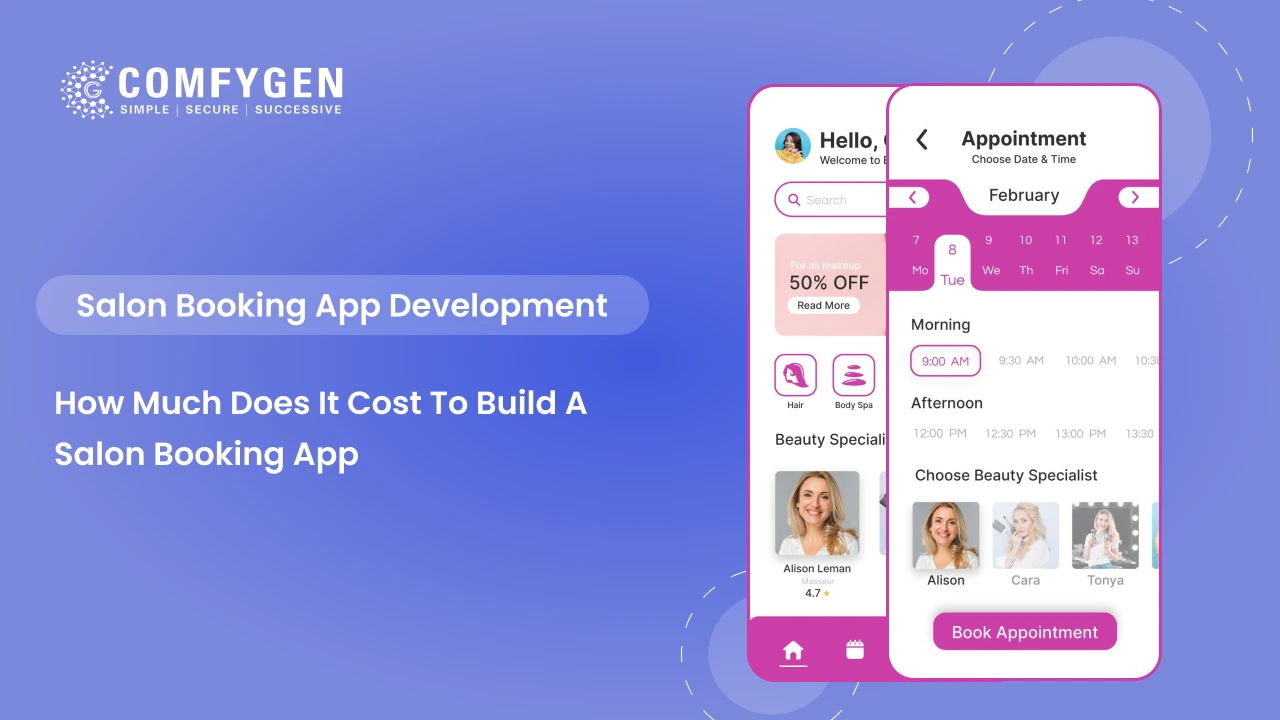





Quick Answer: The cost to build a salon app typically ranges from $5,000 to $30,000+, depending on the features, platforms, integrations, and level of customization required. A basic app with booking and payments costs $5,000–$8,000, a medium solution with features such as notifications, reviews, and staff management costs $9,000–$15,000, while an advanced platform with AI-powered features, AR experiences, loyalty programs, or multi-location support starts at $20,000 and can exceed $30,000.
The global Salon Booking Software Market size is estimated at USD 629.27 million in 2026 and is projected to reach USD 1128.53 million by 2035, growing at a CAGR of 6.7% from 2026 to 2035. Fresha alone surpassed 1 million monthly app downloads in early 2026, a 300% increase since mid-2024. Booksy serves over 15 million users and generates more than $50 million annually. StyleSeat has processed over $6.5 billion in revenue for stylists since its launch.
These numbers tell you one thing: the demand for digital salon booking is real, growing, and still has room for new players — especially those targeting niche markets, regional languages, or specific service verticals. If you are a salon owner, entrepreneur, or startup founder asking “how much does it cost to build a salon app,” this article gives you specific numbers, a real cost breakdown, and everything you need to plan your investment correctly.
What Is a Salon Booking App?
A salon app is a mobile application that allows customers to schedule, pay for, and manage beauty service appointments directly from their smartphones. It connects clients with salons, shows real-time stylist availability, automates appointment reminders, and processes payments, replacing the traditional phone call or walk-in booking model.
On the business side, it provides salon owners with a live dashboard to manage bookings, staff schedules, revenue, and customer data in one place.
Types of Salon Booking Apps
1. Standalone Salon App
Built for a single salon or spa brand. Customers download your app, book your services, and interact only with your brand. It builds loyalty and gives you full ownership of your customer data.
Best for: Established salons, chains, and premium spa brands wanting direct client relationships.
Estimated cost: $5,000–$15,000, depending on feature depth.
2. Aggregator Marketplace App
One platform connecting customers to multiple salons similar to how Fresha or Booksy work. Users compare salons, read reviews, and book from a single app.
Best for: Entrepreneurs building a business around the marketplace model, earning through commissions and listing fees.
Estimated cost: $20,000–$30,000+ due to multi-vendor architecture, review systems, and payment splitting.
3. Hybrid Salon App
Combines standalone and marketplace features. Individual salons manage their own bookings and branding, while users can discover partner salons within the same platform.
Best for: Salon chains expanding into new markets or franchise models.
Estimated cost: $15,000–$30,000.
Ready to Build Your Own Salon App
Like StyleSeat?
Let’s Connect
Why Build a Salon App Instead of Using an Existing Platform?
This is a fair question. Fresha is free to use. Booksy starts at $29.99/month. Why spend $10,000+ building your own?
Three concrete reasons:
1. You own your customer data. On Fresha or Booksy, your clients are also the platform’s clients. The platform can recommend competing salons to your customers. With your own app, every booking, preference, and contact belongs to you.
2. No commission cuts. StyleSeat charges stylists a booking fee on every appointment and takes a commission on Smart Pricing upsells. At scale, those fees add up to tens of thousands of dollars annually.
3. Full control over features and branding. You cannot add a custom loyalty program, integrate with your own POS, or run your own referral campaigns on a third-party platform. Your own app gives you that freedom.
Digital booking and customer engagement tools can help salons improve client communication and encourage repeat visits. The return on investment depends on factors such as customer adoption, service demand, marketing, and how effectively the platform is used.
When a Custom Salon App Is Not Worth It
Not every salon should build. Here is when the honest answer is to stay on existing software.
- You run one location under 200 bookings a month. Fresha’s free tier or a $30/month plan covers what you need. Revisit this at 500 bookings or a second location.
- You have no plan for app downloads. Building the app is the cheap part. Getting clients to install it is the expensive part, and salons that skip this end up with a $10,000 app nobody uses.
- You want it purely for the branding. A branded booking page on your website costs a fraction and delivers most of the perceived benefit.
- You should also plan for post-launch maintenance. Regular updates help keep the app compatible with evolving operating systems, security requirements, and third-party services.
Build when you have multiple locations, meaningful commission or processing fees, a client base that already books repeatedly, or a marketplace model where the app is the business rather than a channel.
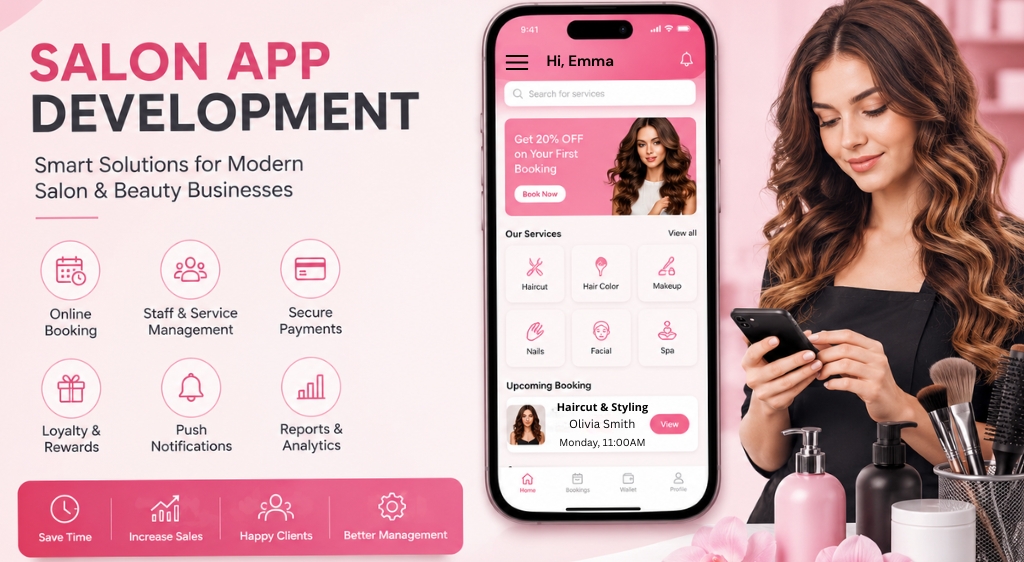
Key Features of a Salon Booking App
Customer-Facing Features
- User Registration and Login: Customers create accounts via email, phone number, or social login (Google, Apple). Fast onboarding reduces drop-off. This feature takes 20–40 development hours.
- Service Catalogue and Booking: Users browse services, choose a stylist, pick a time slot, and confirm the booking. The clearer this flow, the higher your conversion. This is the core feature of the app and takes 60–100 hours to build.
- Real-Time Availability: Customers see live stylist availability rather than submitting a request and waiting. This requires a real-time database sync (typically Firebase or WebSockets). Development time: 30–50 hours.
- Secure Online Payment: Support for credit/debit cards, UPI, digital wallets, and net banking through integrated payment gateways such as Stripe, Razorpay, or PayPal. Development time: 40–60 hours.
- Appointment Reminders: Automated SMS and push notification reminders 24 hours and 2 hours before an appointment. Automated reminders can help reduce missed appointments by reminding customers about upcoming bookings.
- Ratings and Reviews: Post-appointment review system for customers to rate services and stylists. Reviews directly affect trust and conversion for new customers.
Salon Owner and Admin Features
- Booking Management Dashboard: A live view of all upcoming appointments, cancellations, and walk-ins. Salon owners can confirm, reschedule, or cancel bookings from this single screen.
- Staff Scheduling: Assign appointments to specific stylists based on their availability and expertise. Prevents double-booking and idle time gaps.
- Revenue and Performance Reports: Daily and monthly earnings, top-performing services, busiest hours, and staff productivity metrics. This data directly supports pricing decisions and staffing.
- Customer Management (CRM): Stores customer history, preferences, previous services, and contact information. Salons that use client history data for personalisation see higher rebooking rates.
- Promotions, Memberships, and Loyalty Programs: Run seasonal discounts, referral programs, and membership packages directly from the admin panel. Loyalty programs can encourage repeat visits by rewarding customers for continued engagement with a salon or service provider.
Advanced Features (Optional but High-ROI)
- AI-Powered Service Recommendations: The app analyses booking history and customer preferences to suggest relevant services or packages. For example, if a client books a haircut every 6 weeks, the app can prompt them to book again at the right time. This is the same logic Vagaro applied when it introduced its AI recommendation engine in 2024.
- AR Virtual Try-On: Augmented Reality lets users virtually preview hairstyles, hair colours, or makeup looks before booking. This can help customers visualize potential hairstyles, hair colours, or makeup looks before booking and may make the decision process easier. AR features also add technical complexity and should be considered based on the needs of the target audience.
- In-App Chat with Stylists: Direct messaging between clients and stylists before an appointment. Helps clients describe what they want and builds pre-appointment trust.
- Voice Booking: Integration with Siri, Google Assistant, or a custom voice interface. Users say, “Book me a haircut at 3 PM tomorrow,” and the app confirms it.
- Social Media Booking: Square Appointments integrated with social media in 2024, allowing clients to book directly from Instagram profiles. This reduces friction for social-first customers.
Factors That Determine Salon Booking App Development Cost
App Complexity
This is the biggest cost driver. A simple app with booking and payments requires far fewer development hours than one with AI, AR, real-time chat, and multi-location management.
| Complexity | Key Features | Estimated Hours |
|---|---|---|
| Basic | Registration, booking, and payments | 200–320 hours |
| Medium | Above + reviews, notifications, staff scheduling | 350–550 hours |
| Advanced | Above + AI, AR, CRM, loyalty, multi-vendor | 650–1,000+ hours |
Platform Choice
Building for one platform generally requires less development effort than developing separate native apps for both Android and iOS. Cross-platform frameworks such as Flutter or React Native can also help businesses build for multiple platforms with a shared codebase.
- Android or iOS only: $5,000–$10,000
- Both platforms (native): $12,000–$25,000
- Cross-platform (Flutter/React Native): $8,000–$18,000
Flutter and React Native both hold a large share of cross-platform development, and either is a solid choice for a salon app. Flutter tends to win on UI consistency across devices; React Native wins if your team already writes JavaScript.
UI/UX Design
A clean, well-designed interface increases bookings. Poor UX loses customers at the booking screen. Research shows users abandon an app after a bad first experience.
- Basic design: $2,000–$3,000
- Custom branded design with animations: $4,000–$8,000
Backend and API Integrations
Your backend handles user data, booking logic, payment processing, and notifications. Integrating with third-party APIs (Stripe, Razorpay, Twilio for SMS, Google Maps for salon location) adds to development time but is non-negotiable for a functional app.
Backend development typically accounts for 30–40% of total project cost.
Developer Location
This single factor can cut your budget in half or double it.
| Region | Hourly Rate |
|---|---|
| USA | $80–$150/hour |
| UK / Western Europe | $60–$120/hour |
| Eastern Europe | $40–$80/hour |
| Dubai / UAE | $50–$100/hour |
| India | $20–$40/hour |
Development costs can vary significantly by region because of differences in hourly rates and operating costs. When comparing development partners, consider the team’s experience, technical expertise, communication process, and project scope alongside pricing.
Post-Launch Maintenance
Your app needs regular updates for new OS versions, security patches, and bug fixes. Budget 10–20% of your initial development cost annually for maintenance. A $12,000 app costs roughly $1,200–$2,400/year to maintain, and a $25,000 advanced build runs $2,500–$5,000/year.
Want to See a Demo of a Salon Booking App?
Get A Demo
Salon App Development Cost Breakdown by Package
Basic Salon Booking App: $5,000–$8,000 (6–8 Weeks)
What you get:
- User registration and login
- Service catalogue with pricing
- Calendar-based appointment booking
- Single payment gateway
- Basic push notifications
- Simple admin dashboard
Medium Salon Booking App: $9,000–$15,000 (10–14 Weeks)
What you get: Everything in basic, plus:
- Multiple payment methods
- Ratings and reviews
- Staff scheduling and management
- Customer history and CRM basics
- Promotional offers and discount codes
- Revenue reports and analytics
Advanced Salon Booking App: $20,000–$30,000+ (16–20 Weeks)
What you get: Everything in medium, plus:
- AI-powered recommendations
- AR virtual hairstyle/makeup try-on
- In-app chat with stylists
- Multi-location or multi-vendor support
- Loyalty programs and memberships
- Social media booking integration
- Advanced analytics and business intelligence
Why This Cost Range Is Lower Than Other Estimates
Most published salon app estimates start at $20,000 for a basic build because they price a US or Western European team at $80 to $150 an hour. The figures above assume an India-based team at $20 to $40 an hour and a single cross-platform codebase instead of two native builds. Feature list, platform coverage, and payment integrations stay identical. What changes is the hourly rate behind them. When you compare quotes, ask which region the engineers sit in before treating a higher number as a better product.
Beauty App Development Cost: Beyond Salon Booking
Beauty apps can cover a wider range of products beyond salon appointment booking, including beauty e-commerce platforms, virtual try-on experiences, AI-powered skincare tools, and integrated beauty marketplaces, which can affect the overall cost.
- Beauty E-commerce App: Product catalogs, shopping carts, payments, order management, customer accounts, and delivery integrations.
- Virtual Try-On App: AR-based experiences that allow users to preview makeup, hairstyles, or other beauty products virtually.
- AI Skincare App: Skin analysis, personalized skincare recommendations, product suggestions, and user profiles.
- All-in-One Beauty Marketplace: Multiple beauty services or products, provider/vendor profiles, bookings, payments, reviews, and marketplace management.
Development costs vary depending on the technology, features, integrations, and level of customization involved. Advanced capabilities such as AI, computer vision, AR, and multi-vendor functionality can increase the overall complexity and development requirements of the project.
How Much Does It Cost to Build an App Like Fresha, Booksy, or StyleSeat?
Apps inspired by platforms such as Fresha, Booksy, or StyleSeat can require more complex development than a standard salon booking app. Depending on the business model, they may include multi-vendor management, customer discovery, marketplace functionality, payment workflows, and advanced business tools.
App like Fresha: Fresha’s core differentiator is its freemium model — free software for salons, revenue from payment processing. Building a similar platform with multi-vendor support, a marketplace, payment processing, and real-time analytics costs $30,000–$60,000+.
App like Booksy: Booksy combines a consumer marketplace with a salon management tool. It charges salons a monthly subscription. Building a comparable app costs $25,000–$50,000.
App like StyleSeat: StyleSeat focuses on independent stylists with Smart Pricing and a client discovery marketplace. Building a similar app with marketplace search, stylist profiles, and commission-based payments costs $25,000–$60,000.
All three are mature platforms built over the years with large engineering teams. If you are starting, build a focused MVP first. Validate your market. Then expand.
Tech Stack for a Salon Booking App
Here is what a production-ready salon booking app typically uses:
| Layer | Technology Options |
|---|---|
| Frontend (Mobile) | Flutter, React Native |
| Backend | Node.js, Python (Django/FastAPI) |
| Database | PostgreSQL (relational data), Redis (caching, real-time) |
| Real-Time | Firebase, WebSockets |
| Payments | Stripe, Razorpay, PayPal |
| Push Notifications | Firebase Cloud Messaging (FCM) |
| SMS Reminders | Twilio |
| Cloud Hosting | AWS, Google Cloud, DigitalOcean |
| Maps | Google Maps API |
How to Choose a Salon Booking App Development Company
Check Their On-Demand App Portfolio
Look specifically for apps they have built in the on-demand services space: food delivery, home services, and appointment booking. These require the same real-time booking logic, payment integration, and calendar systems your salon app needs.
Generic mobile app portfolios with only e-commerce or social apps are not the same thing.
Verify Their Security Practices
Your app handles customer payment data and personal information. Ask any potential development partner:
- Do you follow OWASP mobile security guidelines?
- Do you conduct penetration testing before launch?
- How do you handle payment data? (Answer should be: through certified gateways like Stripe, not stored on your servers)
Ask About Post-Launch Support
Your app will have bugs. OS updates will break things. New payment regulations will require changes. A company that disappears after handoff costs you more than their slightly cheaper quote suggests.
Get a clear post-launch support agreement in writing: response time SLA, monthly maintenance cost, and what is included.
Evaluate Communication Transparency
For offshore development, the time zone gap is real. Ask how they handle daily standups, how they share progress, and what project management tool they use. Teams using Jira, Slack, and weekly demo calls are far more reliable than those who disappear for two weeks and send you a file.
Comfygen’s salon app development team works across the full stack — mobile, backend, and design — with a dedicated project manager on every engagement.
Development Timeline: What to Expect
| Phase | Duration |
|---|---|
| Discovery and requirement analysis | 1–2 weeks |
| UI/UX design | 2–4 weeks |
| Frontend development | 4–8 weeks |
| Backend development | 4–8 weeks |
| Third-party integrations | 2–3 weeks |
| Testing and QA | 2–3 weeks |
| App Store / Play Store submission | 1–2 weeks |
| Total (basic to medium app) | 6–14 weeks |
Future Trends Shaping Salon App Development
AI Personalisation at Scale
Vagaro introduced an AI-driven recommendation engine in 2024, and the direction is clear. Top salon apps increasingly predict when a client is due for a service, recommend treatments based on past bookings, and personalise offers by segment. Building this in from the start is cheaper than retrofitting it, and the AI salon app development route is now a standard scoping question rather than a premium add-on.
Social Commerce Booking
AI-powered search and conversational tools are creating new ways for customers to discover services and make booking decisions. Businesses can benefit from flexible integrations and APIs that support emerging booking channels as customer behaviour evolves.
Data-Driven Salon Management
The next generation of salon apps gives owners predictive analytics: projected revenue for the next 30 days, likelihood of a client churning, and the best time slots to run promotions. Large chains already use this in enterprise software. As analytics tools become more accessible, data-driven features may become increasingly common across salon management platforms of different sizes.
Conclusion
The cost to build a salon booking app ranges from $5,000 to $30,000+ in 2026, depending on complexity, platform, features, and developer location.
Here is the summary:
| App Type | Features | Cost Range | Timeline |
|---|---|---|---|
| Basic | Booking, payments, reminders | $5,000–$8,000 | 6–8 weeks |
| Medium | Above + staff management, reviews, CRM | $9,000–$15,000 | 10–14 weeks |
| Advanced | Above + AI, AR, loyalty, multi-vendor | $20,000–$30,000+ | 16–20 weeks |
Which Salon App Package Fits Your Business?
- Basic: A practical choice for single salons and solo stylists who need online booking and essential customer management features.
- Medium: Suitable for growing salons and small chains that need staff management, CRM, promotions, and more operational control.
- Advanced: Designed for salon chains, franchises, and aggregator platforms that require advanced features, multiple locations, or complex workflows.
Not sure which package fits your idea? Share your requirements to get a feature-based estimate based on your business model and launch goals.
As customer expectations continue to shift toward convenient digital experiences, salons are increasingly turning to technology to simplify appointment booking, strengthen customer engagement, and manage daily operations more efficiently. A custom salon app can give your business greater control over its brand, customer relationships, bookings, and overall digital experience.
If you’re ready to build a salon booking app, Comfygen’s salon app development team can help you identify the right features for your budget, select a suitable technology stack, and plan a clear path from development to launch. Whether you’re building an app for a single salon, a growing chain, or a larger salon marketplace, we can help you create a solution aligned with your business goals.
FAQs
How much does it cost to build a salon booking app in India?
What features are essential for a salon booking app?
Can I build a salon booking app like Fresha or Booksy?
How long does it take to develop a salon booking app?
Which is better: Native or Cross-platform app development for salons?
How can a salon booking app help grow my salon business?

Mr. Saddam Husen, (CTO)
Mr. Saddam Husen, CTO at Comfygen, is a renowned Blockchain expert and IT consultant with extensive experience in blockchain development, crypto wallets, DeFi, ICOs, and smart contracts. Passionate about digital transformation, he helps businesses harness blockchain technology’s potential, driving innovation and enhancing IT infrastructure for global success.