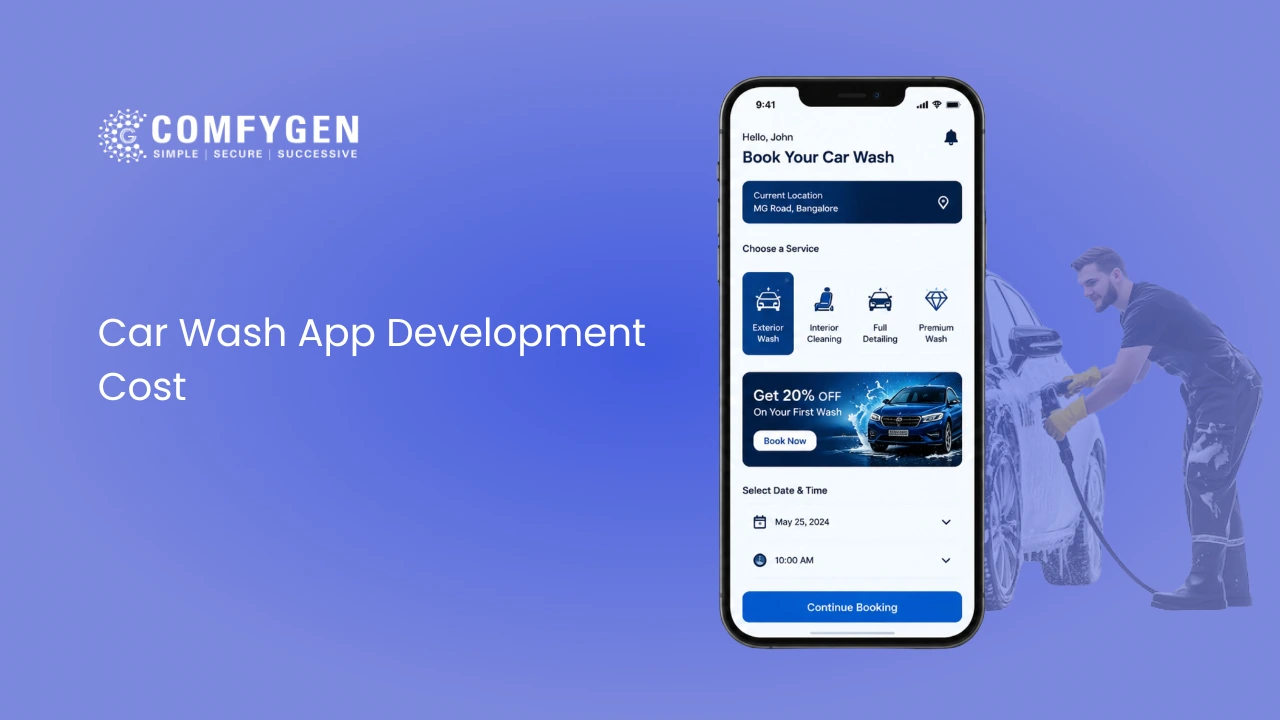





Quick answer: Car wash app development cost in 2026 usually runs between $5,000 and $90,000+, depending on how complex the app is. A basic booking app for a single car wash business sits at the lower end. A full multi-vendor, on-demand marketplace app, the kind that competes with players like Washos, sits at the top.
If you have ever waited in a car wash queue on a Saturday morning, you already know why on-demand car wash apps took off. Nobody wants to lose an hour of their weekend for a wash that takes fifteen minutes. That gap between what customers want and what most car wash businesses still offer is why so many owners and entrepreneurs come to us at Comfygen with the same question: what does it actually cost to build one of these apps in 2026?
This isn’t just a hunch. The global car wash services market is set to reach nearly $47 billion by 2034, pushed along by the same shift toward doorstep convenience we have already seen in food delivery and ride-hailing. There is no single number that fits every business, and anyone who gives you one flat figure without asking about your features first is guessing. What we can give you instead is a real breakdown of what goes into building these apps, piece by piece.
In this guide, we will walk through exact cost ranges by app type, a feature-by-feature breakdown, platform and regional cost differences, the hidden expenses people forget to budget for, and practical ways to bring the cost down without cutting corners on quality.
How Much Does It Cost to Build a Car Wash App in 2026?
The short version: your cost comes down to three things. How many features you want, which platforms you build for, and who builds it. Everything else is really just a variation on those three.
Here is how the numbers break down by app complexity in 2026:
| App Type | Cost Range | Timeline | Best Suited For |
| MVP / Single Vendor Booking App | $5,000 – $7,000 | 6–10 weeks | Independent car wash owners testing the waters |
| Mid-Tier App (multiple services, live tracking, payments) | $10,000 – $13,000 | 3–5 months | Small chains and regional operators |
| Full On-Demand Marketplace (Washos-style, multi-vendor) | $40,000 – $90,000+ | 5–9 months | Franchises and platforms serving multiple cities |
Here’s a simple way to think about any quote you get: Development Cost = Team Size × Hourly Rate × Total Hours. Total hours cover design, coding, testing, and the back-and-forth that happens during any real build. So if someone hands you a number without walking you through this, they are skipping a step.
Why are the ranges so wide? Think of it this way. A booking app with a basic admin panel is one product. A marketplace app with live GPS tracking, in-app chat, vendor payouts, and subscription billing is another. Yet both get called “a car wash app.” In fact, if you have looked into other on-demand home service apps before, this same jump will feel familiar. Your feature list is what really moves the number, so let’s break that down next.
Car Wash App Development Cost Breakdown by Feature
The clearest way to see where your budget goes isn’t a flat list of features priced on their own. Rather, it’s what gets added as you move up a tier. Each tier builds on the one before it, and the jump in price reflects a real jump in complexity, not just a few extra screens.
MVP tier ($5,000 – $7,000) includes:
- Customer registration and login
- Service selection and booking
- One payment gateway
- A basic admin dashboard for managing bookings and users
- Push notifications
- Single vendor, single service area
Mid-Tier ($10,000 – $13,000) adds on top of the MVP:
- Live GPS tracking for the assigned technician
- A separate washer app for the service provider
- Ratings, reviews, and basic loyalty points
- Better admin reporting, plus support for multiple service packages
Marketplace tier ($40,000 – $90,000+) adds on top of the Mid-Tier:
- Sign-up and management tools for multiple vendors
- Automatic job matching and dispatch
- Vendor payouts and commission handling, including a way to sort out disputes
- Subscription and repeat billing
- AI-based scheduling and service suggestions
- The setup needed to run in more than one city
That big jump between Mid-Tier and Marketplace isn’t a pricing trick, though. A marketplace app is closer to a different piece of software than a bigger version of the same one. Matching jobs to washers, splitting payouts between vendors, and handling subscriptions all live in the backend, not just in what the customer sees.
As a result, they cost more than any single feature on the customer’s screen. In most cases, the real question isn’t “can I afford all of this.” It’s “which tier do I actually need right now.” Our usual advice: launch with the MVP or Mid-Tier feature set. Then hold off on marketplace-level features until real usage proves the demand is there.
Still deciding on frameworks and tools? Our guide on choosing the right tech stack for a mobile app covers the same trade-offs in more depth.
What Does It Cost to Build an App Like Washos?
We hear this question often enough that it deserves its own section. Washos runs on a marketplace model: customers book a wash, an independent detailer takes the job, and the app handles matching, payment, and payouts behind the scenes. In some markets, it also offers subscription-style wash plans.
Building something similar sits toward the top of the marketplace tier, usually $60,000 to $90,000+ in 2026. So what pushes the price up when you move from a standard on-demand app to a Washos-style platform? Mainly these five things:
- A true three-sided system (customer app, washer app, and admin panel) instead of one app with different views for different roles
- Matching logic that assigns jobs based on location, availability, and washer rating
- Subscription billing, not just one-time payments
- Payouts to dozens or hundreds of independent service providers, plus a way to handle disputes
- A setup built from the start to run across multiple cities, rather than patched in later
If you’re truly building a multi-city marketplace, plan your budget toward the higher end of that range and give yourself extra time for testing. After all, these apps tend to fail because of broken matching logic or payment disputes, not because of bad design. That’s not where you want to cut corners. For comparison, we covered a very similar build in our breakdown of what it costs to build an app like Urban Company, which runs into nearly the same matching and payout problems outside the car wash space.
Car Wash App Development Cost by Platform
Mobile car wash app cost also shifts depending on which platforms you target. Decide this early, though, since switching later usually means rebuilding rather than just adding on.
- iOS only: Cheapest option for a single platform, but it limits your reach depending on your market. Works well if your customers lean toward iPhones, which is common in parts of the US and Western Europe.
- Android only: Similar cost to iOS-only. Often the smarter first move in Asia, Africa, and Latin America, where Android leads.
- Cross-platform (Flutter or React Native): Roughly 20–30% more than building for a single platform, yet far cheaper than building two separate native apps. For most car wash startups, this is the practical middle ground: one codebase, both app stores, a faster path to launch.
Unless you have a strong reason to go fully native, cross-platform is what we point most first-time clients toward. Native usually only makes sense for heavy performance needs or specific hardware access, and a car wash app rarely needs either.
Car Wash App Development Cost by Region
Where your development team is based changes your total bill more than almost any other factor. Hourly rates vary widely, and so does what that rate actually buys you in terms of experience and process maturity.
| Region | Hourly Rate (USD) | Typical Full Project Cost |
| USA / Canada | $100 – $180 | $80,000 – $150,000+ |
| Western Europe (UK, Germany) | $70 – $130 | $60,000 – $120,000 |
| Eastern Europe (Poland, Ukraine) | $35 – $60 | $35,000 – $70,000 |
| India / South Asia | $20 – $45 | $20,000 – $50,000 |
| Southeast Asia | $25 – $50 | $25,000 – $55,000 |
Keep in mind that these figures show typical market rates across the industry, not any one vendor’s pricing. Comfygen’s own tier pricing above comes in below the India/South Asia average, mainly because we build on-demand and marketplace apps often enough to skip a lot of the trial and error that drives up other quotes.
Meanwhile, a lower rate doesn’t automatically mean lower quality, and a higher rate doesn’t automatically mean better work. What actually matters is whether the team has built on-demand or marketplace apps before, how well they communicate across time zones, and whether their quote is broken down or just one big number.
For example, a team charging $30 an hour with a clear process and real experience will usually beat a $150-an-hour team that’s building its first marketplace app.
Factors That Affect Car Wash App Development Cost
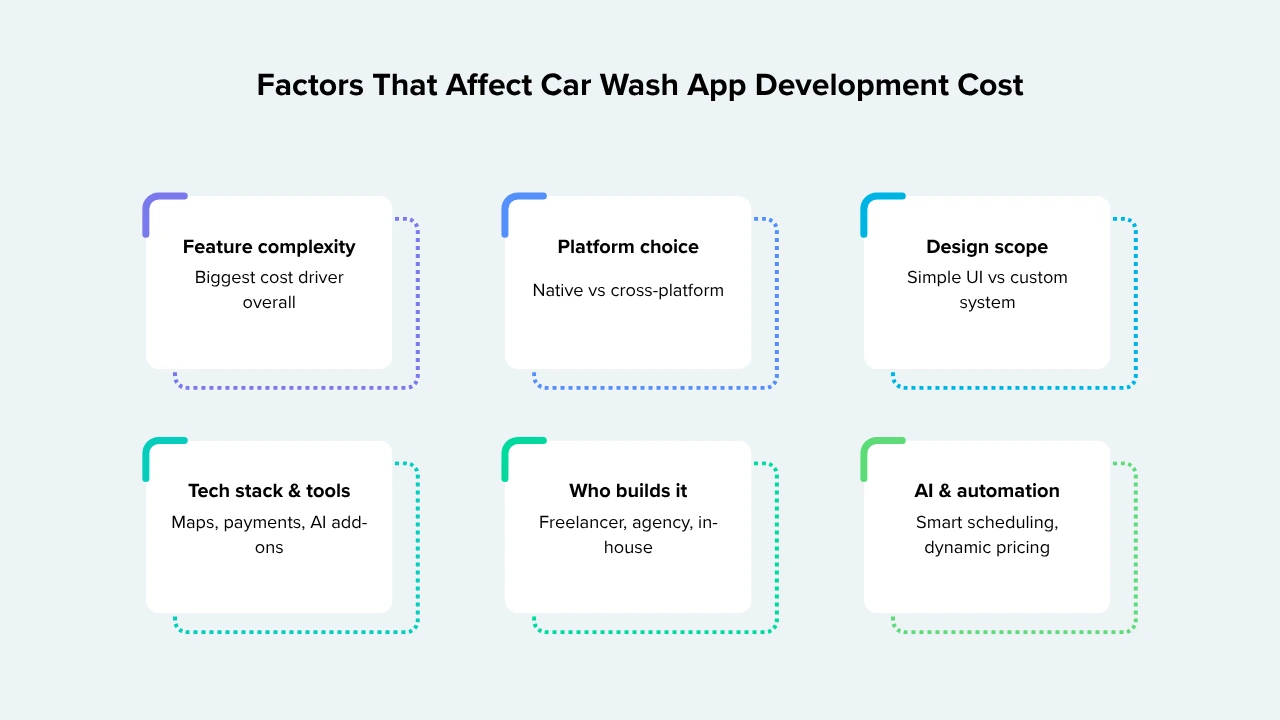
Beyond region and platform, here’s what moves your final number the most:
- Feature complexity: every feature you add is more hours someone has to build, test, and look after. This is easily the biggest factor.
- Platform choice: native or cross-platform, as covered above.
- How much design work you need: a clean, simple design costs less than custom animations and a fully branded design system built from scratch.
- Tech stack and outside tools: maps, payment gateways, and AI tools all carry their own costs on top of development time.
- Who’s building it: freelancers are cheaper upfront but riskier past a certain point. Agencies cost more, though they bring a clear process. An in-house team gives you the most control at the highest cost.
- AI and automation: smart scheduling, chat support, and pricing that shifts with demand are becoming standard asks in 2026. Naturally, they add real development time that older cost guides don’t account for.
Hidden On-Demand Car Wash App Development Costs to Budget For
The build itself is only part of the bill. Unfortunately, these costs catch a lot of first-time founders off guard, since they rarely show up in the first quote:
| Hidden Cost | Typical Range |
| App Store / Play Store fees | $99/year (Apple) + $25 one-time (Google) |
| Third-party API and SDK licensing (maps, SMS, push notifications) | $50 – $500/month |
| Cloud hosting (AWS, GCP, or similar) | $150 – $1,500/month depending on user volume |
| Post-launch maintenance | 15–20% of total build cost, annually |
| Legal and compliance (PCI-DSS, local business licensing) | $2,000 – $10,000 one-time |
| Marketing and user acquisition | Varies widely, and almost always underestimated |
Set aside a real maintenance budget from day one. Apps that launch and then get ignored for six months tend to break in small, embarrassing ways, an outdated map SDK, a payment gateway update that was not applied, and those problems cost more to fix later than they would have cost to prevent. We break down what that ongoing spend actually looks like in our guide to mobile app maintenance cost, if you want to plan further ahead than year one.
How to Reduce Your Car Wash App Development Cost
You do not have to choose between a good app and an affordable one. A few practical moves make a real difference:
Build the MVP First
Launch with booking, payments, and the washer app. Add loyalty programs, AI recommendations, and advanced analytics once you have real users and real data telling you what they actually want.
Go Cross-Platform
Unless you have a strong reason not to, this alone can save you tens of thousands of dollars over building two native apps.
SDKs for Maps and Payments
Use pre-built SDKs for maps and payments instead of coding these systems from scratch. There is no reason to reinvent GPS tracking in 2026.
Development Region
Choose your development region based on fit, not just price. The cheapest hourly rate is not a bargain if it costs you three extra months of revisions.
Negotiate a Fixed-Price
Negotiate a fixed-price contract for a well-defined MVP scope, and switch to time-and-materials for later phases once requirements naturally become more fluid.
For a broader look at trimming costs across any type of app, not just car wash platforms, see our full guide on how to reduce app development cost.
Car Wash App Monetization Models
Once the app is live, here is how most car wash platforms recover their investment:
- Commission model a percentage taken from each booking completed through the platform
- Subscription plans monthly or yearly wash packages for regular customers
- In-app advertising local businesses paying to appear on the platform
- Premium upsells express service, full detailing, or add-ons priced above the base wash
Most successful car wash apps combine at least two of these rather than relying on commission alone. Subscription plans in particular tend to stabilize revenue and reduce the marketing spend needed to keep bringing in one-off customers.
How to Choose the Right Development Partner
Cost matters, but it should never be the only filter you use when picking a car wash app development company. Look for:
- A portfolio with real on-demand or marketplace apps, not just general mobile projects
- A quote broken down by feature, not one vague lump sum
- A clear plan for support after launch, not just a handoff and goodbye
- A team that asks about your business before pitching a tech stack
At Comfygen, this is the process we walk every car wash client through before quoting a number. We have built booking and marketplace apps for clients in India, the UAE, and Germany, so we have run into the same payment and payout issues you are likely to face. That experience is why our quotes are broken down feature by feature instead of one flat number.
Final Thoughts
The honest range for car wash app development cost in 2026 is $18,000 to $120,000+, and where you land depends almost entirely on your feature list, not on luck or vendor markup. Before you request quotes from any development team, write out your MVP feature list using the breakdown above. Vendors can quote two or three times apart on the exact same idea simply because the requirements were never itemized in the first place.
If you are ready to turn your car wash app idea into an actual project plan and cost estimate, get in touch with our team at Comfygen. We are happy to walk through your requirements and give you a real, itemized quote, not a guess.
FAQs
How much does it cost to build a car wash app in 2026?
What is the cost to develop an app like Washos?
Is Flutter or native development cheaper for a car wash app?
What features are essential for an MVP car wash app?
How long does it take to build a car wash app?

Mr. Saddam Husen, (CTO)
Mr. Saddam Husen, CTO at Comfygen, is a renowned Blockchain expert and IT consultant with extensive experience in blockchain development, crypto wallets, DeFi, ICOs, and smart contracts. Passionate about digital transformation, he helps businesses harness blockchain technology’s potential, driving innovation and enhancing IT infrastructure for global success.