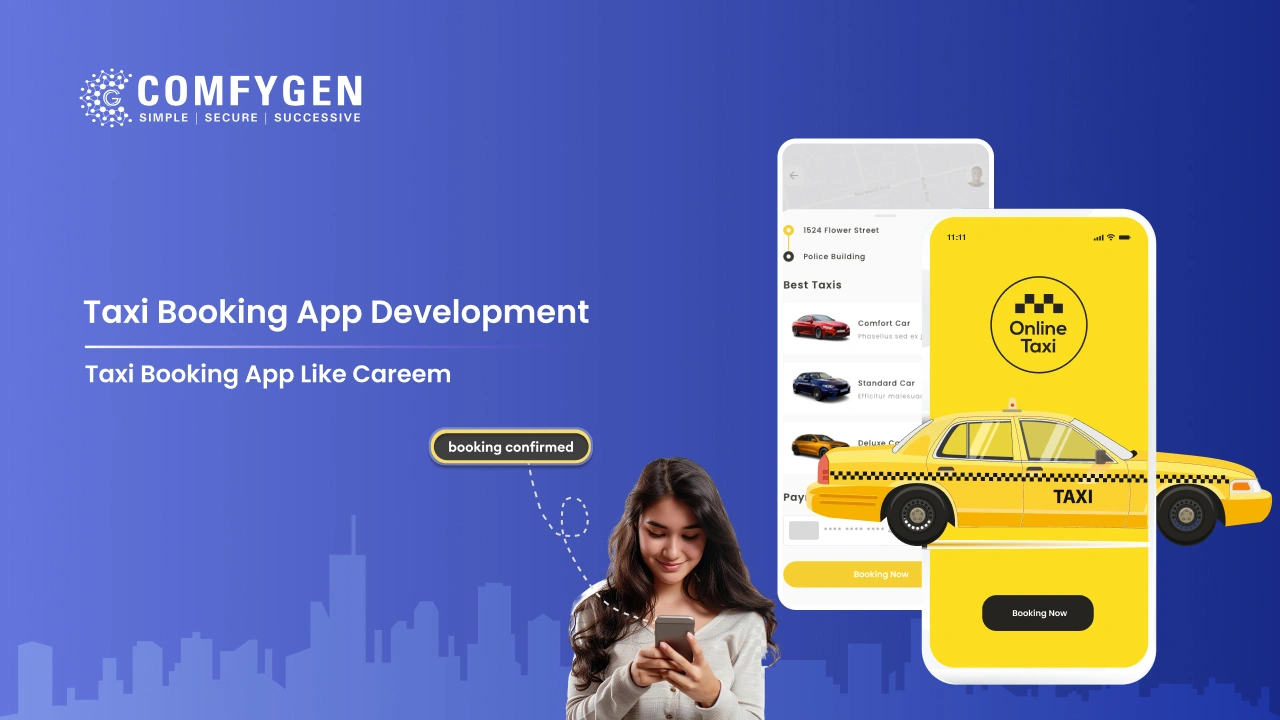
Building a taxi app like Careem means creating three connected apps, a rider app, a driver app (Careem calls drivers “captains”), and an admin panel, that run on the aggregator model: you connect riders with captains who use their own vehicles and earn a commission on each trip. The cost to develop a taxi app like Careem can range from 5,000–80,000+, depending on the features, platforms, integrations, and scalability requirements. A basic MVP can start at 5,000–10,000, while more advanced platforms require a larger investment and longer development timeline.
This guide covers how Careem works, the features you need, the tech behind it, the real cost, and how to win the market Careem built.
Why build a taxi app like Careem
Careem is one of the great regional success stories in ride-hailing. Founded in Dubai in 2012, it grew to serve more than 70 cities across 10 countries in the Middle East, Africa, and South Asia, reached roughly 48 million users, and was acquired by Uber for $3.1 billion in 2020. It now runs as a super-app, ride-hailing plus food delivery, payments, and courier services, all under one brand.
Here’s the part that matters for you: Careem won its market by out-localizing a global giant. Uber was already everywhere, but Careem understood the Middle East better. It accepted cash when most riders didn’t use cards. It supported Arabic. It was built for regional payment habits and partnered with local regulators. That’s the whole lesson. A focused app that genuinely fits one market can beat a bigger, more generic competitor in that market.
And the opportunity is still open. The global taxi market is expected to sit at roughly 367 billion by 2031, growing about 7.6% a year (Mordor Intelligence). The Middle East in particular, with high smartphone use, a young population, and strong tourism in cities like Dubai, remains a prime market for new ride-hailing and niche taxi apps: corporate transport, airport transfers, EV taxis, women-focused rides, and bike taxis.
Why Develop an App Like Careem? Market Size & Opportunity in 2026
The ride-hailing industry is entering a high-growth phase in 2026, making it one of the most profitable sectors for startups and enterprises investing in digital mobility solutions. If you’re planning to build a taxi booking app like Careem, the market data clearly shows strong demand, rapid expansion, and long-term scalability.
Massive Market Growth in MENA & UAE
The Middle East and Africa (MEA) ride-hailing market is expected to grow at a CAGR of nearly 18.8% from 2026 to 2033, reaching over $10.9 billion by 2033.
At the same time, the broader MENA region is projected to reach over 145 million users by 2030, highlighting massive adoption of app-based mobility services.
The UAE stands out as a key growth hub, with high smartphone penetration (around 80%) and a rapidly expanding user base, expected to surpass 4 million ride-hailing users by 2028.
High Revenue Potential & Proven Business Model
Apps like Careem have already validated the business opportunity. With billions in annual revenue and consistent growth driven by mobility, delivery, and fintech services, the Careem clone app model offers multiple monetization streams, such as:
How does an app like Careem work?
Careem runs on the aggregator model, and understanding it is the first step to building your own.
Your app has three parts. The rider app is where passengers book, track, pay, and rate. The captain (driver) app is where drivers accept requests, navigate, and track earnings. The admin panel is your control center for managing users, setting commissions, handling disputes, and reading the data.
The flow looks simple to the rider but involves real work underneath. A rider requests a trip, the system finds nearby available captains using GPS, a captain accepts, the app dispatches and tracks the ride in real time, processes payment at the end, and collects ratings from both sides. The hard engineering sits in the real-time location sync, the captain-matching logic, fare calculation, and payment handling, including cash reconciliation, which Careem made central.
You earn through commission. Careem takes a percentage of each completed fare, steady revenue that scales with rides without pricing anyone out. Careem then layered on more: per-kilometer and per-minute pricing, corporate accounts, advertising, and its expansion into food and payments once the ride base was solid. You can follow the same path, start with rides, add revenue streams as you grow.
Must-have features to build a taxi app like Careem
A Careem-style app needs features across all three apps.
Rider app features
Registration and profile setup with social and phone login. Ride booking with pickup, drop-off, and vehicle type selection. Real-time captain tracking on a live map. Upfront fare estimates before booking. Multiple payment options, including cards, wallets, and cash, and cash is not optional in many of Careem’s markets. Ride history with fare breakdowns. Captain ratings and reviews. Push notifications for ride status. An SOS button and trip sharing for safety.
Captain (driver) app features
Registration with document and license verification. Accept or decline requests with rider details shown. In-app navigation with route optimization. An earnings dashboard with daily and weekly breakdowns. An availability toggle to go online or offline. Heat maps showing high-demand zones. Trip history and performance metrics.
Admin panel features
A live dashboard of rides, revenue, and active users. Full rider and captain management. Commission and dynamic fare controls. Surge pricing and zone management. Dispute and complaint handling. Detailed reports and business intelligence. Promotion and referral management.
Advanced and AI features that set your app apart
The basics get you a working app. These make it competitive in 2026.
Surge and dynamic pricing that adjusts fares by real-time demand. AI-powered captain-rider matching that cuts wait times. Route optimization that saves time and fuel. Demand prediction that positions captains before peak hours. Fraud detection for fake bookings and payment abuse. Scheduled and shared rides. Corporate accounts for business clients are a stable, high-value revenue stream. And multi-language and multi-currency support, essential for a Careem-style app, since Arabic and local-currency support are exactly what made Careem work across the region.
These raise the build cost but are often what lets a new app compete. Our taxi app cost guide breaks the pricing down tier by tier.
Tech stack to build a taxi app like Careem
The technology shapes both cost and how well your app scales. A typical production stack:
Frontend on Flutter or React Native, cross-platform frameworks that run on iOS and Android from one codebase and cut costs by 30 to 40% versus separate native builds. Backend on Node.js, Python, or Java to handle ride requests, user data, and payments. Real-time tracking with WebSockets, Firebase, or Socket.IO, the piece that makes live location work. Maps and navigation from the Google Maps API. Payments via Stripe, PayPal, or regional gateways, with cash handling built into the flow. Cloud hosting on AWS, Google Cloud, or Azure to scale as ride volume grows.
The real-time layer and the captain-matching logic are the hardest parts to get right and the most important. An app that lags on live tracking or mismatches captains loses riders fast.
Step-by-step process to build a taxi app like Careem
A ride-hailing build runs in clear stages.
- Discovery and planning: define your market and which features are core versus phase two.
- UI/UX design: wireframes and a clickable prototype for all three apps before any code.
- Development: the rider app, captain app, admin panel, and backend built in sprints.
- Third-party integration: maps, payments, SMS, and notifications wired in.
- Testing and QA: every booking path, payment flow, and edge case is checked.
- Launch and support: deployment to the App Store and Play Store, then ongoing maintenance.
Most builds run 4 to 12 months, depending on scope. Starting with an MVP, core booking, tracking, and payments gets you to market faster and lets real riders guide what you build next, which is exactly how Careem itself started before expanding.
How Does Careem’s Business Model Work?
Understanding how Careem operates is essential if you plan to develop a taxi booking app like Careem or launch your own Careem clone app. Its business model is built on a scalable, multi-service platform that connects users, drivers, and businesses while generating revenue through multiple streams.
1. Aggregator-Based Ride-Hailing Model
At its core, Careem follows an aggregator model, where it connects passengers with nearby drivers through a mobile app. The platform does not own vehicles—instead, it enables independent drivers to register, accept ride requests, and earn income.
This model is widely used in taxi app development because it is:
2. Commission-Based Revenue System
The primary revenue stream comes from ride commissions, where the platform charges drivers a percentage (typically 15–25%) on each completed trip.
For businesses looking to develop a taxi booking app like Careem, this ensures:
3. Dynamic Pricing & Surge Model
Careem uses dynamic pricing (surge pricing) based on demand, traffic, and driver availability. During peak hours or high-demand situations, fares automatically increase.
This feature is a must-have in on-demand taxi app features because it:
4. Multi-Service (Super App) Expansion
Careem has evolved beyond ride-hailing into a super app, offering services like:
5. Subscription & Loyalty Programs
Careem also generates revenue through subscription models like Careem Plus, where users pay a monthly fee to access benefits such as:
-
Discounted rides
-
Free delivery services
-
Exclusive offers
6. In-App Advertising & Partnerships
The platform collaborates with brands and local businesses to offer in-app promotions and advertisements, creating an additional revenue stream.
For startups targeting the MENA ride-hailing app development market, this is a valuable strategy to:
-
Increase monetization
-
Build local partnerships
-
Enhance user engagement
Why Invest in a Careem-Like Taxi App in 2026
Investing in a taxi booking app like Careem in 2026 offers strong potential, driven by clear market shifts. Smartphone adoption continues to grow across the Middle East, South Asia, and other emerging regions, making mobile apps the go-to choice for on-demand transportation. At the same time, increasing traffic congestion and fast-paced urban lifestyles are pushing more people toward ride-hailing services for daily travel.
What this really means is the opportunity goes beyond rides. The rise of super apps is opening doors to combine taxi booking services with digital payments, deliveries, and other everyday needs within a single platform. Add to that growing government support for smart mobility and digital transport systems, and businesses have the right environment to launch compliant, scalable, and future-ready taxi booking apps.
| Service |
Potential User Coverage (% of urban smartphone users) |
Target Users (in millions) |
Monthly Revenue per User (USD) |
Potential Monthly Revenue (USD Million) |
| Ride-Hailing |
30–50% |
5–7 |
50–70 |
12–15 |
| Food Delivery |
20–35% |
3–5 |
30–50 |
4–6 |
| Grocery Delivery |
10–20% |
1–3 |
30–50 |
1–2 |
| Digital Payments |
25–40% |
4–6 |
5–10 (fees) |
0.5–1 |
| Bike & Car Rentals |
5–10% |
0.5–1 |
40–60 |
0.5–1 |
| Delivery Services |
10–15% |
1–2 |
20–40 |
0.2–0.8 |
| Rewards & Loyalty |
All active users |
10+ |
Indirect |
Indirect |
Let’s build a Careem-like taxi app that’s scalable, reliable
and built for real users. Get in touch and start your journey today.
Get a Free Quote
How Much Does It Cost to Develop a Taxi App Like Careem?
The cost of Careem clone app development for startups and businesses entering the ride-hailing market depends on several factors, including feature set, app complexity, technology stack, and the location of the development team. While basic versions require a lower investment, advanced apps with real-time tracking, multiple payment options, and scalable infrastructure naturally increase development costs.
| Type |
Features |
Estimated Cost (USD) |
| MVP |
Basic user & driver app, admin panel, GPS, payment |
$10,000 – $15,000 |
| Full-Feature App |
Multi-language support, wallet, AI ride matching, in-app chat, loyalty programs |
$15,000 – $30,000+ |
| Maintenance (Annual) |
Server hosting, updates, bug fixes, scaling |
15–20% of development cost |
MVP Cost Breakdown
For a Minimum Viable Product (MVP) with essential features—user registration, ride booking, real-time tracking, basic payments, and admin panel—the estimated cost ranges between $25,000 to $40,000. This budget typically covers:
- Core user and driver app development
- Basic admin panel setup
- GPS and map integration
- Standard payment gateway integration
Full-Feature App Cost
A fully-featured taxi booking app, including advanced functionalities like multi-language support, wallet integration, ride scheduling, AI-based ride matching, in-app chat, and loyalty programs, can cost between $70,000 to $120,000. This estimate also includes:
- Advanced analytics and reporting in admin panel
- Surge pricing and dynamic fare calculation
- Cloud infrastructure for scalability
- Security enhancements and GDPR/regional compliance
Regional Pricing (Middle East vs Asia)
Development costs differ based on geography:
- Middle East & North America: $70–$120 per hour due to higher developer rates.
- Asia (India, Pakistan, Bangladesh): $25–$50 per hour, offering more affordable development without compromising quality.
Maintenance & Scaling Costs
Post-launch, ongoing expenses include server hosting, regular updates, bug fixes, and scaling infrastructure as the user base grows. Annual maintenance typically costs 15–20% of the initial development budget.
How Long Does It Take to Build a Ride-Hailing App?
The time required to build a ride-hailing app like Careem or Uber depends on several factors, including app complexity, feature set, technology stack, and the development approach you choose. On average, a fully functional taxi booking app like Careem can take anywhere from 3 to 9 months to design, develop, and launch.
Development Timeline Breakdown
Here’s a realistic phase-wise estimate for taxi app development:
-
Planning & Requirement Analysis (1–2 weeks):
Defining business goals, target audience (e.g., UAE or MENA market), and finalizing core features.
-
UI/UX Design (2–4 weeks):
Creating intuitive designs for rider, driver, and admin panels to ensure a seamless user experience.
-
App Development (8–16 weeks):
Building core functionalities such as booking, real-time tracking, payment integration, and notifications.
-
Testing & QA (2–3 weeks):
Ensuring the app is bug-free, secure, and optimized for performance across devices.
-
Deployment & Launch (1–2 weeks):
Publishing the app on platforms and setting up backend infrastructure.
Timeline Based on App Type
-
Basic MVP (Minimum Viable Product): 2–3 months
Essential rider booking, fare calculation, and basic tracking for startups validating their idea.
-
Mid-Level App: 3–5 months
Android and iOS apps with rider/driver features, payments, ratings, tracking, and notifications.
- Full-Featured Custom Solutions: 5–8 months
Complete rider, driver, and admin ecosystem with automated dispatch, AI-powered ETA, and pricing.
-
Enterprise Ride-Hailing Ecosystem: 6–9 months
Scalable multi-city, multi-fleet platform with corporate tools, analytics, and compliance features.
How to Choose the Right Taxi App Development Company
Choosing the right development partner is key to building a successful taxi booking app like Careem. Comfygen Technologies stands out with its proven expertise in developing ride-hailing apps, deep knowledge of Middle Eastern markets, and experience in delivering scalable, future-ready solutions.
They offer end-to-end support from app design and development to post-launch maintenance, ensuring your Careem-like taxi booking app is compliant, user-friendly, and efficient at handling high volumes of rides. With Comfygen, businesses can confidently launch a robust, market-ready taxi app that meets regional demands.
Conclusion
Investing in a Careem-like taxi app in 2026 offers immense growth potential. With Comfygen Technologies as your Taxi booking App Development partner, you get end-to-end support from app design and development to post-launch maintenance, ensuring a user-friendly, compliant, and scalable ride-hailing platform.
FAQ
How much does it cost to develop a taxi booking app like Careem?
The cost to develop a taxi booking app like Careem typically ranges from $5,000 to $80,000+, depending on the features, platforms, and level of customization. A basic MVP may cost $5,000–$10,000, while a mid-level app can cost $10,000–$15,000. A full-featured solution may range from $15,000–$30,000, while an enterprise ride-hailing platform can cost $30,000–$80,000+.
How long does it take to build a taxi app like Careem?
A basic MVP typically takes 2–3 months, a mid-level platform takes 3–5 months, a full-featured custom solution takes 5–8 months, and an enterprise ride-hailing ecosystem can take 6–9 months. The actual timeline depends on features, integrations, testing requirements, and customization.
What are the must-have features of a taxi app like Careem?
A Careem-like taxi app requires three separate panels, each with its own feature set:
Passenger App: Real-time ride booking, GPS-based driver tracking, fare estimation, multiple payment options (card, cash, wallet), ride history, in-app chat and SOS button, ride scheduling, and ratings & reviews.
Driver (Captain) App: Trip requests and acceptance, navigation with turn-by-turn directions, earnings dashboard, document upload for verification, online/offline toggle, and in-app support.
Admin Panel: User and driver management, real-time ride monitoring, dynamic pricing (surge), promo code management, revenue analytics, dispute management, and push notification control.
What technology stack is used to build a Careem-like app?
A modern ride-hailing app like Careem typically uses the following tech stack:
- Frontend (Mobile): React Native or Flutter for cross-platform iOS and Android development
- Backend: Node.js or Python (Django) for high-performance server logic
- Database: MongoDB or PostgreSQL for scalable data storage
- Real-Time Features: Socket.io for live tracking and instant notifications
- Maps & Navigation: Google Maps API or Mapbox
- Payments: Stripe, PayPal, or regional gateways (PayTabs for MENA)
- Cloud Hosting: AWS or Google Cloud for scalability and reliability
- SMS/OTP: Twilio or Firebase Authentication
What is the difference between building a Careem clone and a custom taxi app?
A Careem clone is a pre-built, white-label solution that replicates Careem's core functionality. It is faster to launch (2–6 weeks) and cheaper ($3,000–$10,000), but offers limited customization, shared codebases, and less competitive differentiation. A custom taxi app is built from scratch to your exact specifications — your branding, unique features, proprietary algorithms, and full scalability. Custom development costs more and takes longer, but it is the only viable path if you plan to scale, raise investment, or build a defensible market position.