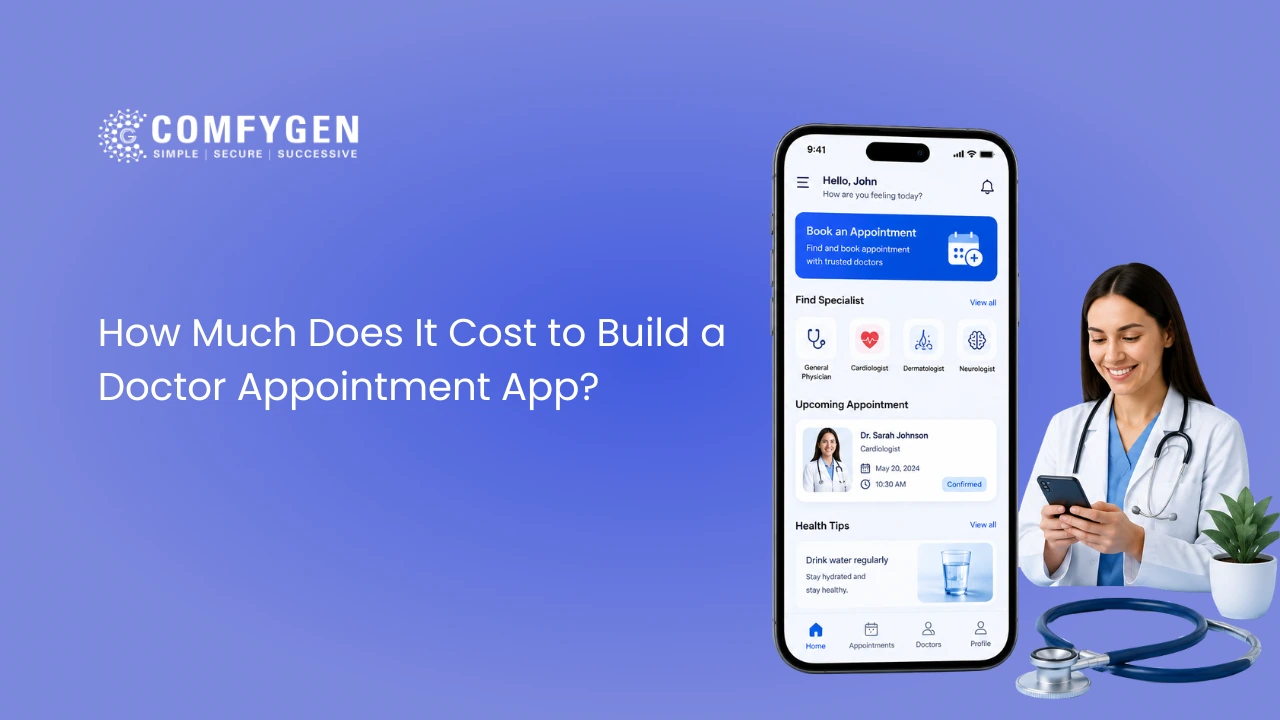





A doctor appointment app costs between $10,000 and $100,000+ to build in 2026. A basic single-platform MVP with booking, doctor profiles, and chat lands around $10,000–$18,000. A standard clinic app with payments and video consultation runs $18,000–$30,000. A hospital platform with EHR integration and analytics sits at $30,000–$55,000, and a full marketplace or enterprise build with AI diagnostics and billing crosses $55,000–$100,000 or more.
That range exists because no two apps carry the same feature set, compliance load, or team. Below, we break the number down by feature, platform, and region so you can walk into any vendor conversation with real figures instead of guesses.
The timing matters, too. The global telemedicine market was valued at USD 141.19 billion in 2024 and is projected to reach USD 380.33 billion by 2030 at a 17.55% CAGR, according to Grand View Research. Patients now expect to book, consult, and follow up from a phone, and the businesses that meet that expectation early are the ones capturing the market.
The Doctor Appointment App Market
Demand for online scheduling stopped being a pandemic side effect years ago. It is now the default. Practo alone reported a 500% jump in online consultations since March 2020, and the habit stuck.
A few numbers worth keeping in front of you as you plan a budget:
- The global telemedicine market is set to grow from USD 141.19 billion in 2024 to USD 380.33 billion by 2030.
- The healthcare appointment scheduling market is forecast to reach USD 803.7 million by 2030, up from USD 342.3 million in 2023, at a 13.8% CAGR.
- In Asia-Pacific, public platforms like India’s eSanjeevani have scaled to hundreds of millions of consultations, and the region is the fastest-growing globally.
For anyone weighing a healthcare app development project, that is a market big enough to justify a serious build and competitive enough that a weak product gets ignored.
Cost at a Glance: What You Pay by App Type
Here is the fastest way to size your budget before scoping a single feature.
|
App Type |
What It Includes | Estimated Cost |
Timeline |
|---|---|---|---|
| Basic MVP | Single platform, booking, doctor profiles, in-app chat, notifications | $10,000 – $18,000 | 8 – 12 weeks |
| Standard Clinic | Both platforms, payments, video consultation, and staff scheduling | $18,000 – $30,000 | 12 – 20 weeks |
| Hospital Platform | EHR/EMR integration, multi-department scheduling, analytics, admin controls | $30,000 – $55,000 | 20 – 32 weeks |
| Marketplace / Enterprise | AI symptom checker, generative AI notes, billing/RCM, wearables, multi-location | $55,000 – $100,000+ | 32 – 48 weeks |
Why This Cost Range Is Lower Than Other Estimates
Published doctor appointment app estimates often begin at $50,000 because they price a US-based team at $150 to $200 an hour and quote HIPAA work as a separate consulting engagement. The ranges above assume Indian development rates of $20 to $50 an hour, a shared Flutter or React Native codebase, and compliance costed inside the build rather than billed on top. Feature scope and regulatory obligations stay identical. What changes is the hourly rate behind them. When comparing quotes, ask each vendor which region their engineers sit in and whether compliance is inside the number they gave you.
Most healthcare founders should start at the MVP tier. It puts a working product in front of real patients faster, generates usage data, and keeps early spend low. You then reinvest revenue into the features that data proves patients actually want.
Doctor Appointment App Development Cost Breakdown
The total cost always resolves into the same core components. Here is what each one costs on a mid-level build.
|
Component |
Cost Range |
What It Covers |
|---|---|---|
| UI/UX Design | $2,500 – $5,000 | Wireframes, prototypes, patient, and doctor dashboards |
| Frontend + Backend | $12,000 – $22,000 | Booking logic, APIs, admin panel, databases |
| Video Consultation | $3,000 – $6,000 | WebRTC/SDK integration, session handling, recording |
| EHR / EMR Integration | $4,000 – $9,000 | Connecting to hospital record systems |
| Security + Compliance + QA | $5,000 – $11,000 | Encryption, audits, HIPAA/GDPR certification, testing |
| Annual Maintenance | 15–20% of build cost | Patches, OS updates, new features |
Design is where retention is won or lost, so treat it as an investment rather than an area to trim. A clean, intuitive interface built by an experienced UI/UX design team keeps patients coming back, and that directly protects your revenue.
Key Factors That Influence the Cost
Platform choice: Building for one platform first is cheaper. Native iOS app development and Android app development each cost more than a shared codebase, which is why many teams pick a cross-platform route to cover both at once.
Development team location: Rates vary widely by geography, and this single factor can swing a budget by half:
|
Region |
Hourly Rate |
|---|---|
| USA / Canada | $100 – $200 |
| Western Europe | $80 – $150 |
| Eastern Europe | $40 – $90 |
| India | $20 – $50 |
Development costs can vary significantly by region because of differences in hourly rates and operating costs. When comparing development partners, consider healthcare experience, technical capabilities, security practices, communication, and project scope alongside pricing.
Feature depth: Booking and notifications are inexpensive. Video, AI, and record integrations are not. Every advanced module adds both development hours and testing cycles.
Compliance scope: Handling patient data requires appropriate security measures, secure storage, access controls, and regulatory planning. The cost depends on the target market and project requirements, so it should be clearly defined within the project scope and estimate.
Must-Have Features and Their Cost Impact
A doctor appointment app is really three connected products: a patient app, a doctor panel, and an admin panel. The core features every version needs include:
- Patient and doctor profiles with specialization, credentials, consultation fees, and health history
- Doctor and clinic search with filters for specialty, location, wait time, and cost
- Geo-location search to surface nearby doctors using map APIs
- Appointment booking with real-time slot availability and accept/reject logic
- In-app chat, calls, and reminders to keep patients engaged and reduce no-shows
- Ratings and reviews, which patients rely on before booking any doctor
- Secure in-app payments with multiple methods, ideally including a UPI payment option for Indian users
These form the MVP. Get them working cleanly before layering on anything advanced.
AI and Advanced Features That Raise the Cost
This is where 2026 apps separate from the ones built five years ago, and where budgets climb fastest.
- AI symptom checker and chatbot ($4,000 – $10,000): Patients rarely search “ophthalmologist.” They search “eye doctor.” An AI-powered matching layer bridges everyday language to the right specialist and screens patients before a consult.
- Generative AI documentation: Consultation notes, discharge summaries, and patient reports drafted automatically. Generative AI is the fastest-growing line item in healthcare builds right now.
- Video consultation and ePrescription ($3,000 – $6,000): Live consults plus digital prescriptions and pharmacy hand-off, which pairs naturally with a telemedicine app or pharmacy app.
- Wearable integration: Syncing heart rate, glucose, or blood pressure from devices, which connects well to a health tracking app.
- Medical billing and RCM ($6,000 – $15,000): Claims processing, insurance verification, and payment reconciliation for larger providers.
Zocdoc’s own move here is telling. In 2025 it launched an AI phone assistant that automates scheduling directly into provider systems, a sign of where patient expectations are heading.
Technology Stack for a Doctor Appointment App
Picking the wrong stack means paying for rewrites later. A dependable 2026 stack looks like this:
- Frontend (cross-platform): Flutter or React Native, so one codebase serves iOS and Android
- Backend: Node.js, Python/Django, or Ruby on Rails
- Database: PostgreSQL, MongoDB, or Firebase
- Video and messaging: WebRTC, Agora, or Twilio
- Maps: Google Maps or Apple MapKit
- Cloud: AWS, Google Cloud, or Azure with HIPAA-compliant hosting
Cross-platform frameworks meaningfully lower the bill because you skip building and maintaining two separate native apps. The savings usually go straight back into features.
Compliance and Regulations (HIPAA, GDPR, India’s ABDM)
Handling medical data is the part founders underestimate most. Costs here are non-negotiable, and they differ by market.
HIPAA (USA): Governs how patient health information is stored and shared. Non-compliant apps face heavy fines. Details are published by the U.S. Department of Health and Human Services.
GDPR (EU): Sets strict consent and data-handling rules for any app serving European patients.
India’s framework: If you are targeting Indian users, three things shape your build. The Telemedicine Practice Guidelines 2020 legalized and standardized remote consultation. The Ayushman Bharat Digital Mission (ABDM) introduced ABHA health IDs and provider registries you can integrate with. And the Digital Personal Data Protection Act 2023 governs how you collect and store patient data.
Budget compliance as a separate line item from day one. Teams that plan it upfront save 30–40% on the rework that hits when it is treated as an afterthought. This is especially true for a clinical application or laboratory app tied into hospital systems.
How Doctor Appointment Apps Make Money
Development cost is only worth it if the app earns. The proven revenue models are:
- Commission per booking: The platform takes a small cut of every consultation booked between doctor and patient. This is how most marketplace-style apps operate.
- Subscription plans: Doctors or clinics pay a monthly fee for premium listing, analytics, and management tools. Patients may pay for unlimited consultations.
- Featured listings: Doctors pay to appear higher in search results, similar to sponsored placement.
- In-app advertising: Pharmacies, labs, and insurers pay to reach your patient base, though this works best once you have volume.
Many successful apps blend two or three of these. A medicine delivery app tie-in, for example, can add a second revenue stream on top of consultation commissions.
Development Timeline
A realistic schedule for a standard clinic build runs 3 to 5 months across these phases:
1. Discovery and planning (1–2 weeks): Feature scoping, stack selection, compliance mapping.
2. UI/UX design (2–4 weeks): Wireframes and patient/doctor screen flows.
3. Core development (6–10 weeks): Booking, profiles, payments, admin panel.
4. Advanced integrations (3–6 weeks): Video, EHR, AI modules where required.
5. Testing and launch (2–4 weeks): Security audits, HIPAA checks, load testing, bug fixes.
Hospital platforms and enterprise builds with AI and billing add several weeks to each of these stages.
How to Reduce Development Cost
You can bring the number down without gutting quality:
- Start with an MVP: Ship the three features patients cannot live without, then expand on real usage data.
- Go cross-platform: One Flutter or React Native codebase instead of two native apps.
- Use proven APIs: Off-the-shelf scheduling, payment, and messaging APIs save weeks of custom work.
- Hire in a cost-efficient region: A vetted team in India can deliver senior talent at a fraction of onshore rates.
- Plan compliance early so you avoid expensive late-stage rework.
Why Build Your Doctor Appointment App With Comfygen
At Comfygen, we build healthcare apps that are compliant, scalable, and priced honestly. We scope every project feature by feature, so you know where each dollar goes before development starts, and we cover the full stack, from a lean doctor appointment app MVP to an enterprise platform with AI and billing built in.
Wrapping it up
A doctor appointment app costs $10,000 to $100,000+ in 2026, and where you land depends on three decisions: how many features ship in version one, which market’s compliance rules apply, and where your development team sits. Founders who scope tightly and start at the MVP tier get to real patients faster and spend less proving demand.
Comfygen builds native and cross-platform healthcare apps with compliance costed into the build rather than billed after it. Tell us what your practice or platform needs and you’ll get a feature-by-feature estimate before any work starts. Contact us for a custom quote.
FAQs
How much does it cost to build a doctor appointment app?
How long does it take to develop a doctor appointment app?
What features increase the cost of a doctor appointment app the most?
Is HIPAA compliance mandatory for a doctor appointment app?
Yes, any app handling U.S. patient health data must be HIPAA compliant. Apps serving Europe need GDPR compliance, and Indian apps must follow the Telemedicine Practice Guidelines and DPDP Act 2023.
Can I reduce the cost by building an MVP first?

Mr. Saddam Husen, (CTO)
Mr. Saddam Husen, CTO at Comfygen, is a renowned Blockchain expert and IT consultant with extensive experience in blockchain development, crypto wallets, DeFi, ICOs, and smart contracts. Passionate about digital transformation, he helps businesses harness blockchain technology’s potential, driving innovation and enhancing IT infrastructure for global success.