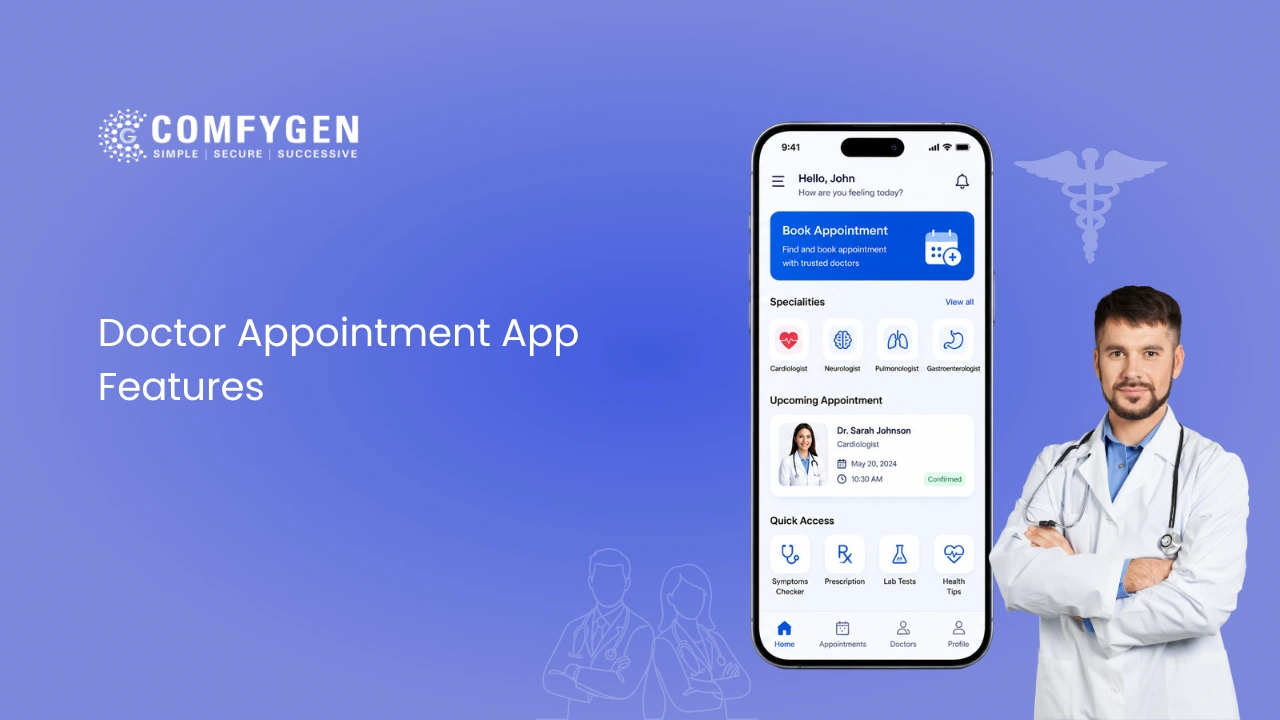





A doctor appointment app’s success depends heavily on how well its features solve real problems for patients, doctors, and healthcare administrators. Two apps can share the same booking screen, yet one keeps patients coming back while the other gets uninstalled after a single visit. The difference almost always sits in the details: how quickly someone finds the right specialist, whether a reminder actually arrives, how safely a prescription moves from screen to pharmacy.
This guide breaks down the doctor appointment app features that matter in 2026, organised the way real products are built, by user role. Whether you run a single clinic, a multi-city hospital chain, or a telehealth startup, you can use this as a working checklist rather than a wish list. The global scheduling apps market was valued at roughly USD 663.1 million in 2025 and is expected to reach USD 749.3 million in 2026, growing at about 13.46% a year through 2033, according to Grand View Research. Getting the feature mix right is how you claim a share of that growth.
Why Features Decide the App’s Success
Patients rarely describe what they want in product terms. They just want to see a trusted doctor without the phone tag, the waiting room, or the guesswork about cost. Every good feature quietly removes one of those frictions.
Mobile apps already account for around 70% of online doctor consultation revenue, and roughly half of adults now reach their health information through an app rather than a desk browser, per Mordor Intelligence. That shift raises the bar. A modern patient expects the same polish they get from food delivery or ride-hailing, and they judge a healthcare product against those standards, not against the clinic’s old paper register.
So the goal is not to cram in every possible function. It is to select the essential features of a doctor appointment app that solve genuine problems for each user, then add advanced ones as the product matures.
How the Feature Set Is Structured
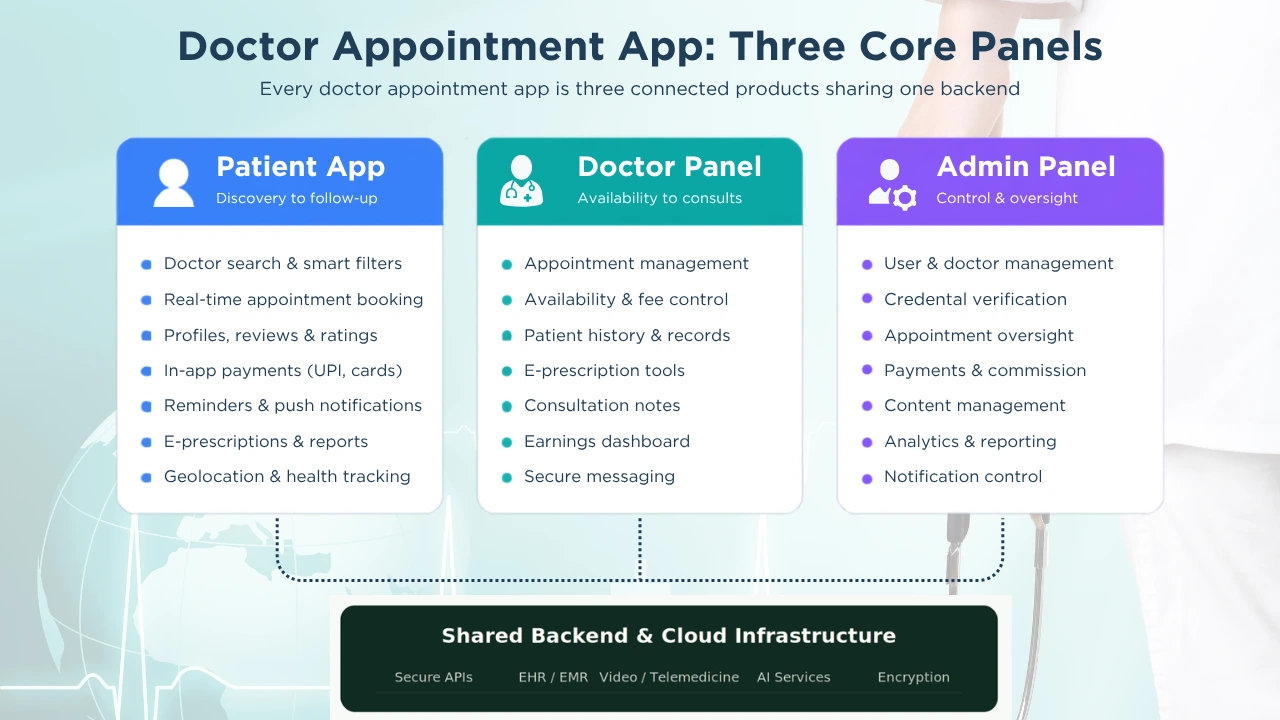
A doctor booking app is really three connected products sharing one backend: a patient-facing app, a doctor panel, and an admin dashboard. Thinking in these layers keeps scope honest and keeps each role’s needs distinct.
The patient app handles discovery, booking, and follow-up. The doctor panel handles availability, consultations, and records. The admin panel controls the platform itself, users, payments, content, and reporting. Telemedicine, AI, and security features then cut across all three. The sections below map directly to that structure, which is also how most engineering teams break down the build.
Patient App Features
The patient app is the front door. These patient app features determine whether someone completes a booking or bounces to a competitor. Every screen here should assume the user is busy, possibly unwell, and impatient, which means fewer taps, clearer labels, and no dead ends. The features below are ordered roughly the way a patient actually moves through the app, from first sign-up to post-visit follow-up.
Registration and Profile Management
Sign-up should take seconds, with options for phone, email, or social login. Once inside, patients build a profile holding basic details, medical history, allergies, and past reports, so the information is ready for every future visit.
Smart Doctor Search and Filters
Users should find a doctor by specialty, symptom, location, language, gender, availability, consultation type, and rating. Strong search is one of the most decisive doctor booking app functionality choices, because a patient who cannot find the right doctor quickly will not book at all.
Real-time Appointment Scheduling
The core of any appointment scheduling app is a live calendar showing open slots, letting patients book, reschedule, or cancel instantly. Supporting both online consultations and in-clinic visits widens the app’s usefulness.
Doctor Profiles with Reviews
Detailed profiles carrying qualifications, experience, fees, clinic photos, and verified patient reviews build trust before a single rupee changes hands. Ratings have become the primary way patients pick a provider.
In-App Payments
A patient doctor appointment app should support cards, UPI, wallets, net banking, and insurance where relevant. Clean, secure checkout reduces drop-off; if you are adding fast local rails, UPI payment integration is close to mandatory for the Indian market.
Reminders and Push Notifications
Automated reminders can help reduce missed appointments by keeping patients informed about upcoming visits. Push notification features should cover booking confirmations, upcoming visits, prescription updates, and follow-up nudges, delivered through push, SMS, and email.
Prescriptions and Reports
Patients should view and download e-prescriptions and lab reports, then act on them, ordering medicines through a linked medicine delivery app or booking tests through a connected laboratory app.
Geolocation and Navigation
Map integration surfaces nearby clinics and gives turn-by-turn directions, useful for in-person visits and urgent care.
Health Tracking
Optional vitals tracking, weight, blood pressure, glucose, activity, keeps patients engaged between appointments and feeds richer context to the doctor. This pairs naturally with a dedicated health tracking app module.
Doctor Panel Features
The doctor panel is where retention on the supply side is won. If clinicians find the tool clumsy, they stop using it, and the patient experience collapses with them. These doctor panel features keep practitioners in control.
Appointment Management Dashboard
A single view to accept, reschedule, or decline requests, with real-time updates that remove manual coordination.
Availability and Schedule Control
Doctors set working hours, breaks, slot lengths, holidays, and consultation fees, preventing double-booking and scheduling conflicts.
Patient History and Records Access
Secure access to profiles, past consultations, and medical records so the doctor walks into every appointment informed. This is one of the must have features in a doctor appointment app on the clinical side, and it overlaps closely with what a dedicated clinical application manages.
E-prescription Tools
Doctors generate digital prescriptions during or after a consultation, share them instantly, and keep them stored against the patient record.
Consultation Notes and Reports
Space to record diagnoses, upload results, and attach treatment plans that the patient can view later.
Earnings and Performance View
A dashboard showing completed consultations, ratings, and payouts gives doctors a clear picture of their activity on the platform.
Secure Messaging
Follow-up questions and post-visit instructions handled inside the app maintain continuity of care without exposing personal phone numbers.
Create a Smarter Doctor Appointment App
Deliver seamless patient experiences using innovative features, secure technology, and customized healthcare app solutions today.
Talk to Our Experts
Admin Panel Features
The admin panel is mission control. These admin panel features for a healthcare app let operators run the platform without calling a developer for every change.
User and Doctor Management
Add, edit, verify, or remove doctor and patient accounts. Credential and licence verification before a doctor goes live is central to the admin panel features that protect platform quality.
Appointment Oversight
A master view of all bookings, cancellations, and rescheduling across the platform, with the ability to step in when needed.
Payment and Commission Control
Handle invoicing, payouts, refunds, and platform commission from one place, with a full transaction trail.
Content and Catalogue Management
Manage specialties, clinic listings, banners, and promotional content without touching code.
Analytics and Reporting
These admin dashboard features surface appointment volume, revenue, user growth, popular specialties, and doctor performance, turning raw activity into decisions. Custom reports help operators spot trends early, such as which specialties are overbooked, where cancellations cluster, and which doctors drive the most repeat visits. Exportable dashboards also make it easier to share performance with investors or clinic partners.
Notifications and Communication Control
Configure the automated messages patients and doctors receive, and broadcast announcements when required.
Telemedicine and Online Consultation Features
Video is no longer a bonus. With hybrid care now standard, telemedicine app features are core to a competitive product. Patients increasingly treat a video consultation as the default for follow-ups, minor complaints, and second opinions, reserving in-person visits for cases that truly need them. If remote care is central to your model, a purpose-built telemedicine app foundation is worth the investment.
- HD video and audio consultations: Stable, encrypted video is the headline online consultation app feature. Fallback to audio-only on weak networks keeps rural and low-bandwidth users connected.
- In-consultation chat and file sharing: Patients and doctors exchange messages, images, and documents live during a session, useful for sharing a rash photo or a prior report.
- Waiting room and queue management: A virtual waiting room sequences patients and notifies the next in line, smoothing OPD-style flow for busy practices.
- E-prescription at consultation close: The doctor issues a prescription the moment the call ends, and it lands directly in the patient’s records.
- Multi-mode consultations: Offering video, audio, and text options lets patients pick what suits their situation and connection.
- Recording and consultation summaries: With consent, sessions or their summaries can be stored for continuity and future reference.
AI Features in a Doctor Appointment App
AI is becoming increasingly relevant in healthcare software, particularly for administrative automation, patient support, and data-driven workflows. These AI features in a doctor appointment app improve both discovery and clinical support, and they are increasingly what separates a modern build from a dated one. A team experienced in AI development can integrate these responsibly.
AI Symptom Checker
A guided intake that suggests likely specialties before booking, so patients reach the right doctor faster. Health systems using conversational AI report meaningfully shorter call-centre queues.
Smart Doctor Recommendations
The app matches patients to clinicians based on symptoms, history, location, and past preferences.
Predictive Scheduling
AI-powered doctor appointment app features can forecast demand, cut wait times, and optimise slot allocation across a practice.
Chatbots for Support
A conversational assistant handles routine questions, booking help, and FAQs around the clock, easing the load on staff.
Voice-enabled Booking
Voice commands let patients schedule, set reminders, and retrieve information hands-free, widening access for elderly and differently-abled users.
Ready to Build a Doctor Appointment App That Patients Trust?
Our healthcare app experts deliver secure, scalable solutions with every essential feature for lasting business success.
Get Started Today
Security and Compliance Features
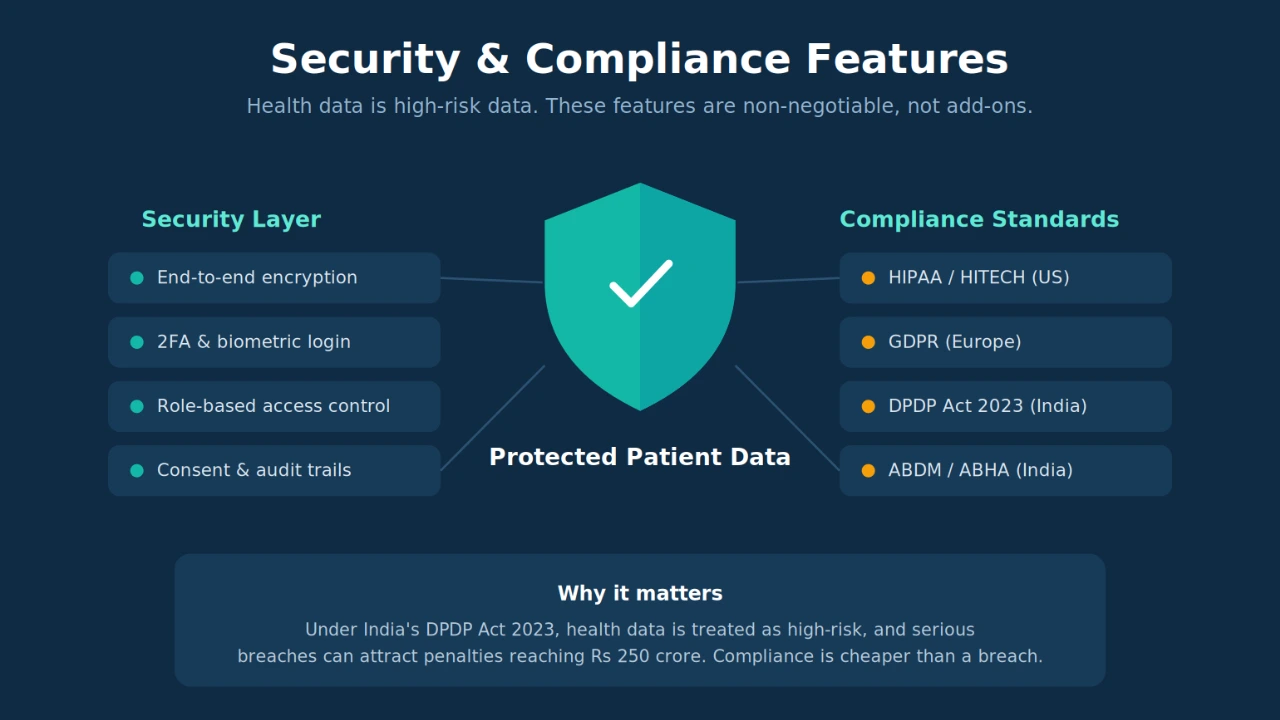
Health data is among the most sensitive data a company can hold, so security is not a feature you bolt on later. These doctor appointment app security features protect patients and shield you from serious legal exposure.
End-to-End Encryption
Consultations, messages, and records must be encrypted in transit and at rest. Under India’s Digital Personal Data Protection Act, 2023, health data is treated as high-risk, and serious breaches can attract penalties reaching ₹250 crore.
Two-factor Authentication and Biometric Login
2FA plus FaceID or fingerprint access keeps accounts locked to the right person while staying frictionless.
Role-based Access Control
Patients, doctors, and admins each see only what their role permits, limiting exposure if a single account is compromised.
Consent Management and Audit Trails
Explicit patient consent, purpose limitation, and full audit logs are required practice. Platforms operating in India must also align with the Ayushman Bharat Digital Mission framework for secure health-data exchange, using ABHA-based identity where relevant.
HIPAA and Global Compliance
For US-facing products, HIPAA-compliant healthcare app features, secure storage, access controls, and breach protocols, are non-negotiable, alongside GDPR for European users. Building on a compliance-first healthcare app development foundation is far cheaper than retrofitting it.
EHR Integration and Third-Party Features
The best apps do not sit alone; they plug into the wider health ecosystem. These integration features raise a product from a booking tool to a genuine care platform.
EHR and EMR Integration
EHR integration features let the app read and update electronic health records through standards like FHIR, giving doctors a complete history and reducing duplicate data entry.
Pharmacy and Diagnostics Links
Connecting to a pharmacy app and diagnostic labs turns a prescription into a fulfilled order without the patient leaving the ecosystem.
Wearable and IoT device sync
Pulling live vitals from wearables through IoT integration feeds real-time context into consultations and enables remote monitoring.
Insurance and Pay Gateway Integration
Payment gateway features should extend to insurance verification and cashless claims where the market supports it.
Calendar and Communication APIs
Two-way sync with Google and Apple calendars, plus SMS and email gateways, keeps everyone aligned across tools they already use.
Doctor Appointment App Features Checklist
Use this quick doctor appointment app features checklist to sanity-check any build or brief:
- Patient app: registration, search and filters, real-time booking, profiles and reviews, payments, reminders, e-prescriptions, geolocation, health tracking.
- Doctor panel: appointment dashboard, availability control, records access, e-prescription tools, consultation notes, earnings view, secure messaging.
- Admin panel: user and doctor management, appointment oversight, payment control, content management, analytics, notification control.
- Cross-cutting: video consultation, AI intake and recommendations, encryption, 2FA, consent and audit, EHR integration, wearable sync.
Every doctor appointment app should have this backbone. The advanced features of a doctor appointment booking app, AI triage, predictive scheduling, deep EHR interoperability, then become your differentiation once the essentials are solid. If you want the full picture of scope, our complete guide to doctor appointment app development walks through the build end to end, and the business benefits breakdown covers the return side.
When you are ready to turn this feature list into a working product, Comfygen builds custom doctor appointment app development solutions across Android, iOS, and cross-platform Flutter and React Native stacks, with the healthcare compliance and clinical integrations these features demand. You can hire experienced app developers to scope the feature set, and if budgeting is your next step, our development cost breakdown shows how each feature tier affects the total.
Wrapping it up
Be careful if you are hoping to work with a reputable mobile app development for medical appointments. Hire a mobile app development service provider that can help you in growing your company if you are eager to introduce this type of services in the market.
So, where can you look for the best doctor scheduling app development company? At Comfygen Technologies, we take exceptional care to ensure that your orders are delivered on schedule. Using our experience and industry know-how, we make sure that the product you get aligns with your business goals and target audience. Contact Comfygen, if you need to discuss about build a doctor appointment app.
FAQs
Patients can simply schedule online appointments with doctors through an app system, at the comfort of their home. Also, the doctors can decide their availability as per the number of patients booking on a particular day. The essentials are patient registration, doctor search with filters, real-time booking, doctor profiles with reviews, secure payments, automated reminders, e-prescriptions, and a separate admin panel for platform management. The doctor panel needs appointment management, availability and fee control, secure access to patient records, e-prescription tools, consultation notes, an earnings dashboard, and in-app secure messaging for follow-up care. Yes. Video and audio consultations, in-call chat, file sharing, virtual waiting rooms, and instant e-prescriptions are now standard, since a large share of patients expect remote consultation options alongside in-clinic visits. AI adds symptom checkers, smart doctor matching, predictive scheduling, support chatbots, and voice booking. These features help patients reach the right doctor faster and reduce administrative load on clinic staff. Healthcare appointment apps should use appropriate security controls such as encryption, access management, consent controls, and audit logging. Legal and regulatory requirements—including HIPAA, GDPR, or India's applicable data-protection and digital-health frameworks—depend on the markets where the platform operates.What is a Doctor appointment app?
What are the must-have features of a doctor appointment app?
What features should the doctor panel include?
Are telemedicine features necessary in a doctor booking app?
How do AI features improve a doctor appointment app?
What security features must a healthcare appointment app have?

Mr. Saddam Husen, (CTO)
Mr. Saddam Husen, CTO at Comfygen, is a renowned Blockchain expert and IT consultant with extensive experience in blockchain development, crypto wallets, DeFi, ICOs, and smart contracts. Passionate about digital transformation, he helps businesses harness blockchain technology’s potential, driving innovation and enhancing IT infrastructure for global success.