




Building a taxi booking app can cost anywhere from $5,000 to $80,000+, depending on the app’s features, platforms, integrations, customization, and scalability requirements. A basic MVP may cost $5,000–$10,000, while a mid-level Android and iOS platform can range from $10,000–$15,000. A full-featured custom taxi app typically costs $15,000–$30,000, while an enterprise ride-hailing ecosystem can require $30,000–$80,000+.
How Much Does It Cost to Build a Taxi App?
A taxi app costs $5,000 to $80,000+ in 2026. Here’s the quick version, then the detail:
| App type | What’s included | Cost range | Timeline |
| Basic MVP | Single platform, rider app, booking, fare calculation, basic tracking | $5,000 – $10,000 | 8 – 12 weeks |
| Mid-level platform | Android + iOS, rider + driver apps, payments, ratings, push notifications | $10,000 – $15,000 | 12 – 20 weeks |
| Full-featured custom | Rider + driver + admin panel, automated dispatch, AI ETA and pricing | $15,000 – $30,000 | 20 – 32 weeks |
| Enterprise ride-hailing ecosystem | Multi-city, multi-fleet, corporate portal, analytics, compliance layer | $30,000 – $80,000+ | 24 – 36 weeks |
The appropriate development budget depends on the app type and scope outlined in the cost breakdown below. That kind of budget covers a rider app, a driver app, and an admin panel with the stuff passengers now treat as standard: sign-up, booking, live GPS tracking, fare calculation, in-app payment, and ratings.
Why This Cost Range Is Lower Than Other Estimates
Most published taxi app estimates start at $40,000 or more because they price a North American or Western European team at $100 to $250 an hour. The figures above assume an India-based team at $25 to $50 an hour, a single cross-platform codebase instead of two native builds, and a tested ride-hailing foundation rather than a ground-up build. Same feature list, same three apps, different labour rate. When you compare quotes, check which of those three variables each vendor is pricing before treating a higher number as a better product.
And the market’s worth the effort. The global ride-hailing services market sat at around $47.6 billion in 2025 and is on track to reach roughly $181.5 billion by 2033, growing at close to 18.6% a year, according to Grand View Research. App-based e-hailing already pulls the biggest share of that, and Asia Pacific is growing faster than anywhere else on the map.
Taxi Booking App Development Cost by App Type
Price tracks how finished the product is. Here’s what you actually get at each tier.
- Basic MVP ($5,000 to $10,000). A single-platform taxi booking app with core rider functionality, booking, fare calculation, and basic ride tracking. It is a practical starting point for businesses that want to validate demand before investing in advanced features.
- Mid-level platform ($10,000 to $15,000). An Android and iOS taxi booking platform with dedicated rider and driver apps, online payments, ratings, and push notifications. This tier is suitable for businesses ready to operate a more complete ride-hailing service.
- Full-featured custom solution ($15,000 to $30,000). A customized rider and driver experience with an admin panel, automated dispatch, AI-powered ETA, and intelligent pricing. This option is designed for businesses that need more control over operations and ride management.
- Enterprise ride-sharing ecosystem ($30,000 to $80,000+). A scalable solution built for multi-city operations, multiple fleets, corporate customers, analytics, and compliance requirements. The final investment depends on the number of markets, integrations, and operational complexity.
Taxi and Ride-Hailing MVP Development Cost
The cost to develop a taxi booking app MVP typically ranges from $5,000 to $10,000, with an estimated development timeline of 8–12 weeks. A basic MVP focuses on the essential experience—rider booking, fare calculation, and basic ride tracking—so businesses can launch sooner, validate demand, and expand the platform based on real user feedback.
A basic taxi booking app MVP typically focuses on the core functionality needed to launch and test the service:
- Rider booking functionality
- Fare calculation
- Basic ride tracking
- A single-platform app experience
As the business grows, features such as driver management, online payments, ratings, push notifications, automated dispatch, and AI-powered capabilities can be added in later development phases.
Here’s what pushes an MVP number up or down:
| Factor | Lower cost | Higher cost |
| Platform | One platform (Android or iOS) | Both platforms |
| Approach | Cross-platform (Flutter, React Native) | Two native builds |
| Payments | One gateway | Wallet + multiple gateways |
| Maps | Standard map SDK | Custom routing + heatmaps |
| Team location | South Asia | North America |
Cross-platform frameworks like Flutter are the usual way to keep an MVP affordable, since one codebase runs on both Android and iOS. That single decision alone can knock 25% to 40% off a two-platform MVP. Choosing the right MVP scope can help control development costs while giving you enough functionality to validate your business model before investing in advanced features.
What Affects the Cost of Building a Taxi App
Six things decide where your quote lands.
- Feature depth. Core booking and tracking are on the floor. Every extra system after that (wallet, surge pricing, loyalty, ride scheduling, SOS) adds hours.
- Number of apps. A real taxi platform isn’t one app. It’s a rider app, a driver app, and an admin panel, sometimes a dispatcher console on top. Each one is its own build.
- Platform and tech stack. Native iOS and Android cost more than a single cross-platform codebase. Your backend, database, and hosting picks move the number too.
- Third-party integrations. Maps, SMS/OTP, payment gateways, push notifications. Each carries build time plus a monthly usage bill.
- Design complexity. A clean template-based UI is cheaper than custom animation, branded illustration, and a full design system.
- Team location and size. Often the single biggest lever of the lot, and there’s a full section on it below.
Feature-by-Feature Cost Breakdown
Here’s roughly what each feature adds to a taxi app built in 2026. These assume a mid-market rate.
| Feature | Approximate cost |
| User registration & profiles | $300 – $600 |
| Booking & ride request flow | $700 – $1,300 |
| Real-time GPS tracking | $900 – $1,800 |
| Fare estimation & calculation | $500 – $1,000 |
| In-app payments (single gateway) | $800 – $1,600 |
| Driver app & ride management | $1,200 – $2,200 |
| Push notifications | $250 – $500 |
| Ratings & reviews | $300 – $700 |
| Admin dashboard | $1,200 – $2,500 |
| Surge / dynamic pricing | $800 – $1,800 |
| In-app chat & call | $600 – $1,300 |
| SOS / safety features | $500 – $1,100 |
| AI-based driver matching | $1,500 – $4,000 |
Add those up, and the tiers from earlier start to make sense. Core-only gets you an MVP. Core plus payments, an admin panel, and both platforms put you in the mid-range. Adding advanced capabilities such as automated dispatch, AI-powered ETA, and intelligent pricing moves a taxi booking app into the full-featured custom tier, which typically costs $15,000–$30,000.
Cost by Platform: Android, iOS, and Cross-Platform
The platform call is one of the first big decisions you’ll make, and one of the priciest.
- Single native platform (Android or iOS): $6,000 to $20,000. Cheapest to get going, but you’re only reaching half the market.
- Both native platforms: $12,000 to $45,000. Two separate codebases, so roughly 1.7x to 1.9x the cost of one.
- Cross-platform (Flutter or React Native): $8,000 to $28,000 for both platforms. One codebase covers Android and iOS, which is why most cost-conscious founders start right here.
For a taxi product where getting to market quickly matters, a cross-platform build with Flutter usually gives you the best cost-to-reach ratio. Native earns its keep later, once you need heavy background location performance or platform-specific hardware features at scale.
Cost by Team Location and How to Hire Taxi App Developers
Where your developers sit can swing the price of the exact same app by 5x or more. Hourly rates in 2026 look like this:
| Region | Hourly rate |
| India & South Asia | $25 – $50 |
| Eastern Europe | $40 – $70 |
| Latin America | $40 – $75 |
| Western Europe & Australia | $80 – $150 |
| North America | $100 – $250 |
A mid-level taxi platform takes somewhere around 350 to 550 development hours. At $150 an hour, that’s $52,500 to $82,500. At $30 an hour, it’s $10,500 to $16,500 for comparable output. That gap is exactly why so many founders in the US, UK, and UAE hire taxi app developers in India.
You’ve got three ways to staff a build:
Cheapest per hour, but the coordination risk is high, and covering three apps plus a backend gets messy fast.
- In-house team. Full control, though salaries, benefits, and the time it takes to hire push your real cost well above agency rates for a first product.
- Development company. A team of designers, mobile developers, backend engineers, and QA who already work together. Usually, the best fit for a taxi platform, since all the pieces are in place from day one.
If you want to keep a grip on scope while holding cost down, hiring a dedicated development team tends to beat both freelancers and full in-house hiring for a first launch.
Cost to Build an App Like Uber, Ola, and inDrive
People always ask what it cost Uber to build Uber. That number won’t help you much, though, since Uber has burned through hundreds of millions over more than a decade. The question that actually helps you plan: what does an app like Uber cost to build today?
| App to replicate | Cost to build a comparable version |
| Basic Uber-like clone | $10,000 – $18,000 |
| Full Uber-like platform | $30,000 – $80,000+ |
| Ola-style multi-service app | $25,000 – $60,000 |
| inDrive-style bidding app | $18,000 – $45,000 |
The reason an Uber-like build gets pricey isn’t the rider screen. It’s everything sitting behind it: matching rides at scale, surge pricing, driver payouts, fraud checks, running multiple cities at once, and a backend that won’t buckle at peak. A taxi clone app hands you that proven feature set for a fraction of building it all from scratch, which is why so many new operators start there.
inDrive-style apps come in a touch lower than Uber-style ones at the low end, because the price-bidding model can stand in for part of the dynamic-pricing engine. They do add a negotiation layer, though, and that has its own build cost.
Ride-Hailing vs Ride-Sharing vs Taxi Booking: Cost Differences
These three terms get thrown around like they’re the same thing, and the pricing questions around them mostly circle back to a similar build. The differences still matter for your budget, though.
- Taxi booking. A rider requests a car, a driver accepts, the trip runs on a metered or upfront fare. Simplest model, lowest cost.
- Ride-hailing. The broader bucket that includes taxi booking plus features like surge pricing, driver ratings, and cashless payment. This is what “ride hailing app development cost” usually points at, and it maps to the mid-range and advanced tiers above.
- Ride-sharing / carpooling. Matches several riders heading the same way into one vehicle and splits the fare. The matching logic gets more complicated, which nudges ride-sharing app development cost toward the higher end even on a basic build.
The global ride-sharing market on its own sat near $42.9 billion in 2024 and is projected to reach roughly $96.9 billion by 2030, with India tipped to grow fastest, per Grand View Research. If your model is carpool-first, budget 15% to 25% above a comparable taxi-only app for the extra matching work.
Ongoing Costs to Run a Taxi App
Building the app is a one-time expense. Keeping it running isn’t. Plan for these every month and every year:
| Ongoing cost | Typical range |
| Maintenance & updates | 15% – 20% of build cost/year |
| Cloud hosting & servers | $100 – $2,000 / month |
| Maps & location API usage | $100 – $1,500 / month |
| SMS / OTP & push | $50 – $500 / month |
| Payment gateway fees | 1% – 3% per transaction |
| App store fees | $99/yr (Apple) + $25 once (Google) |
Rule of thumb: set aside 15% to 20% of your original development cost each year to keep the app secure, updated, and running well. Skipping that is the most common reason early taxi apps quietly die a few months after launch.
How AI Changes Taxi App Development Cost
AI’s a real line on taxi app quotes now, not just marketing talk. The features buyers ask about most in 2026:
- AI driver-rider matching that cuts pickup times by predicting where demand’s about to spike
- Dynamic pricing that adjusts fares to real-time supply and demand
- ETA prediction built on live and historical traffic
- Fraud and safety detection across accounts and trips
- Demand forecasting so operators can move drivers into position before the rush hits
AI capabilities can significantly influence the overall taxi app development cost, especially when they involve custom ETA prediction, automated dispatch, or intelligent pricing. In our pricing model, these capabilities are included within the full-featured custom solution range of $15,000–$30,000, depending on the level of customization and integration required. For plenty of operators, it pays for itself, since better matching means shorter waits and more completed rides. If AI sits at the center of your plan, get an AI app development team involved at the architecture stage, not tacked on after launch.
How to Reduce Your Taxi App Development Cost
You can trim a taxi app budget without gutting the quality. Here’s what actually works:
- Start with an MVP. Ship core booking and tracking first. Add wallet, surge, and loyalty once you’ve got real usage data to point to.
- Go cross-platform. One Flutter or React Native codebase for both Android and iOS beats paying for two native builds.
- Use a clone or proven base. Starting from a tested Uber-style foundation skips months of ground-up work.
- Hire in a lower-cost region. A skilled team in India or Eastern Europe ships the same app for a fraction of North American rates.
- Integrate instead of rebuilding. Plug into existing map, payment, and SMS providers rather than building those from scratch.
- Lock your scope early. Scope creep is the number one reason taxi app budgets quietly double halfway through.
Why Build Your Taxi App with Comfygen
Since 2019, Comfygen has helped businesses build mobile and web applications, delivering 550+ projects for 400+ clients across 30+ countries. Our 100+ member team includes developers, designers, and QA specialists who have worked on taxi, ride-hailing, and on-demand transportation apps for businesses in the USA, UK, UAE, Canada, and Singapore.
What a taxi build here gets you:
- The full stack in one place: rider app, driver app, admin panel, and backend
- Cross-platform or native, matched to your budget and your growth plan
- AI matching, surge pricing, and live tracking when you’re ready for them
- A fixed scope and quote before work starts, so the budget actually holds
- Support and maintenance after launch, not just a handover at delivery
Our Taxi App Development Portfolio

Corporate Taxi Service Provider
Enterprise-grade taxi booking solution with real-time tracking and fleet management.
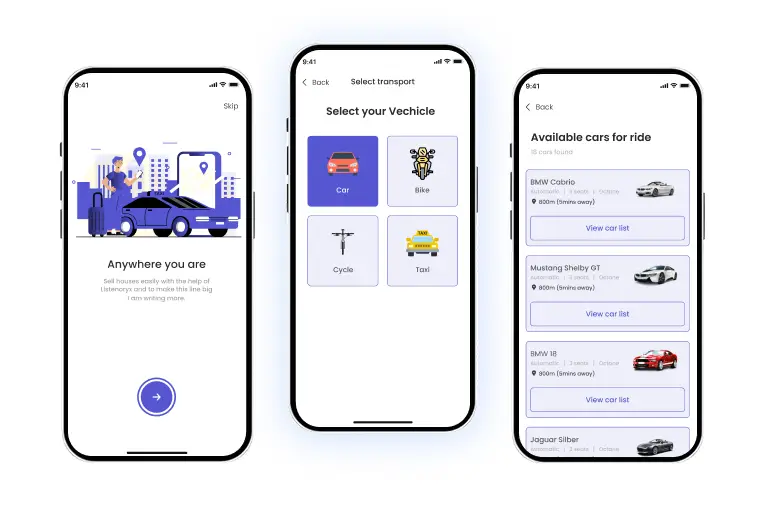
Tourism Taxi Booking App
Smart travel taxi app with route planning, booking automation, and user-friendly UI.
Conclusion
The taxi app development cost in 2026 typically ranges from $5,000 to $80,000+, depending on the platform, features, integrations, customization, and scalability requirements. A basic MVP can start at $5,000–$10,000, while a mid-level Android and iOS platform ranges from $10,000–$15,000. A full-featured custom taxi booking app can cost $15,000–$30,000, while an enterprise ride-hailing ecosystem may require $30,000–$80,000+.
In order to succeed in this highly competitive market, taxi booking applications must combine essential, user-friendly features with reliable, modern technology. And it will be built by an experienced taxi app development company in 2026.
A taxi booking application can generate high revenue and provide a solid foundation for a future business venture if developed using the latest technological advances, an MVP (Minimum Viable Product) approach, cross-platform development, and an affordable yet highly skilled company like Comfygen.
Ready to build your taxi booking app? Contact Comfygen Technologies today for a free consultation and receive a customized cost estimate tailored to your specific business requirements. Let us help you transform your ride-hailing vision into reality.
Frequently Asked Questions
How much does it cost to build a taxi app?
What is the cost to develop a taxi booking app MVP?
How much does it cost to make an app like Uber?
How much does it cost to run a taxi app after launch?
Why is taxi app development cheaper in India?
How long does it take to build a taxi app?
Should I build for Android, iOS, or both?

Mr. Saddam Husen, (CTO)
Mr. Saddam Husen, CTO at Comfygen, is a renowned Blockchain expert and IT consultant with extensive experience in blockchain development, crypto wallets, DeFi, ICOs, and smart contracts. Passionate about digital transformation, he helps businesses harness blockchain technology’s potential, driving innovation and enhancing IT infrastructure for global success.