




At some point, every growing delivery business hits the same wall.
Spreadsheets get too messy. Phone calls between dispatch and drivers eat up hours. A customer complains their order is late and nobody knows exactly where it is. You know the system is breaking. You just haven’t found the right moment to fix it.
Building delivery management software is usually that fix. But before you start, you need a real answer to one question: how much is this going to cost?
We get asked this constantly at Comfygen Technologies. Our team has worked with courier companies, e-commerce brands, and on-demand businesses on exactly this kind of project. This guide gives you the honest breakdown, what the numbers look like, what pushes them up, and how to keep the project on budget.
The Delivery Management Software Market
Before getting into development costs, it helps to understand the scale of what is happening in this space.
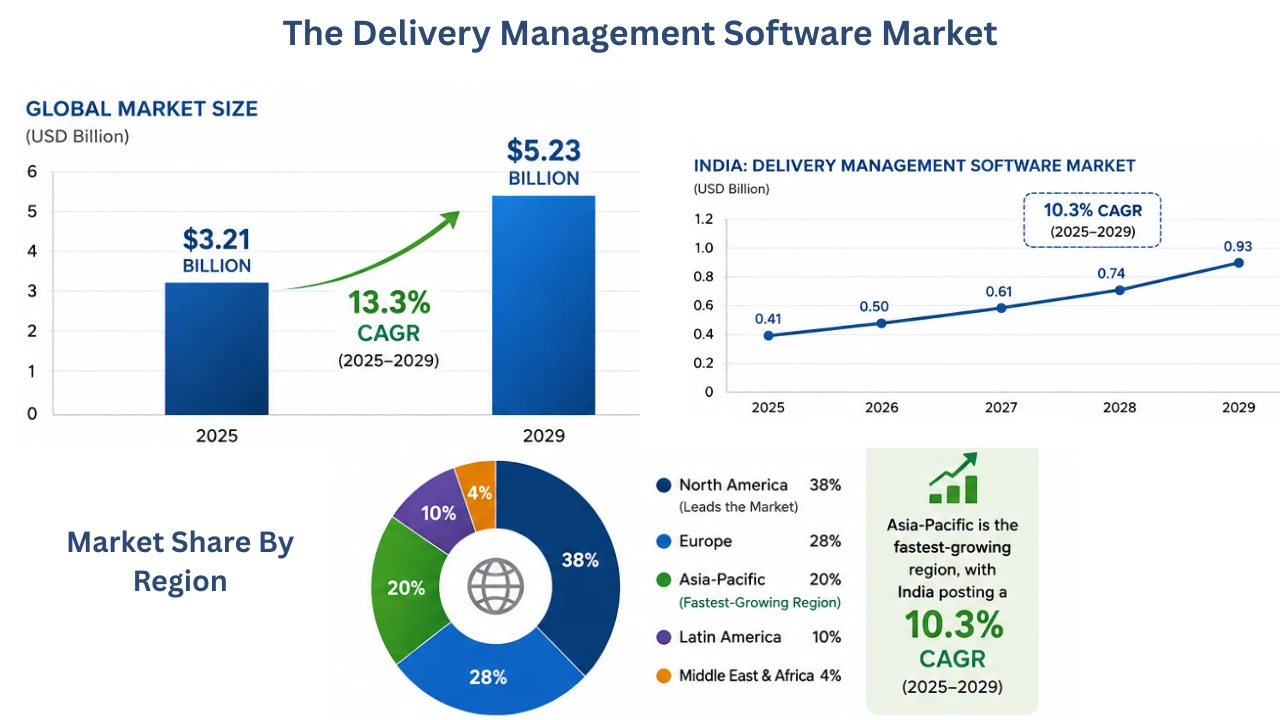
The global delivery management software market is valued at $3.21 billion in 2025, growing at a 13.3% CAGR. It is projected to reach $5.23 billion by 2029. That growth is not speculative. It is being driven by three concrete forces:
E-commerce volume: Global parcel volumes have grown significantly, and carriers, retailers, and 3PLs are all under pressure to handle more deliveries with tighter windows and lower cost per drop.
Customer expectations:. 75% of consumers now expect same-day or next-day delivery, which means real-time tracking and accurate ETAs are no longer a differentiator. They are a baseline.
Last-mile complexity: As delivery networks expand into smaller cities and multi-stop routes become the norm, manual coordination stops working. Software handles what spreadsheets cannot.
North America currently leads the market, but Asia-Pacific is the fastest-growing region, with India posting a 10.3% CAGR through the forecast period. Businesses in these regions are not just adopting delivery software. They are building custom platforms to match their specific logistics networks and customer bases.
If you are evaluating whether to build now or wait, the market data makes a clear case. The companies investing in custom delivery management software development today are the ones setting the standard their competitors will be chasing in two to three years.
How Much Does Delivery Management Software Development Cost?
The cost to build delivery management software breaks down into four tiers based on complexity:
|
Build Type |
Core Features | Estimated Cost | Timeline |
|---|---|---|---|
| Basic / MVP | Order tracking, single-route dispatch, driver app | $10,000 to $25,000 | 3 to 4 months |
| Mid-Level | Multi-stop routing, real-time GPS, basic reporting | $25,000 to $50,000 | 4 to 6 months |
| Advanced | Dynamic route optimization, predictive analytics, ERP integration | $50,000 to $100,000 | 6 to 9 months |
| Enterprise | AI-powered routing, multi-region, full ERP/WMS/CRM stack | $100,000 to $200,000+ |
9 to 12 months+ |
These ranges reflect blended teams that include backend developers, mobile app developers, UI/UX designers, QA engineers, and a project manager. If you work with a team in a high-cost region, the numbers shift upward. If you work with an offshore or hybrid team in South Asia or Eastern Europe, you can expect significantly lower rates for equivalent output.
Get Your Free Cost Estimate
Unsure how much your delivery management software will cost? Share your requirements with us and get a personalized cost breakdown within 24 hours.
Request Free Estimate
The Cost Estimation Formula
Before you talk to any delivery software and mobile app development company, it helps to have a rough number in your head. Here is a simple formula that gets you close:
Total Cost = Team Size × Monthly Hours × Blended Hourly Rate × Duration in Months
Let’s make it concrete with a real example.
Say you want to build a mid-level delivery management system. It includes a dispatcher console, a cross-platform driver app, real-time tracking, and two integrations — one with your OMS and one with a maps API. A typical team for this looks like five people: one backend developer, one frontend developer, one mobile developer, one QA engineer, and a project manager and designer splitting their time.
With an India-based team charging around $40 per hour, working 160 hours a month over 6 months, the math works out like this:
5 × 160 × $40 × 6 = $192,000
Now run the same numbers with a North American team at $150 per hour. The total jumps to $720,000 for the exact same project.
That gap is why most businesses either go fully offshore or use a hybrid model, keeping product ownership in-house while the development work gets handled by a team in India or Eastern Europe. You get the same output at a fraction of the cost.
Factors That Affect Delivery Management Software Development Cost
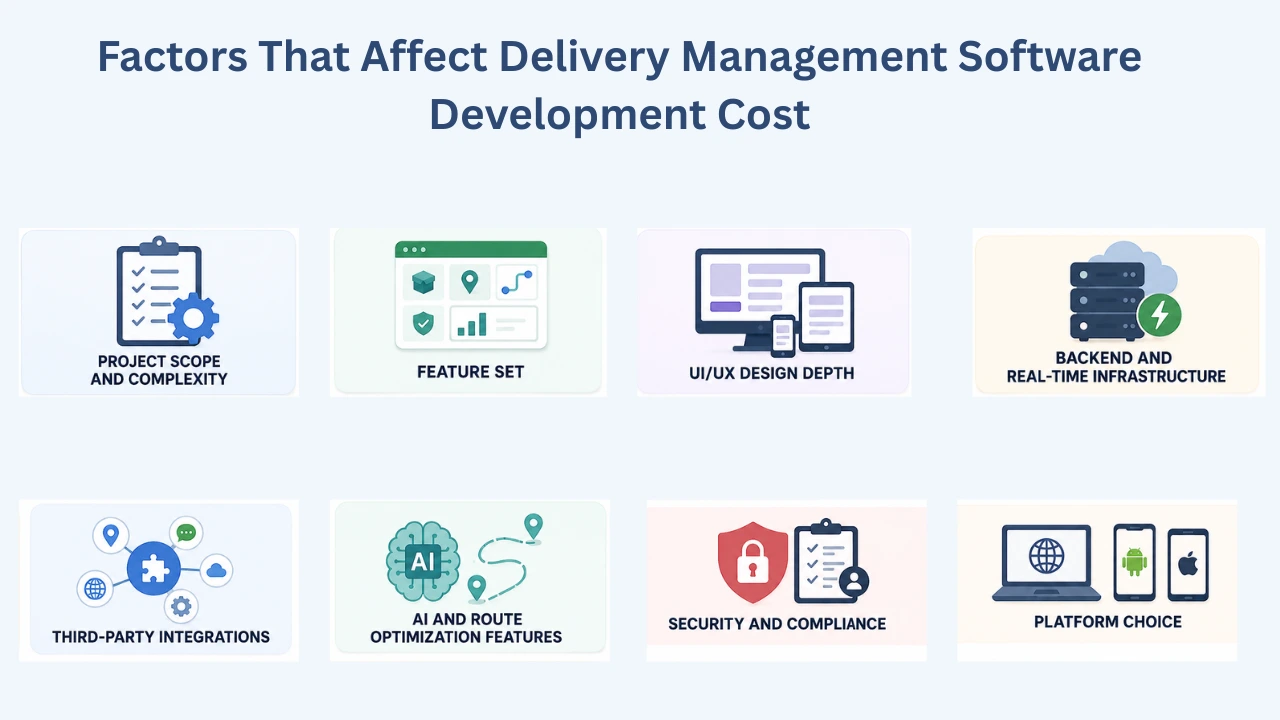
No two delivery management projects cost the same. These are the variables that move the number up or down.
Project Scope and Complexity
A basic MVP covering single-drop deliveries in one city costs far less than a platform handling multi-stop routes, cross-docking, reverse logistics, and 3PL orchestration across multiple countries. The number of user roles (dispatcher, driver, customer, admin, partner), geographic coverage, and workflow depth all directly affect development time.
Feature Set
This is the single biggest cost driver. The table below shows how basic and advanced features compare:
|
Area |
Basic | Advanced |
|---|---|---|
| Order handling | Single-drop, manual assignment | Multi-stop, auto-assignment, time windows |
| Routing | Static distance-based routing | Dynamic optimization with traffic, SLAs, capacity |
| Proof of delivery | Status update only | Photos, e-signature, OTP, geo-tagged proof |
| Returns | Manual handling | Structured reverse logistics, automated reattempts |
| Fleet management | In-house only | Mixed fleets, 3PL partners, scorecards |
| Reporting | Daily / weekly summaries |
Drill-down dashboards, cost per drop, SLA views |
| Integrations | 1 to 2 systems | OMS, WMS, ERP, CRM, payment gateways, carrier APIs |
Each row in the “advanced” column adds development weeks. Prioritize only what operations genuinely needs in version one.
UI/UX Design Depth
A dispatcher managing 300 orders on one monitor needs a different interface than a driver checking their next stop on a six-inch screen with patchy network. Design that accounts for real working conditions, multiple languages, and role-based dashboards costs more than a generic layout. However, it also reduces training time and driver errors, which are costs that show up elsewhere.
Backend and Real-Time Infrastructure
Every route update, driver location ping, and delivery status change moves through your backend. A lean setup handles a few hundred orders per day without issue. An enterprise-grade backend processing thousands of concurrent deliveries, with failover, load balancing, and real-time event streaming, requires significantly more architecture work. That work adds cost upfront and reduces incidents later.
Third-Party Integrations
Clean integrations with well-documented APIs (Google Maps, Twilio, Stripe) take a few days each. Legacy ERP systems, custom OMS platforms, or fragmented WMS setups can consume weeks. Every integration you add increases development time and testing scope.
AI and Route Optimization Features
Adding AI-powered routing, predictive demand models, or anomaly detection for delayed deliveries requires data engineering work on top of standard development. These features can save 15 to 30 percent on fuel and driver time at scale, but they add $20,000 to $80,000 to the development cost depending on complexity. Tie them to a clear ROI case before adding them to version one.
Security and Compliance
Customer addresses, payment data, and driver location logs are sensitive. Encryption at rest and in transit, role-based access control, audit logs, and secrets management are baseline requirements. If your operations touch healthcare deliveries, financial services, or regions with GDPR-style rules, compliance work adds further scope.
Platform Choice
Building for web only is the cheapest option. Adding Android or iOS driver apps increases cost. A cross-platform mobile app (one codebase for both iOS and Android) reduces build and maintenance cost compared to two separate native apps and is the right choice for most driver-facing tools.
Delivery Management Software Development Cost by Team Location
Where your developers are located affects your total spend as much as what you are building. Mobile App developer hourly rates range from $25 to $49 per hour in India and $50 to $300 per hour in North America, with Eastern Europe sitting at $25 to $99 per hour depending on seniority.
|
Region |
Hourly Rate Range | Notes |
|---|---|---|
| North America | $100 to $250 | Highest cost, same time zone for US clients |
| Western Europe | $80 to $180 | High quality, higher cost |
| Eastern Europe | $40 to $99 | Strong engineering, good English proficiency |
| India / South Asia | $15 to $50 | Largest talent pool, most cost-effective for scale |
| Latin America | $45 to $75 |
Strong nearshore option for US time-zone alignment |
Most businesses working with Comfygen choose a hybrid model: internal teams own product decisions and requirements, while our offshore team in India handles design, development, and QA. This keeps costs competitive without giving up control.
Cost Breakdown by Development Stage
Here is where the budget actually goes across a typical delivery management software project:
|
Phase |
% of Total Budget | Dollar Range (Mid-Level Build) |
|---|---|---|
| Discovery and planning | 5 to 10% | $2,500 to $5,000 |
| UI/UX design | 10 to 20% | $5,000 to $10,000 |
| Software development | 50 to 70% | $25,000 to $40,000 |
| Testing and QA | 15 to 25% | $7,500 to $12,500 |
| Maintenance (year one) | 10 to 15% |
$5,000 to $10,000 |
The development phase covers backend services, the dispatcher console, driver app, and integrations. Testing is where you validate that the system holds up during peak loads, failed deliveries, and real driver workflows. Skipping or compressing QA is the most common way projects end up with expensive post-launch issues.
Read More: How Much Does it Cost to Develop a Delivery App?
Types of Delivery Management Software and Their Development Cost
Delivery software is not one-size-fits-all. The type you build changes what features you need, and that directly affects your cost. Here is a quick breakdown:
| Type | What It Covers | Estimated Cost |
|---|---|---|
| Food Delivery Management Software | Restaurant dashboard, real-time driver tracking, live ETAs, customer notifications | $20,000 to $60,000 |
| Grocery Delivery Management Software | Slot booking, inventory sync, item substitutions, delivery time management | $25,000 to $70,000 |
| Pharmacy Delivery Management Software | Develop pharmacy management software for prescription verification, proof of delivery, temperature handling, and compliance. | $30,000 to $80,000 |
| Courier Delivery Management Software | Bulk order management, multi-stop routing, COD handling, partner integrations | $20,000 to $60,000 |
| eCommerce Delivery Management Software | Storefront integration, OMS sync, returns management, live tracking, notifications | $35,000 to $100,000 |
| Fleet Management and Delivery Software | Vehicle tracking, driver monitoring, fuel management, maintenance scheduling | $50,000 to $120,000 |
| Logistics and Transportation Management Software | Load planning, carrier management, freight billing, multi-warehouse operations | $75,000 to $150,000+ |
| Multi-Vendor Delivery Management Software | Seller dashboards, payout management, consolidated routing, unified tracking | $50,000 to $120,000 |
Turn Your Delivery Operations into a Competitive Advantage
Whether it’s food, grocery, pharmacy, or logistics delivery, we help you design and launch software that drives efficiency and customer satisfaction.
Get Started Today
Hidden Costs in Delivery Software Development
The proposal covers the build. These costs run in the background after launch.
Maintenance And Updates
Operating systems change, browsers update, and your operations team will request small fixes regularly. Budget 15 to 20 percent of the initial build cost per year for ongoing maintenance.
Cloud And Infrastructure Hosting
Every location ping, order record, and delivery photo costs money on AWS, Google Cloud, or Azure. A mid-size operation handling 1,000 deliveries per day will spend $800 to $2,500 per month on infrastructure, depending on architecture choices.
Third-party API Licensing
Google Maps API billing is based on usage. Twilio charges per SMS. WhatsApp Business API has per-message fees. For high-volume operations, these costs add up to $1,000 to $5,000 per month.
Security Audits
A penetration test and security review every 12 months costs $3,000 to $15,000 depending on scope. For platforms handling customer and payment data, this is not optional.
Legal And Compliance
Data protection agreements, carrier contracts, and GDPR-aligned policies require legal review. Set aside $2,000 to $10,000 for initial legal setup, more if you operate across multiple jurisdictions.
How to Reduce Delivery Management Software Development Cost
You cannot spend nothing, but you can spend smarter.
Start With an MVP
Cover the core flows: order capture, dispatch, routing, driver app, tracking, and proof of delivery. Release to one city or one business unit. Validate assumptions with real data before committing to full scale.
Prioritize Ruthlessly
Sit with your operations and finance teams and agree on the features that must exist in version one. Anything that does not clearly reduce cost, reduce failures, or improve delivery speed moves to a later phase. This one decision can save 30 to 40 percent of initial development scope.
Use Cross-Platform for the Driver App
A single codebase for iOS and Android (using React Native or Flutter) reduces build time and maintenance effort compared to two separate native apps. For driver-facing tools, the performance difference is negligible.
Design for Scale From Day One
A microservices architecture and cloud-native infrastructure cost slightly more upfront but prevent you from rebuilding the entire backend when you double your delivery volume.
Work With an Offshore or Hybrid Team
You do not need a full in-house team at North American rates to get enterprise-grade software. Partner with a proven delivery software development company in India or Eastern Europe, keep product ownership internal, and review progress every two weeks.
ROI: When Does Delivery Management Software Pay Back?
The payback period depends on your current delivery cost structure. Here is how the return shows up:
Route Efficiency Savings
AI-powered routing typically reduces empty miles by 10 to 20 percent. For a fleet running 200 deliveries per day at $8 cost per drop, a 15 percent improvement saves $240 per day, or roughly $88,000 per year.
Fewer Failed Deliveries
First-attempt delivery failure costs an average of $10 to $15 per reattempt including driver time, fuel, and customer service. A platform that reduces failed attempts from 12 percent to 6 percent on 500 daily deliveries saves $15 to $30 per day on reattempts alone.
Premium Delivery Monetization
Once you can promise accurate time windows and live tracking, you can charge for same-day or express options. Even a $2 premium on 10 percent of orders adds meaningful revenue at scale.
Better Data for Renegotiation
Lane-level performance reports and carrier scorecards give you the evidence to renegotiate 3PL rates and reprice zones that are unprofitable. That data-driven work often returns more value than any single new feature.
For a mid-size operation spending $200,000 on a custom delivery management platform, the combination of routing efficiency and reduced failed deliveries can recover the investment within 12 to 18 months.
Custom vs. Off-the-Shelf: What Most Businesses Get Wrong
Most teams underestimate how quickly SaaS costs scale with volume. A platform like Onfleet at $550 per month works perfectly for 500 to 1,000 deliveries per month. Push that to 20,000 deliveries per month and your licensing cost becomes a significant line item, often with features you cannot customize and integrations you cannot build without vendor approval.
Custom software does not mean starting from zero. At Comfygen, we use modular architectures and reusable components that speed up delivery without cutting corners on quality. A well-scoped custom build can go live in 4 to 6 months for most mid-level requirements.
Why Businesses Choose Comfygen for Delivery Management Software Development
Comfygen Technologies is leading delivery management app development company builds custom delivery and logistics software for companies that have outgrown off-the-shelf tools or need a platform tailored to their operations. Our team includes backend engineers, mobile developers, UI/UX specialists, and QA engineers who have worked on dispatch consoles, driver apps, route optimization systems, and multi-carrier integrations.
Here is what working with us looks like on a typical delivery management project:
- We start with a discovery workshop to map your actual delivery workflows, not a generic template.
- We build an MVP that goes live in one region first, so you can test with real data before scaling.
- We use cross-platform mobile development for driver apps to cut build and maintenance cost.
- We design the backend to handle 10x your current volume without re-architecture.
- We deliver fortnightly builds so you see working software, not just status updates.
Results from a recent client project (mid-size e-commerce retailer, 3 metro cities):
- 18% reduction in cost per delivery within the first 9 months
- 22% improvement in on-time delivery rate
- 30% fewer failed or reattempted deliveries
- 15% higher drop density per route
- 25% reduction in dispatcher-to-driver phone calls
If you are comparing delivery management app development costs across vendors, get in touch with Comfygen for a scoped estimate based on your actual requirements. We will give you a realistic number, not a range that is too wide to be useful.
Conclusion
The cost to create delivery management software sits between $10,000 and $200,000+. Where your project lands depends on your features, team, and how much you take on in version one.
Start focused. Build what your operations actually need. Scale based on real data.
At Comfygen Technologies, we help you scope the right build for your budget and deliver it without surprises. Contact us today to get a clear estimate for your project.
Frequently Asked Questions
How much does it cost to develop delivery management software?
How long does it take to build delivery management software?
What features should delivery management software include?
Is custom delivery management software cheaper than SaaS long term?
How much does AI-powered delivery management software cost?
How much does it cost to maintain delivery management software per year?
What tech stack is used for delivery management software development?
Can I start with an MVP and expand later?

Mr. Saddam Husen, (CTO)
Mr. Saddam Husen, CTO at Comfygen, is a renowned Blockchain expert and IT consultant with extensive experience in blockchain development, crypto wallets, DeFi, ICOs, and smart contracts. Passionate about digital transformation, he helps businesses harness blockchain technology’s potential, driving innovation and enhancing IT infrastructure for global success.