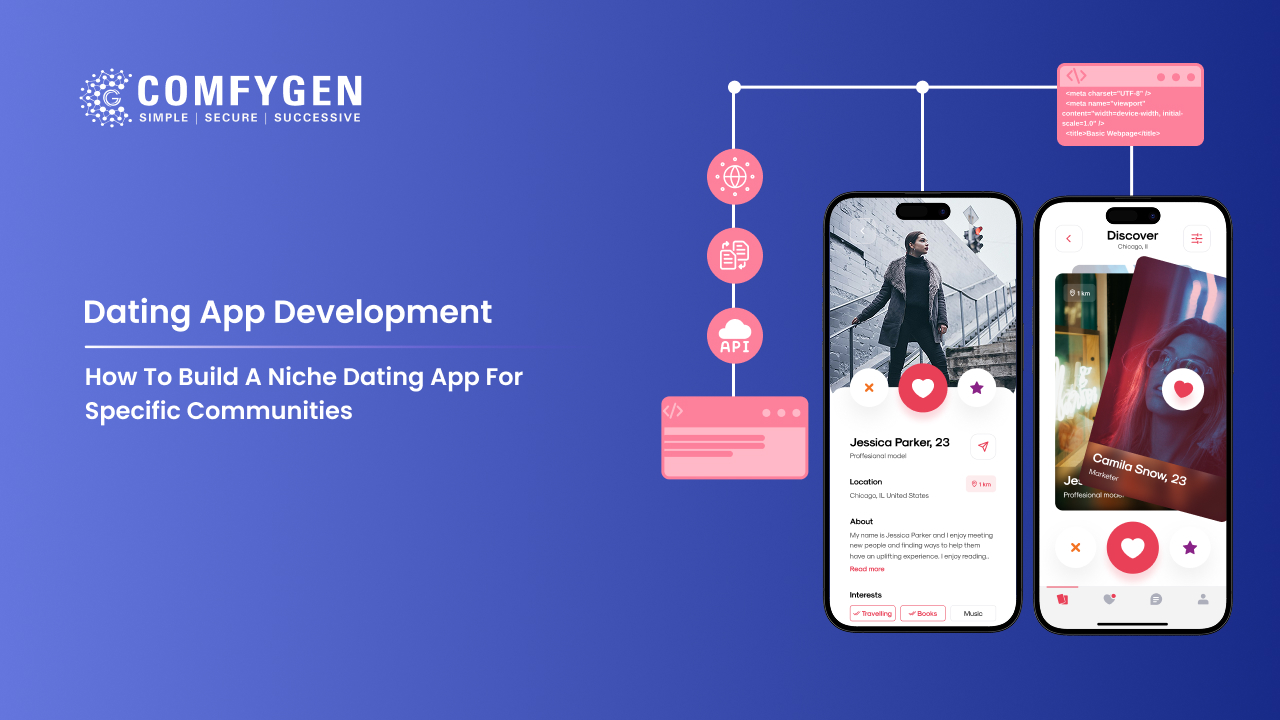





Tinder and Bumble still dominate the headlines, but they are not where the growth is anymore. Both platforms posted declining revenue through 2025, even as the broader dating market kept expanding a sign that users aren’t abandoning dating apps, they’re abandoning swipe-everything apps for something built around who they actually are. Founders who choose to build a niche dating app from scratch, for a focused audience like working professionals, fitness communities, faith groups, or pet owners, are the ones capturing that shift.
This guide walks through exactly how to build a niche dating app from scratch: the market data behind the opportunity, the features that actually matter at each stage, UI/UX and branding decisions, the development process, tech stack choices, security and compliance requirements, testing, realistic cost ranges for India and global markets, and how to monetize once you’ve launched.
The Market Opportunity: Why Niche Dating Apps Are Growing
The global online dating market is projected to generate $3.24 billion in revenue in 2026, according to Statista’s Online Dating market forecast, with the user base expected to reach 475 million people by 2030. India’s dating services market is one of the fastest-growing segments within that, expanding at close to 11–12% annually as smartphone penetration and digital-first dating habits spread beyond metro cities.
What’s notable is where that growth is concentrated. Industry research shows niche dating segments — platforms built around faith, ethnicity, profession, or lifestyle — are expanding roughly 25–30% faster than generalist dating apps, even as the giants post flat or declining numbers. Subscription revenue alone makes up close to 70% of total dating app revenue, which tells you something important for anyone planning to build a dating app for development purposes: users are willing to pay, but they’re increasingly choosing who they pay.
That combination a maturing market, incumbent fatigue, and rising willingness to pay for relevance — is exactly the gap a well-built niche dating application is designed to fill.
Market Validation: Before You Write a Line of Code
Before any development work begins, validate the niche dating app idea. This single step is what separates apps that retain users past month one from apps that quietly disappear after launch.
- Define your first 1,000 users: Identify exactly where this audience already gathers — Facebook groups, subreddits, professional associations, places of worship, fitness communities — and confirm they’re currently underserved by Tinder, Bumble, or Hinge.
- Validate willingness to pay: Run a landing page or waitlist before development starts. A niche dating app concept with no early signup interest is a signal to refine the niche, not to add more features.
- Study direct and indirect competitors: Look at both niche-specific apps already serving your category and general apps your audience currently settles for, to find the exact features they complain about missing.
Core Features to Build Into a Niche Dating Application
A niche dating app still needs the fundamentals of any dating platform, plus a layer of audience-specific functionality on top. The table below separates what’s required at MVP stage from what gets layered in as the app for development matures.
|
Category |
Feature |
Why It Matters |
|
MVP |
Profile creation & onboarding |
Captures niche-specific data points (interests, values, lifestyle) that generic apps never ask for |
|
MVP |
Matching algorithm |
Drives accuracy using niche attributes instead of generic location/age filters alone |
|
MVP |
In-app chat |
Core retention driver; text plus media sharing is the baseline expectation |
|
MVP |
Identity & profile verification |
Trust is the top reason users pick a niche app over a generic one |
|
Growth |
Interest-based filters |
Lets users self-segment by lifestyle, profession, or values |
|
Growth |
Community feed / group chat |
Converts a dating app into a sticky community product, not just a matching tool |
|
Growth |
Events & meetups |
Builds offline trust loops that improve retention and word-of-mouth referrals |
|
Advanced |
AI-based compatibility scoring |
Differentiates from swipe-only competitors at the premium tier |
|
Advanced |
Video chat |
Reduces fake-profile risk and speeds up trust-building before meeting in person |
UI/UX Design and Branding for a Niche Dating App
In dating apps, user perception forms in the first few seconds. A clean, intuitive interface isn’t a nice-to-have — it directly affects whether someone completes onboarding or deletes the app on day one.
User Flow and Wireframing
The typical journey runs through onboarding, profile setup, match discovery, and messaging. Every extra tap between these steps costs you a percentage of users, so wireframing should focus on cutting friction at each handoff, not adding more screens.
Design Principles for Niche Audiences
Keep navigation simple and visual hierarchy clear, but let the branding reflect the niche. A faith-based dating app, a fitness-community app, and a pet-lovers app should not share the same visual language — your audience notices when an app feels generic, and it undermines the trust a niche product is supposed to build in the first place.
Building Brand Identity
Brand identity shapes user trust before a single profile is viewed. Whether your app is built for long-term relationships, casual connections within a community, or a specific lifestyle group, the messaging on your onboarding screens needs to make that purpose unmistakable in the first 30 seconds.
Step-by-Step Process to Build a Dating App From Scratch
Market research & niche validation: Confirm audience size, willingness to pay, and the specific gaps in existing apps before locking in your feature scope.
Feature planning & MVP scoping: Lock the must-have feature list for launch and deliberately defer advanced features like AI matching or video chat to post-MVP releases.
1. UI/UX design: Design an interface that reflects the niche’s tone and identity, building on the wireframes and branding direction set above.
2. Tech stack selection: Choose frameworks and infrastructure for scalability, real-time chat, and geolocation from day one, not as a retrofit later.
3. Development (frontend + backend): Build the user-facing app and the admin panel in parallel, covering chat, matching, profile management, and moderation tools.
4. Testing & QA: Run functional, security, and performance testing, with particular focus on chat reliability and matching accuracy under load.
5. Launch & go-to-market: Launch with app store optimization and niche-community marketing inside the target audience, rather than broad paid ads aimed at everyone.
6. Post-launch iteration: Use retention and engagement data to refine the matching algorithm and decide what to build next, instead of guessing.
Have a niche in mind and want to know if it’s worth building? Get a free feasibility call →
Tech Stack for Building a Niche Dating App
Most niche dating apps today are built cross-platform to control cost without sacrificing native-like performance.
- Frontend: Flutter or React Native for a single codebase across iOS and Android
- Backend: Node.js or Python (Django) for API and business logic
- Database: PostgreSQL or MongoDB, paired with Firebase for real-time features
- Real-time chat: Firebase Realtime Database, Socket.io, or a dedicated chat SDK
- Geolocation: Google Maps API or Mapbox for proximity-based matching
- Video/voice: Agora or Twilio for in-app video chat where the niche calls for it
Security, Compliance, and Data Protection
Dating apps handle some of the most sensitive personal data a user will ever hand over — location, photos, private conversations. A security gap here doesn’t just risk a breach; it kills trust in a niche product faster than almost anything else, because niche audiences often have more on the line if their data leaks.
- End-to-end encryption for messages and stored personal data
- Secure authentication (OTP, social login, or two-factor authentication)
- Role-based access controls on the admin panel to limit who can view user data internally
- Age verification at sign-up, with no exceptions, regardless of niche
- Clear, accessible privacy policy and consent flows aligned with GDPR (for EU users) and India’s DPDP Act
Building these in from day one is significantly cheaper than retrofitting them after a compliance issue or user complaint forces the question.
Testing Your Niche Dating App Thoroughly
Before launch, the app needs to hold up across devices, network conditions, and edge cases that QA teams often skip under deadline pressure.
- Functional testing across different screen sizes and OS versions
- Messaging and push notification reliability under poor network conditions
- Edge cases: incomplete profiles, dropped connections mid-chat, duplicate accounts
- Load testing on the matching algorithm as the user base scales
- A closed beta with 50–100 real users from your target niche, run before public launch, to catch usability issues no internal QA pass will find
Cost to Build a Niche Dating App in India
The cost to develop a niche dating app ranges from ₹8 lakhs to ₹1.2 crore ($10,000 to $150,000+), depending on feature complexity and platform scope. Here’s how that breaks down by build stage:
|
Build Stage |
Scope |
Cost & Timeline |
|
MVP |
Profiles, swipe/browse, basic chat |
₹8–20 lakhs ($10,000–$25,000) | 2–3 months |
|
Standard |
Filters, geolocation, push notifications, verification |
₹25–40 lakhs ($30,000–$50,000) | 4–6 months |
|
Advanced |
AI matching, video chat, live moderation, subscriptions |
₹50 lakhs–₹1.2 crore+ ($60,000–$150,000+) | 6–9+ months |
Ongoing costs — cloud hosting, third-party API fees, maintenance, and marketing — should be budgeted separately and typically run 15–20% of build cost annually.
Want a cost estimate scoped to your specific niche and feature list? Request a free quote
Build vs. White-Label: Which Should You Choose?
Founders who build a niche dating app from scratch get full ownership of the codebase and complete control over features, but it costs more and takes longer to launch. A white-label platform gets you to market faster at lower upfront cost, with less flexibility to differentiate later. Custom development from scratch makes the most sense once you’ve validated demand and need a product that can scale on your own roadmap, not someone else’s.
Monetization Strategies for Niche Dating Apps
- Premium subscriptions with niche-specific perks (priority placement, advanced filters)
- Boosted or featured profiles
- Pay-per-event ticketing for in-app meetups
- In-app purchases (super likes, read receipts, profile highlights)
How Comfygen Helps You Develop a Niche Dating App From Scratch
Comfygen Technologies is a dating app development company that has shipped 250+ projects across mobile app, AI, and blockchain development. If you’ve also looked at how AI and machine learning are reshaping dating app matching, or you’re comparing swipe-based models like our guide to building a dating app like Hinge, our team can help you decide which approach fits your niche before you commit budget.
When you work with us to build a niche dating app, you get:
- A dedicated team experienced in real-time chat, geolocation matching, and secure verification systems
- Transparent, milestone-based pricing aligned to MVP, standard, or advanced build scope
- Agile development cycles that let you adjust features post-launch based on real user data
- Post-launch support for scaling, new feature rollout, and platform maintenance
Final Verdict
Building a niche dating app from scratch is one of the few remaining ways to enter the dating market without going head-to-head with Tinder or Bumble on their own terms. The data backs this: niche segments are growing faster than the giants, and users are increasingly paying for relevance over reach. The opportunity isn’t in cramming in more features — it’s in serving one audience better than any general app can. Start with validation, scope a lean MVP, and build outward from there.
Frequently Asked Questions
How much does it cost to build a niche dating app?
Costs typically range from ₹8 lakhs to ₹1.2 crore ($10,000 to $150,000+) depending on features and complexity. A lean MVP with profiles, swiping, and chat sits at the lower end; AI matching, video calls, and advanced moderation push costs toward the higher end.
How long does it take to develop a niche dating app?
A focused MVP typically takes 2–3 months. A standard app with filters, geolocation, and verification takes 4–6 months. A fully-featured app with AI matching and video chat can take 6–9+ months.
What features are essential for a niche dating app MVP?
At minimum: profile creation, a matching mechanism, in-app chat, and identity verification. Advanced features like AI compatibility scoring, video chat, and event tools can be added in later releases once the core experience is validated.
Should I build my niche dating app from scratch or use a white-label platform?
Build from scratch if you've validated demand and want full ownership and long-term flexibility. Choose a white-label platform if speed to market and lower upfront cost matter more than customization at this stage.
What tech stack is best for building a niche dating app?
Flutter or React Native for cross-platform frontend development, Node.js or Python for the backend, and PostgreSQL or MongoDB paired with Firebase for real-time chat and notifications are the most common combination for new dating apps in 2026.
How do niche dating apps make money?
Premium subscriptions are the dominant model, followed by boosted profiles, in-app purchases, and paid event ticketing. Subscription revenue alone accounts for close to 70% of total dating app industry revenue.
What legal and compliance requirements apply to dating apps?
You'll need age verification at sign-up, encrypted storage of personal data, and a clear privacy policy aligned with regulations like GDPR for EU users and India's DPDP Act for Indian users. Compliance should be built in from day one, not added after launch.
Is a niche dating app actually more profitable than a general dating app?
Not automatically more profitable in absolute terms, but niche segments are growing 25–30% faster than generalist apps and tend to see stronger retention and higher perceived value per user, since people pay more readily for a platform built around their specific identity or interests.

Mr. Saddam Husen, (CTO)
Mr. Saddam Husen, CTO at Comfygen, is a renowned Blockchain expert and IT consultant with extensive experience in blockchain development, crypto wallets, DeFi, ICOs, and smart contracts. Passionate about digital transformation, he helps businesses harness blockchain technology’s potential, driving innovation and enhancing IT infrastructure for global success.
Based on Interest
Cloud Kitchen Management Software Development: Features, Process, Cost & Compliance Guide
Quick Summary: Cloud kitchen management software development brings order aggregation, kitchen display systems, inventory tracking, and analytics into one dashboard, replacing the…