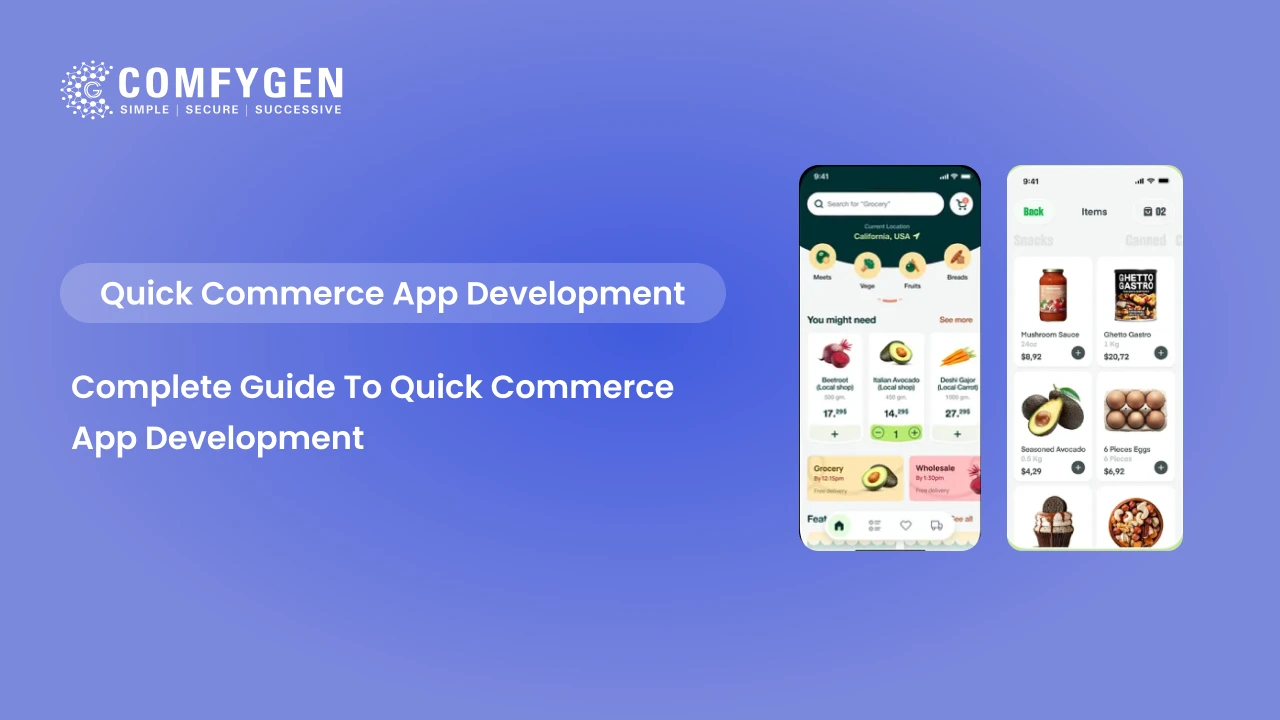





Quick commerce app development means building four connected systems: a customer app, a rider app, a dark store panel, and an admin dashboard that keeps them synced in real time. Costs run $25,000 to $45,000 for a single-city MVP and $120,000 to $250,000+ for a multi-city platform. Timelines run 8 to 30 weeks depending on scope.
That’s the short answer. The rest of this guide covers what those numbers actually buy, which business model fits your situation, and the operational details that decide whether your 10-minute promise holds at 8pm on a Friday.
Key Takeaways
- A working Q-commerce platform needs four connected systems, not one app: customer, rider, dark store panel and admin dashboard.
- Budget $25,000 to $45,000 for a single-city MVP, $50,000 to $90,000 for a growth build, and $120,000 to $250,000+ for a multi-city platform.
- A dark store holding 1,500 to 4,000 fast-moving items within a 2 to 3 km radius is what makes 10-minute delivery physically possible.
- Delivery radius, order density and basket size decide profitability. All three are settled before a line of code gets written.
- Most failed Q-commerce startups died from unit economics, not from technology. Launch one city and one category, then expand.
What is Quick Commerce (Q-Commerce)?
Quick commerce is a retail model that delivers small orders of everyday items within 10 to 30 minutes, using small local warehouses called dark stores placed two to three kilometres from customers. Groceries, medicines, snacks, beverages, personal care and small electronics are the categories where it works.
The distinction that matters: e-commerce optimises for selection, quick commerce optimises for speed. An e-commerce platform wins by carrying 50,000 products. A quick commerce platform wins by carrying the 2,000 products people need right now and getting them there before the customer changes their mind.
Zepto, Blinkit and Swiggy Instamart run this model in India. Getir and Flink built it across Europe. GoPuff runs it in the United States. All of them lose money for years before turning a profit, which is a detail worth sitting with before you start.
Market context: The global Quick Commerce (Q-commerce) market was valued at approximately USD 184.55 billion in 2025 and is projected to reach USD 385.36 billion by 2034, growing at a CAGR of 8.55%.
On the demand side the picture is clearer. Around 600 million people used quick commerce in 2024, and Statista projects roughly 900 million by 2029. Roughly 6,000 dark stores operate worldwide, about 200 of them in the United States. Zepto led global downloads in 2024 with 27.7 million, ahead of Getir at 3.9 million and GoPuff at 1.8 million.
How Quick Commerce Actually Works: The 6-Step Flow
Understanding the operational flow makes every technical decision downstream easier to reason about.
1. Customer places an order
The app shows only products physically in stock at the dark store serving that address. Location detection happens before the catalogue renders, not after.
2. Stock deducts instantly
The moment payment confirms, inventory drops. This is the step most platforms get wrong, and it’s why customers get cancellation messages ten minutes after paying.
3. Order routes to a store
Not necessarily the nearest one. The routing engine weighs distance against current picker load, stock accuracy and rider availability. A store 400 metres further away with an idle picker beats a closer store with a queue.
4. Picker assembles the basket.
Bin-level mapping gives the picker a walking route. In a well-mapped 2,000 SKU dark store, a ten-item basket takes 90 seconds to assemble.
5. Rider collects and delivers.
Assignment happens while picking is still in progress, so the rider arrives as the basket finishes. Route recalculates live against traffic.
6. Proof of delivery closes the loop
Photo, OTP or signature. The order state machine updates, the customer gets a notification, and the data feeds back into demand forecasting.
The whole cycle runs 10 to 30 minutes. Steps 2 and 3 are where the engineering difficulty lives.
Quick Commerce vs E-Commerce: What Changes in the Build
| Aspect | E-commerce | Quick commerce |
|---|---|---|
| Delivery window | 1 to 7 days | 10 to 30 minutes |
| Fulfilment site | Central warehouse | Dark store 2 to 3 km away |
| Catalogue size | 50,000+ SKUs | 1,500 to 4,000 SKUs |
| Inventory sync | Batch updates | Real time, on order confirmation |
| Basket value | Higher, less frequent | Lower, several times weekly |
| Delivery fleet | Third-party couriers | Own or contracted riders |
| Hardest technical problem | Search and catalogue at scale | Order routing and stock accuracy |
| Margin pressure | Product margin | Delivery cost per order |
If you already run an e-commerce platform and are considering adding quick commerce, budget for a rebuild of the inventory and dispatch layers rather than an extension of them. The two architectures solve genuinely different problems.
Choosing Your Business Model: Dark Store, Aggregator or Hybrid
This decision shapes your entire build. Pick it before anyone designs a screen.
| Aspect | Dark store (owned inventory) | Aggregator (partner stores) | Hybrid |
|---|---|---|---|
| Who holds stock | You | Partner retailers | Both |
| Capital needed | High | Low | Medium |
| Delivery speed | Fastest, most reliable | Variable | Fast in core zones |
| Stock accuracy | You control it | Depends on partner systems | Mixed |
| Margin per order | Higher | Lower (commission only) | Mixed |
| Speed to launch | Slower | Faster | Medium |
| Example | Zepto, Getir | Early Dunzo, Swiggy Instamart | Blinkit |
| Extra build work | Warehouse management, picking, replenishment | Vendor onboarding, KYC, commission engine, partner stock APIs | Both |
Practical guidance: if you’re testing a market, start as an aggregator. Capital requirements are far lower and you learn your basket size and repeat rate before signing warehouse leases. Move to dark stores in the zones where volume justifies it. This is roughly the path Blinkit took.
If you already own retail locations, you have a shortcut. Your existing stores become dark stores after hours, which removes the biggest cost line from the delivery app business model.
How Quick Commerce Platforms Make Money
Most guides skip this. It’s the part investors ask about first.
Product margin
Buy at wholesale, sell at retail. Typically 12% to 25% on groceries, higher on personal care and impulse categories. This only exists in the dark store model.
Delivery fees
Usually $0.50 to $3 per order, often waived above a basket threshold. The threshold is a deliberate lever to push average order value up.
Commission from partners
In aggregator models, 10% to 25% of order value from the partner store.
Subscription memberships
Free delivery plus perks for a monthly fee. The real value isn’t the fee, it’s that members order two to three times more often.
In-app advertising and slotting fees
Brands pay for placement in search results and category pages. This is the highest-margin revenue line on the platform and the one most operators build far too late. Blinkit’s ad revenue became meaningful well before its delivery operation did.
Surge and peak pricing
Higher delivery fees during rush hours, weather events and demand spikes.
Practical note: platforms that survive usually run three or more of these at once. Delivery fees alone rarely cover delivery costs.
The Unit Economics Nobody Talks About
Here’s the maths that decides whether your app becomes a business.
A quick commerce order has four cost lines: the goods, the picking labour, the rider payment, and the fixed cost of the dark store spread across orders.
The rider cost is roughly fixed per delivery regardless of basket size. Which means a $6 basket and a $30 basket cost about the same to deliver. That single fact drives most operational decisions in the industry.
What follows from it:
- Average order value is the whole game. Raising AOV from $8 to $14 can move an order from loss-making to profitable without touching delivery cost at all. This is why every quick commerce app pushes minimum-order thresholds, bundles and “add $3 more for free delivery” prompts. Those aren’t growth hacks, they’re survival mechanics.
- Orders per rider hour matters more than delivery speed. A rider completing three deliveries an hour on batched routes beats a rider completing two at higher speed. Batching logic in your dispatch system directly moves your margin.
- Dark store density is a fixed-cost problem. A store needs a certain order volume per day to cover its lease and staff. Below that number, every additional order still loses money. This is why operators cluster launches into dense neighbourhoods rather than spreading thin.
Build implication: your admin dashboard needs to report AOV, orders per rider hour, and orders per store per day from day one. If those three numbers aren’t on the main screen, your ops team is flying blind on the metrics that determine whether the business works.
The Four Apps You Need to Build
Quick commerce app development is not one app. It’s four systems that have to stay in sync.
1. Customer app (iOS, Android, web): Location-aware catalogue, search that tolerates typos, one-tap reorder, checkout in under 60 seconds, live order tracking.
2. Rider app: Task queue, navigation, earnings tracker, proof of delivery, offline order caching. Riders use this for six-hour shifts on mid-range Android phones with patchy signal, so battery behaviour and offline handling matter more than visual polish. This is the app founders consistently underestimate.
3. Dark store or vendor panel: Picking lists with bin locations, stock adjustment, order acceptance, batch management, expiry tracking for perishables and pharmacy.
4. Admin dashboard: Live order board, rider fleet view, inventory across all locations, pricing and promotions, analytics, exception handling.
A build that skips any of these isn’t a quick commerce platform. It’s a shopping app with a delivery promise it can’t keep.
Essential Features by Module
Customer app
- Location detection and zone-based catalogue
- Real-time stock visibility (only shows what’s actually available)
- Search with typo tolerance and voice input
- One-tap reorder and saved baskets
- Live rider tracking with dynamic ETA
- Wallet, coupons, cashback and multiple payment methods
- Ratings on product, rider and packaging separately
Rider app
- Auto-assigned task queue with accept/reject window
- Turn-by-turn navigation and route recalculation
- Offline caching that syncs when signal returns
- Earnings and incentive tracker
- Proof of delivery via photo, OTP or signature
- In-app support and escalation
Dark store panel
- Bin-level picking lists
- Batch picking for grouped orders
- Live stock adjustment and shrinkage logging
- Expiry and batch tracking
- Replenishment alerts based on rolling demand
Admin dashboard
- Live order board with SLA breach alerts
- Rider fleet map and manual reassignment
- Multi-location inventory view
- Zone-level pricing and promotions
- AOV, orders per rider hour, orders per store reporting
- Refund and exception workflows
Dark Store and Micro-Fulfilment Technology
A dark store is a small warehouse holding 1,500 to 4,000 fast-moving items, sited two to three kilometres from the customers it serves and closed to the public. It’s the infrastructure that makes sub-10-minute delivery physically possible.
The software running it decides whether your promise holds during peak hours:
- Bin-level inventory mapping so a picker walks the shortest route to a complete basket
- Live stock deduction on order confirmation, which is what prevents overselling during a flash sale
- Batch picking grouping nearby orders into one rider trip during peaks
- Automated replenishment triggered by the last 14 days of local demand, not a fixed reorder point
- Store-level cut-off logic that hides an unavailable item rather than cancelling after payment
Micro-fulfilment centres run the same software with a larger footprint, typically 5,000 to 15,000 SKUs serving several dark stores in a hub-and-spoke pattern.
A hard-won lesson: ten minutes is a radius problem, not a speed problem. No routing algorithm rescues a store placed six kilometres from its customers. Get the location right before writing code.
Technology Stack and Required Integrations
| Layer | Options | Why |
|---|---|---|
| Mobile | React Native, Flutter | One codebase for iOS and Android at roughly 30% less than two native builds |
| Backend | Node.js, Python (Django), Go | Event-driven order handling |
| Database | PostgreSQL, MongoDB | Transactional order data plus flexible catalogue |
| Cache / real-time | Redis, Firebase | Live inventory deduction needs sub-millisecond reads |
| Cloud | AWS, GCP | Auto-scaling for the 6pm to 9pm peak |
| Containers | Docker, Kubernetes | Independent scaling of routing vs catalogue services |
Integrations you will actually need
- Maps and geolocation: Google Maps Platform or Mapbox for tracking, geocoding, distance matrix and route optimisation
- Push notifications: Firebase Cloud Messaging or OneSignal for order state changes
- Payments: Razorpay and UPI for India, Stripe or PayPal for US and UK, PayTabs or Apple Pay for the Gulf
- SMS and OTP: Twilio, MSG91
- Analytics: Mixpanel or Amplitude for funnel behaviour, plus your own ops dashboard
- POS and ERP: connections to existing retail systems where the client already runs stores
Cost note: mapping APIs bill per request. At scale, live tracking on every active order becomes a real line item. Budget for it and cache aggressively.
Step-by-Step Quick Commerce Development Process
Step 1: Define Your Market and Delivery Radius
Pick one city and one category. Run the radius maths: how many households sit within three kilometres of your candidate store location, and what order volume does that imply? This step kills more bad ideas than any other.
Step 2: Choose Your Business Model
Picking the right model shapes how you manage inventory, delivery, and cost from day one.
Inventory-Led Model: You own and stock the inventory through dark stores or micro-warehouses. This gives full control over quality, pricing, and delivery speed. Best suited for grocery, medicine, and daily essentials, where accuracy and fast availability matter most.
Marketplace Model: Your app connects multiple sellers and local stores on one platform. You don’t hold inventory yourself; vendors list their own products and handle stock. This model needs less upfront capital and scales faster across cities.
Aggregator & Hybrid Model: An aggregator model partners with existing local stores and delivery providers to fulfil orders. A hybrid model combines marketplace and inventory-led approaches, giving you more control in some categories while relying on partners for others. Startups targeting multiple cities often start hybrid to balance cost and delivery speed.
Choose based on your available capital, target category, and how fast you want to launch. Grocery and pharmacy apps usually go inventory-led; general essentials and multi-category apps lean toward marketplace or hybrid.
Step 3: Design For Speed
Every tap between search and checkout costs conversions. Wireframe the customer flow to under 60 seconds from open to order.
Step 4: Architect The Backend
Micro services for order routing, inventory and catalogue so each scales independently. Order volume triples for three hours a day, not twenty-four.
Step 5: Build in Two-Week Sprints
Customer app and admin panel first, rider app and store panel in parallel. Working software at the end of every sprint, not a demo at the end of the project.
Step 6: Integrate and Test Under Load
Simulate peak-hour volume. A platform that handles 20 orders an hour and collapses at 400 isn’t finished. Test the rider app on a three-year-old Android with 2GB of RAM, because that’s what your riders will use.
Step 7: Launch Narrow, Then Expand
One zone, one store, real orders. Fix what breaks. Add zones once the first one holds its delivery promise consistently for two weeks.
Quick Commerce App Development Cost in 2026
| Build type | What’s included | Cost | Timeline |
|---|---|---|---|
| Single-city MVP | Customer app, rider app, basic admin, one payment gateway, live tracking | $25,000 to $45,000 | 8 to 12 weeks |
| Growth build | Adds dark store inventory sync, wallet and coupons, vendor panel, analytics | $50,000 to $90,000 | 14 to 18 weeks |
| Multi-city platform | Adds AI routing, demand forecasting, multi-vendor, multi-warehouse, ERP and POS integrations | $120,000 to $250,000+ | 20 to 30 weeks |
What moves the number
Team location. US and UK studios bill $100 to $200 an hour. A vetted India-based team delivers comparable scope at a fraction of that.
Platform choice. One cross-platform codebase costs roughly 30% less than separate native builds. For quick commerce there’s rarely a technical reason to go native.
Integration count. Every POS, ERP or logistics connection adds engineering time. Four integrations can add six weeks to a schedule that looked comfortable on paper.
Ongoing costs people forget: cloud hosting, mapping API calls, SMS and OTP, payment gateway fees, and app store fees. Budget 15% to 20% of build cost annually for maintenance.
One caution. If a quote comes in under $15,000 for a full Q-commerce platform, something has been left out, usually the rider app or the real-time inventory sync. Those are precisely the parts that make the delivery promise work.
For a category-by-category breakdown, see our cost to develop an app like Zepto guide.
How Long Does It Take? Timeline by Scope
| Phase | MVP | Growth build | Multi-city platform |
|---|---|---|---|
| Discovery and design | 1 to 2 weeks | 2 to 3 weeks | 3 to 4 weeks |
| Core development | 5 to 7 weeks | 8 to 10 weeks | 12 to 18 weeks |
| Integrations | 1 to 2 weeks | 2 to 3 weeks | 3 to 5 weeks |
| QA and load testing | 1 week | 2 weeks | 2 to 3 weeks |
| Total | 8 to 12 weeks | 14 to 18 weeks | 20 to 30 weeks |
Add two to three weeks for App Store and Play Store review cycles, which run in parallel with final QA if planned properly.
Build, White Label or Clone?
Three routes to market, and the right one depends far more on your stage than your budget.
| Aspect | Custom build | White label | Clone app |
|---|---|---|---|
| Best for | Unusual model or heavy existing systems | Fast launch on a proven model | Entering a market a known player validated |
| Time to launch | 14 to 30 weeks | 6 to 10 weeks | 10 to 16 weeks |
| Source code ownership | Full | Full on delivery | Full |
| Design freedom | Unlimited | Themes, colours, layout | Follows the reference app, branding yours |
| Customisation ceiling | None | Moderate | Moderate |
| Typical spend | Highest | Lowest | Middle |
Most first-time operators do better launching on white label or a clone build, proving the unit economics in one city, then rebuilding custom once the numbers work. Spending $200,000 before you know your average basket size is one of the more common ways to run out of runway.
The exception is anyone with existing ERP, POS or warehouse systems that have to stay. Retrofitting a white label platform around entrenched enterprise systems usually costs more than building for them from the start.
Quick Commerce Use Cases by Industry
| Industry | Common Use Cases | What the App Needs |
|---|---|---|
| Grocery & FMCG | Milk, vegetables, snacks, beverages | Dark store integration, real-time inventory sync |
| Pharmacy | OTC medicines, hygiene products | Prescription upload, 24/7 stock availability |
| Food & Beverage | Snacks, ready-to-eat meals, ice cream | Cloud kitchen integration, peak-hour order batching |
| Beauty & Personal Care | Skincare, toiletries, grooming items | Subscription and auto-reorder features |
| Electronics | Mobile accessories, wearables | Limited SKU catalog, predictive stock planning |
| Pet Supplies | Pet food, toys, grooming items | Scheduled weekly delivery, low-stock alerts |
Compliance and Regulation by Market
Requirements shift substantially by geography, and discovering this after launch is expensive.
| Market | Key considerations |
|---|---|
| India | FSSAI licensing for food, drug licence for pharmacy, GST handling, UPI mandates |
| USA | State-level sales tax, CCPA for California data, alcohol licensing where applicable, gig worker classification |
| UK and EU | GDPR, VAT, consumer rights on refunds and delivery windows, worker status rules |
| UAE and Saudi Arabia | Local trade licensing, Arabic language support, food safety authority registration |
Two areas catch operators out most often.
Pharmacy needs prescription verification, pharmacist sign-off and a full audit trail, and the architecture has to support your obligations as the licensed entity.
Gig worker classification has shifted in several markets and determines whether riders are contractors or employees. That changes your cost base materially, so model both before you commit to a fleet structure.
Team Structure: Who You Actually Need
A quick commerce build typically needs:
- 1 project manager
- 1 UI/UX designer
- 2 to 3 mobile developers (customer app and rider app)
- 2 backend developers
- 1 frontend developer (admin panel and store panel)
- 1 DevOps engineer (part time on smaller builds)
- 1 to 2 QA engineers
On an MVP, some of these roles double up. On a multi-city platform, the backend team usually grows first, since routing and inventory carry the load. You can hire dedicated developers for specific roles rather than staffing the whole team internally.
Why Quick Commerce Startups Fail
- Launching too wide: Five cities and 8,000 SKUs before knowing basket size or repeat rate. The data arrives after the money runs out. Operators who survive launch narrow and expand into proven demand.
- Treating the rider app as an afterthought: The customer app gets the design budget, the rider app gets whatever’s left. Then riders can’t complete deliveries efficiently and the delivery promise breaks from the inside.
- Stock accuracy problems: A late delivery annoys a customer. A cancelled order because the item wasn’t actually on the shelf loses them permanently. Real-time deduction and picker confirmation are worth more than shaving two minutes off a route.
- Ignoring average order value: Chasing order count while every order loses money. Growth accelerates the losses.
- Wrong dark store location: Chosen on lease price rather than customer density. No amount of engineering fixes a store six kilometres from demand.
- Building advertising revenue too late: The highest-margin line on the platform, usually postponed until year three.
The record speaks for itself
These are not hypothetical failure modes. Gorillas was acquired after heavy losses. Getir raised billions and then withdrew from the UK, US, Germany, France, Spain, Italy, Portugal and the Netherlands, retreating to Turkey. Dunzo wound down. Statista’s own sector commentary notes that many of the best-funded names in the category never turned a profit, and that profitability remains genuinely difficult to achieve.
Every one of those companies had a good app. None of them failed on engineering.
The practical conclusion for anyone scoping a build: your app is not the main risk. Prove that one dark store, in one postcode, makes money on a real basket size. Then spend on scale.
KPIs to Track After Launch
Build these into the admin dashboard from day one:
| Metric | Why it matters | Rough benchmark |
|---|---|---|
| Average order value | Determines whether an order is profitable at all | Push toward $12 to $15 |
| Orders per rider hour | Directly drives delivery cost per order | 2.5 to 4 with batching |
| Orders per store per day | Decides whether a store covers its fixed cost | 300 to 600 in mature zones |
| On-time delivery rate | The promise you’re actually selling | 90%+ |
| Order cancellation rate | Usually a stock accuracy problem | Under 3% |
| Repeat order rate (30-day) | The single best predictor of survival | 40%+ |
| Basket fill rate | Percentage of requested items actually available | 95%+ |
Benchmarks vary by market and category. Treat them as starting points, not targets handed down from above.
How to Choose a Development Partner
Questions worth asking any quick commerce app development company:
- Have you built a rider app before, and can I see it running?
- How do you handle real-time inventory deduction across multiple stores?
- What happens when two customers order the last item simultaneously?
- Do I own the source code outright on delivery?
- What does your load testing cover, and at what order volume?
- Who maintains it after launch, and at what cost?
The second and third questions are the useful ones. Any team can build a catalogue and a checkout. Concurrent inventory handling under load is where experience shows.
Comfygen has built delivery platforms across grocery, pharmacy, food, FMCG and logistics since 2019, with 550+ projects delivered for 400+ clients across 30+ countries. If you’d rather launch on a proven base, our white label option reaches store submission in six to ten weeks.
Talk to our team about your build →
FAQs
What is quick commerce app development?
How much does it cost to develop a quick commerce app?
How long does it take to build a quick commerce app?
What is a dark store in quick commerce?
Which business model works best for a quick commerce startup?

Mr. Saddam Husen, (CTO)
Mr. Saddam Husen, CTO at Comfygen, is a renowned Blockchain expert and IT consultant with extensive experience in blockchain development, crypto wallets, DeFi, ICOs, and smart contracts. Passionate about digital transformation, he helps businesses harness blockchain technology’s potential, driving innovation and enhancing IT infrastructure for global success.