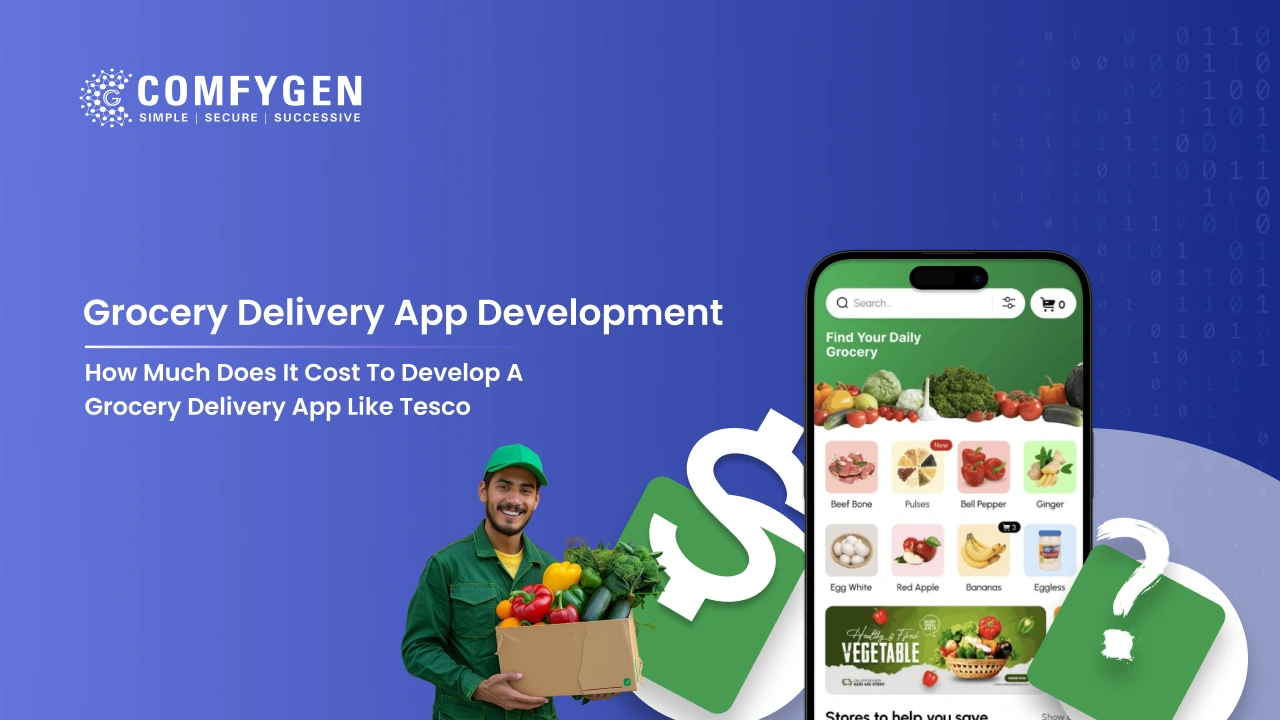





A grocery delivery app like Tesco costs $15,000 to $120,000 or more. A single-store app with a customer app and admin panel runs $15,000 to $30,000 in 8 to 12 weeks. A multi-store chain app with a vendor panel, driver app, and click and collect runs $35,000 to $70,000 in 14 to 20 weeks. A Tesco-scale platform with loyalty pricing, rapid delivery, and POS integration starts at $70,000.
Tesco has sold groceries since 1919 and now runs one of the largest online grocery operations in the world. Its app is not a warehouse business: orders are picked in the stores Tesco already owns, which is what lets it cover most of the UK without building separate fulfilment centres.
Retailers and startups keep asking what it costs to build the same thing. This guide breaks the cost down by build type, by panel, by feature, and by platform, including the three things that make a Tesco-style app more expensive than a standard grocery build.
What Makes a Tesco-Style App Different
Three features define the Tesco model, and each one adds real cost.
Loyalty pricing at basket level
Clubcard prices differ from standard prices. That is not a discount code at checkout. The app has to show two prices as the customer shops, apply the member price live, and keep it correct when a picker substitutes a different brand.
Click and Collect Alongside Delivery
Pickup slots are limited by staging space for bagged orders, while delivery slots are limited by available drivers. Those are unrelated numbers, and running both means building two capacity models.
Rapid Delivery from Stores
Tesco Whoosh delivers a small range in under an hour from the store rather than a dark store. So the same platform has to handle a booked weekly shop and an immediate order, with different picking priorities for each.
A build that ignores these three is not a Tesco-style app. It is a generic grocery app, and it will cost less because it does less.
What Is the Average Cost to Develop an App Like Tesco?
| Build type | Cost | Timeline |
| Single-store grocery app | $15,000 to $30,000 | 8 to 12 weeks |
| Multi-store chain app | $35,000 to $70,000 | 14 to 20 weeks |
| Tesco-scale platform | $70,000 to $120,000+ | 20 to 32 weeks |
| White-label launch | From $8,000 | 3 to 6 weeks |
Single-store covers a customer app and admin panel for one shop: product listing, search, cart, checkout, payments, and simple delivery management. Store staff pick the orders and a courier partner delivers, so no driver app is needed at launch.
Multi-store chains add a vendor or store panel per location, a driver app, order routing by stock availability, per-store pricing, and click and collect.
Tesco-scale adds loyalty pricing, rapid delivery alongside booked slots, POS and ERP integration, demand forecasting, and multi-country configuration for tax and restricted items.
Cross-platform development with Flutter or React Native keeps the cost at the lower end of each band. Native iOS and Android builds run 30 to 40% higher, because you pay for two codebases.
How Much Does Each Grocery Business Model Cost?
Single-Store Grocery App
$15,000 to $30,000. Best for independent supermarkets and small chains testing online demand. One shop, one delivery zone, one catalog. Covers product listing, search, cart, checkout, payment integration, and basic delivery management.
Multi-Store Chain App
$35,000 to $70,000. The Tesco shape at a smaller scale. Each store carries its own catalog, pricing, stock, and slot capacity, and orders route to the branch that actually holds the items. Adds the vendor panel and driver app, plus click and collect staging.
The store-level data model is the part to get right early. Retrofitting multi-store into a single-store database is a migration rather than a settings change.
Hyperlocal Grocery Delivery App
$25,000 to $45,000. Built for fast delivery from nearby stores, with store discovery by location, livestock, and dispatch by rider position rather than roster. Suits same-day and sub-hour services rather than booked weekly shops.
Subscription Grocery App
$20,000 to $35,000. For recurring deliveries of staples such as milk, bread, and vegetables, plus delivery passes like Tesco’s Delivery Saver. Covers subscription plans, recurring payments, automated scheduling, and pause or skip handling.
Subscriptions earn their build cost faster in grocery than in most categories, because the weekly shop repeats whether or not you market to it.
What Each Panel Costs to Build
A complete grocery app like Tesco has four panels. The tables below price each one separately.
Read these as a complete four-panel build. The four panels together total roughly $18,500 to $30,500, which lands at the top of the single-store band or the bottom of the multi-store band. A $15,000 build does not include all four, because a single store usually launches with the customer app and admin panel only.
Customer App Features
| Feature | Estimated cost |
| User login and profile management | $800 to $1,200 |
| Product search and filters | $1,000 to $1,500 |
| Cart and checkout | $1,200 to $1,800 |
| Multiple payment gateway integration | $1,000 to $1,600 |
| Delivery and collection slot booking | $1,200 to $2,000 |
| Order tracking and push notifications | $1,200 to $2,000 |
| Substitution preferences | $900 to $1,500 |
| Customer app total | $7,300 to $11,600 |
Substitution preferences appear on almost no competitor cost table, and leaving them out is why so many grocery builds come in over budget. Every out-of-stock item becomes a refund and a support ticket without them.
Store and Vendor Panel Features
| Feature | Estimated cost |
| Store profile and product management | $1,500 to $2,500 |
| Inventory and stock management | $1,200 to $2,000 |
| Order management dashboard | $1,000 to $1,800 |
| Picker workflow with aisle ordering | $1,200 to $2,000 |
| Offers, discounts, and pricing tools | $800 to $1,200 |
| Vendor panel total | $5,700 to $9,500 |
Aisle ordering in the picker workflow saves more staff time than any other single feature here, because it turns a shopping list into a route through the shop.
Delivery Partner App Features
| Feature | Estimated cost |
| Delivery agent registration | $600 to $1,000 |
| Order assignment system | $1,000 to $1,600 |
| GPS navigation and route tracking | $1,200 to $2,000 |
| Proof of delivery | $600 to $1,000 |
| Earnings and payout management | $800 to $1,200 |
| Delivery app total | $4,200 to $6,800 |
Admin Panel Features
| Feature | Estimated cost |
| User, vendor, and delivery management | $1,500 to $2,500 |
| Zone and slot capacity configuration | $1,200 to $2,000 |
| Commission and revenue tracking | $1,200 to $2,000 |
| Reports and analytics dashboard | $1,000 to $1,800 |
| CMS and system settings | $800 to $1,200 |
| Admin panel total | $5,700 to $9,500 |
The admin panel usually takes longer to build than the customer app, because it is where the operation actually runs. An admin dashboard for grocery delivery carries order triage, stock overrides, and slot capacity across every store.
Build Your Own Grocery Delivery App Like Tesco
Turn your grocery app idea into a scalable digital platform with the right features, technology, and development strategy.
Get a Free Consultation
What Tesco-Specific Features Add to the Cost
These three are what separate a Tesco-style build from a standard grocery app.
| Feature | Estimated cost | Why it costs this much |
| Loyalty pricing at basket level | $3,000 to $6,000 | Two price sets per product, applied live, surviving substitution |
| Click and collect with staging board | $3,500 to $7,000 | A second capacity model, arrival check-in, bay assignment, cold-chain timers |
| Rapid delivery alongside booked slots | $4,000 to $8,000 | Two picking priorities in one store, separate dispatch logic |
Budget $10,500 to $21,000 on top of the four panels if you want all three. That is the honest gap between a generic grocery app and a Tesco-style one.
How Much Do Advanced Features Cost?
AI Features and What They Cost
| Feature | Purpose | Estimated cost |
| Product recommendations | Personalised reorder prompts | $2,000 to $4,000 |
| Demand forecasting | Predicts stock-outs per store | $1,500 to $3,000 |
| Voice product search | Search by speaking | $1,200 to $2,500 |
All three need months of order history before they produce anything useful. Building them at launch gives you an empty feature.
Real-Time and Automation Features
| Feature | Purpose | Estimated cost |
| Real-time inventory sync with POS | Keeps stock matched to the shelf | $1,500 to $3,000 |
| Route optimisation | Cuts delivery time and fuel cost | $1,200 to $2,500 |
| Dynamic delivery fee calculation | Adjusts charges by zone and demand | $800 to $1,500 |
POS sync is the one to prioritise. Stock drift causes more cancelled grocery orders than any other single problem, and the fix is treating the till as the source of truth rather than the app. Teams that manage inventory in grocery delivery apps will build this first.
Security and Compliance Features
| Feature | Purpose | Estimated cost |
| Secure payment encryption | Protects transactions, PCI DSS compliant | $800 to $1,500 |
| Role-based access control | Limits what store staff can see | $700 to $1,200 |
| Fraud detection and monitoring | Prevents fake orders and misuse | $1,000 to $2,000 |
Role-based access matters more in a chain than a single shop. A store manager must not see another branch’s margins.
How Platform Choice Changes the Cost
| Platform | Estimated cost |
| Android app | $6,000 to $12,000 |
| iOS app | $7,000 to $13,000 |
| Web admin panel | $4,000 to $8,000 |
| Cross-platform, one codebase | $10,000 to $18,000 |
Cross-platform costs less than building Android and iOS separately, which is why most grocery builds use Flutter or React Native. Native becomes worth it only when you need platform-specific hardware features.
How Much Does UI/UX Design Cost?
| Task | Estimated cost |
| Wireframing and prototyping | $800 to $1,500 |
| Custom UI design | $1,500 to $3,000 |
| UX optimisation and testing | $1,000 to $2,000 |
| Total | $3,300 to $6,500 |
Design carries unusual weight in grocery. Baskets hold 20 to 40 items, so a cart that needs two thumbs to change a quantity loses the order at exactly the wrong moment.
What Third-Party Integrations Cost
| Integration | Estimated cost |
| Payment gateway | $800 to $1,500 |
| Maps and GPS APIs | $700 to $1,200 |
| SMS, email, and push notifications | $500 to $1,000 |
| ERP and POS system integration | $1,500 to $3,000 per system |
ERP and POS integration is priced per system, not per project, because each one has its own API. Get the system name from your client before quoting.
How Long Does It Take to Build?
| Build type | Timeline |
| Single-store app | 8 to 12 weeks |
| Multi-store chain app | 14 to 20 weeks |
| Tesco-scale platform | 20 to 32 weeks |
| White-label launch | 3 to 6 weeks |
| Stage | Duration |
| Planning and scoping | 2 to 4 weeks |
| UI/UX design | 4 to 6 weeks |
| Development | 8 to 20 weeks |
| Testing, including load testing | 4 to 6 weeks |
| App store submission and launch | 2 to 3 weeks |
Load testing is the stage teams skip and regret. Grocery traffic peaks on weekday evenings and weekend mornings, so a platform sized for the daily average falls over at 6pm on a Friday.
What the App Costs to Run After Launch
| Activity | Annual cost |
| App maintenance and updates | $1,000 to $3,000 |
| Cloud hosting and servers | $800 to $2,500 |
| Security updates and bug fixes | $700 to $2,000 |
Plan for 15 to 20% of the original build cost each year. Grocery apps need more maintenance than most, because catalogs, prices, and payment rules change constantly.
Hidden Costs to Plan For
App Store Fees
Google Play and the Apple App Store charge publishing and annual renewal fees. Small, but required to keep the app live.
Payment Gateway
Payment gateway transaction charges. Charged per order, so this grows with success rather than staying fixed.
Third-party Subscriptions
Maps, SMS, notifications, and analytics mostly run on monthly or usage-based plans. Maps API usage in particular rises with order volume.
Customer Acquisition
This is the cost that kills most grocery launches, and almost no development company mentions it. A build might cost $30,000 while reaching the first several thousand active users costs more.
Future Enhancements
Adding stores, cities, or features needs extra development. Planning the architecture for growth early avoids sudden expense later, and the grocery delivery app development challenges that cost most to fix are the ones where the data model assumes one store.
How to Reduce Your Grocery App Development Cost
Start with an MVP: Launch with the customer app and admin panel only. Add the vendor panel when you onboard a second store and the driver app when you bring delivery in-house.
Prioritise features honestly: Slot booking is required. A wishlist is not. AI recommendations need data you will not have at launch.
Choose cross-platform: One codebase for Android and iOS saves 30 to 40% against native builds.
Use existing APIs: Google Maps, Stripe, and Firebase cost less than building the same functionality.
Skip click and collect at launch unless pickup is central to your model. It is a second capacity model and a second set of screens.
Consider a white-label base: From $8,000 and live in 3 to 6 weeks, which is the cheapest way to find out whether anyone in your area will order groceries online at all.
White-label, single-store, multi-store, and enterprise grocery delivery app development each carry a different cost and timeline, from $8,000 up to $120,000.
Why Build Your Tesco-Style App With Comfygen
Comfygen has delivered 550+ projects for 400+ clients across 30+ countries since 2019. Our team builds supermarket platforms with click and collect, loyalty pricing, and POS sync, working as a grocery delivery app development company for chains, independent grocers, and startups.
Every project ships with the source code in your name and a signed NDA from the first call. Comfygen Technologies holds ISO 9001:2015, ISO/IEC 20000-1:2018, and ISO 27001 certification.
Frequently Asked Questions
How much does it cost to develop a grocery delivery app like Tesco?
How long does it take to build?
What makes a Tesco-style app cost more than a standard grocery app?
Can I reduce the cost?
Are there ongoing costs after launch?
Do I need a driver app?
What does click and collect add to the build?

Mr. Saddam Husen, (CTO)
Mr. Saddam Husen, CTO at Comfygen, is a renowned Blockchain expert and IT consultant with extensive experience in blockchain development, crypto wallets, DeFi, ICOs, and smart contracts. Passionate about digital transformation, he helps businesses harness blockchain technology’s potential, driving innovation and enhancing IT infrastructure for global success.