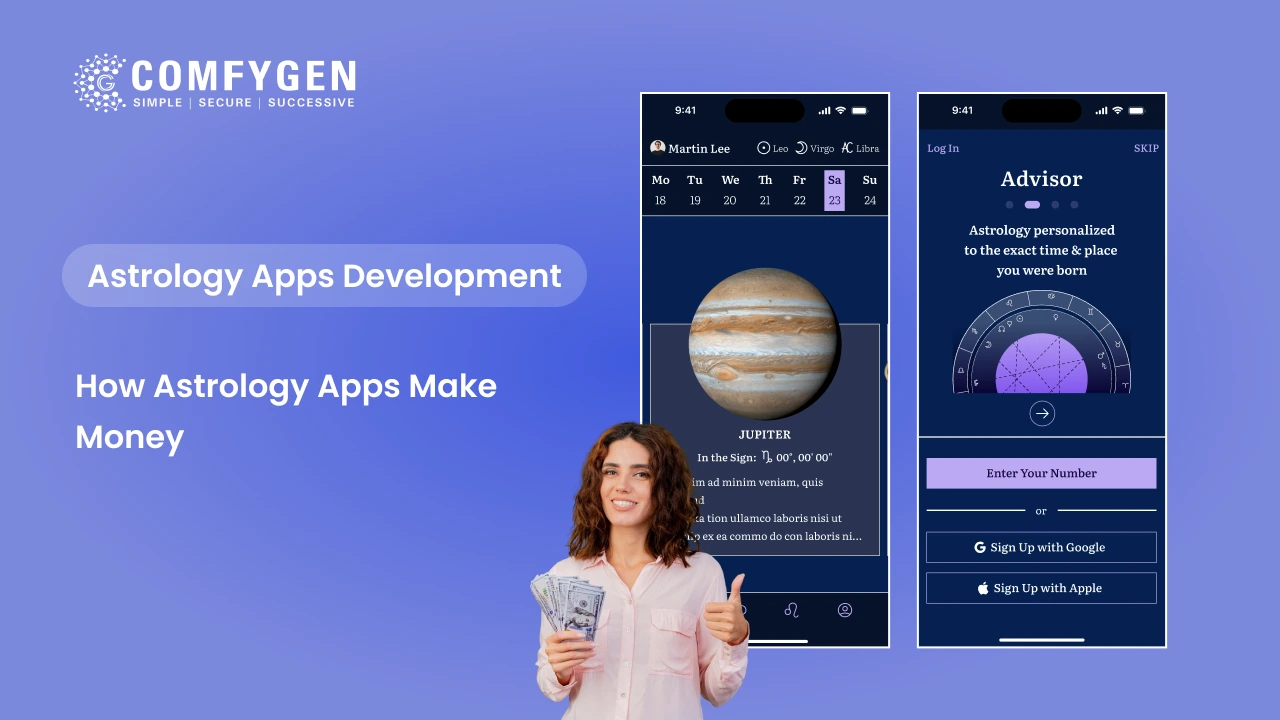





In today’s digital world, astrology is no longer limited to TV shows or newspaper columns. With the rise of mobile technology, millions of users are turning to the best astrology apps for personalized horoscopes, Kundli readings and compatibility reports.
Astrology businesses are going online to reach global users, automate services, and earn steady revenue. A profitable online business can be built by developing an astrology app if you are an astrologer or entrepreneur.
The Business Case for Astrology Apps in 2026
The numbers behind the astrology app industry are hard to ignore.
The global astrology app market was valued at USD 5.69 billion in 2026 and is projected to reach USD 11.71 billion by 2030, growing at a 19.8% CAGR. In India specifically, the market stood at USD 163 million in 2024 and is racing toward USD 1.797 billion by 2030 at a 49.19% CAGR — one of the fastest growth rates of any consumer app category in the country.
What’s driving this? Several factors converge. Smartphones and affordable data have made astrology services accessible to anyone. Gen Z, who grew up with digital media, treats astrology as a mainstream part of self-care and identity. And personalization technology has made it possible for an app to deliver something that feels genuinely individual rather than a generic sun sign forecast copied from a newspaper column.
The spiritual-tech segment, now called “astrotech” by industry analysts, attracted USD 50 million in funding in India alone in 2024, up from just USD 88,000 in 2015. That trajectory is a signal, not a coincidence.
For entrepreneurs and businesses considering astrology app development, the question is no longer whether the market exists. The question is how to build the right revenue model to capture it.
How Much Do Astrology Apps Actually Make?
Real revenue benchmarks help put the opportunity in context.
Astrotalk, launched in 2017, currently holds an 80% share of India’s astrology app market with over 60 million registered users and 15,000 active astrologers. By late 2024, it was clocking ₹70 crore in monthly revenue and targeting a ₹1,000 crore (~$120 million) annual run rate by 2026. It currently processes approximately 4.5 million paid sessions per month, with session pricing ranging from ₹99 quick chats to ₹1,999 deep-dive video calls.
AstroSage, a pioneer in the space since the early 2000s with over 10 million installs, generates an estimated ₹60 crore annually as of 2026 – a figure that has roughly doubled each year since 2020.
In the U.S., Co-Star pulls in approximately $400,000 per month with over 20 million downloads, driven primarily by Gen Z users engaging with daily horoscopes and compatibility reports. Nebula has scaled to nearly 3.9 million downloads in a single year.
Average profit margins in the space run between 15–30%, with consultation commission and report-based revenue yielding the highest margins. About 70% of revenue for major platforms comes from India and South Asia; the remaining 30% comes from diaspora users in the U.S., UK, and Middle East.
These are not niche numbers. This is a mainstream consumer market with multiple proven paths to revenue.
Monetization Model 1: Freemium with Premium Upgrades
The freemium model is the entry point for most successful astrology apps. The logic is straightforward: give users enough value for free to build a habit, then unlock deeper features behind a paywall.
Free features typically include daily horoscope notifications, basic sun sign and moon sign readings, a basic birth chart, and limited compatibility checks. These give users a genuine reason to open the app regularly without requiring payment.
Premium upgrades then offer what free users genuinely want but can’t access: detailed natal chart analysis, personalized monthly or yearly forecasts, compatibility reports that go beyond the sun sign, ad-free experience, and priority access to live astrologers.
Co-Star and The Pattern both use this model effectively. Their free content is genuinely engaging, which builds the user habit. Once users feel the app understands them, conversion to paid features becomes a natural progression rather than a hard sell.
Revenue potential: Freemium conversion rates in astrology apps typically run between 5–12%. On an app with 500,000 monthly active users, even a 5% conversion to a ₹299/month plan generates ₹74.75 lakh per month from subscriptions alone.
Monetization Model 2: Subscription Plans
Subscriptions are the most predictable revenue stream in the astrology app space. Unlike one-time purchases or per-session fees, subscriptions generate monthly or annual recurring revenue that compounds over time.
Most apps that succeed with subscriptions offer two to three tiers.
A basic tier, typically priced between ₹149–₹299/month, gives access to expanded daily readings, weekly forecasts, and an ad-free experience. A premium tier at ₹499–₹799/month adds birth chart analysis, compatibility tools, access to exclusive astrologer content, and priority booking for live sessions. A VIP tier, where it exists, often bundles a fixed number of live consultation minutes per month along with all premium features.
Annual plans deserve special attention. Offering a 20–30% discount for annual commitment improves revenue predictability significantly and reduces churn. A user who has paid ₹2,000 upfront for an annual plan is far less likely to leave than one who is billed ₹199 each month.
The subscription model yields the highest profit margins in the business, since marginal delivery costs are low once content is created. Platforms that get subscription mechanics right tend to see lifetime values 3–5x higher than platforms relying purely on transaction-based models.
Monetization Model 3: Live Consultations and Pay-Per-Session
Live consultations are the highest-grossing revenue stream for platforms like Astrotalk and GaneshaSpeaks. They’re also the most complex to operate, because the quality of consultations directly determines whether users return.
Here’s how the model works. Users browse a list of verified astrologers on the platform, each with their own profile, specialization (Vedic, numerology, tarot, Vastu, etc.), ratings, and per-minute pricing. Users initiate a chat, voice, or video session, and the platform charges either per minute or per session. The platform takes a commission of 20–40% on every session.
Astrotalk’s pricing ranges from ₹20–₹100 per minute depending on the astrologer. A 15-minute session at ₹30/minute generates ₹450 in gross revenue; the platform retains ₹90–₹180 and the astrologer receives the rest. Multiply that by 4.5 million sessions per month and the revenue scale becomes clear.
For a new platform, consultation revenue accounts for roughly 40–60% of total earnings once the astrologer supply side is established. The critical success factor is astrologer quality and verification. Users who have a poor experience do not return. Platforms that invest in vetting, onboarding, and ongoing rating systems earn the trust that keeps consultation revenue growing.
Pricing should be transparent and flexible. Per-minute billing works well for quick queries. Fixed-price session packages work better for longer, more structured consultations. Offering both lets users choose based on their preference.
Ready to Build Your Own
AI Powered Astrology App?
LET’S TALK
Monetization Model 4: Premium Astrology Reports
Not every user wants to speak to an astrologer. Many prefer a detailed written report they can read at their own pace, revisit when needed, and share with family members.
Premium astrology reports are a natural fit for this behavior. The typical product catalog includes birth chart analysis (also called Kundli in Indian astrology), annual forecast reports, career prediction reports, marriage compatibility reports, and monthly guidance packs.
Pricing in India typically runs between ₹299–₹599 per report. A Vedic birth chart analysis, for example, might be priced at ₹399 and sell to a significant portion of users who initially signed up for free horoscopes.
The economics work well because report generation has shifted from manual astrologer effort to AI-assisted production. AstroSage launched AstroSage AI in September 2024, using generative AI to produce multilingual, personalized reports at scale. This means report revenue carries higher margins than consultation revenue, since delivery cost per unit drops significantly with AI.
Reports also serve as a gateway to consultation bookings. A user who reads a detailed birth chart report and has follow-up questions is highly motivated to book a consultation session. The report-to-consultation conversion funnel is one of the most effective upsell paths in the astrology app business.
Monetization Model 5: In-App Advertising
Advertising works well for astrology apps that have large free user bases. The logic is simple: users who don’t pay still generate revenue by viewing ads.
Ad formats in astrology apps include banner ads displayed in free horoscope feeds, interstitial ads between content sections, sponsored content from wellness brands, and native ads that match the app’s spiritual tone.
The most common integration is Google AdMob, which manages ad placement and revenue share automatically. For a free astrology app with 500,000 monthly active users generating three to five ad impressions per session, advertising can contribute ₹10–₹25 lakh per month depending on CPM rates and user geography.
A critical design consideration: ads must be placed carefully in spiritual apps. Intrusive interstitials or irrelevant promotions from incompatible advertisers will drive uninstalls faster than almost any other UX problem. The best implementations partner specifically with wellness brands, meditation platforms, yoga studios, and spiritual product sellers whose audiences overlap directly with astrology app users.
Many established apps use advertising only for their free tier and completely remove ads as a subscription benefit. This creates a clean incentive for users to upgrade and simultaneously makes the paid experience measurably better.
Monetization Model 6: E-Commerce and Spiritual Products
E-commerce is an underutilized revenue stream for most astrology apps, but the opportunity is significant. Users who trust an app’s astrological guidance are naturally receptive to product recommendations tied to that guidance.
The product catalog that performs well includes gemstones recommended based on birth chart analysis, rudraksha beads, yantras, spiritual jewelry, Puja kits, and personalized lucky items. These are not novelty purchases; in the Indian market, these are considered functional spiritual tools with genuine cultural significance.
Pricing ranges widely, from ₹500 for a basic rudraksha to ₹5,000 or more for high-quality gemstones or custom-engraved yantras. Margins on spiritual products can be substantial, particularly for items sold through the app’s own inventory or through white-labeled supplier partnerships.
The critical factor is integration quality. Product recommendations must feel contextually connected to the user’s astrological profile, not like a generic store attached to the app. When a user receives a birth chart report that identifies a weak Venus placement and the app immediately recommends a white sapphire with an explanation of how it relates to their chart, the conversion rate is far higher than a generic “shop” tab.
Apps targeting the Indian diaspora in the UK, U.S., and Middle East have found particularly strong demand for curated spiritual products shipped internationally, since access to specialized stores is limited outside of India.
Monetization Model 7: Affiliate Partnerships
Affiliate partnerships allow astrology apps to earn commission from third-party products and services their users purchase through links or promotions in the app.
Natural affiliate partners include wellness and meditation platforms like Headspace or Calm, online puja booking services, vastu consultation services, spiritual book publishers, and travel companies offering pilgrimage packages.
The affiliate model requires minimal development effort beyond link integration and tracking. For platforms where direct monetization is still building, affiliate income can provide a useful revenue floor while the user base grows.
The key discipline is selectivity. Every affiliate partner promoted in the app either strengthens or weakens the user’s trust in the platform. Recommending products and services that are genuinely relevant to users’ spiritual interests builds credibility. Promoting irrelevant offers for commission erodes it.
Commission rates in the wellness and spiritual space typically range from 5–20% depending on the product category and partner.
Monetization Model 8: Sponsored Astrologer Listings
As astrology platforms grow their astrologer supply, the competition among astrologers for visibility becomes its own monetizable feature.
Sponsored listings allow astrologers to pay for prominent placement in search results, category listings, or on the app’s homepage. An astrologer who specializes in career predictions might pay for featured placement in the “career” consultation category during peak planning periods in January and mid-year.
Featured slot pricing typically runs between ₹500–₹5,000 per day depending on platform size and placement quality. For established platforms with tens of thousands of astrologers, this stream can generate significant additional income without any incremental cost to serve users.
This model requires careful implementation. Sponsored placement must be visibly labeled as such, and the integrity of the rating system must be maintained independently of payment status. Users who discover that top-listed astrologers paid for the position rather than earned it through quality will lose trust in the platform rapidly.
Which Monetization Model Works Best?
No single model outperforms all others in every context. The most successful platforms combine multiple streams.
Here is how the revenue mix typically looks for a mature Indian astrology app:
| Revenue Stream | Share of Total Revenue | Margin Profile |
|---|---|---|
| Live Consultations (Commission) | 40–60% | Medium (20–40% of gross) |
| Subscription Plans | 20–30% | High |
| Premium Reports | 15–25% | High (especially AI-generated) |
| E-Commerce Products | 5–15% | Variable |
| In-App Advertising | 5–10% | Low-Medium |
| Affiliate and Sponsored | 2–5% | High (low delivery cost) |
For a new app entering the market, the recommended sequencing is to start with the freemium model to build a user base, add premium reports early since they require no live astrologer supply, launch consultation features once astrologer onboarding reaches a critical mass, and layer in subscriptions and e-commerce once users have demonstrated consistent engagement.
Trying to launch all models simultaneously dilutes focus and complicates development. Building revenue streams sequentially lets each one mature before the next is added.
Real-World Examples of Profitable Astrology Apps
The global astrology app market is booming, and top players like AstroTalk, Co–Star, and The Pattern have turned astrology into a multi-million-dollar business. Let’s look at how these apps make money and what makes them successful — so you can plan your own profitable astrology app.
AstroTalk: Personalized Consultations and AI Predictions
AstroTalk is one of the most popular astrology apps globally, offering live chat and video consultations with verified astrologers.
Here’s how AstroTalk makes money:
- Paid Consultations: Users pay per minute for expert sessions with astrologers.
- Premium Reports: Offers paid Kundli, matchmaking, and yearly predictions.
- E-Commerce Integration: Sells gemstones, puja items, and astrology-based remedies directly through the app.
- Subscription Packages: Users can subscribe for priority services or discounts on consultations.
Takeaway: By combining AI-driven predictions, live chat features, and E-Commerce integration, AstroTalk has created a seamless experience that blends spirituality with technology.
Co–Star: AI-Powered Horoscope & Data-Driven Engagement
Co–Star stands out for its modern, minimal design and advanced AI astrology algorithm. It uses NASA data and machine learning to generate hyper-personalized daily horoscopes.
Here’s how Co–Star generates revenue:
- Premium Subscriptions: Offers users the ability to unlock deeper compatibility insights.
- In-App Purchases: Users can buy detailed birth chart analyses and personality reports.
- Brand Collaborations: Partners with lifestyle and wellness brands for promotions.
Takeaway: Co–Star proves the power of personalization. When users get content that feels unique and tailored, they’re more likely to upgrade to premium plans — increasing your app’s lifetime revenue.
The Pattern Astrology: Emotional Insights and Relationship Analysis
The Pattern focuses on emotional awareness, compatibility, and personal growth through astrology. It connects users on a deeper level using data-driven relationship mapping.
Here’s how The Pattern monetizes its services:
- Subscription Model: Premium users get access to in-depth compatibility and life-cycle reports.
- In-App Purchases: Special reports on love, friendship, and life patterns are sold individually.
- Community Engagement: Increases retention by letting users connect and discuss insights within the app.
Takeaway: Emotional connection drives retention. When users feel understood and connected, they stay longer — helping apps earn more through repeat purchases.
Key Features That Drive Revenue in Astrology Apps
Features are not just product decisions. In an astrology app, each feature is a revenue mechanism. Here are the ones that most directly move the needle.
Personalized Horoscope Dashboard
A daily dashboard customized to the user’s full birth details — not just sun sign — creates a daily open habit. Apps that users open daily have dramatically higher conversion rates to paid features than those opened weekly or less. This is the single most important retention feature in the entire product.
Kundli Generation and Matching
For Indian users, Vedic birth chart (Kundli) generation and kundali matching for marriage compatibility are table-stakes features. Vedic astrology accounts for over 60% of market share in India’s astrology app segment. Any serious platform targeting Indian users must do this well.
Live Chat, Voice, and Video Consultations
Real-time sessions with human astrologers drive the highest average revenue per user of any feature. Building this requires three panels: a user panel for booking and sessions, an astrologer panel for availability, session management, and earnings tracking, and an admin panel for astrologer verification, commission control, and dispute resolution.
AI Chatbot for Astrology Queries
An AI-powered chatbot that can answer astrology questions, generate instant horoscope interpretations, and provide preliminary birth chart readings 24/7 reduces dependency on human astrologer availability and handles query volume that live consultations cannot economically serve at scale.
Push Notifications
Daily horoscope alerts, session reminders, offer notifications, and loyalty milestone alerts are the primary drivers of daily app opens. Users who receive personalized push notifications open an app 4x more frequently than those who don’t. Every incremental open is another opportunity for conversion.
Multi-Language Support
India alone has 22 officially recognized languages and hundreds of regional variations. Offering astrology content in Hindi, Tamil, Telugu, Bengali, Marathi, Gujarati, and Kannada significantly expands the addressable market beyond English-speaking urban users. AstroSage’s early investment in multi-language support was a key driver of its scale.
In-App Wallet and Payment Flexibility
and use it across consultations, reports, and products without re-entering payment details for every transaction. Reducing payment friction directly improves session initiation rates. Supporting UPI, credit and debit cards, net banking, and wallet solutions covers the full spectrum of Indian payment preferences.
How AI Changes the Monetization Game
Artificial intelligence is not a future consideration for astrology apps in 2026. It is already redefining what is possible.
AI-generated Personalized Reports
AI-generated personalized reports can be produced in seconds at near-zero marginal cost. A platform that previously required an astrologer to spend 90 minutes writing a detailed Kundli analysis can now generate a comparable report instantly using AI trained on Vedic astrology principles. This makes premium reports economically viable at lower price points, which widens the buyer pool.
Predictive Personalization
Predictive personalization uses machine learning to analyze a user’s engagement history, birth data, and behavioral patterns to surface content, reports, and astrologer recommendations most likely to convert. Platforms using personalization algorithms consistently see higher session lengths, more repeat purchases, and lower churn than those serving generic content to all users.
Conversational AI Consultations
Conversational AI consultations allow users to engage in real-time dialogue with an AI that can interpret birth charts, answer follow-up questions, and adapt responses to the user’s emotional context. For users who are not ready to spend ₹300–₹1,000 on a human consultation, an AI consultation at a lower price point serves as an entry point that captures revenue that would otherwise be zero.
AstroSage’s AI launch in September 2024, described as a generative AI platform with AGI-level expertise in astrology, is an early example of where the category is heading. Startups that build AI from the ground up rather than bolting it on later will have a structural advantage.
The technology stack for AI-enabled astrology apps typically includes Python or Node.js on the backend, OpenAI or Google Gemini APIs for language model integration, Swiss Ephemeris for accurate planetary calculations, and Firebase or AWS for real-time infrastructure.
Cost to Build an Astrology App in 2026
The cost of building an astrology app depends primarily on the feature set you launch with, the platforms you target, and where your development team is based. Here is a realistic breakdown.
By App Complexity
| App Type | Features | Estimated Cost (INR) | Estimated Cost (USD) |
|---|---|---|---|
| Basic MVP | Daily horoscopes, basic Kundli, user profiles | ₹3–5 Lakh | $4,000–$7,000 |
| Standard | Above + live chat consultations, premium reports, payment integration | ₹6–10 Lakh | $8,000–$15,000 |
| Advanced | Above + video calls, AI personalization, e-commerce, admin panel | ₹12–20 Lakh | $15,000–$30,000 |
| Enterprise | Full AI integration, multi-language, astrologer marketplace, analytics | ₹25–60 Lakh | $35,000–$75,000+ |
An Astrotalk-equivalent app typically requires an investment in the advanced to enterprise range, reflecting the complexity of three-panel architecture (user, astrologer, admin), real-time communication infrastructure, and payment system integration.
Development Timeline
A basic app takes 10–14 weeks from discovery to launch. A standard app with consultation features runs 16–22 weeks. Advanced AI-integrated platforms with multiple panels can take 6–9 months depending on scope and revision cycles.
Ongoing Costs to Plan For
Annual maintenance typically runs 15–20% of initial development cost. Third-party API costs (Google Maps for location features, payment gateway fees, push notification services) scale with usage. Astrologer quality assurance and support is an operational cost specific to consultation platforms. Marketing and user acquisition is the highest ongoing spend for most early-stage platforms.
Ready to Develop Your Own Astrology
App Like AstroTalk?
LET’S TALK
How to Choose the Right Astrology App Development Company
The astrology app development company you choose determines whether your app launches on schedule, performs at scale, and monetizes as designed. Here’s what to evaluate.
Domain Experience
Has the company built apps in the spiritual tech, edtech, or on-demand consultation space? The architecture for a live astrologer consultation app is meaningfully different from a standard e-commerce app. Ask for portfolio examples with real-time communication and marketplace features.
Technical Depth
A credible partner should speak clearly about their approach to real-time communication (WebRTC or similar for video calls), payment gateway integration (Razorpay, Stripe, CCAvenue for India), Swiss Ephemeris integration for accurate planetary calculations, and AI API integration for personalization features.
Scalability Considerations
Astrology apps often see spiky traffic around eclipses, significant planetary events, and festival periods like Navratri or Diwali. Your development partner should build with horizontal scaling in mind from day one, not as an afterthought.
Post-launch Support
Launching the app is the beginning, not the end. Confirm what the development contract covers for the six months post-launch: bug fixes, OS update compatibility, performance optimization, and feature iteration based on user data.
IP and Code Ownership
You should own all source code outright. Some vendors work on proprietary platforms that create long-term lock-in. This is particularly common in white-label solutions. Confirm IP ownership explicitly in writing before any work begins.
At Comfygen, our astrology app development practice covers end-to-end builds including Kundli engine integration, live consultation infrastructure, AI personalization, multi-language support, and admin panel development. Our mobile app development team has worked on consultation-based and spiritually-aligned platforms and understands the specific architecture challenges this niche presents.
Conclusion
The astrology app business is not speculative. Astrotalk crossing ₹70 crore in monthly revenue, AstroSage doubling revenue year-over-year, and venture capital pouring USD 50 million into India’s astrotech sector in a single year all point to a market that has moved well past novelty.
The revenue models are proven. Subscriptions deliver predictable income. Live consultations generate the highest per-user revenue. AI-generated reports scale at near-zero marginal cost. E-commerce and affiliate models add incremental streams with minimal operational complexity. Platforms that combine several of these intelligently, rather than relying on a single model, build the most durable businesses.
If you are planning to build an astrology app, the architecture decisions you make at the start determine which of these models you can activate and how quickly. Getting the technical foundation right from day one matters more than getting every feature right on launch day.
Comfygen’s astrology app development team works with founders and businesses across these build scenarios, from lean MVPs to full-scale consultation marketplaces. If you want to understand what a build looks like for your specific use case and budget, our team is available for a no-obligation consultation.
Frequently Asked Questions
How do free astrology apps make money?
What is the most profitable monetization model for an astrology app?
How much commission do astrology apps take from astrologers?
How much does it cost to develop an astrology app in India?
Can I build an astrology app without astrologers at launch?
What astrology features are most popular in India?
How do astrology apps handle astrologer quality control?
What technology stack is used to build astrology apps?
Is the astrology app market too competitive for new entrants?

Mr. Saddam Husen, (CTO)
Mr. Saddam Husen, CTO at Comfygen, is a renowned Blockchain expert and IT consultant with extensive experience in blockchain development, crypto wallets, DeFi, ICOs, and smart contracts. Passionate about digital transformation, he helps businesses harness blockchain technology’s potential, driving innovation and enhancing IT infrastructure for global success.