


































Solana Smart Contract Development

Solana Smart Contract Development

Comfygen builds secure, audit-ready Solana smart contracts using Rust and the Anchor framework — custom programs for DeFi, token, NFT, and DEX platforms that run on Solana's parallel-execution runtime. From architecture to deployment and post-launch audits, we write smart contracts engineers can actually read.

 Industry Experience
Since 2019
Industry Experience
Happy Clients
400+
Happy Clients
Countries Served
30+
Countries Served
Projects Delivered
550+
Projects Delivered

Our Solana Smart Contract Development Services

Rust & Anchor programs built to your exact business logic, from scratch.

services background

Custom Smart Contract Development

Rust & Anchor programs built to your exact business logic, from scratch.

Smart Contract Auditing

Manual review plus static-analysis tooling before you coordinate a third-party audit.

Smart Contract Optimization

Reduce compute units and rent cost on existing Solana programs.

DeFi Contract Development

Lending, staking, AMM, and vault logic. See our Solana DeFi development service.

Token & SPL Contract Development

SPL token programs with custom mint, transfer, and governance logic. See token development.

DEX & AMM Contract Development

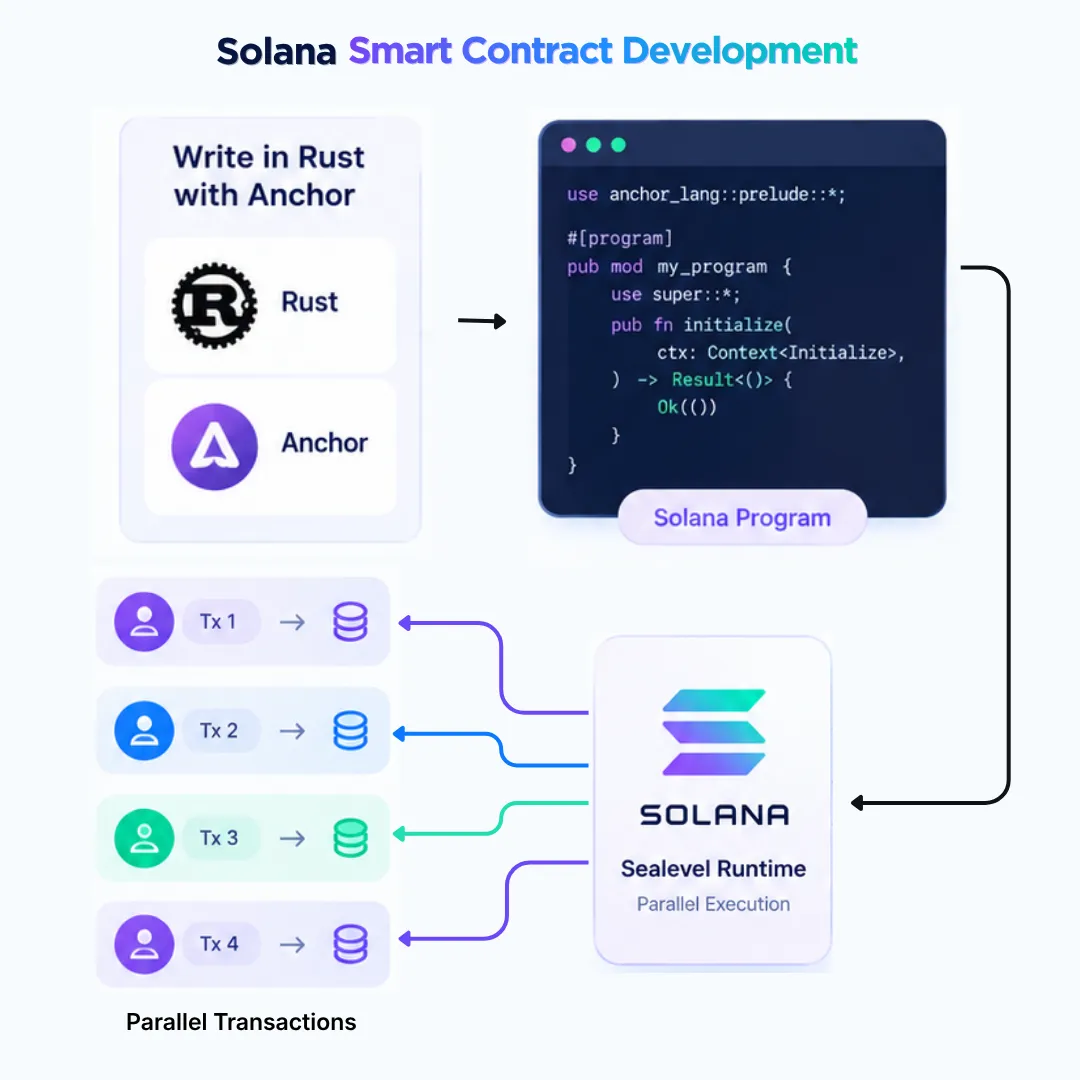
Swap, pool, and order-matching programs built for high liquidity efficiency on Solana's Sealevel runtime.

Smart Contract Migration

Port EVM/Solidity logic to Rust/Anchor for deployment on Solana.

Testing & QA

Unit tests, integration tests, and devnet/testnet simulation before mainnet launch.

What Is Solana Smart Contract Development?

What Is Solana Smart Contract Development?

Solana smart contract development is the process of writing on-chain programs — typically in Rust using the Anchor framework — that run on Solana's parallel-execution (Sealevel) runtime. Unlike Solidity contracts on Ethereum, Solana programs are stateless logic that operate on separate account data, which lets thousands of transactions touching different accounts execute in parallel instead of one at a time. This is what makes Solana smart contracts cheap (sub-$0.00025 per call) and fast (~400ms finality) enough to power order-book exchanges,high-frequency DeFi, and real-time gaming economies.

Challenges We Solve

Most Solana smart contract problems we're brought in to fix come down to one of these.

Unaudited contracts going to mainnet

Shipping without a structured audit process is the single biggest cause of Solana program exploits.

PDA & CPI complexity

Program Derived Addresses and Cross-Program Invocations are easy to get subtly wrong without Solana-specific experience.

Account model confusion

Teams coming from Solidity often misuse Solana's account/rent model, leading to costly rewrites.

Compute budget & rent inefficiency

Poorly optimized programs hit compute limits or bleed rent on unnecessary account data.

Hard-to-read legacy code

Contracts written without documentation or tests are expensive to hand off or extend.

No clear upgrade/migration path

Programs deployed without an upgrade authority strategy get stuck when requirements change.

Solana vs Ethereum Smart Contracts

The key differences that shape how we architect a Solana smart contract versus a Solidity one.

FactorSolanaEthereum
LanguageRust (Anchor framework)Solidity
Execution modelParallel (Sealevel) — independent accounts run concurrentlySequential — one transaction at a time per block
State storageSeparate accounts, rent-basedContract storage, gas-based
Avg. transaction cost< $0.00025$0.50 – $50+ depending on gas
Finality~400ms~12 – 15 minutes (pre-finality confirmations vary)
Audit tooling maturityGrowing (Sec3, Neodyme, OtterSec, Soteria)Mature (Slither, MythX, OpenZeppelin)
App Pricing Overview

Language

Rust (Anchor framework)

Solidity

Execution model

Parallel (Sealevel) — independent accounts run concurrently

Sequential — one transaction at a time per block

State storage

Separate accounts, rent-based

Contract storage, gas-based

Avg. transaction cost

< $0.00025

$0.50 – $50+ depending on gas

Finality

~400ms

~12 – 15 minutes (pre-finality confirmations vary)

Audit tooling maturity

Growing (Sec3, Neodyme, OtterSec, Soteria)

Mature (Slither, MythX, OpenZeppelin)

What Our Anchor Code Looks Like

A simplified example of the structure, documentation, and account-validation style we write into every Solana program.

escrow.rs — illustrative example
use anchor_lang::prelude::*;

declare_id!("Fg6PaFpoGXkYsidMpWTK6W2BeZ7FEfcYkg476zPFsLnS");

#[program]
pub mod escrow {
    use super::*;

    pub fn initialize(ctx: Context<Initialize>, amount: u64) -> Result<()> {
        let escrow = &mut ctx.accounts.escrow_account;
        escrow.amount = amount;
        escrow.authority = ctx.accounts.authority.key();
        Ok(())
    }
}

#[derive(Accounts)]
pub struct Initialize<'info> {
    #[account(init, payer = authority, space = 8 + 40)]
    pub escrow_account: Account<'info, Escrow>,
    #[account(mut)]
    pub authority: Signer<'info>,
    pub system_program: Program<'info, System>,
}

#[account]
pub struct Escrow {
    pub amount: u64,
    pub authority: Pubkey,
}

Our Security & Audit Process

Every Comfygen Solana contract goes through this process before it touches mainnet — a step most agencies skip or skim.

1
Threat Modeling
2
Static Analysis
3
Manual Code Review
4
Third-Party Audit Coordination
5
Post-Launch Monitoring
Consultancy for App Development

Key Features of Our Solana Smart Contracts

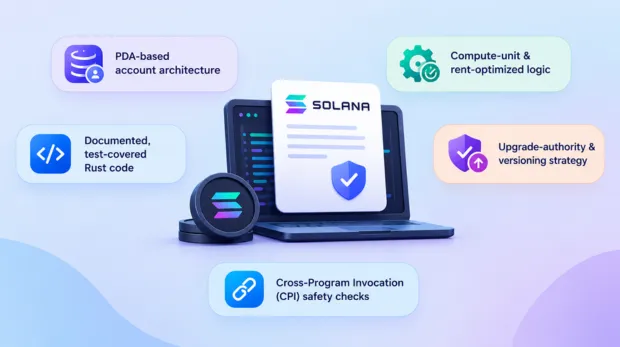
PDA-based account architecture

Every account relationship is modeled with Program Derived Addresses, giving your contract deterministic, collision-free storage instead of relying on externally owned accounts like Ethereum does..

Documented, test-covered Rust code

Each program ships with inline documentation and automated test coverage in Mocha/Chai, so any future developer can read, trust, and extend it safely, without guesswork.

Compute-unit & rent-optimized logic

We profile compute unit usage and account rent during development, trimming both so your contract runs cheaper and avoids wasting SOL on unused account space.

Upgrade-authority & versioning strategy

Every deployment includes a defined upgrade-authority plan, spelling out who can upgrade the program and under what process, so changes never become an unplanned risk.

Cross-Program Invocation (CPI) safety checks

Every cross-program call validates the calling program's identity and account ownership before executing, closing the most common attack vector in composable Solana smart contract systems.

Technology Stack We Use for Solana DEX Development

A production-grade stack purpose-built for high-frequency, on-chain trading.

React jsReact js
Angular jsAngular js
Vue.jsVue.js
HTML5HTML5
CSS3CSS3
JavaScriptJavaScript
NodejsNodejs
DjangoDjango
PythonPython
Java (Spring Boot)Java (Spring Boot)
NET CoreNET Core
PostgreSQLPostgreSQL
MongoDBMongoDB
MySQLMySQL
RedisRedis
Google Maps APIGoogle Maps API
MapboxMapbox
Geolocation APIsGeolocation APIs
 React Native React Native
FlutterFlutter
Swift (iOS)Swift (iOS)
Kotlin (Android)Kotlin (Android)
AWSAWS
GCPGCP
DockerDocker
Microsoft AzureMicrosoft Azure
KubernetesKubernetes
RazorpayRazorpay
StripeStripe
PayPalPayPal
Plaid (for banking APIs)Plaid (for banking APIs)
UPI IntegrationUPI Integration
End-to-End EncryptionEnd-to-End Encryption
OAuth AuthenticationOAuth Authentication
JWT AuthenticationJWT Authentication
PCI-DSS CompliancePCI-DSS Compliance
ApacheApache
HadoopHadoop
SparkSpark
Real-time AnalyticsReal-time Analytics
Business Intelligence ToolsBusiness Intelligence Tools
SoliditySolidity
Go (Golang)Go (Golang)
PythonPython
JavaScript / TypeScriptJavaScript / TypeScript
Ethereum (EVM)Ethereum (EVM)
BNB Smart ChainBNB Smart Chain
PolygonPolygon
SolanaSolana
AvalancheAvalanche
TRONTRON
ERC-20 / BEP-20ERC-20 / BEP-20
ERC-721 (NFT)ERC-721 (NFT)
ERC-1155 (Multi-Token)ERC-1155 (Multi-Token)
TRC-20 / TRC-10TRC-20 / TRC-10
SPL TokenSPL Token
OpenZeppelinOpenZeppelin
Remix IDERemix IDE
TruffleTruffle
FoundryFoundry
GanacheGanache
MetaMaskMetaMask
Trust WalletTrust Wallet
Coinbase WalletCoinbase Wallet
MyEtherWalletMyEtherWallet
Hardware WalletsHardware Wallets

Our Solana Smart Contract Development Process

Requirement & Architecture Analysis

We map your business logic to Solana's account model before writing code.

Contract Design & PDA Planning

Account structures, PDAs, and CPI flows are designed and documented.

Development in Rust/Anchor

Modular, tested program development against devnet.

Internal Review & Static Analysis

Manual review plus automated tooling before external audit.

Third-Party Audit Coordination

We prepare documentation and liaise with your chosen audit firm.

Mainnet Deployment

Deployment with a defined upgrade-authority strategy.

Post-Launch Monitoring & Support

Ongoing monitoring and upgrades aligned with Solana network changes.

Requirement & Architecture Analysis

We map your business logic to Solana's account model before writing code.

Need Secure, Audit-Ready Solana Smart Contracts?

Get a free consultation and a detailed cost estimate for your Solana smart contract project.

Need Secure, Audit-Ready Solana Smart Contracts?

Solana Smart Contract Development Cost and Timeline

Starting at $10,000. Includes architecture design, development, internal review, and test coverage. Full pricing depends on contract complexity and audit scope — every engagement starts with a free consultation.

Project TypeEstimated CostTimeline
Single-purpose contract (e.g. token vesting, staking)$10,000 – $20,0004 – 8 weeks
Multi-contract system (e.g. lending protocol)$20,000 – $45,0008 – 14 weeks
Enterprise-grade suite with full audit coordination$45,000+14+ weeks
App Pricing Overview

Single-purpose contract (e.g. token vesting, staking)

$10,000 – $20,000

4 – 8 weeks

Multi-contract system (e.g. lending protocol)

$20,000 – $45,000

8 – 14 weeks

Enterprise-grade suite with full audit coordination

$45,000+

14+ weeks

Why Choose Comfygen as Your Solana Smart Contract Development Company

✓ ISO 9001:2015, ISO/IEC 20000-1:2018 & ISO 27001 certified delivery process
✓Engineering led by Saddam Husen, Co-Founder & CTO,with hands-on Rust/Anchor delivery oversight
✓ 550+ projects delivered with a97% client retention rate
✓Audit-coordination built into every engagement, not sold as an add-on
✓Transparent, milestone-based delivery with weekly demos
Optimum Outcome Focused

Optimum Outcome Focused

Our developers are focused to bring optimum outcomes through our competitive dApp and wallet-connected engineering.

PDA-First Architecture Discipline

Every account relationship starts with Program Derived Address design, giving your contract deterministic, collision-free storage instead of structure that gets bolted on after the logic is already written.

Layered Audit Process

Static analysis, manual internal review, and third-party audit coordination happen in sequence, not as a single rushed pass before launch, so vulnerabilities surface while they're still cheap to fix.

Compute and Rent Optimization

We profile compute-unit usage and account rent during development, not after a costly Mainnet bill, so your program runs lean without sacrificing functionality or security.

Documented for Hand-Off

Every program ships with inline documentation and test coverage, so a future developer — on your team or ours — can read, trust, and extend it without reverse-engineering it first.

Upgrade-Authority Governance

We define who can upgrade your program and under what process before deployment, so a necessary change later doesn't become an unplanned security decision made under pressure.

Engineering Led by Our CTO

Saddam Husen, Comfygen's Co-Founder and CTO, stays hands-on in Rust/Anchor delivery oversight, so contract-level decisions get senior technical judgment rather than just junior execution.

Hire Solana Smart Contract Developers

Need extra Rust and Anchor capacity without the overhead of a full-time hire? Bring Comfygen's smart contract engineers onto your team on a dedicated, hourly, or project basis — specialists who already write PDA-based, audit-ready Solana programs and can plug straight into your sprint cadence.

  • Specialized in Rust and Anchor for custom Solana program development

  • Experienced across DeFi, token, NFT, and DEX smart contract systems

  • Flexible engagement: dedicated, hourly, or project-based hiring models

  • Direct communication with developers throughout the project lifecycle

Hire Solana Smart Contract Developers

Engagement Models

Fixed Price

Defined scope, cost, and timeline for a clearly-specced contract.

Dedicated Team

A full-time Rust/Anchor engineering pod embedded with your team.

Time & Material

Flexible scope for evolving contract requirements.

Who We Build Solana Smart Contracts For

DeFi Protocols

Token & NFT Projects

GameFi Studios

DEX & Trading Platforms

RWA Tokenization Platforms

Client Success Stories

Hear what our clients have to say about their experience working with us

Nitesh Rajput

Book My Tutor

Sayead Shadab Arif

Froge Flex

Frequently Asked Questions

Solana smart contracts are primarily written in Rust, usually with the Anchor framework, which handles serialization, account validation, and other boilerplate so your code stays focused on actual program logic.

Pricing starts at $10,000 for a single-purpose contract such as token vesting or staking, while multi-contract systems like a full lending protocol typically run $20,000 to $45,000 or more.

Yes, any contract that handles user funds should go through static analysis, manual internal review, and a coordinated third-party audit before it's deployed to mainnet and starts holding real value.

A single-purpose contract typically takes 4 to 8 weeks, while a multi-contract system such as a lending protocol takes 8 to 14 weeks with audit coordination.

Yes, we port EVM and Solidity logic to Rust and Anchor, re-architecting the account structure for Solana's parallel-execution model rather than translating the original code line by line.

Yes, post-launch monitoring, bug fixes, and upgrades aligned with Solana network changes are part of our standard delivery process, not a separate retainer you have to negotiate later.

Mr. Saddam Husen

Mr. Saddam Husen
(CTO)

Mr. Saddam Husen, CTO at Comfygen, is a renowned Blockchain expert and IT consultant with extensive experience in blockchain development, crypto wallets, DeFi, ICOs, and smart contracts. Passionate about digital transformation, he helps businesses harness blockchain technology's potential, driving innovation and enhancing IT infrastructure for global success.