




In the dynamic world of cryptocurrencies, the need for high-performance, secure, and user-centric trading platforms has never been more critical. While centralized exchanges (CEXs) offer speed and liquidity, and decentralized exchanges (DEXs) ensure privacy and autonomy, both have their limitations. Enter the Hybrid Crypto Exchange—a next-gen trading solution that fuses the strengths of both models into a single, scalable, and secure platform.
As we move into 2026, hybrid exchanges are poised to become the gold standard in crypto trading, especially as regulatory frameworks evolve and institutional adoption increases.
What Is a Hybrid Crypto Exchange?
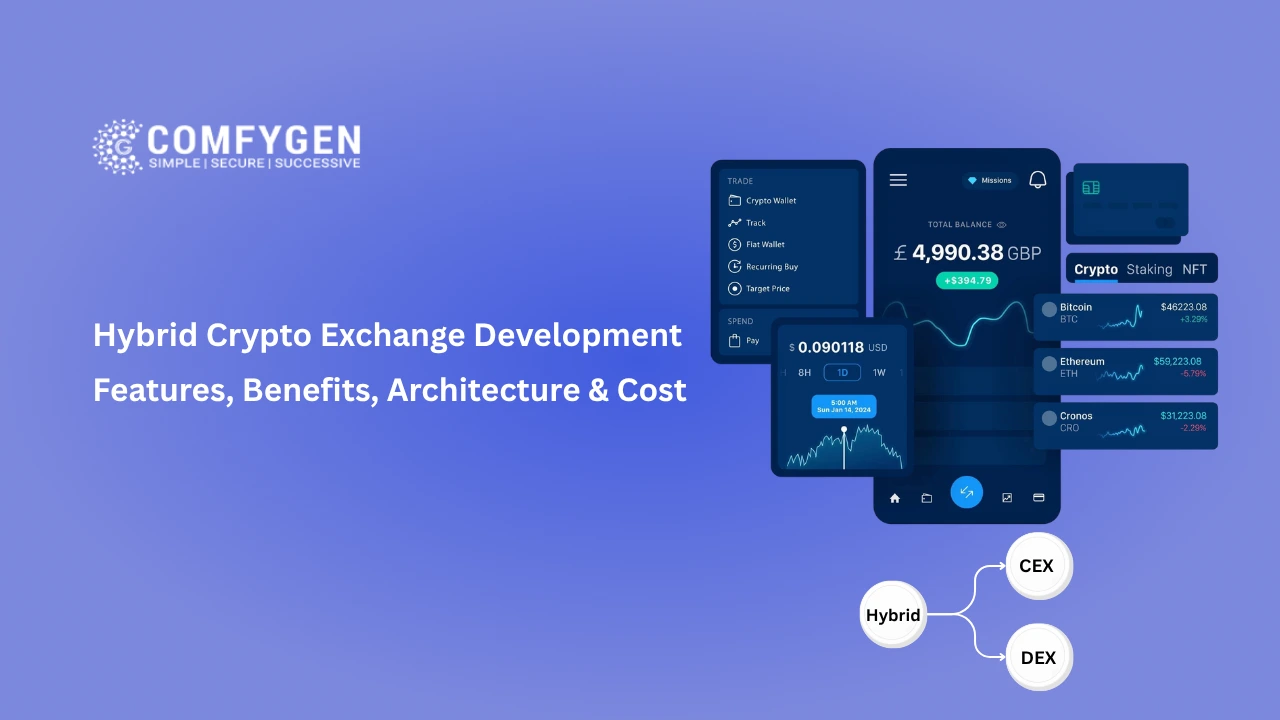
A hybrid crypto exchange is a next-generation trading platform that merges the best properties of both centralized exchanges (CEX) and decentralized exchanges (DEX) into a single, unified architecture.
On one hand, centralized exchanges like Binance and Coinbase deliver high liquidity, lightning-fast order matching, and familiar UX. On the other, decentralized exchanges like Uniswap and dYdX give users full asset custody, on-chain transparency, and censorship resistance. Until 2024, traders were forced to choose between these paradigms. In 2026, hybrid exchanges eliminate that trade-off entirely.
By design, a hybrid platform handles order matching off-chain for speed while settling trades on-chain for transparency. Users can optionally hold assets in non-custodial wallets, connect via Web3 interfaces, or use traditional custodial accounts — all within the same platform. This dual-mode operation is what makes hybrid exchanges the fastest-growing segment of the crypto exchange market today.
The term “hybrid” also extends to compliance: these platforms are architected to support KYC/AML verification for regulated markets while allowing permissionless access for DeFi use cases, depending on jurisdiction. This regulatory flexibility is one of the primary reasons blockchain investors and crypto startups are prioritizing hybrid crypto exchange development in 2026.
Looking to build a
Future-ready hybrid crypto exchange?
Contact Now
Why Hybrid Exchanges Dominate the 2026 Crypto Landscape
Several converging forces have made development of hybrid cryptocurrency exchange the dominant investment theme of 2026
Regulatory Clarity Has Arrived
Following the EU’s MiCA (Markets in Crypto-Assets) regulation coming into full effect in 2025, and the US SEC and CFTC publishing joint digital asset framework guidance in early 2026, exchanges now have clear compliance pathways. Hybrid models, with their built-in KYC/AML modules and optional on-chain audit trails, are structurally better positioned than pure DEXs for regulated environments.
Institutional Capital Requires Hybrid Infrastructure
Hedge funds, prime brokers, and family offices now account for over 67% of crypto trading volume globally. These participants need the deep liquidity, advanced order types, and compliance tooling of a CEX — but also require transparent, auditable settlement mechanisms that only on-chain settlement can provide. Cryptocurrency exchange development has had to respond accordingly.
High-Profile CEX Failures Eroded Trust
The collapse of several centralized exchanges between 2022 and 2024 demonstrated the systemic risk of full custody models. Hybrid exchanges solve this by offering users non-custodial wallet options while maintaining the platform’s liquidity pools — meaning even if the operator faces problems, user funds in self-custody wallets remain safe.
Layer-2 Networks Made On-Chain Speed Viable
In 2023–2024, Ethereum’s Layer-2 ecosystem (Arbitrum, Optimism, zkSync) matured significantly, processing thousands of transactions per second at near-zero cost. By 2026, Layer-2 networks handle the bulk of on-chain settlement for hybrid exchanges without the congestion or fees that previously made DEXs impractical for high-frequency trading.
The Rise of Real-World Asset (RWA) Tokenization
With over $24 billion in tokenized real-world assets on-chain as of early 2026, hybrid exchanges are becoming the primary venue for RWA trading. Unlike pure DEXs (too permissionless for securities) or pure CEXs (too opaque for on-chain verification), hybrid platforms support the compliance + transparency combination that RWA trading demands.
Core Features of a Hybrid Cryptocurrency Exchange in 2026
A production-grade hybrid exchange built in 2026 includes a substantially richer feature set than platforms from even two years ago. Here is what comprehensive hybrid crypto exchange development now encompasses:
High-Performance Matching Engine
Off-chain order matching capable of 500,000+ TPS with microsecond latency. Supports limit, market, stop-loss, and algorithmic order types.
Dual Custody Architecture
Users choose custodial (CEX-style) or non-custodial (self-custody) wallet modes. Funds in non-custodial wallets remain fully under user control at all times.
Aggregated Liquidity Engine
Pulls real-time liquidity from on-chain DEX pools (Uniswap v4, Curve), off-chain CEX order books, and OTC desks to ensure minimal slippage.
Smart Contract Settlement
All finalized trades settle via audited smart contracts on the chosen blockchain, providing immutable trade records.
Multi-Chain Support
Native support for Ethereum, Solana, BNB Chain, Arbitrum, Polygon, Avalanche, and emerging chains like Monad and Berachain.
Modular KYC/AML Suite
Jurisdiction-aware compliance engine with tiered verification: anonymous (limited), basic KYC, and full institutional verification levels.
Advanced Trading Interface
TradingView-integrated charting, depth-of-market views, portfolio analytics, and customizable dashboards for retail and professional traders.
API & Trading Bot Infrastructure
FIX protocol and REST/WebSocket APIs for algorithmic traders. Integrates with crypto trading bot frameworks and institutional prime brokers.
Cross-Chain Atomic Swaps
Protocol-level cross-chain trading without bridges — eliminates bridge hack risk while enabling BTC/ETH/SOL swaps natively.
Derivatives & Margin Trading
Perpetuals, futures, and options with up to 50x leverage. Risk engine enforces liquidation logic via DeFi smart contracts.
Institutional OTC Desk
Integrated over-the-counter trading for large-block orders with RFQ (Request for Quote) workflows and settlement SLA guarantees.
Mobile-First Trading Apps
Native iOS and Android apps with biometric auth, push alerts, and full trading feature parity with the web platform.
AI-Powered Features That Define Hybrid Exchanges in 2026
What separates a 2026 hybrid exchange from a 2023-era platform is the deep integration of AI across every layer of the stack. This is a gap the original article did not address — and it is now a core requirement for competitive platforms.
AI Risk & Fraud Detection
Machine learning models monitor every trade in real time, detecting wash trading, spoofing, and front-running patterns before they impact the order book. Models trained on millions of historical fraud events flag anomalous behavior with sub-second latency, far exceeding what rule-based systems could achieve. Comfygen’s AI crypto exchange development practice integrates these models at the matching engine level.
Predictive Liquidity Routing
Rather than statically routing orders to liquidity sources, AI engines dynamically predict which pools will offer the best execution for a given order size and token pair — accounting for gas costs, price impact, and real-time pool depth. This results in measurably better fill rates for users.
Natural Language Trading Interface
2026-era hybrid platforms increasingly offer LLM-powered command interfaces where traders type or speak instructions (“Buy $10,000 of ETH when RSI drops below 35 and set a 5% trailing stop”) and the system converts these to programmatic orders — removing the barrier for non-technical retail traders.
AI-Assisted Compliance Screening
AI models cross-reference wallet addresses against OFAC lists, chainalysis databases, and behavioral risk scores. They also detect structuring patterns in large deposits — an AML requirement in most regulated jurisdictions — with far lower false-positive rates than keyword-based screening.
2026 Benchmark: Hybrid exchanges using AI-driven liquidity routing report 23–38% better trade execution compared to static routing, according to DeFi analytics provider DeFi Llama research published in Q1 2026.
Development Benefits of Hybrid Cryptocurrency Exchange
From both a business and a user perspective, hybrid exchanges offer advantages that neither pure CEX nor pure DEX models can match:
For Exchange Operators
- Faster regulatory licensing: compliance-first architecture accelerates approval in EU (MiCA), UK (FCA), and APAC (MAS) jurisdictions.
- Multiple revenue streams: trading fees, maker/taker rebates, listing fees, staking yield, OTC spread, and API access fees.
- Reduced custodial liability: partial non-custodial model reduces the operator’s liability for user fund security, lowering insurance costs.
- Institutional onboarding: meets the audit and reporting requirements of institutional counterparties, unlocking high-volume trading relationships.
- Scalable infrastructure: cloud-native microservices architecture scales horizontally to handle traffic spikes without downtime.
For Traders & Users
- Asset self-custody option: users who prefer to hold their own keys can do so while still accessing the platform’s liquidity.
- Better prices through aggregation: AI-powered routing across multiple liquidity sources produces better execution than any single venue.
- Transparent settlement: on-chain settlement provides an immutable audit trail for every completed trade.
- Lower counterparty risk: smart contract escrow eliminates the need to trust the operator during trade settlement.
- Cross-chain access: trade assets on multiple blockchains from a single unified interface without bridging funds manually.
Hybrid Crypto Exchange Architecture (2026 Stack)
A production-ready hybrid exchange is built across five primary architectural layers. Each layer is independently scalable and fault-tolerant:
Client Layer — Web, Mobile & API
React/Next.js web app, native iOS/Android apps, and FIX/WebSocket APIs for algorithmic traders. Supports Web3 wallet connections (MetaMask, WalletConnect, Ledger) alongside traditional email/password auth. Progressive Web App (PWA) available for emerging markets.
Trading Engine Layer
Ultra-low-latency off-chain matching engine (built in Rust or C++), order book management, trade execution pipeline, and position risk calculator. Processes 500K+ orders per second with sub-millisecond matching. Connected to real-time market data aggregator (CoinGecko, Chainlink price feeds).
Liquidity & Settlement Layer
Aggregates liquidity from on-chain DEX pools, internal maker/taker order books, and OTC desks. Routes optimal execution via AI-powered smart order routing. On-chain settlement executed through audited smart contracts on the target chain(s).
Compliance & Identity Layer
Modular KYC/AML engine integrating providers such as Sumsub, Onfido, or Chainalysis. Tiered verification levels by jurisdiction. Real-time OFAC screening, transaction monitoring, SAR (Suspicious Activity Report) generation, and geo-restriction logic for restricted territories.
Data, Analytics & Security Layer
Real-time data warehouse (ClickHouse/Apache Kafka), user behavior analytics, market surveillance system, and security infrastructure: HSM-backed key management, cold/warm/hot wallet tiering, multi-sig treasury, DDoS protection, and penetration-tested API gateway.
Architecture Note: Modern hybrid exchanges are deployed on Kubernetes clusters across at least three geographic regions for 99.99% uptime SLA. Infrastructure-as-code (Terraform) ensures reproducible deployments and rapid disaster recovery.
CEX vs DEX vs Hybrid: Full 2026 Comparison
This head-to-head comparison helps founders and investors understand precisely where hybrid exchanges add value and where trade-offs remain:
| Dimension | Centralized Exchange (CEX) | Decentralized Exchange (DEX) | Hybrid Exchange |
|---|---|---|---|
| Asset Custody | Exchange-held | Full user custody | User’s choice (custodial or self-custody) |
| Transaction Speed | Sub-millisecond | Chain-dependent (2–15s) | Sub-millisecond (off-chain matching) |
| Liquidity | Deep, centralized order book | AMM pools, fragmented | Aggregated (CEX + DEX + OTC) |
| Settlement Transparency | Opaque, internal ledger | Fully on-chain | On-chain final settlement |
| Regulatory Compliance | Established KYC/AML | Permissionless, legally risky | Modular, jurisdiction-aware compliance |
| Hack / Counterparty Risk | High (honeypot for hackers) | Lower (no central custodian) | Low-to-moderate (partial custody) |
| Privacy | Full identity required | Pseudonymous | Tiered (anonymous → verified) |
| Institutional Support | Full API, FIX, OTC | Limited tooling | Full institutional stack |
| Multi-Chain Trading | Limited, siloed | Chain-specific | Native cross-chain support |
| Development Cost | High | Medium | High (highest ROI) |
2026 Technology Stack for Building a Hybrid Exchange
The technology landscape for crypto exchange development has evolved considerably. Here is a representative 2026 stack for a full-featured hybrid platform:
| Layer | Technologies (2026) |
|---|---|
| Frontend | Next.js 15, React 19, TypeScript, TailwindCSS, TradingView Charting Library, ethers.js / viem, WalletConnect v3 |
| Mobile | React Native (Expo), Flutter (for institutional-grade apps), Swift/Kotlin for native modules |
| Backend / Matching Engine | Rust (matching engine core), Go (microservices), Node.js (API gateway), gRPC, Kafka / Redpanda (event streaming) |
| Databases | PostgreSQL (transactional), Redis (order book cache), ClickHouse (analytics), TimescaleDB (OHLCV data) |
| Blockchain / Smart Contracts | Solidity (EVM chains), Rust (Solana/Anchor), Foundry (testing), OpenZeppelin v5, Chainlink (price oracles) |
| Multi-Chain | Ethereum + L2s (Arbitrum, Optimism, Base, zkSync Era), Solana, BNB Chain, Avalanche, Polygon |
| Infrastructure | AWS / GCP / Azure (multi-region), Kubernetes, Terraform, Cloudflare (DDoS + CDN), Grafana / Prometheus (monitoring) |
| Security | AWS KMS / HSM (key management), MPC wallets (Fireblocks / Fordefi), SIEM (Splunk), smart contract audits (Trail of Bits, Certik) |
| AI / ML | Python (TensorFlow / PyTorch), real-time fraud models, smart order routing ML, LLM integration (OpenAI API / fine-tuned models) |
| Compliance | Sumsub / Onfido (KYC), Chainalysis / Elliptic (AML), ComplyAdvantage (sanctions screening) |
Ready to Build Your Hybrid Crypto Exchange?
Talk to our blockchain development experts and get a custom project estimate within 48 hours.
Start Your Project →
Who Uses Hybrid Crypto Exchanges in 2026?
Hybrid exchange platforms serve a broader range of users and business models than either CEX or DEX alternatives:
Institutional Investors & Hedge Funds
Family offices, crypto hedge funds, and algorithmic trading firms require deep liquidity, FIX protocol API access, prime brokerage services, and regulatory compliance. Hybrid platforms are the only venue that meets all these requirements simultaneously.
Retail Traders Moving from CEX to Self-Custody
A significant segment of retail crypto users who previously used Binance or Coinbase are now migrating to self-custody models following high-profile exchange failures. Hybrid platforms offer them the familiar UX of a CEX while allowing them to retain asset control.
Real-World Asset (RWA) Trading Venues
Tokenized bonds, real estate, private equity, and commodities require both on-chain verifiability and KYC/AML compliance. Hybrid exchanges — and not pure DEXs — are the natural home for the rapidly growing RWA tokenization market.
DeFi Protocols Seeking Institutional Liquidity
DeFi protocols building on top of AMMs (automated market makers) often integrate with hybrid exchange backends to access institutional-grade liquidity and more sophisticated order types than simple AMM swaps can provide.
Cross-Border Payment & Remittance Platforms
Fintech companies using crypto payment gateways for cross-border remittance embed hybrid exchange infrastructure to provide real-time FX conversion between fiat and digital assets.
Web3 Gaming & NFT Ecosystems
Gaming platforms and NFT marketplaces integrate hybrid exchange modules to allow in-game asset trading, with on-chain provenance and fast off-chain matching for low-latency gaming environments.
Hybrid Crypto Exchange Development Process
Building a hybrid exchange is a multi-phase project that typically spans 6–12 months for a full-featured platform. Here is Comfygen’s proven delivery methodology:
Discovery & Requirement Analysis
Deep-dive workshops to map your target markets, regulatory jurisdiction, trading pairs, liquidity strategy, and monetization model. As a leading hybrid crypto exchange development company, we ensure the output includes a detailed product requirements document (PRD) and a comprehensive technical architecture blueprint tailored to your business goals.
Architecture Design & Tech Stack Finalization
Selection of blockchain networks, matching engine design, custody architecture, and infrastructure planning. Smart contract architecture review with security specifications.
UI/UX Design
Wireframes, interactive prototypes, and visual design for web and mobile interfaces. Trader usability testing with real crypto users before development begins.
Core Development — Matching Engine & Backend
Development of the high-performance matching engine, trade settlement pipeline, wallet infrastructure, user management, and API layer. Parallel team tracks ensure concurrent delivery.
Compliance Integration
KYC/AML provider integration, geofencing rules, transaction monitoring setup, and regulatory reporting dashboards configured for target jurisdictions.
Liquidity Setup & Market Maker Onboarding
Integration with liquidity aggregators, API agreements with market makers, and initial liquidity pool seeding. Critical for ensuring competitive spreads at launch.
QA, Penetration Testing & Load Testing
Full QA cycle including unit, integration, and end-to-end testing. Penetration testing for all attack surfaces. Load testing to simulate 10x expected peak traffic.
Mainnet Deployment & Monitoring Setup
Phased mainnet deployment (beta → soft launch → full launch) with real-time monitoring, alerting, and 24/7 incident response protocols active from day one.
Ongoing Support, Upgrades & Feature Development
Post-launch DevOps support, smart contract upgrade management, feature development sprints, regulatory update responses, and performance optimization on retainer.
Hybrid Crypto Exchange Development Cost in 2026
Development costs vary significantly based on feature scope, geographic markets, tech stack complexity, and the size of your development partner. Here are realistic cost tiers for 2026:
MVP / Starter: $60K–$120K (Core CEX+DEX hybrid, 3–5 trading pairs, basic KYC, single chain, 4–6 months)
Growth Platform: $150K–$300K (Full feature set, multi-chain, institutional API, advanced compliance, 6–9 months)
Enterprise / Institutional: $350K–$600K+ (Custom matching engine, prime brokerage, derivatives, OTC desk, 10–14 months)
White Label Hybrid: $30K–$80K (White label solution, faster to market, customizable branding, 4–8 weeks setup)
Cost Reduction Tip: Launching with Comfygen’s white label hybrid exchange solution can reduce time-to-market by 60–70% and upfront development cost by 50%+, while retaining full custom branding and configuration flexibility.
Ongoing Operational Costs to Budget For
- Cloud infrastructure: $3,000–$25,000/month depending on trading volume
- KYC/AML provider fees: $0.50–$5.00 per verification plus monthly platform fees
- Smart contract audits: $20,000–$80,000 per audit cycle
- Regulatory licensing: $10,000–$500,000+ depending on jurisdiction
- Market maker agreements: Spread-based revenue share or fixed monthly retainer
- Ongoing development & support: $15,000–$50,000/month retainer
Regulatory Compliance for Hybrid Exchanges in 2026
Navigating the global regulatory landscape is one of the most complex aspects of hybrid exchange development — and one where the 2026 environment is meaningfully different from 2023. Here is what operators must address:
Key 2026 Regulatory Frameworks
- EU — MiCA (Markets in Crypto-Assets): In full effect since December 2024. Requires CASP (Crypto Asset Service Provider) registration, whitepapers for asset issuers, and strict reserve reporting for stablecoin issuers. Hybrid exchanges operating in EU must comply.
- US — SEC/CFTC Digital Asset Framework (2026): Joint guidance published Q1 2026 creates distinct registration tracks for spot exchanges (SEC) and derivatives platforms (CFTC). Hybrid exchanges offering both must maintain dual registrations.
- UK — FCA Crypto Asset Regime: The UK’s Financial Conduct Authority has established a full crypto exchange authorization regime. Hybrid platforms are well-positioned due to their built-in compliance infrastructure.
- Singapore — MAS PSA Licensing: Payment Services Act (major payment institution license) covers digital token exchange services. Singapore remains a preferred jurisdiction for hybrid exchanges targeting APAC.
- UAE — VARA Regime: Dubai’s Virtual Assets Regulatory Authority has established one of the most crypto-friendly yet structured regulatory frameworks globally, making it attractive for hybrid exchange launches.
- FATF Travel Rule: Global standard requiring exchanges to pass counterparty information on transactions above thresholds. Hybrid exchanges must implement Travel Rule compliance (solutions: Notabene, Sygna Bridge).
Comfygen Compliance Support: Our team includes regulatory specialists with hands-on experience navigating MiCA, FCA, MAS, and VARA licensing processes. We build compliance infrastructure that is designed to adapt as regulations evolve — not just today’s requirements.
Why Choose Comfygen for Hybrid Crypto Exchange Development?
Comfygen Technologies has been at the forefront of blockchain and crypto exchange development solution, creating production-ready trading platforms for clients across Southeast Asia, the Middle East, Europe, and the Americas. Our commitment to innovation, reliability, and client success sets us apart in a rapidly evolving industry.
- End-to-end ownership: We handle every layer — from smart contract architecture and matching engine to mobile apps, compliance integration, and post-launch DevOps — under a single accountable team.
- 250+ delivered projects: Our portfolio spans centralized exchanges, decentralized exchange platforms, DeFi protocols, and NFT marketplaces — giving us pattern-matched knowledge of what works at scale.
- Security-first methodology: Every smart contract undergoes internal security review before external audit. We maintain relationships with leading audit firms and can facilitate fast-track engagements.
- Regulatory advisory: Our team has navigated MiCA, FCA, MAS, and VARA licensing processes with clients and can advise on jurisdiction selection and compliance architecture from day one.
- Transparent pricing: Fixed-milestone contracts with clearly defined deliverables. No scope creep surprises. Cost estimates provided within 48 hours of discovery call.
- Post-launch support: We offer 24/7 infrastructure monitoring, smart contract upgrade management, and dedicated Slack channels for rapid incident response after launch.
Conclusion
Hybrid crypto exchanges are not just an innovation—they are a necessity. By combining the best aspects of CEX and DEX platforms, hybrid models offer unmatched security, performance, and flexibility. Whether you’re a startup, institutional investor, or DeFi innovator, developing a hybrid crypto exchange will position you at the forefront of the blockchain revolution.
Frequently Asked Questions
What exactly makes an exchange "hybrid" in 2026?
How is a hybrid exchange different from just adding a DEX feature to a CEX?
Simply "adding DEX functionality" to a CEX (as some platforms attempted in 2021–2023) typically means bolting on a swap widget that routes to Uniswap. A true hybrid exchange is architecturally different: it uses smart contracts for settlement of orders that originated on the centralized order book, supports genuine non-custodial wallet connections throughout the trading lifecycle, and aggregates liquidity across both on-chain and off-chain sources at the matching engine level.
How long does it take to develop a hybrid crypto exchange?
A minimal viable product (MVP) with core trading features typically takes 4–6 months. A full-featured institutional platform with derivatives, multi-chain support, and full compliance integration typically requires 10–14 months. Using a white label hybrid exchange base can compress this to 4–8 weeks for initial launch, with custom features added iteratively.
What blockchains should a 2026 hybrid exchange support?
At minimum: Ethereum mainnet plus its leading Layer-2 networks (Arbitrum, Base, Optimism), Solana (high-speed retail trading), and BNB Chain (liquidity depth). Depending on your target market, consider adding Polygon, Avalanche, or emerging high-performance chains like Monad. Cross-chain atomic swap support future-proofs the platform against ecosystem shifts.
Do hybrid exchanges require a license to operate?
In most regulated jurisdictions, yes. The specific license type depends on your target market (EU requires MiCA CASP registration, UK requires FCA authorization, Singapore requires MAS PSA licensing, etc.) and the services you offer (spot trading vs. derivatives have different requirements in some jurisdictions). The good news is that hybrid exchanges are architecturally better suited for licensing than pure DEXs, because their built-in KYC/AML and compliance modules directly address regulator requirements.
Can a hybrid exchange support institutional traders?
Yes — institutional support is actually one of the primary advantages of hybrid over DEX models. A properly built hybrid exchange provides FIX protocol API access, sub-account management for fund managers, advanced order types (iceberg, TWAP, VWAP), prime brokerage integration, and the regulatory compliance documentation that institutional compliance teams require.
How are user funds protected on a hybrid exchange?
Multiple layers: users in non-custodial mode hold their own private keys (funds are never at risk from operator failure). For custodial users, funds are protected through cold wallet storage (typically 95%+ of assets), HSM-backed key management, multi-signature transaction authorization, and insurance coverage. Settlement smart contracts use time-lock mechanisms and multi-sig controls to prevent unauthorized withdrawals. Regular Merkle-tree proof-of-reserves publications provide user-verifiable on-chain proof that their balances are fully backed.
What is the typical revenue model for a hybrid exchange?

Mr. Saddam Husen, (CTO)
Mr. Saddam Husen, CTO at Comfygen, is a renowned Blockchain expert and IT consultant with extensive experience in blockchain development, crypto wallets, DeFi, ICOs, and smart contracts. Passionate about digital transformation, he helps businesses harness blockchain technology’s potential, driving innovation and enhancing IT infrastructure for global success.