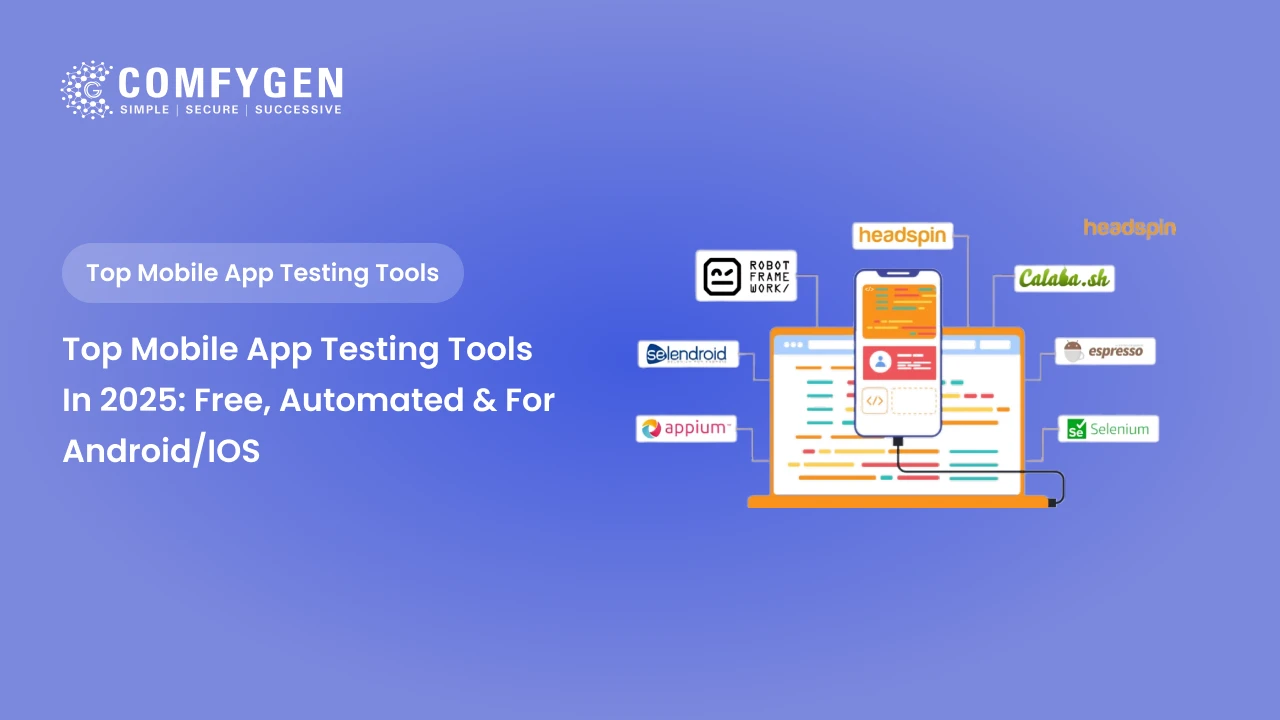





In 2026, the mobile app development industry will continue to grow at an unprecedented pace. With billions of active mobile devices and increased competition across the Android and iOS ecosystems, mobile app development companies are under pressure to release high-performing, bug-free, and secure applications. The key to success lies in robust mobile app testing tools that ensure reliability, functionality, usability, and performance across devices and platforms.
Whether you’re offering mobile app development services to startups or building enterprise-grade solutions, automated and manual testing remain vital for meeting user expectations. In this blog, we’ll explore the top mobile app testing tools in 2026, including free, automated, and platform-specific options for both Android and iOS.
Why Mobile App Testing Matters in 2026
Mobile users have zero patience. A single crash, a sluggish load time, or a broken flow can trigger an immediate uninstall and a damaging one-star review. In 2026, testing is no longer just a QA checkbox — it is a competitive advantage baked into every stage of the app development lifecycle.
Robust testing guarantees app stability across devices, cross-platform compatibility, genuinely secure user experiences, and faster releases through continuous integration pipelines. These goals are especially critical for apps serving fintech, healthcare, e-commerce, and on-demand delivery audiences.
Key Testing Challenges in Mobile App Development
Even with excellent tooling, mobile QA is genuinely hard. The most common friction points teams encounter in 2026:
- Device fragmentation — Thousands of Android models and multiple active iOS versions create a sprawling test matrix.
- OS churn — Frequent platform updates can silently break features that worked perfectly the week before.
- Network variability — Apps must perform gracefully on 2G, spotty Wi-Fi, and everything in between.
- UI/UX expectations — Responsive, adaptive design must hold up across screen sizes and orientations.
- Security risks — Data privacy, encrypted storage, and secure authentication are table stakes, not extras.
Ready to Launch
A High-Quality App?
Contact Now
Features to Look for in a Mobile App Testing Tool
Before choosing a tool, consider the following must-have features:
- Cross-platform support (Android & iOS)
- Automation capabilities
- Integration with CI/CD tools
- Real-device and emulator testing
- Performance monitoring
- Bug tracking integration
- Cloud access for scalability
- Open-source or free options for startups
Top Free Mobile App Testing Tools in 2026
Budget constraints should not mean skipping QA. These open-source and free tools cover the majority of everyday testing needs.
- Appium (Open-source automation) is a cross-platform framework that tests native, hybrid, and web apps using Java, Python, or JavaScript. Backed by an enormous community with broad CI/CD integration across all major pipelines.
- Espresso (Android UI framework) is Google’s native UI testing library for Android. Fast, synchronized, and embedded directly in Android Studio — ideal for developers who want tight feedback loops.
- XCUITest (iOS UI framework) Apple’s built-in framework for native iOS apps. Tightly integrated with Xcode and supports accessibility testing out of the box.
- Robot Framework (Automation framework) is a keyword-driven, modular architecture that suits teams practising test-driven development without heavy scripting overhead. Extensible via a wide library ecosystem.
Top Automated Testing Tools in 2026
When test coverage needs to scale or your team lacks deep scripting experience, these commercial and cloud automation platforms deliver significant leverage.
TestComplete (Commercial)
AI-driven UI recognition and no-code test creation. Covers Android, iOS, and Windows apps from a single interface — useful for QA teams managing multiple product surfaces simultaneously.
Kobiton (Cloud-based)
Real-device cloud with scriptless automation. Strong CI/CD integration and performance metrics built in, making it a solid choice for teams that want automation without complex setup.
Ranorex Studio (Cross-platform)
Enterprise-grade tool with a low learning curve. Detailed reporting and object-based UI testing make it popular with QA teams new to automation who still need professional-grade output.
Katalon Studio (All-in-one)
Covers web, API, and mobile testing in a single platform. A generous free tier makes it accessible for startups scaling up their QA practice before committing to a paid solution.
Best Tools for Android Testing in 2026
Android’s sprawling device ecosystem makes comprehensive testing especially important. These tools are built specifically for Android-native workflows.
- Android Studio Profiler — Built into Android Studio. Profiles CPU, memory, network, and battery usage in real time during test runs, making it indispensable for performance-sensitive apps.
- Firebase Test Lab — Runs tests on Google-hosted physical and virtual Android devices. Ideal for catching hardware-specific bugs without the cost and overhead of maintaining a physical device lab.
- Espresso — Fast, synchronized UI tests that run within the same process as the app — virtually eliminating the timing-related flakiness that plagues external test runners.
Best Tools for iOS Testing in 2026
iOS testing demands deep integration with the Apple ecosystem. These tools are the go-to options for teams building native and hybrid iPhone and iPad experiences.
- XCUITest — Apple’s native testing framework. Built into Xcode and the only framework that can test SwiftUI-based apps with full fidelity. Essential for any team targeting the App Store.
- TestFlight — Apple’s official beta distribution tool. Lets real users test pre-release builds at scale before an App Store submission, providing invaluable real-world feedback.
- Appium + iOS Simulators — Extends Appium’s cross-platform reach to iOS simulators and real devices via WebDriverAgent. Suitable for teams that want to maintain shared test scripts across both platforms.
Cross-Platform Testing Tools
Writing one test suite that validates both Android and iOS dramatically reduces QA overhead. These frameworks make that goal realistic in 2026.
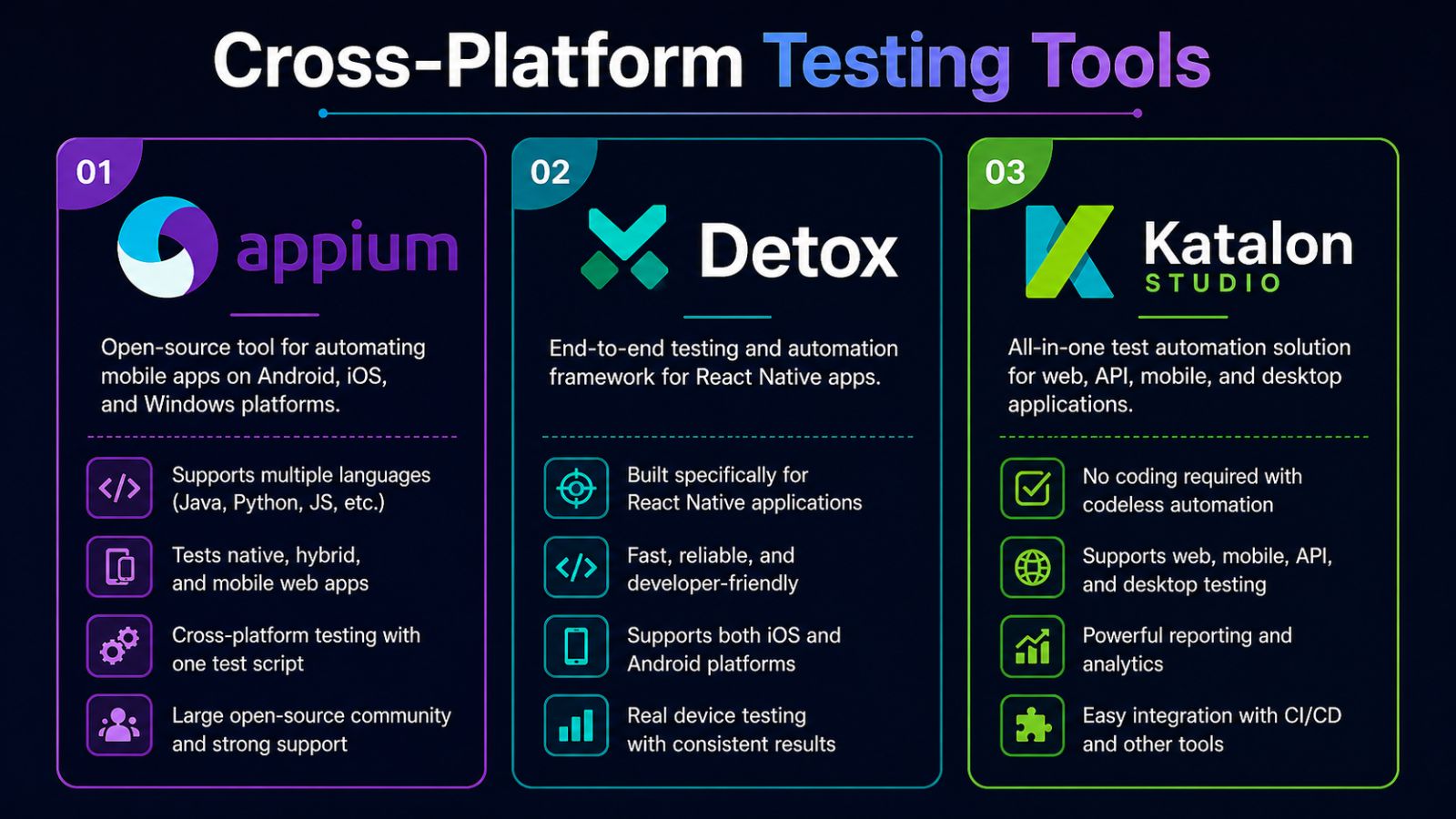
1. Appium
The industry default for cross-platform automation. One script, both stores. Supports multiple languages and integrates with virtually every CI/CD system on the market.
2. Detox
End-to-end testing tailored specifically for React Native apps. Runs in-process for fast, reliable, flake-free tests that hold up in high-frequency CI environments.
3. Katalon Studio
All-in-one platform covering mobile, web, and API testing. The generous free tier suits growing teams that need breadth before depth.
Performance Testing Tools for Mobile Apps
A functionally correct app that falls over under real load is still a failed product. These tools simulate traffic and measure backend performance before launch day.
- Apache JMeter (Open-source) — The go-to open-source tool for load and stress testing. Ideal for validating backend API performance at scale before your app goes live to real users.
- NeoLoad — Real-time performance analysis with low-code test design. Well-suited for continuous performance testing embedded directly into CI pipelines.
- LoadRunner — Industry veteran for simulating thousands of concurrent users. Strong reporting and analytics make it a reliable choice for enterprise-scale applications with complex infrastructure.
Cloud-Based Mobile App Testing Tools
Remote-first QA teams and distributed development shops benefit most from cloud device farms in 2026 — no hardware to buy, no labs to maintain.
1. BrowserStack App Live
Instant access to a large catalogue of real Android and iOS devices via a browser. Supports both manual and automated testing sessions without any local setup.
2. Sauce Labs
Automates tests across thousands of real and virtual devices simultaneously. Strong Appium and Espresso integration makes it a natural fit for teams already using those frameworks.
3. AWS Device Farm
Run tests in parallel on Android and iOS devices hosted in AWS infrastructure. Integrates natively with CodePipeline and other AWS services for seamless DevOps workflows.
Real-World Use Cases
- E-commerce — A retail team combined Appium with AWS Device Farm to validate checkout flows across 100+ Android device profiles ahead of a peak-season launch, catching three critical rendering bugs that would have been invisible on emulators.
- Fintech — A startup adopted Katalon Studio to automate regression testing after each sprint, cutting their manual QA cycle from three days to four hours.
- Healthcare — A patient-facing platform chose TestComplete because its audit logging and reporting formats aligned directly with their HIPAA compliance documentation requirements.
Choosing the Right Tool for Your App
No single tool wins every scenario. Match your choice to your team’s actual constraints in 2026:
| Use Case | Recommended Tools |
|---|---|
| Cross-platform apps | Appium, Katalon Studio |
| Native Android | Espresso, Firebase Test Lab |
| Native iOS | XCUITest, TestFlight |
| React Native | Detox, Appium |
| Cloud / remote teams | BrowserStack, Sauce Labs, AWS Device Farm |
| Performance & load | JMeter, LoadRunner |
| Startups / free budget | Appium, Robot Framework, Katalon (free) |
| Enterprise automation | TestComplete, Ranorex Studio |
Looking for End-to-End
Mobile App Development?
Contact Now
Conclusion
In a mobile-first world, quality assurance is foundational, not optional. The tools covered in this guide — from Appium’s open-source flexibility to BrowserStack’s cloud real-device access — give every team, regardless of size or budget, the means to ship apps that users trust and return to in 2026.
The winning strategy is rarely a single tool. Combine a solid automation framework such as Appium, Espresso, or XCUITest with a cloud device farm and a performance testing layer, and you have a QA pipeline that scales with your product through every release cycle.
FAQ
What is mobile app testing and why does it matter in 2026?
What are the main types of mobile app testing?
What is the best free mobile app testing tool in 2026?
What testing tool should I use for a React Native app?
What are the best cloud-based testing platforms in 2026?
What are the best mobile testing tools for startups with a limited budget?

Mr. Saddam Husen, (CTO)
Mr. Saddam Husen, CTO at Comfygen, is a renowned Blockchain expert and IT consultant with extensive experience in blockchain development, crypto wallets, DeFi, ICOs, and smart contracts. Passionate about digital transformation, he helps businesses harness blockchain technology’s potential, driving innovation and enhancing IT infrastructure for global success.