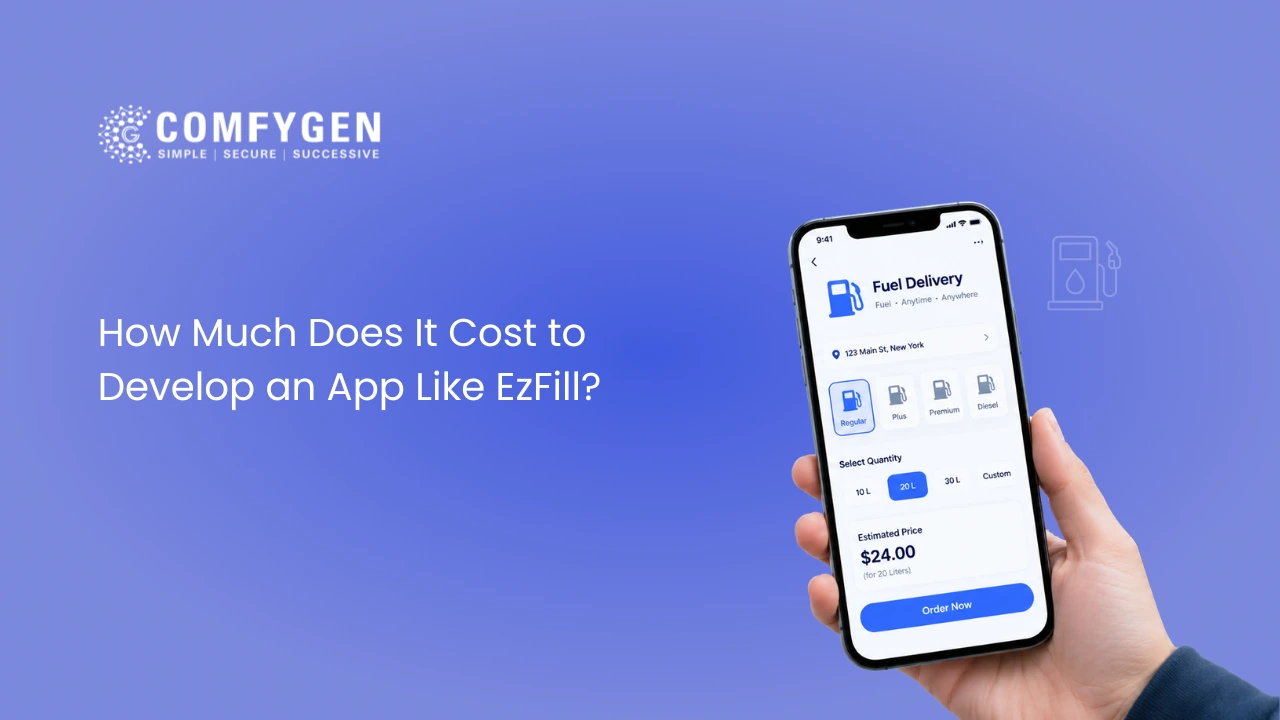





Building an app like EzFill costs $25,000 to $150,000. A single-vertical MVP runs $25,000 to $40,000 over 10 to 14 weeks. A two-vertical MVP covering consumer and fleet costs $30,000 to $50,000. A full platform matching EzFill’s three-vertical model, spanning consumer, commercial, and specialty fueling, runs $70,000 to $130,000.
Before you budget a clone, though, you should know something that most guides on this topic get wrong.
EzFill isn’t an independent company anymore.
What EzFill Is Today, and Why It Matters for a Clone
EzFill launched in Miami in 2019 as an app-based mobile fueling service. It went public on Nasdaq in 2021 at $4 a share, raising $25 million, and ran a fleet of 13 delivery trucks across South Florida. The pitch was simple: order fuel to your car, your office lot, or your job site instead of driving to a station.
Then in 2025, EzFill merged with NextNRG. The combined company now trades as NXXT. It went on to acquire Yoshi Mobility’s fuel division along with a fleet of Shell Oil delivery trucks, which roughly doubled its capacity. Today EzFill operates as the fuel delivery arm of a broader energy company that also works on AI-driven smart microgrids, solar and battery storage, and wireless EV charging.
Two things follow from that, and both matter if you’re building something similar.
First, the model works at scale but it consolidates. Mobile fueling in the US generates real revenue. However, it also carries heavy fixed costs in trucks, drivers, permits, and insurance. Those costs favour whoever buys fuel cheapest and runs the most trucks, so independent operators tend to get acquired rather than grow forever.
Second, fuel delivery is becoming an energy platform play. NextNRG doesn’t treat fuel as the destination. It treats fuel as the customer relationship that EV charging and microgrid services get sold into later. So if you’re building today, the question worth asking early is what your version two looks like.
What Makes the EzFill Business Model Worth Copying
EzFill served three customer verticals rather than one, and that structure is the genuinely useful thing to borrow.
- Consumer: Individual drivers, refueling at home or at work.
- Commercial: Fleets, refueled on site overnight while the vehicles sit idle.
- Specialty: Marine and construction equipment, the segment almost every competitor ignores.
That third vertical deserves attention. Boats and construction equipment can’t drive to a station at all, so the value proposition isn’t convenience, it’s necessity. As a result, margins run better and competition stays thinner.
Ordering also worked two ways. Customers could order on demand for a one-off fill, or subscribe for scheduled recurring delivery based on their own consumption pattern. That subscription side is what made revenue predictable enough to take the company public.
Cost to Develop an App Like EzFill by Scope
| Build scope | Cost | Timeline |
| Single-vertical MVP (consumer or fleet) | $25,000 – $40,000 | 10 – 14 weeks |
| Two-vertical MVP (consumer + fleet) | $30,000 – $50,000 | 12 – 16 weeks |
| Full three-vertical platform | $70,000 – $130,000 | 18 – 26 weeks |
| Enterprise with IoT and ERP integration | $150,000+ | 24 weeks+ |
Notice that going from one vertical to three doesn’t triple the price. That’s because the core ordering and dispatch engine gets shared across all of them. What actually gets added is different pricing logic, different scheduling rules, and different compliance requirements per vertical.
EzFill App Development Cost by Module
| Module | Cost | What it covers |
| Consumer app | $12,000 – $25,000 | Ordering, live tracking, saved vehicles, subscriptions |
| Fleet portal | $10,000 – $22,000 | Bulk scheduling, per-vehicle logs, cost centres, net terms |
| Driver app | $9,000 – $20,000 | Routing, gallon logging, proof of delivery, inspection checklist |
| Admin and dispatch | $12,000 – $28,000 | Assignment engine, zone pricing, compliance export |
| Backend and APIs | $12,000 – $32,000 | The layer that decides whether you scale |
| Subscription billing | $4,000 – $9,000 | Plans, proration, failed payment recovery |
| Specialty vertical logic | $5,000 – $12,000 | Marine and construction scheduling, site access notes |
Those figures sit close to what any mobile fueling build costs in the US market, and a fuller module-level view of fuel delivery app development cost covers the ongoing expenses that most quotes leave out entirely.
Three Features That Decide Whether an EzFill Clone Works
Subscription Billing Drives EzFill’s Recurring Revenue
EzFill’s value to investors came from recurring revenue, not one-off orders. A customer on a scheduled plan is worth several times a customer who orders once and disappears.
Because of that, your billing system is a first-class product rather than a payment integration. It needs plan management, usage caps, proration when someone upgrades mid-cycle, and proper dunning when a card fails.
Failed-payment recovery in particular deserves real attention. On most subscription businesses, involuntary churn from expired cards runs larger than customers actively cancelling.
Payment Pre-Authorization Is Essential in Any Mobile Fueling App
You don’t know the final amount until the pump stops. So you hold an estimated maximum, dispense the fuel, capture the real number, then release the difference.
Get this wrong and three things happen. You get chargebacks. Customers see a large pending charge and panic. Drivers start improvising workarounds. It remains the most commonly underestimated piece of any fuel delivery build.
Per-Vehicle Fuel Logs Win Fleet Contracts
A fleet manager doesn’t want a receipt. They want to know which truck took how many gallons, on which day, at what cost, assigned to which cost centre, and exportable into their accounting system.
That reporting layer is often what actually wins the contract. The refueling itself is a commodity. The visibility isn’t.
Have an Idea for an App Like EzFill?
Get help defining features, technology, and development requirements before turning your on-demand fuel delivery idea into an app.
Start Building
What an EzFill-Style Business Needs Beyond the App
Worth being blunt here, because the app is the cheaper half of this.
Trucks
A used fuel delivery truck runs well into six figures. EzFill went public with 13 of them.
Permits
DOT hazmat registration, drivers holding a CDL with hazmat endorsement, local fire marshal permits, and vehicle inspections meeting NFPA 385. State rules vary considerably, and a few states restrict dispensing into passenger vehicles without a specific variance.
Insurance
Commercial auto with pollution liability, general liability, and environmental impairment cover. Expect to pay more than a standard delivery business does.
Fuel Supply
You need a jobber or terminal relationship to buy at volume, since retail pump prices leave you no margin at all.
None of this should discourage you. Instead, it should change your sequencing. Build the MVP while permits are in process rather than after, and sign the fuel supply relationship before you spend on software.
Where Your App Should Differ From EzFill
Copying feature for feature is the wrong goal. Here are three places to diverge deliberately.
Go Narrower at Launch
EzFill took years to reach three verticals, so pick one. Fleet usually gets you to revenue fastest, because you’re selling to a purchasing manager with a budget instead of acquiring consumers one at a time.
Own a Metro EzFill isn’t in
Mobile fueling is a local business. National brand recognition matters far less than being the only operator holding permits in your county.
Plan The Energy Adjacency Early
NextNRG’s entire thesis is that fuel delivery gives you a customer relationship you can sell EV charging into later. Even if you never build that, designing your customer records so a vehicle can be electric costs nothing today and saves a painful migration later. Comfygen handles this kind of forward-compatible architecture on every fuel delivery app development project, because retrofitting a data model is always more expensive than planning one.
Frequently Asked Questions
How much does it cost to develop an app like EzFill?
Is EzFill still an independent company?
How long does it take to build an EzFill-style app?
What makes EzFill's model different from other fuel delivery apps?
Do I need my own trucks to launch a mobile fueling app?
Which is more profitable, consumer or fleet fueling?
Can I build an EzFill clone for under $30,000?

Mr. Saddam Husen, (CTO)
Mr. Saddam Husen, CTO at Comfygen, is a renowned Blockchain expert and IT consultant with extensive experience in blockchain development, crypto wallets, DeFi, ICOs, and smart contracts. Passionate about digital transformation, he helps businesses harness blockchain technology’s potential, driving innovation and enhancing IT infrastructure for global success.