




The global real estate market is valued at over $326 trillion — yet for most people on the planet, investing in it remains out of reach. High entry costs, geographic barriers, illiquidity, and layers of intermediaries have kept this enormous asset class locked away from everyday investors for generations.
That is changing fast — and real estate tokenization development is at the center of this transformation.
By converting physical property ownership into digital tokens on a blockchain, tokenization is fundamentally democratizing access to real estate investment. A retail investor in Mumbai can now own a fractional stake in a Manhattan skyscraper. A startup founder in Nairobi can invest in commercial property in Dubai with a few clicks. And a real estate company in Jaipur can raise capital from thousands of global investors without a single traditional broker in sight.
If you’re a startup founder, enterprise, real estate developer, or investor exploring how to build a real estate tokenization platform, this guide is for you. We’ll walk you through everything — from the foundational concepts to the technology stack, development process, compliance requirements, cost breakdown, and how to choose the right real estate tokenization development company.
What Is Real Estate Tokenization?
Real estate tokenization is the process of representing ownership rights in a physical property as digital tokens on a blockchain network. Each token corresponds to a fractional share of the asset — its equity, revenue stream, or both — and can be bought, sold, or transferred just like any other digital asset.
Think of it like this: instead of one person or institution owning a $10 million commercial building, that building is divided into 10,000 digital tokens worth $1,000 each. Investors can purchase any number of tokens, receive proportional rental income, benefit from capital appreciation, and sell their tokens on a secondary market — without any of the friction associated with traditional real estate transactions.
How Tokenization Differs from Traditional Real Estate
| Factor | Traditional Real Estate | Tokenized Real Estate |
|---|---|---|
| Minimum Investment | $50,000 – $1M+ | $100 – $1,000 |
| Liquidity | Very low (months to sell) | High (secondary market trading) |
| Settlement Time | 30 – 90 days | Minutes (smart contract) |
| Intermediaries | Brokers, lawyers, banks | Automated via smart contracts |
| Geographic Access | Local/regional | Global |
| Transparency | Limited | Full on-chain visibility |
| Transaction Cost | 5% – 15% | 1% – 3% |
Key Stakeholders in the Ecosystem
- Property Owners / Developers: Raise capital by tokenizing their real estate assets
- Investors: Purchase tokens to gain fractional ownership, income, and appreciation
- Platform Operators: The business running the tokenization marketplace
- Regulators: Ensure compliance with securities and property laws
- Custodians & Legal Counsel: Manage SPV structures, title deeds, and investor protections
Why 2026 Is the Right Time to Build a Real Estate Tokenization Platform
The convergence of several macro-level trends makes 2026 a uniquely favorable moment to enter the real estate tokenization space:
Regulatory Clarity Is Emerging
After years of regulatory ambiguity, jurisdictions like the UAE (VARA), EU (MiCA framework), Singapore (MAS), and the United States (SEC Reg D, Reg A+) have established clearer frameworks for digital securities and tokenized assets. This reduces legal risk for new platforms significantly.
Institutional Adoption Is Accelerating
Major financial institutions — including global banks, REITs, and asset managers — are actively exploring or already using blockchain-based tokenization. Early movers in the platform space have a significant advantage in capturing institutional partnerships.
Investor Appetite Is Surging
The post-2024 crypto recovery, combined with a global search for yield, has pushed retail and institutional investors to explore alternative assets. Tokenized real estate sits at the sweet spot of blockchain innovation and tangible asset security.
Technology Has Matured
Layer 2 solutions on Ethereum (like Polygon and Arbitrum), combined with mature security token standards (ERC-3643, ERC-1400), robust KYC/AML APIs, and stable DeFi infrastructure mean the technology stack for building a production-grade platform has never been more accessible.
Types of Real Estate Tokenization Platforms
Before you begin developing your real estate tokenization platform, it’s important to understand the different business models available. Each caters to a different investor profile and property type.
Equity Tokenization Platforms
Investors purchase tokens representing equity ownership in a property or a Special Purpose Vehicle (SPV) that holds the property. Token holders benefit from rental income distributions and capital appreciation. This is the most common model for residential and commercial real estate.
Debt / Mortgage Tokenization Platforms
Real estate loans or mortgages are tokenized and sold to investors as fixed-income instruments. Investors receive regular interest payments without taking on equity risk. This model closely resembles traditional mortgage-backed securities, but on blockchain.
Hybrid Platforms (Equity + Debt)
More sophisticated platforms offer both equity and debt instruments from a single interface, allowing investors to construct diversified real estate portfolios tailored to their risk appetite.
REIT Tokenization Platforms
Traditional Real Estate Investment Trusts (REITs) are digitized onto blockchain, offering improved liquidity and global access compared to publicly listed REITs or private REIT structures.
White Label Real Estate Tokenization Platforms
Pre-built, fully customizable platforms that businesses can launch under their own brand. This model is ideal for real estate companies, investment firms, and financial institutions that want to enter the tokenization market quickly without building from scratch.
Core Features of a Real Estate Tokenization Platform
A production-ready real estate tokenization platform requires a comprehensive set of features spanning property management, compliance, investor experience, and secondary market functionality. Here is the full breakdown:
Property Onboarding & Listing Module
Enables property owners to submit assets for tokenization. Includes document upload, legal verification workflows, property valuation integration (via APIs like CoStar or Zillow), and SPV formation support.
Token Issuance Engine
The heart of the platform. Handles smart contract deployment, token supply configuration (ERC-1400/ERC-3643 for security tokens), minting, and distribution to investor wallets upon purchase.
KYC/AML Compliance Module
Mandatory for securities-grade platforms. Integrates with providers like Onfido, Jumio, or Sumsub for identity verification, investor accreditation checks, sanctions screening, and ongoing monitoring.
Smart Contract Infrastructure
Automated on-chain logic for ownership transfers, dividend/rental income distribution, voting rights for token holders, lock-up periods, and forced transfer mechanisms required by securities law.
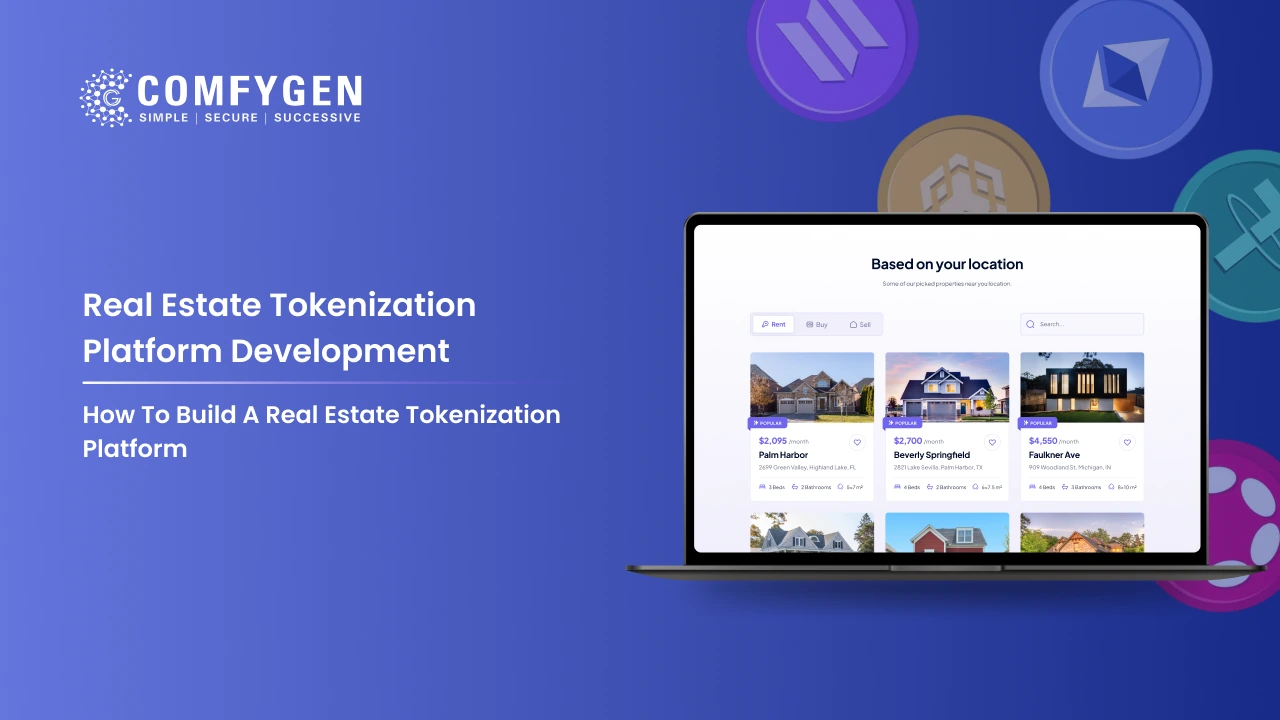
Investor Dashboard & Portfolio
A clean, intuitive interface where investors can view their holdings, track ROI, monitor property performance, download tax documents, and manage their wallet and bank account integrations.
Secondary Market / P2P Trading
Enables token holders to trade their positions before a property is sold. Includes an order book or liquidity pool mechanism, price discovery, and settlement automation via smart contracts.
Multi-Rail Payment Gateway
Accepts investment via fiat (credit card, bank wire, ACH) and cryptocurrency (ETH, USDC, BTC). Includes on-ramp/off-ramp providers like MoonPay or Transak for seamless fiat-to-crypto conversion.
Admin Panel & Compliance Dashboard
A back-office interface for platform operators to manage property listings, monitor token supply, approve/reject investors, oversee compliance status, and generate regulatory reports.
Document Management (IPFS)
All property-related documents — title deeds, valuation reports, legal agreements, SPV certificates — are stored on IPFS with their cryptographic hashes anchored on-chain for tamper-proof record keeping.
Notification & Reporting Engine
Real-time email, push, and in-app notifications for investment confirmations, income distributions, platform announcements, and regulatory updates. Automated report generation for investor tax filings.
Technology Stack for Real Estate Tokenization Development
Choosing the right technology stack is one of the most consequential decisions in your real estate tokenization development journey. Here’s a comprehensive breakdown of each layer:
| Category | Technologies / Tools |
|---|---|
| Blockchain Layer | Ethereum, Polygon, Solidity, ERC-1400, ERC-3643, Hardhat, OpenZeppelin |
| Smart Contract Auditing | Slither, MythX, Certik, Trail of Bits |
| Frontend | React.js, Next.js, TypeScript, wagmi, viem, ethers.js |
| Backend | Node.js, Python (Django/FastAPI), GraphQL, REST APIs, Kafka |
| Database | PostgreSQL, MongoDB, Redis |
| Storage & Infrastructure | IPFS / Filecoin, AWS S3, AWS, GCP, Azure, Cloudflare |
| Oracle & Data Feeds | Chainlink, Band Protocol |
| KYC/AML Providers | Onfido, Jumio, Sumsub, Persona |
| Payment Infrastructure | Stripe, MoonPay, Transak, Circle (USDC) |
Real Estate Tokenization Platform Development: Step-by-Step Process
Building a platform of this nature requires meticulous planning, a disciplined development process, and close collaboration between blockchain engineers, compliance specialists, and product teams. Here is the end-to-end process that Comfygen follows for every real estate tokenization development engagement:
1. Discovery, Market Research & Business Model Finalization
Define your target market (retail investors, accredited investors, institutional), geographic focus, property types (residential, commercial, industrial), and revenue model (platform fee, transaction fee, management fee, carried interest). Validate your business model with real estate and legal advisors before a single line of code is written.
2. Legal Structure & Regulatory Framework Setup
Work with securities lawyers to structure your platform around applicable regulations in each target jurisdiction. Determine whether you need a broker-dealer license, ATS registration, or can operate under an exemption. Set up the SPV or trust structures that will hold the underlying properties on behalf of token holders.
3. Smart Contract Architecture & Design
Design the on-chain architecture — token standards, compliance rules (transfer restrictions, whitelisting, lock-up periods), dividend distribution mechanics, governance logic, and upgradeability patterns. Use proxy patterns (e.g., OpenZeppelin Transparent Proxy) to allow future upgrades without token migration.
4. UI/UX Design & Prototyping
Create wireframes and high-fidelity prototypes for all user-facing interfaces: the investor portal, property listing pages, wallet onboarding, KYC flow, dashboard, and admin panel. Conduct usability testing with target users before development begins.
5. Core Platform Development
Simultaneously build the frontend (React/Next.js), backend (Node.js/Python APIs), database layer, smart contracts (Solidity), and blockchain integration layer. Use Agile sprints with bi-weekly reviews. Backend integrates with blockchain via ethers.js/viem; IPFS handles document storage.
6. KYC/AML Integration & Compliance Automation
Integrate your chosen identity verification provider. Build automated workflows for investor accreditation checks, sanctions screening, document verification, and ongoing transaction monitoring. Implement the compliance layer within your ERC-3643 smart contract or an off-chain compliance oracle.
7. Security Audits & Smart Contract Auditing
This is non-negotiable. Commission a comprehensive smart contract audit from a reputable firm (CertiK, Trail of Bits, OpenZeppelin). Run automated analysis with Slither and MythX. Conduct penetration testing on the web and API layers. Address every high and critical finding before proceeding.
8. Testnet Deployment & QA Testing
Deploy the full platform to a testnet (Sepolia for Ethereum, Mumbai for Polygon). Conduct end-to-end functional testing, load testing, edge case scenarios (failed transactions, oracle failures, KYC rejection flows), and regulatory scenario simulations with your compliance team.
9. Mainnet Launch & First Token Issuance
Deploy smart contracts to the mainnet. Onboard your first property and complete the first token offering. Start with a limited pilot (e.g., one property, invite-only investors) before opening to the public. Monitor all on-chain and off-chain activity closely during the first 30 days.
10. Post-Launch Support, Iteration & Feature Expansion
Ongoing platform maintenance, smart contract monitoring, regulatory updates, and feature development (secondary market launch, mobile app, new asset classes, DeFi integrations). Establish a bug bounty program. Build the investor community and property pipeline in parallel.
Legal & Regulatory Compliance in Real Estate Tokenization
Compliance is not an afterthought in real estate tokenization — it is the foundation upon which your entire platform is built. Regulators in every major jurisdiction classify tokenized real estate as securities, and failure to comply can result in platform shutdowns, fines, and criminal liability.
Regulatory Landscape by Region
| Region | Key Regulator | Relevant Framework | Key Requirements |
|---|---|---|---|
| United States | SEC | Reg D, Reg A+, Reg S | Accredited investor verification, Form D filing, ATS registration for secondary trading |
| European Union | ESMA / National regulators | MiCA, MiFID II, MICA | Prospectus requirements, CASP license, investor disclosures |
| UAE | VARA / DFSA | VARA Virtual Asset Framework | Virtual Asset License, AML program, regulated custody |
| Singapore | MAS | SFA, PS Act | Capital Markets Services license, AML/CFT compliance |
| India | SEBI / RBI | Evolving framework (2025–2026) | Consult legal counsel; framework actively developing |
| UK | FCA | Financial Services Act 2021 | FCA authorization, financial promotion rules |
Security Token vs. Utility Token: Why It Matters
Tokenized real estate is almost universally classified as a security token — not a utility token. This means it must comply with securities regulations in every jurisdiction where it’s offered. The Howey Test (USA) and similar frameworks in other jurisdictions are used to make this determination. Attempting to structure real estate tokens as “utility tokens” to avoid compliance is a serious legal risk and has been challenged by regulators worldwide.
AML/KYC Obligations
- Mandatory identity verification for all investors before any investment
- Sanctions screening against OFAC, UN, EU, and other lists
- Ongoing transaction monitoring for suspicious activity
- Suspicious Activity Report (SAR) filing when required
- Record retention for 5+ years (jurisdiction-dependent)
White Label Real Estate Tokenization Platform Development
For businesses looking to enter the real estate tokenization market quickly and cost-effectively, a white-label platform is the ideal solution. Rather than building from scratch — which takes 12–18 months and significant capital — a white label solution gives you a production-ready platform you can customize, brand, and launch in a fraction of the time.
What’s Included in a White Label Real Estate Tokenization Platform
- Complete investor portal with property listing, investment, and portfolio management
- Token issuance engine with configurable ERC-1400/ERC-3643 smart contracts
- Integrated KYC/AML verification module
- Admin panel for property and investor management
- Multi-rail payment gateway (fiat + crypto)
- Secondary market / peer-to-peer trading module
- Full source code ownership
- Custom branding, domain, and UI customization
- Post-launch technical support and upgrades
Real Estate Tokenization Development Cost Breakdown
One of the most common questions we receive at Comfygen: “How much does it cost to build a real estate tokenization platform?” The honest answer is that it depends on several factors — but here’s a transparent breakdown to guide your planning:
| Component | White Label | Custom Build |
|---|---|---|
| Smart Contract Development & Audit | Included | $15,000 – $45,000 |
| Frontend (Investor Portal + Admin) | Included | $15,000 – $35,000 |
| Backend API & Infrastructure | Included | $12,000 – $30,000 |
| KYC/AML Integration | Included | $5,000 – $12,000 |
| Payment Gateway Integration | Included | $4,000 – $10,000 |
| Secondary Market Module | Included | $10,000 – $25,000 |
| Security Audit (Platform + Smart Contracts) | Included | $8,000 – $25,000 |
| Legal & Compliance Advisory | $10,000 – $30,000 | $15,000 – $50,000 |
| Total Estimated Investment | $15,000 – $50,000 | $80,000 – $230,000+ |
How to Choose the Right Real Estate Tokenization Development Company
Your choice of real estate tokenization development company will make or break your platform. The technical complexity, regulatory stakes, and capital requirements of this space mean that experience and specialization are paramount. Here’s how to evaluate your options:
Key Criteria to Evaluate
1. Proven Blockchain & Tokenization Track Record
Look for a company with verifiable experience deploying security token platforms — not just general blockchain projects. Ask to see live platforms they’ve built, the smart contract standards they work with, and references from past clients in the tokenization space.
2. Compliance & Legal Knowledge
The best development companies either have in-house compliance expertise or have established partnerships with securities law firms. They should be able to guide you on structuring your platform for your target jurisdictions, not just write code.
3. Full-Stack Development Capabilities
Real estate tokenization platforms require expertise across smart contracts, blockchain integration, backend APIs, frontend development, security, and DevOps. Avoid companies that subcontract critical components to unknown third parties.
4. Security Audit Partnerships
Reputable development companies have established relationships with third-party security auditors and conduct independent audits of their code — not just internal reviews. This is non-negotiable for a platform handling real money.
5. Post-Launch Support Model
Your platform will require ongoing smart contract monitoring, feature development, regulatory updates, and performance optimization. Ensure your partner offers a clear SLA for post-launch support before signing any contract.
Conclusion
Real estate tokenization is not a future concept — it is happening right now, and the platforms being built in 2026 will define the landscape for the next decade. The combination of regulatory clarity, institutional interest, mature technology, and hungry investors has created the most favorable environment in history for launching a real estate tokenization platform.
Whether you choose to build a custom platform from scratch or launch with Comfygen Technologies‘s white-label real estate tokenization solution, the most important decision is to start. The barriers to entry are lower than they have ever been. The market is ready. The technology is proven.
The only question is: are you ready to build?
Frequently Asked Questions
What is real estate tokenization?
How much does it cost to build a real estate tokenization platform?
Which blockchain is best for real estate tokenization?
What is a white label real estate tokenization platform?
How long does it take to build a real estate tokenization platform?

Mr. Saddam Husen, (CTO)
Mr. Saddam Husen, CTO at Comfygen, is a renowned Blockchain expert and IT consultant with extensive experience in blockchain development, crypto wallets, DeFi, ICOs, and smart contracts. Passionate about digital transformation, he helps businesses harness blockchain technology’s potential, driving innovation and enhancing IT infrastructure for global success.