




To develop a courier delivery app, you choose a business model, plan a first version with only the core features, design the customer, driver, and admin apps, build and connect maps and payments, test the app under real order volume, and then launch. A basic courier app costs about $5,000 to $12,000. A full Android and iOS app with AI-based dispatch costs $25,000 to $50,000 or more and takes 14 to 20 weeks to build.
Key takeaways
- Pick your business model first. It decides how dispatch, pricing, and tracking work.
- Launch with core features only, then add advanced features once real users are on the app.
- Every courier app needs three parts: a customer app, a driver app, and an admin panel.
- The dispatch and tracking system is usually the biggest cost.
- Plan for data privacy laws and courier licensing before launch.
Many people who plan a courier app start with the features. That’s usually the wrong place to start. Most courier businesses that rebuild their app in the first year do it because they picked a business model that didn’t match how they deliver, or because they left out something important, like proof of delivery.
This guide walks you through the full process in plain language. If you’d rather hand the build to a team that has already shipped courier and logistics platforms, Comfygen offers end-to-end courier delivery app development from planning to launch.
What Is a Courier Delivery App?
A courier delivery app is a mobile app that connects people who need to send a package with drivers who can deliver it. Customers book a pickup, track the driver on a map, and pay inside the app. The business runs everything from an admin panel.
A courier app is different from a full logistics platform. Logistics software handles warehouses, freight, and supply chains. A courier app focuses on the last mile, which means moving a package from one address to another as quickly and clearly as possible.
How Does a Courier Delivery App Work?
Here’s what happens during a typical delivery:
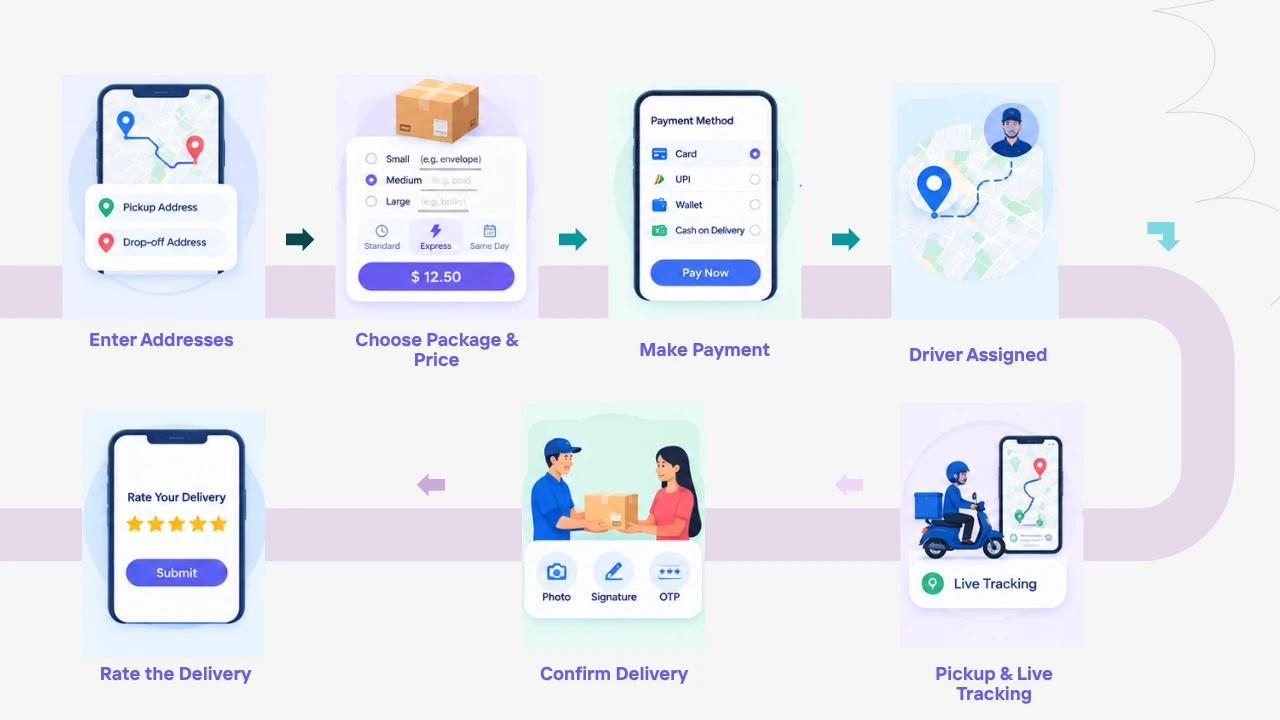
1. The customer enters the pickup and drop-off addresses.
2. The customer picks the package size and delivery speed, then sees the price.
3. The customer pays in the app.
4. The system assigns the nearest available driver.
5. The driver picks up the package while the customer tracks the trip live on a map.
6. The driver confirms delivery with a photo, a signature, or an OTP (a one-time code the receiver shares with the driver).
7. The customer rates the delivery.
This only works well when the customer app, driver app, and admin panel all run on the same live data. When they are built separately and joined later, tracking updates lag and orders get lost between systems.
Is a Courier Delivery App Worth Building?
Yes, the demand is large and still growing. The global courier, express, and parcel market was worth about $956 billion in 2025 and is expected to reach nearly $3 trillion by 2033. That’s a yearly growth rate of about 15.4% (Grand View Research).
Software spending is growing along with it. The courier software market is expected to reach $26.7 billion by 2032, growing about 8.8% each year, as more courier businesses move to automated dispatch and live tracking (Coherent Market Insights). Courier businesses that still take orders by phone and plan routes by hand are falling behind the ones that have moved to apps.
Types of Courier Delivery Apps
Your courier delivery business model shapes almost every technical decision that comes after it, so choose it first.
Postal and Courier Service Apps
These apps give an existing courier company a digital way to book shipments, print labels, and track packages. FedEx and DHL use this model at a large scale.
Package Tracking Aggregators
These apps collect tracking data from many carriers and show it in one place. The customer can track any package without knowing which company is delivering it. This model works for businesses that don’t run their own delivery fleet.
On-Demand Delivery Marketplaces
A customer requests a pickup and the app sends the nearest free driver right away. Lalamove and Borzo work this way. Most new courier startups choose this model because it grows quickly and gives customers the fastest service.
Branded Delivery Apps
One company builds its own app to manage its own deliveries, from dispatch to proof of delivery. Retailers and courier brands choose this when they want full control over the customer experience.
Freight and Haulage Platforms
These apps handle heavy goods, multi-stop routes, and business-to-business shipments. They add fleet tracking and supply chain views on top of normal courier features.
Which Model Fits Your Business?
| Business Model | Best For | Example |
| Postal and courier service app | Established courier companies | FedEx, DHL |
| Package tracking app | Businesses without their own fleet | Multi-carrier trackers |
| On-demand marketplace | Startups and same-day delivery | Lalamove, Borzo |
| Branded delivery app | Retailers and single courier brands | In-house store delivery apps |
| Freight and haulage platform | Heavy goods and B2B shipments | Fleet and haulage operators |
Delivery speed is a separate choice. Same-day, scheduled, and subscription delivery can run on any of these models.
How Courier Apps Make Money
Plan your revenue model early, because it affects pricing screens, payment flows, and the admin panel. Most courier apps use two or three of these:
- Delivery fees based on distance, package size, and speed
- Commission on each order when independent drivers do the deliveries
- Surge pricing during busy hours or bad weather
- Subscription plans for customers or businesses that ship often
- Business accounts with monthly billing for bulk orders
- Add-ons like delivery insurance or priority pickup
- In-app ads from local businesses
Features Your Courier App Needs
Building every feature before launch is the fastest way to run over budget. Split your features into two stages instead.
Tier 1: MVP Features (Build These First)
An MVP (minimum viable product) is the first working version of your app, with only the features needed to complete a delivery from start to finish.
Customer App
- Sign-up and profile
- Address search with autocomplete
- Instant price estimate
- Package size and type selection
- In-app payment (cards, wallets, cash on delivery)
- Live tracking on a map
- Push notifications at each delivery step
- Order history and ratings
Driver App
- Sign-up with license and document checks
- Accept or decline delivery requests
- GPS navigation to pickup and drop-off points
- Proof of delivery (photo, signature, or OTP)
- Earnings summary
- In-app chat with the customer
Admin Panel
- Live map of all active deliveries
- Manual and automatic driver assignment
- Customer and driver management
- Payment reports
- Support tickets and dispute handling
Tier 2: Growth Features (Add After Validation)
Once real customers are using the app, these features help you keep them and grow:
- AI route planning for multi-stop deliveries
- Scheduled and repeat bookings
- Support for more countries, currencies, and languages
- Referral and loyalty rewards
- Business accounts with bulk ordering
- Driver bonuses and incentives
- Delivery insurance for valuable or fragile items
Why Proof of Delivery Matters
Most courier disputes start with “I never got my package.” Good proof of delivery combines three things: a photo of the package at the door, the GPS location at drop-off, and a signature or OTP. Together they give both sides a clear record. Adding this after launch costs much more than building it in from the start.
Let’s Build Your Courier Delivery App Together
From planning and design to development, we can help you create an app that fits your delivery business.
Start a Conversation
Step-by-Step Process to Develop a Courier Delivery App
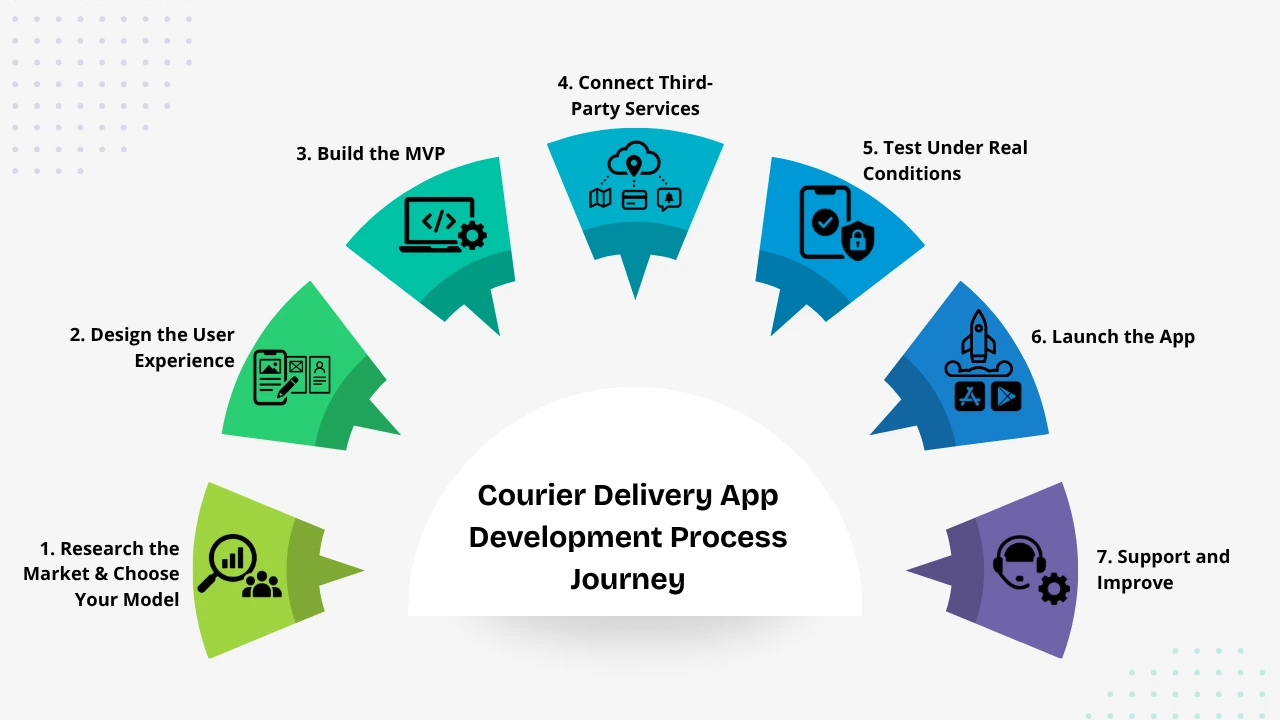
1. Research the Market and Choose Your Model
Study your competitors and target customers. Then decide on your business model, target city or country, and core feature list.
2. Design the User Experience
Create wireframes (simple screen layouts) and final designs for the customer app, driver app, and admin panel. Keep booking to as few taps as possible.
3. Build the MVP
Develop the Stage 1 features first. This lets real users test the app before you spend more money.
4. Connect Third-Party Services
Add maps (Google Maps or Mapbox), payment gateways (Stripe, Razorpay, or PayPal), and SMS and push notification services.
5. Test Under Real Conditions
Test features, security, and performance on different devices. Load testing matters most here. A dispatch system that handles 50 test orders can fail at 5,000 real ones.
6. Launch the App
Publish the apps on the App Store and Google Play. Watch performance closely during the first few weeks.
7. Support and Improve
Fix bugs, track performance, and roll out Stage 2 features based on how customers actually use the app.
Custom Build or White-Label App?
A white-label app is a ready-made courier app that you rebrand with your own name and design. A custom app is built from scratch around your business.
| Factor | White-Label App | Custom App |
| Launch time | 6 to 10 weeks | 10 to 20 weeks |
| Cost | Lower upfront | Higher upfront |
| Flexibility | Limited to built-in modules | Fully flexible |
| Best for | Testing a market quickly | Unique workflows and long-term growth |
If you choose white-label, make sure you get full ownership of the source code. Without it, you can’t change or move the app later.
The Team You’ll Need to Build a Courier Delivery App
A typical courier app project runs with:
- 1 to 2 UI/UX designers
- 3 to 4 mobile and web developers
- 2 to 3 backend developers
- 1 admin panel developer
- 1 to 2 QA testers
- 1 project manager
- 1 business analyst
That’s about 10 to 14 people. A team that has built courier or logistics apps before will usually move faster through dispatch and tracking decisions than a team building its first one.
Recommended Tech Stack for Building a Courier App
| Layer | Common Choices |
| Mobile apps | React Native, Flutter, Swift, Kotlin |
| Backend | Node.js, Python, Laravel, Java (Spring Boot) |
| Database | MongoDB, PostgreSQL, Firebase |
| Maps and tracking | Google Maps API, Mapbox |
| Cloud | AWS, Google Cloud, Microsoft Azure |
| Payments | Stripe, Razorpay, PayPal |
| Notifications | Firebase, OneSignal, Twilio |
React Native and Flutter let you build one codebase for both Android and iOS, which usually lowers cost and build time.
How Much It Costs to Develop a Courier Delivery App
Cost depends far more on which features are included than on how complex the app looks on the surface.
| App Type | Estimated Cost | Timeline |
| Basic courier app (one platform) | $5,000 to $12,000 | 8 to 10 weeks |
| Standard on-demand app (Android and iOS) | $12,000 to $25,000 | 10 to 14 weeks |
| Advanced app with AI dispatch | $25,000 to $50,000+ | 14 to 20 weeks |
| White-label courier app | $8,000 to $20,000 | 6 to 10 weeks |
| Enterprise logistics platform | Custom quote | 20+ weeks |
These ranges reflect app development rates at teams like Comfygen. Agencies based in the US or Western Europe often quote well above them for the same scope.
What drives the cost up:
- Dispatch and tracking. This is usually the biggest cost, because it has to stay accurate in real time with many orders at once.
- Number of platforms. Separate native Android and iOS apps cost more than one cross-platform app.
- AI features. Route planning and smart dispatch add development and testing time.
- Multiple countries. More currencies, languages, and tax rules add work, but much less when planned from day one.
Legal and Compliance Considerations
A courier app handles personal data, payments, and real deliveries, so it has to follow the law in every market where it runs.
Data privacy laws
Laws like GDPR in the EU, CCPA in California, and the DPDP Act in India control how you collect and store customer data, including location and payment details.
Courier and transport licensing
Many countries and cities require a permit to run a delivery service. This is separate from publishing the app.
Terms of service and liability
Your terms of service should cover lost or damaged packages, late deliveries, and how disputes are settled.
Driver classification
Whether drivers are contractors or employees changes your tax, insurance, and labor obligations. The rules differ a lot by country.
Get local legal advice for each market before launch. Fixing these issues later costs far more.
Where Courier Delivery Is Headed Next
A few shifts are worth planning around rather than reacting to later:
- AI dispatch and route planning: Customers now expect accurate delivery times, and AI makes that possible at scale. You can read more about how AI is changing courier delivery apps, from smart driver assignment to fraud checks.
- Crowdsourced delivery: More apps use independent local couriers instead of a fixed fleet, especially for same-day delivery.
- Drones and self-driving vehicles: These are still early in most markets. It helps to design your dispatch system so new delivery methods can be added later.
Need a Courier Delivery App for Your Business?
Tell us what you need, and we’ll help you plan the right features, cost, and development process for your app.
Talk to Us
Mistakes to Avoid When Building a Courier App
1. Choosing the wrong business model: An on-demand app built for a business that runs scheduled freight routes will need its dispatch system rebuilt.
2. Launching with too many features: Building Stage 1 and Stage 2 together delays launch and spends money on features no customer has tested yet.
3. Skipping load testing: An app that works in a demo can crash when real orders start coming in.
4. Leaving legal work until the end: Privacy and licensing problems are much cheaper to prevent than to fix.
5. Forgetting the driver: A driver app without good navigation or a clear earnings view leads to drivers quitting, which means slower deliveries and worse reviews.
Why Work With Comfygen for Courier App Development
Everything in this guide applies no matter who builds your app. What changes the result is whether the team has built courier or logistics apps before.
Comfygen has built delivery apps and logistics platforms since 2019, including a custom logistics app development with real-time tracking for a courier client. The team has completed 550+ projects for 400+ clients in 30+ countries, with a 97% client retention rate. Work follows ISO 9001, ISO/IEC 20000-1, and ISO 27001 certified processes, and every custom courier app is priced by milestone before development starts, so you know the full cost upfront.
Frequently Asked Questions
How do I develop a courier delivery app?
How much does it cost to develop a courier delivery app?
How long does it take to build a courier delivery app?
What features does a courier app need at minimum?
What is the best business model for a courier app?
Should I build a custom courier app or use a white-label app?
How many people does it take to build a courier app?
Can I build an app like Lalamove or Borzo?

Mr. Saddam Husen, (CTO)
Mr. Saddam Husen, CTO at Comfygen, is a renowned Blockchain expert and IT consultant with extensive experience in blockchain development, crypto wallets, DeFi, ICOs, and smart contracts. Passionate about digital transformation, he helps businesses harness blockchain technology’s potential, driving innovation and enhancing IT infrastructure for global success.