




Cryptocurrency terminology can be confusing, especially because the terms “coin” and “token” are often used interchangeably.
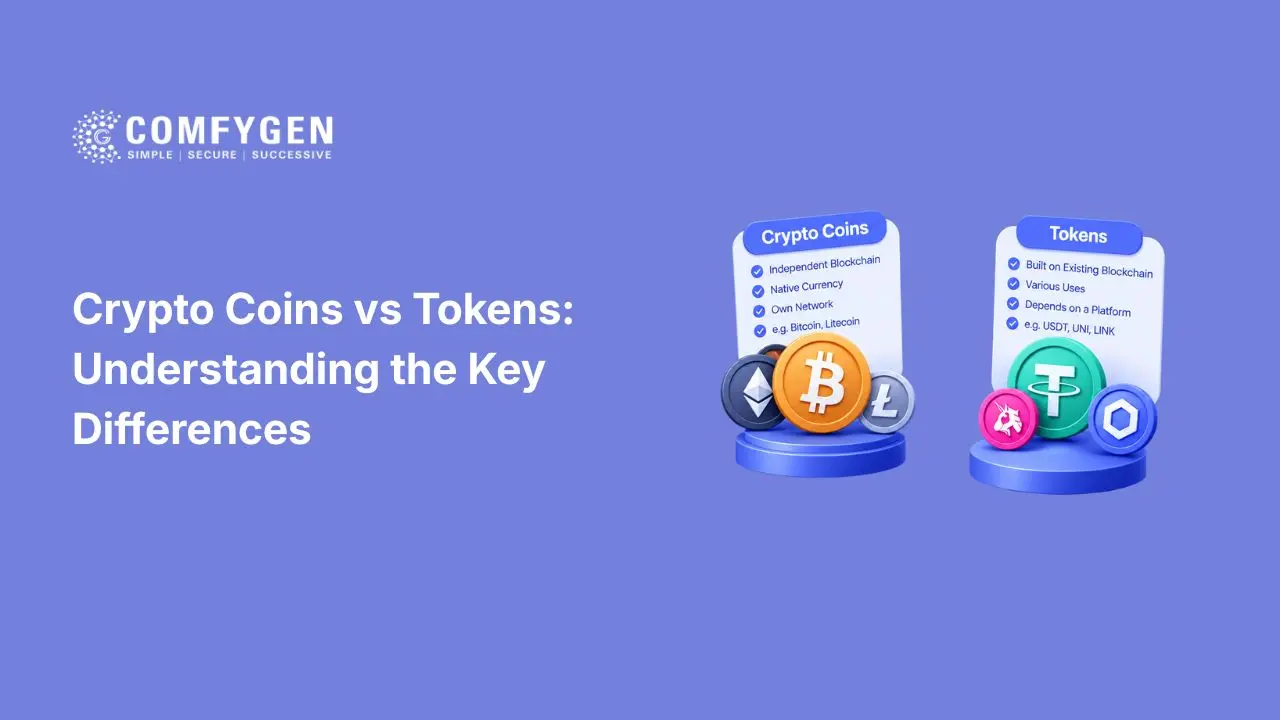
Although both are digital assets that exist on blockchain networks, they are not the same. The most significant difference is that a crypto coin is a native digital asset that operates on its own blockchain. In contrast, a crypto token is generally created on and operates on an existing blockchain.
What Is a Crypto Coin?
A crypto coin is a digital asset that operates on its own blockchain network.
It is primarily designed to function as digital money, allowing users to pay network fees, make peer-to-peer payments, and use it for investment and trading.
For example, Bitcoin operates on the Bitcoin blockchain, while Ether (ETH) is the native asset of Ethereum. Coins are commonly used for transferring value, paying network transaction fees, and participating in the operation of their respective blockchain networks.
Creating a crypto coin generally requires developing or establishing a blockchain network itself, including its underlying protocol, consensus mechanism, network infrastructure, and security model.
What Is a Crypto Token?
A crypto token is a digital asset created and managed through an existing blockchain.
Instead of building a completely new blockchain, a project can use an established network and its token standards. Ethereum, for example, supports standards such as ERC-20 token Development for fungible tokens. ERC-20 defines common functions for transferring tokens, checking balances, managing allowances, and tracking total supply.
Tokens can be designed for different purposes, including utility within an application, governance, rewards, digital assets, and other blockchain-based use cases.
Crypto Coins vs Tokens: What Is the Difference?
The easiest way to understand the difference is to look at the infrastructure behind them.
| Feature | Crypto Coin | Crypto Token |
| Blockchain | Runs on its own blockchain | Usually runs on an existing blockchain |
| Development | Requires blockchain-level development | Usually involves smart-contract development |
| Main purpose | Network value, payments, transaction fees | Utility, governance, assets, rewards, and other uses |
| Infrastructure | Requires its own network | Uses the underlying blockchain’s infrastructure |
| Example | Bitcoin, Ether | ERC-20 tokens on Ethereum |
This distinction also affects development complexity. Building a blockchain-based coin generally involves much more infrastructure and protocol-level work than creating a token on an established network.
How Are Crypto Coins and Tokens Created?
The development process differs significantly.
Crypto Coin Development
Creating a crypto coin generally involves developing or customizing a blockchain network. Depending on the project, this can include:
- Blockchain architecture
- Consensus mechanism
- Network nodes
- Transaction validation
- Wallet infrastructure
- Block explorer
- Security mechanisms
- Native coin economics
Because the coin is tied to its own blockchain, the development process can be technically demanding.
Crypto Token Development
Crypto Token development is generally more straightforward because the project can use an existing blockchain.
A typical token development process includes:
- Defining the token’s purpose
- Selecting the blockchain network
- Choosing the appropriate token standard
- Defining the name, symbol, supply, and decimals
- Developing the smart contract
- Testing and reviewing the contract
- Deploying the token
- Verifying and monitoring the contract
For example, an ERC-20 token follows Ethereum’s standardized interface for fungible tokens, helping it interact with compatible wallets, applications, and other blockchain infrastructure.
Why Do Businesses Choose Tokens Instead of Building a Coin?
For many blockchain projects, creating a token can be more practical than developing an entirely new blockchain.
Using an established network can provide access to existing infrastructure and an ecosystem of wallets, applications, and other smart contracts. Ethereum’s token standards are specifically designed to improve interoperability and composability across the ecosystem.
However, the right choice depends on the project’s actual requirements.
If a project needs its own blockchain architecture, native transaction system, or customized consensus mechanism, coin development may be relevant.
If the project mainly needs a digital asset that operates within an existing blockchain ecosystem, token development may be more appropriate.
What Should You Look for in a Crypto Token Development Company?
If you are planning to create a token, choosing a development partner should involve more than simply comparing development prices.
Look for a company that can clearly explain:
- Which blockchain is appropriate for your use case
- Which token standard should be used
- How the smart contract will be designed
- What security testing will be performed
- How contract ownership and administrative permissions work
- How the token will be deployed and verified
- What post-launch support is available
Security deserves particular attention. A token contract is responsible for important functions such as transfers, balances, supply, and approvals. The ERC-20 standard itself documents these core interfaces, while real-world implementations can add additional functionality and safeguards.
A development company should also be transparent about what is and is not included in its service. Smart-contract development, auditing, wallet integration, exchange integration, tokenomics consulting, and legal support are different areas and should not automatically be treated as the same service.
Coin or Token: Which One Does Your Project Need?
There is no universal answer.
A coin is used when a project needs its own blockchain and native asset.
A token can be used when a project wants to build on an existing blockchain and use established infrastructure.
The decision should come from the project’s technical requirements, intended utility, ecosystem, budget, security considerations, and applicable legal requirements—not simply from the popularity of a particular blockchain.
Final Thoughts
The key difference between a crypto coin and a token comes down to where it operates.
A coin is native to its own blockchain. A token is generally created on an existing blockchain.
For businesses exploring blockchain development, understanding this distinction is the first step. From there, the focus should move toward choosing the right blockchain, defining the token’s purpose, designing secure smart contracts, testing the implementation, and understanding the legal and operational requirements before launch.
A technically sound token is only one part of a successful blockchain project. The underlying use case, security, transparency, and long-term utility matter just as much.
FAQ’S
Is Bitcoin a coin or a token?
Bitcoin is a coin. BTC is the native asset of the Bitcoin blockchain, and it's used to pay transaction fees and reward miners on that network.
Is Ethereum a coin or a token?
Ether (ETH) is a coin because it's the native asset of the Ethereum blockchain. Ethereum itself is the network, and thousands of tokens are built on it.
Which is cheaper to create, a coin or a token?
A token is far cheaper. It needs one smart contract on an existing chain. A coin needs a full blockchain, network infrastructure, and ongoing security.
Do I need a license to launch a token?
It depends on the country and what the token does. Tokens that act like investments or payments often fall under financial rules, so check with a lawyer before launch.

Mr. Saddam Husen, (CTO)
Mr. Saddam Husen, CTO at Comfygen, is a renowned Blockchain expert and IT consultant with extensive experience in blockchain development, crypto wallets, DeFi, ICOs, and smart contracts. Passionate about digital transformation, he helps businesses harness blockchain technology’s potential, driving innovation and enhancing IT infrastructure for global success.