




Most founders skip this step. They say, “I want to build an app like Urban Company,” and jump straight into development. Six months later, they’re operationally overwhelmed, burning cash, and wondering why growth has stalled.
The reason? They picked the wrong business model for their stage, resources, and market.
The home service app industry is booming. The online home service market is expected to grow by USD 336.8 billion at a CAGR of 13.4% from 2025 to 2030, driven by rising consumer demand for convenience and on-demand services. The global home services market is projected to reach $1.8 trillion by 2030, growing at an 18.9% CAGR, and 78% of bookings in this sector are projected to be mobile-first by 2027.
The opportunity is enormous. But the platforms that capture it won’t just be the ones with the most features. They’ll be the ones who choose the right home service app business model from day one.
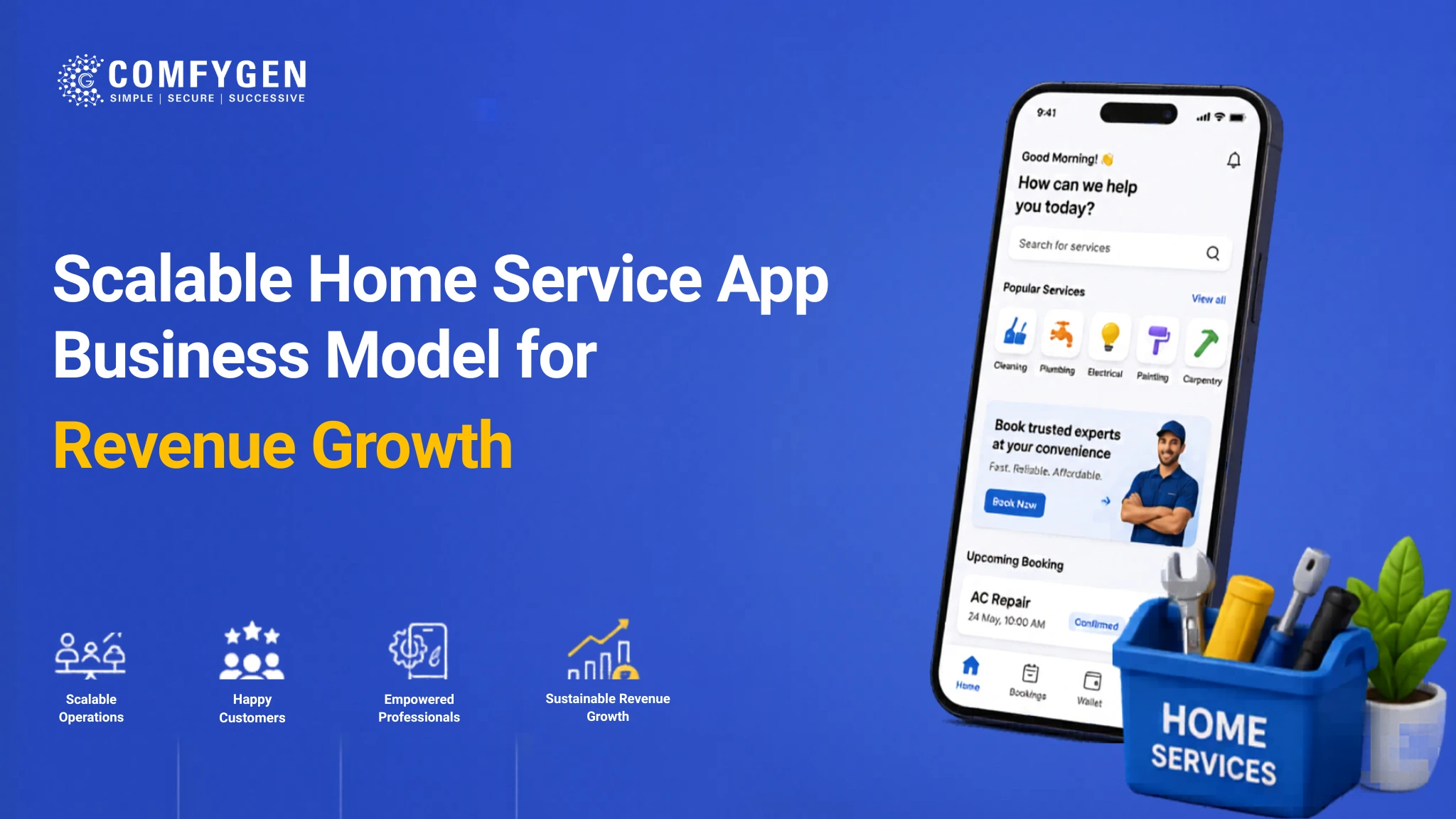
In this guide, Comfygen, a leading home service app development company, breaks down the three core home service app business models in detail to help businesses choose the right model for growth, scalability, and long-term success.
- Single Service Aggregator – one category, many providers
- Multi-Service Aggregator – many categories, many providers
- Home Services Business – your own team, full control
What Is a Home Service App Business Model?
A home service app business model defines how your platform creates value, delivers services, and earns money.
An aggregator is a platform that brings together multiple service providers under one digital roof, offers their services to users in a unified way, and usually operates under one brand, acting as a smarter middleman that aggregates supply, standardizes quality, and makes everything accessible through technology.
But not all home service apps are aggregators. Some companies directly employ their own service teams. The structural difference between these approaches affects everything: your startup costs, your operational complexity, your quality control, your scalability, and ultimately your revenue ceiling.
There are three distinct models in this space, and each one is a legitimate path to building a profitable business. The key is matching the model to your specific context.
Model 1: Single Service Aggregator – Go Deep, Not Wide
A Single Service Aggregator home service app business model focuses on one specific service category and connects customers with multiple independent providers who offer that service. The platform doesn’t deliver the service itself; it connects, coordinates, and earns a commission.
Think of it as being the Uber of one thing: just cleaning, just pest control, just AC servicing, or just plumbing.
The single vendor model works best when the platform itself has full control over operations, pricing, and customer experience within a specific niche, making it ideal for local startups starting small.
How It Works
Customer opens app → Selects the one service available →
Gets matched with a nearby provider →
Pays through the app → Platform earns commission
The platform’s entire product, marketing, and operations revolve around mastering one vertical.
Real-World Examples
- Housejoy (early stage, cleaning-focused)
- UrbanClap (in its early days, before becoming Urban Company)
- Any city-specific “just cleaning” or “just pest control” app
Revenue Streams
| Revenue Source | How It Works | Typical Rate |
|---|---|---|
| Transaction Commission | % of every completed booking | 15–25% |
| Provider Subscription | Monthly fee for platform access | ₹500–₹2,000/month |
| Surge Pricing | Premium rates during peak hours | +20–40% on commission |
| In-app Products | Sell related products (cleaning supplies) | Variable |
| Verified Badge Fee | Providers pay for the trust badge | ₹1,000–₹3,000/year |
Advantages of the Single Service Aggregator Model
1. Laser-Focused Marketing: You’re not trying to be everything to everyone. “Best cleaning app in Jaipur” is a message that lands. You can own a category in a city before expanding.
2. Faster Provider Onboarding: Vetting 50 cleaners is far easier than vetting 50 cleaners + 50 plumbers + 50 electricians. You can launch in weeks, not months.
3. Better Quality Control: When you focus on one service, you understand exactly what a 5-star experience looks like. You build training, checklists, and rating systems around one set of standards.
4. Stronger Network Effects: More cleaners → shorter wait times → more customers → more bookings for cleaners → more cleaners join. This loop tightens faster in a single category.
5. Lower Startup Cost: An MVP single-service app can be built for ₹4–10 lakh. You’re not building 20 different booking flows for 20 service types.
Disadvantages
- Revenue ceiling is lower – you can only grow as fast as your chosen category grows
- Vulnerable to category disruption – if demand for that service changes, your whole business is exposed
- Harder to cross-sell – customers who need plumbing AND cleaning have to use two different apps
Best For
- First-time founders with limited capital
- Founders with deep expertise in one service category
- Markets where one service is significantly underserved
- Anyone who wants to prove unit economics before expanding
Financial Snapshot (Illustrative)
| Stage | Monthly Bookings | Avg Order Value | Commission (20%) | Monthly Revenue |
|---|---|---|---|---|
| Launch (Month 3) | 500 | ₹700 | ₹140 | ₹70,000 |
| Growth (Month 12) | 3,000 | ₹750 | ₹150 | ₹4.5 lakh |
| Scale (Month 24) | 10,000 | ₹800 | ₹160 | ₹16 lakh |
Model 2: Multi-Service Aggregator – The Marketplace Giant
A Multi-Service Aggregator home service app business model is a full-stack home services marketplace, one app where customers can book cleaning, plumbing, electrical work, carpentry, beauty services, pest control, and more. Multiple providers across multiple categories are listed and managed on one platform.
In the multi-service aggregator business model, the aggregator makes providers its partners and sells their services under its brand. The providers never become employees; they remain owners who sign a contract with the aggregator, which relies on its marketing capability to create a single domain offering uniform quality and price.
This is the Urban Company model. The Angi model. The Thumbtack model.
How It Works
Customer opens app → Browses service categories →
Selects AC repair / cleaning / plumbing / etc. →
Gets matched with best available verified provider →
Pays in-app → Platform earns commission + subscription fees
Real-World Examples and Performance
- Urban Company (India): ₹1,144 crore in FY2025 revenue, growing 38% year-on-year, with a net profit of ₹240 crore – having turned profitable after years of losses.
- Thumbtack (USA): Crossed USD 400 million in annual revenue, growing 27% year-on-year, using a commission and subscription model with AI-powered matching.
- Angi (USA): Largest verified professional network in the US – a cautionary example of what happens when you don’t evolve your model fast enough.
Revenue Streams
| Revenue Source | How It Works | Scale Potential |
|---|---|---|
| Transaction Commission | 10–28% per completed booking | Very High |
| Customer Subscription | Monthly/annual membership plans | High (recurring) |
| Provider Listing Fees | Tiered subscription for providers | High |
| In-app Product Sales | Consumables, spare parts, upsells | Medium |
| Surge / Dynamic Pricing | Premium on peak demand bookings | Medium |
| B2B Enterprise Contracts | Housing societies, corporates | High (low volume) |
| In-app Advertising | Promoted provider listings | Medium |
| White-label Licensing | License platform tech to others | High (long-term) |
Advantages of the Multi-Service Aggregator Model
1. Massive Revenue Ceiling When you serve 15 service categories across 10 cities, your TAM (Total Addressable Market) is enormous. Urban Company’s ₹1,144 crore revenue is only possible at this scale.
2. Cross-Selling Power A customer who books a cleaning today can be upsold pest control next week and AC servicing next month – all within the same app. LTV (Customer Lifetime Value) compounds naturally.
3. Network Effects Compound Faster With more categories, customers return more frequently. The more often they return, the more providers benefit. The more providers join, the better the service quality.
4. Data Advantage Knowing that a customer regularly books cleaning, occasionally needs plumbing, and has a 2BHK in Jaipur gives you powerful data to personalise, predict, and upsell.
5. Investor Attractiveness A Deloitte survey found that 72% of investors prioritise startups with tech-enabled recurring revenue models – and multi-service aggregators with subscription layers check that box perfectly.
Disadvantages
- High startup cost – building a multi-category marketplace with proper provider management can cost ₹10–20 lakh or more
- Complex operations – managing quality across plumbers, electricians, carpenters, and beauticians simultaneously is genuinely hard
- Slower to launch – you need enough supply in every category before you can market broadly
- A primary scaling hurdle is implementing a scalable service quality assurance protocol that maintains standards across a diverse workforce – a 5% drop in provider ratings can lead to a 10% decline in new user acquisition.
Best For
- Founders with significant capital (₹30 lakh+)
- Teams with operational experience in service businesses
- Markets where no dominant multi-service platform exists yet
- Founders are thinking about Series A+ fundraising within 2–3 years
Financial Snapshot (Illustrative)
| Stage | MAU | Monthly GMV | Take Rate | Monthly Revenue |
|---|---|---|---|---|
| Launch (Month 6) | 2,000 | ₹35 lakh | 18% | ₹6.3 lakh |
| Growth (Month 18) | 15,000 | ₹2.2 crore | 20% | ₹44 lakh |
| Scale (Month 36) | 60,000 | ₹9.5 crore | 22% | ₹2.09 crore |
Model 3: Home Services Business – Own the Experience
A Home Services Business is fundamentally different from the aggregator models. Here, you are the service provider. Your company directly employs or contracts service professionals, trains them to your standards, and delivers the service under your brand – end to end.
There is no third-party provider network. Customers book through your app, your team shows up, and your company keeps the full service revenue (minus costs).
This model works best when the platform itself provides all the services using in-house professionals or contractors hired under your brand. In this centralised system, the business has full control over operations, pricing, and customer experience.
How It Works
Customer books through app →
Your trained, uniformed employee is dispatched →
Service is delivered to your company's exact standard →
Customer pays → You keep the full revenue
Real-World Examples
- Early Urban Company (before switching to aggregator)
- Molly Maid (cleaning franchise with its own teams)
- Stanley Steemer (carpet cleaning, owns employees)
- Local cleaning or handyman companies that have built a booking app
Revenue Streams
| Revenue Source | How It Works | Margin |
|---|---|---|
| Direct Service Revenue | Full payment for the service delivered | 30–55% gross margin |
| Service Packages | Bundled recurring plans (monthly cleaning) | High (recurring) |
| Annual Maintenance Contracts | Yearly AMC for AC, plumbing, and electrical | Very High |
| Upsell During Service | The technician recommends additional services | High |
| Product Sales | Branded cleaning kits, spare parts | Medium |
| Corporate/B2B Contracts | Office cleaning, facility management | Very High (stable) |
Advantages of the Home Services Business Model
1. Maximum Quality Control:- Your team, your training, your standards. A customer complaint about a plumber is about your employee, and you can fix it, train them, or replace them immediately. Quality is entirely within your control.
2. Strong Brand Trust:- Customers feel safer letting in someone who wears your branded uniform and carries your ID. This trust converts into higher retention, better reviews, and stronger word-of-mouth.
3. Premium Pricing Power:- Since your primary assets are your expertise and your reputation, perceived value is high, allowing for healthy pricing and strong gross margins, making scaling more achievable than in businesses with high overhead.
4. No Provider Churn Problem:- Aggregators constantly worry about providers going direct with customers or leaving the platform. In a Home Services Business, your employees aren’t going anywhere; they’re on your payroll.
5. Predictable Annual Maintenance Contracts (AMCs): AMCs for AC servicing, plumbing maintenance, or pest control create rock-solid recurring revenue that aggregators struggle to capture because they don’t own the provider relationship.
Disadvantages
- Linear scaling problem – every new customer eventually requires another hire. Growth is tied to headcount.
- High operational costs – salaries, training, uniforms, insurance, equipment
- Geographic constraints – expanding to a new city means hiring and training a whole new team there
- Management complexity – managing 100 employees is fundamentally harder than managing 100 partner providers
Best For
- Founders who prioritize quality and brand over speed-to-scale
- Businesses targeting premium segments (luxury apartments, corporate clients)
- Service categories where trust is the primary purchase decision (home security, elderly care)
- Founders who want to build for acquisition by a larger franchise or corporate buyer
Financial Snapshot (Illustrative)
| Stage | Monthly Jobs | Avg Job Revenue | Gross Margin (40%) | Monthly Gross Profit |
|---|---|---|---|---|
| Launch (Month 3) | 200 | ₹900 | ₹360 | ₹72,000 |
| Growth (Month 12) | 800 | ₹1,000 | ₹400 | ₹3.2 lakh |
| Scale (Month 24) | 2,500 | ₹1,100 | ₹440 | ₹11 lakh |
Looking for a reliable home service app development company?
Comfygen helps startups and enterprises build scalable, feature-rich home service apps with advanced features, seamless user experience, and custom business models.
Book a Strategy Call
Side-by-Side Comparison: Which Model Is Right for You?
| Factor | Single Service Aggregator | Multi-Service Aggregator | Home Services Business |
|---|---|---|---|
| Services Offered | One category | Many categories | Own services only |
| Who Delivers the Service | Independent providers | Independent providers | Your employees |
| Startup Capital Needed | Low (₹4–10 lakh) | High (₹10 – 20 lakh+) | Medium (₹15 – 35 lakh+) |
| Time to First Revenue | Fast (2–4 months) | Slower (4–8 months) | Medium (3–5 months) |
| Quality Control | Moderate | Hard | Very High |
| Operational Complexity | Low | Very High | High |
| Scalability | High | Very High | Limited |
| Revenue Ceiling | Medium | Very High | Medium |
| Gross Margin | 15–25% | 15–28% | 30–55% |
| Network Effects | Moderate | Very Strong | Weak |
| Provider/Employee Churn Risk | High | High | Low |
| Investor Appeal | Moderate | Very High | Moderate |
| Best Real Example | Niche category app | Urban Company | Local cleaning franchise |
Revenue Streams Across Home Service App: Three Models
Regardless of which model you choose, the most successful platforms layer multiple revenue streams to build resilience and compound growth.
Tier 1: Core Revenue (All Models)
- Transaction fees / Direct service revenue – your primary engine
- Provider subscriptions or AMCs – predictable recurring income
Tier 2: Growth Revenue (Once You Have Scale)
- Customer subscription plans – monthly membership with priority booking and discounts
- Surge/dynamic pricing – higher margin during peak demand
- In-app product sales – sell consumables used in the service
Tier 3: Advanced Revenue (At Maturity)
- B2B enterprise contracts – housing societies, corporate offices, property managers
- White-label licensing – license your platform tech to other businesses
- In-app advertising – promoted listings for providers or partner brands
- Data and insights – aggregate demand data sold to relevant brands (requires compliance)
Technology Requirements for Each Home Service Business Model
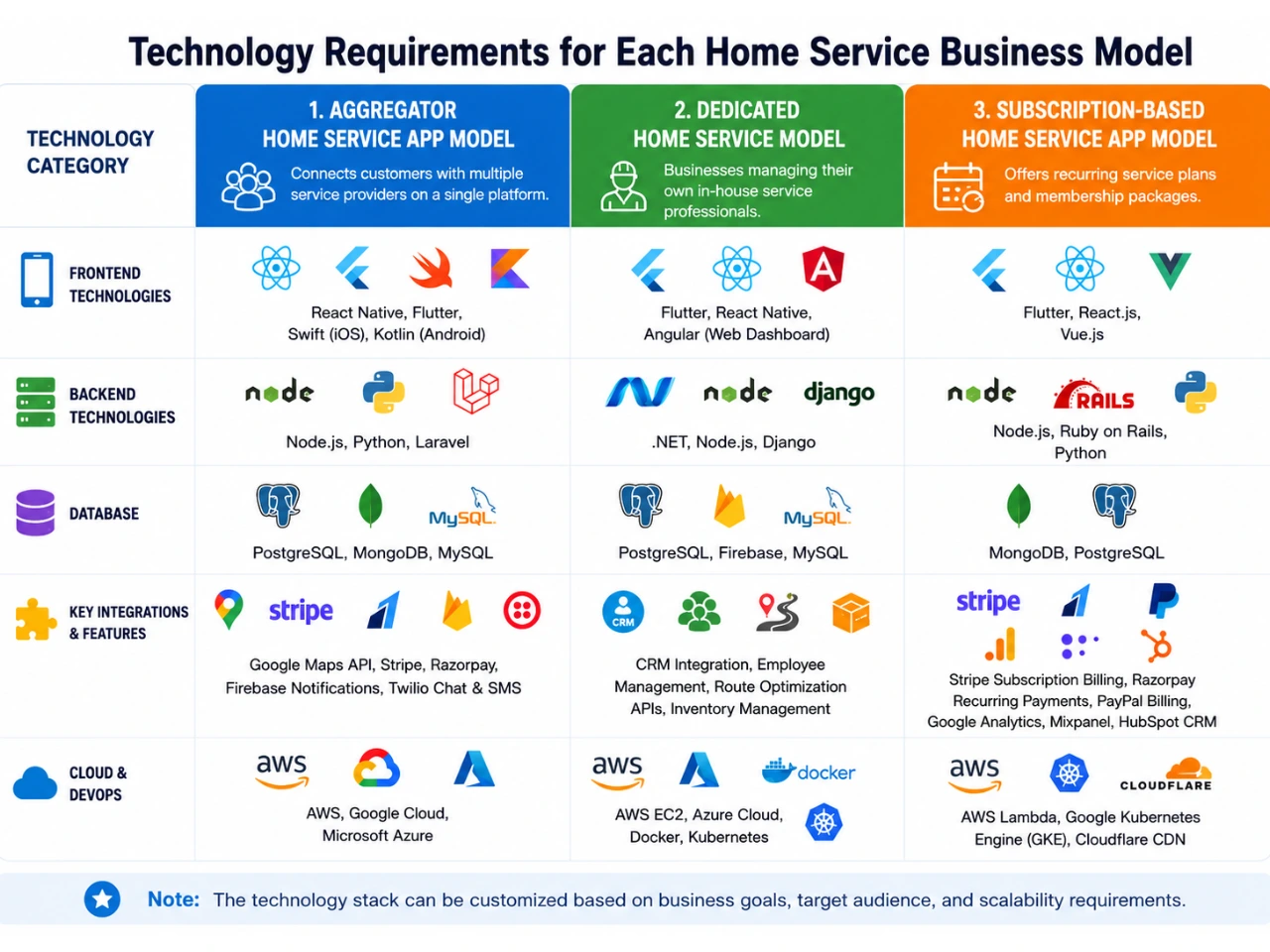
Single Service Aggregator – Tech Stack
Must-Have Features:
- Customer app (iOS + Android) with real-time booking
- Provider app with job management and earnings tracker
- In-app payments (Razorpay / Stripe)
- GPS tracking for provider arrival
- Rating and review system
- Basic admin dashboard
Estimated Build Cost: ₹4–10 lakh
Timeline: 3–4 months
Nice-to-Have (Phase 2):
- Subscription plan management
- Push notifications for re-engagement
- Analytics dashboard with booking trends
Multi-Service Aggregator – Tech Stack
Must-Have Features:
- Everything in Single Service, PLUS:
- Multi-category booking flows (different forms for different services)
- Provider onboarding and verification portal
- Commission management by category
- Dispute resolution module
- Advanced analytics (revenue by category, geography, provider)
- Admin should be able to manually assign jobs to providers if needed, reschedule appointments, handle customer support escalations, track all financial transactions, manage refunds, handle payment disputes, and generate detailed reports on revenue, user growth, service popularity, and provider performance.
AI Layer (Competitive Advantage):
- Smart provider-to-job matching algorithm
- Demand forecasting by location and time
- Automated quality scoring for providers
- Chatbot for 70–80% of support queries
Estimated Build Cost: ₹10–20 lakh
Timeline: 5–10 months
Home Services Business – Tech Stack
Must-Have Features:
- Customer-facing booking app
- Employee scheduling and dispatch system
- Route optimisation (more jobs per day = more revenue)
- Job completion reports with photo uploads
- Payment collection and receipt generation
- Customer feedback system
Key Difference from Aggregator Tech: You need workforce management tools, not provider marketplace tools. Think scheduling + dispatch + payroll integration.
Estimated Build Cost: ₹15–35 lakh
Timeline: 3–5 months
How to Scale Each Business Model
Scaling a Single Service Aggregator
Phase 1 – Hyperlocal Domination (Months 1–6)
- Own one neighborhood or locality completely
- Target 500+ bookings/month before expanding
- Build a 5-star rating baseline (minimum 4.6 average)
Phase 2 – City-Wide Expansion (Months 6–18)
- Expand to 3–5 more areas in the same city
- Launch customer subscription plan to lock in repeat bookings
- Start a provider referral program
Phase 3 – Category Expansion or New Cities (Months 18–36)
- Add 1–2 adjacent service categories (e.g., cleaning → pest control)
- Or replicate the model in a second city
- Begin B2B sales to housing societies
Key Scaling Metric: Customer Repeat Rate. If your customers don’t rebook within 45 days, fix that before you expand.
Scaling a Multi-Service Aggregator
Phase 1 – Launch with 3 Core Categories (Months 1–6)
- Start with the 3 highest-demand services in your city: cleaning, AC servicing, plumbing
- Build your provider network to 200+ verified providers
- Target 2,000+ bookings/month before adding categories
Phase 2 – Category + Geography Expansion (Months 6–24)
- Add 3–5 new service categories based on customer requests
- Expand to 2–3 new cities with proven playbook
- Launch subscription plans and provider premium tiers
Phase 3 – Platform Deepening (Months 24–48)
- AI-powered matching and demand forecasting
- B2B enterprise channel (housing societies, corporates)
- In-app product marketplace
- Explore white-label licensing
Key Scaling Metric: Take Rate Growth. As your platform becomes indispensable, you should be able to raise your commission percentage this signals genuine marketplace power.
Scaling a Home Services Business
Phase 1 – Local Quality Leader (Months 1–12)
- Build a core team of 15–25 professionals
- Obsess over quality ratings – every booking below 4.5 stars gets a personal follow-up
- Target corporate clients and housing society contracts for stable recurring revenue
Phase 2 – AMC Revenue Focus (Months 6–18)
- Push Annual Maintenance Contracts aggressively – these are your highest-margin, most predictable revenue
- Build a referral program through existing corporate clients
- Add one new service category with your existing team (e.g., if cleaning, add deep cleaning, sofa cleaning, carpet cleaning)
Phase 3 – Franchise or Hybrid Pivot (Months 24+)
- Consider a franchise model – let others operate under your brand in new cities
- Or pivot to a hybrid: keep your core team for premium/corporate work, add a provider network for residential volume
- Many successful home service companies eventually move toward the aggregator model once they’ve proven the brand
Key Scaling Metric: Revenue per Employee. If this isn’t growing, you’re adding cost without adding efficiency.
Common Mistakes Founders Make Choosing a Model
Mistake 1: Copying Urban Company Without Urban Company’s Resources
Urban Company raised hundreds of crores of rupees before reaching profitability. Building a multi-service aggregator on a ₹20 lakh budget is not a plan – it’s a recipe for running out of money before you find product-market fit.
Fix: Match your model ambition to your actual capital. Start as a single-service aggregator, prove it works, then raise and expand.
Mistake 2: Starting a Home Services Business When You Want to Scale
If your 3-year dream is to be in 20 cities with 100,000 users, a Home Services Business model will hold you back. Every new city requires hiring and training a whole new team. You’ll run out of management bandwidth long before you run out of market.
Fix: If scale is the goal, aggregator models are the path. If scalability is key, the multi-vendor aggregator model provides the flexibility to grow without taking on operational load for every service.
Mistake 3: Underestimating Quality Management in Aggregator Models
The core of any aggregator platform is seamless provider onboarding, a standardized user experience, and strong quality control. Founders often focus on acquiring customers but neglect building systems to maintain consistent provider quality.
Fix: Build provider quality scoring, automated rating alerts, and a retraining/offboarding system before you scale provider acquisition.
Mistake 4: Building Revenue Features Before Retention Features
Many home service apps launch with complex payment options and promotional codes, but don’t build a simple “rebook your last service” button. One click to rebook is worth more than five promotional campaigns.
Fix: Optimize for the second booking before you optimize for revenue. Retention drives LTV. LTV is what makes the whole model profitable.
Mistake 5: Ignoring the Provider Experience
Your providers are not just a cost center – they are your product. If your plumbers earn poorly, are dispatched inefficiently, or feel undervalued on your platform, they leave. And a marketplace without supply is just an empty app.
Fix: Build provider dashboards, transparent earnings trackers, and fast payout options from day one. Happy providers = quality service = happy customers = growth.
Conclusion: Pick Your Model, Then Build It With the Right Partner
The home service industry doesn’t reward those who hedge their bets. It rewards founders who pick a model that fits their resources, understand it deeply, and execute it relentlessly.
Here’s a quick summary of the decision:
- Single Service Aggregator → Best if you’re starting lean, want fast learning, and plan to expand gradually. Pick one service, dominate one city, then grow.
- Multi-Service Aggregator → Best if you have capital, want investor-grade scale, and can manage operational complexity. This is the Urban Company path.
- Home Services Business → Best if quality and brand are your differentiators, you’re targeting premium customers or corporate clients, and you want maximum control over the customer experience.
The global home services market is projected to reach $1.8 trillion by 2030, growing at 18.9% CAGR. The market is large enough for all three models to succeed in different niches, geographies, and customer segments.
Ready to Build Your Home Service App?
At Comfygen, we specialize in building scalable, production-ready home service apps – whether you’re launching a single-service aggregator, a full multi-service marketplace, or a branded home services business platform.
Frequently Asked Questions
What is the difference between a Single Service Aggregator and a Multi-Service Aggregator?
Which home service app business model is most profitable?
Can I start as a Single Service Aggregator and evolve into a Multi-Service Aggregator?
How much does it cost to build a home service app?
What is the best revenue model for a home service app?

Mr. Saddam Husen, (CTO)
Mr. Saddam Husen, CTO at Comfygen, is a renowned Blockchain expert and IT consultant with extensive experience in blockchain development, crypto wallets, DeFi, ICOs, and smart contracts. Passionate about digital transformation, he helps businesses harness blockchain technology’s potential, driving innovation and enhancing IT infrastructure for global success.