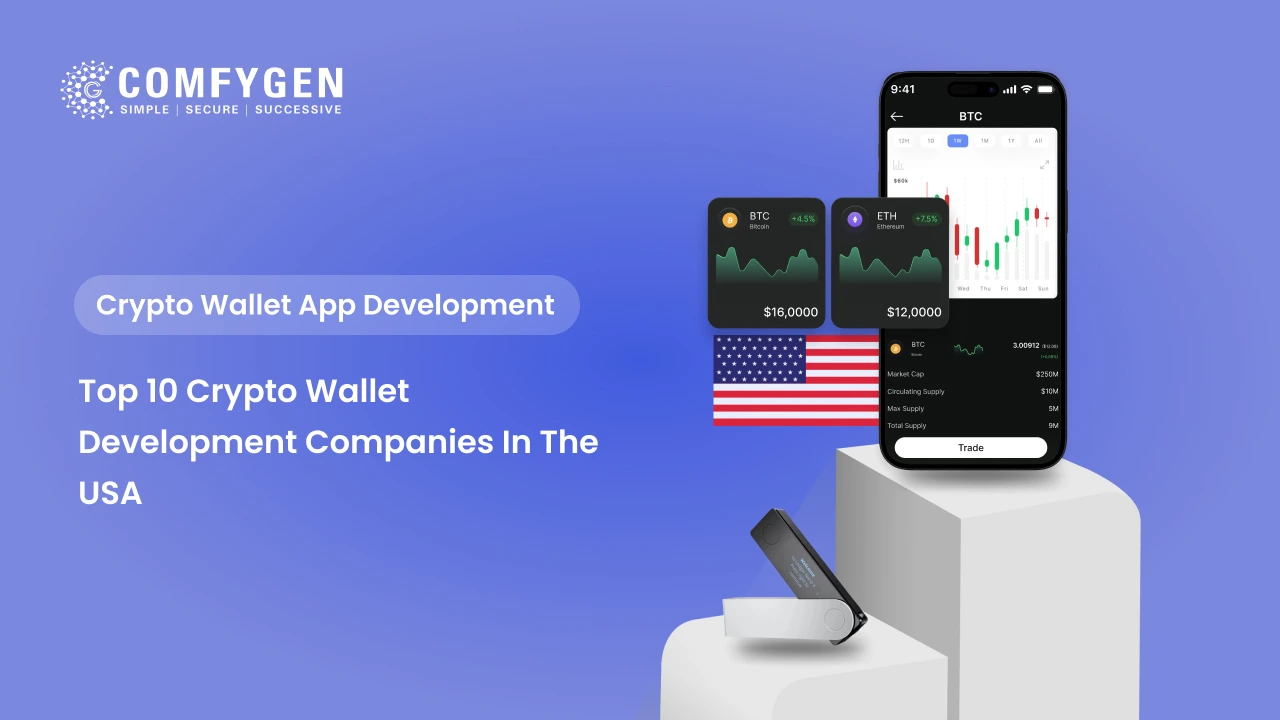





The top crypto wallet development companies serving the USA in 2026 are Comfygen, ConsenSys, LeewayHertz, PixelPlex, Antier Solutions, SoluLab, Debut Infotech, HashCash Consultants, Blockchain App Factory, and Nadcab Labs. They all build secure, multi-chain wallets, but they don’t do the same job. Some are Ethereum-native shops, some are built for white-label speed, and some handle the whole custom build for startups and enterprises.
Picking one really comes down to what you’re building. Below you’ll find what each company is best at, the wallet types they handle, what a project actually costs, and how to choose without getting burned.
Top Crypto Wallet Development Companies at a Glance
The whole list, side by side, before the profiles.
| S.N. | Company | Best for | Location |
| 1 | Comfygen Technologies | End-to-end custom wallets + full Web3 builds | India, serving US clients |
| 2 | ConsenSys | Ethereum and EVM wallet infrastructure | Brooklyn, New York |
| 3 | LeewayHertz | Enterprise-grade custom wallet platforms | San Francisco, California |
| 4 | PixelPlex | Complex multi-chain and DeFi builds | New York |
| 5 | Antier Solutions | White-label and enterprise wallets | Global, with US offices |
| 6 | SoluLab | Scalable wallets with hardware integration | US and India |
| 7 | Debut Infotech | Full-cycle wallet + exchange builds | US and India |
| 8 | HashCash Consultants | Payment-grade and financial wallets | US, global delivery |
| 9 | Blockchain App Factory | Fast startup wallet and DeFi launches | Global |
| 10 | Nadcab Labs | MPC and multi-chain wallet solutions | Global, with US office |
And the money behind this is real. The global crypto wallet market sat at around $15.5 billion in 2025 and is on track to hit roughly $100.8 billion by 2033, growing about 26.6% a year, according to Grand View Research. North America took the biggest chunk at 30.7% in 2025, which is a big part of why wallet projects tend to chase US users first.
The 10 Best Crypto Wallet Development Companies in the USA
1. Comfygen
Comfygen builds custom crypto wallets and full Web3 platforms, and it’s been shipping blockchain products since 2019. The team of 100+ has delivered 550+ projects for 400+ clients across 30+ countries, holds a 97% client retention rate, and carries ISO certification. On the wallet side, that means non-custodial wallets, multi-chain support across Ethereum, Solana, Polygon, and BNB Chain, DeFi and DEX integration, NFT wallets, and third-party smart contract audits. Most of its crypto clients sit in the USA, UK, UAE, Canada, and Singapore.
- Best for: teams that want one partner for the wallet, the smart contracts, and everything around them
- Focus: non-custodial wallets, multi-chain, DeFi/DEX, NFT, smart contract security
- Location: Jaipur, India, delivering to clients worldwide
If you’d rather one team own the custom crypto wallet development from start to finish instead of stitching three vendors together, that’s the pitch here.
2. ConsenSys
ConsenSys is the company behind MetaMask, one of the most-used crypto wallets anywhere. Founded by Ethereum co-founder Joseph Lubin, it builds Ethereum-native wallet and Web3 infrastructure. If your product lives on Ethereum and EVM-compatible chains, few names carry more weight.
- Best for: Ethereum and EVM-based wallet infrastructure
- Focus: MetaMask, Web3 tooling, developer infrastructure
- Location: Brooklyn, New York
3. LeewayHertz
A San Francisco firm known for enterprise blockchain and, lately, AI-plus-blockchain builds. LeewayHertz usually develops custom crypto wallets as part of a wider digital asset platform, and it’s got a long history of working with big brands.
- Best for: enterprise-grade custom wallet and blockchain platforms
- Focus: enterprise blockchain, AI integration, digital asset platforms
- Location: San Francisco, California
4. PixelPlex
A New York blockchain and Web3 studio that builds custom crypto wallets, DeFi platforms, and tokenization systems. PixelPlex tends to take on the complex, multi-chain jobs and run them end-to-end.
- Best for: complex multi-chain wallet and DeFi builds
- Focus: custom wallets, DeFi, tokenization, blockchain consulting
- Location: New York
5. Antier Solutions
One of the better-known crypto specialists out there, with a strong line in white-label wallets that let you launch a branded product in a fraction of the usual time. Antier runs offices across several countries, keeps a US presence, and puts security-first architecture at the middle of everything it builds.
- Best for: white-label and enterprise wallet infrastructure
- Focus: white-label wallets, DeFi, exchange, and custody solutions
- Location: global, with US offices
6. SoluLab
A blockchain and Web3 company working with US and global clients, with crypto wallet development, DeFi, and hardware wallet integration in the mix. Go here if you want a scalable custom wallet built for you rather than a template with your logo on it.
- Best for: scalable custom wallets with hardware integration
- Focus: custom wallets, DeFi, hardware integration, Web3 apps
- Location: US and India
7. Debut Infotech
A full-cycle blockchain product company that builds crypto wallets, exchanges, and Web3 apps, with a long track record in digital assets. Good pick when the wallet is one piece of a bigger platform you’re putting together.
- Best for: full-cycle wallet plus exchange builds
- Focus: wallets, exchanges, full-cycle blockchain engineering
- Location: US and India
8. HashCash Consultants
HashCash builds crypto exchange platforms, digital wallets, and blockchain payment systems, and it leans toward financial-grade infrastructure. Worth a look if payments and remittance sit right at the heart of your product.
- Best for: payment-focused and financial-grade wallets
- Focus: payment rails, exchange platforms, enterprise blockchain
- Location: US, with global delivery
9. Blockchain App Factory
A crypto-native shop known for wallet, exchange, DeFi, and token projects. It’s a favorite with startups that need to get live quickly without building every system from the ground up.
- Best for: startups launching wallet and DeFi products fast
- Focus: wallets, DeFi, token launches, exchange development
- Location: global
10. Nadcab Labs
A blockchain firm focused on multi-chain, DeFi-integrated, and MPC wallets, with offices in a few countries, including a US base. Strong option if MPC key management is a hard requirement for you.
- Best for: MPC and multi-chain wallet solutions
- Focus: MPC wallets, DeFi integration, multi-chain support
- Location: global, with US office
What a Crypto Wallet Development Company Actually Does
A crypto wallet development company builds the software that lets people store, send, receive, and manage digital assets. The wallet juggles a pair of cryptographic keys: a public key that works like an address for receiving funds, and a private key that authorizes transactions. Pretty much everything the company builds exists to keep that private key safe while keeping the app simple enough for a normal person to use.
A full engagement usually covers:
- Security architecture and private key management
- Smart contract development and third-party audits
- Multi-chain support (Ethereum, Solana, Bitcoin, Polygon, BNB Chain)
- Mobile and web app development
- Compliance work like KYC, AML, and transaction monitoring
- Ongoing maintenance and support after launch
The security and compliance work under the hood is where a good wallet company earns its money. Users never see any of it, but it’s the difference between a wallet that protects funds and one that ends up in a breach headline. A blockchain development company that treats audits and key management as an afterthought is exactly where wallet projects tend to fall apart.
Types of Crypto Wallets These Companies Build
Wallets aren’t all the same build. The type you pick drives your cost and your timeline more than almost anything else does.
- Custodial wallets. The provider holds the private keys. Easier for users, heavier on compliance for you.
- Non-custodial wallets. The user holds their own keys. This is what most Web3 and DeFi products need.
- MPC wallets. Multi-Party Computation splits the private key into encrypted shards across devices, so no single spot ever holds the whole key. One of the fastest-growing categories in 2026.
- Smart contract / account abstraction wallets. Built on standards like ERC-4337, these bring social recovery and gasless transactions, which strip out a lot of the friction that scares off first-time users.
- Hardware wallet integration. Wiring your app up to cold-storage devices for offline key protection.
- Multi-chain and DeFi wallets. Wallets that hold assets across several blockchains and plug into DeFi and DEX platforms for in-wallet swaps.
How to Choose the Right Crypto Wallet Development Company
The company you pick decides how secure your wallet ends up, how fast it ships, and whether it holds up when an auditor starts poking at it. Run through these before you sign anything:
- Security audit history. Ask for past audit reports and how they handle third-party security reviews. This is the single most important check on the list.
- Live wallet portfolio. Look for wallets already running in production, not just polished case studies and mockups.
- Multi-chain depth. Make sure they’ve actually shipped on the chains you need, not just one and a promise about the rest.
- Compliance experience. KYC, AML, and transaction monitoring should be baked in from day one, especially for US users.
- Post-launch support. A wallet needs patches, updates, and monitoring for years. Find out what happens the day after handover.
- Clear scope and pricing. A fixed scope and quote up front is what keeps your budget from quietly doubling halfway through.
Crypto Wallet Development Cost in 2026
Crypto wallet development runs from about $10,000 for a basic single-chain wallet to $250,000 or more for an enterprise-grade custody platform. Here’s the rough breakdown:
| Wallet type | Typical cost |
| Basic single-chain wallet | $10,000 – $30,000 |
| Standard multi-currency wallet | $30,000 – $70,000 |
| DeFi / Web3 wallet | $60,000 – $120,000 |
| Enterprise / MPC / custody wallet | $120,000 – $250,000+ |
What pushes the number around: how many chains you support, how deep the security goes (MPC, HSM, multi-signature), whether you need DeFi and swap integration, how much compliance scope you’re carrying, and the hourly rate of the team you hire. A skilled team in India or Eastern Europe can bring the total down by more than half against North American rates for the same output.
Frequently Asked Questions
Which are the top crypto wallet development companies in the USA in 2026?
How much does it cost to build a crypto wallet?
What does a crypto wallet development company do?
Should I build a custodial or non-custodial wallet?
How long does it take to build a crypto wallet?
What's the difference between a crypto wallet company and a dapp development company?
Which crypto wallet development company is best for startups?

Mr. Saddam Husen, (CTO)
Mr. Saddam Husen, CTO at Comfygen, is a renowned Blockchain expert and IT consultant with extensive experience in blockchain development, crypto wallets, DeFi, ICOs, and smart contracts. Passionate about digital transformation, he helps businesses harness blockchain technology’s potential, driving innovation and enhancing IT infrastructure for global success.