




Multi-level marketing runs on trust, and trust is exactly where traditional MLM software tends to break. Distributors question whether commissions were calculated correctly. Members wait days for cross-border payouts. Admins hold the only copy of the genealogy tree, and everyone downline simply has to believe the numbers. Blockchain-based MLM software was built to close that gap. It moves the payout logic, the referral tree, and the transaction history onto a shared ledger where the rules run automatically and nobody can quietly edit the record after the fact.
This guide is written for founders, network-marketing operators, and product teams who are seriously weighing a build. We will cover what the software actually is, the compensation plans it can run, which blockchain to pick, the real development cost in 2026, the timeline, and the legal ground you have to stand on, especially in India. We will also be honest about the parts most vendor blogs skip: where blockchain does not help, and where it can quietly create liability.
What Is Blockchain-Based MLM Software?
Blockchain-based MLM software is a network marketing platform where the referral hierarchy, commission rules, and payouts live on a blockchain instead of a private server. Smart contracts hold the compensation logic, so when a member qualifies for a bonus, the payment triggers automatically to their crypto wallet without an admin approving it by hand.
The everyday parts of MLM stay the same — sponsors, downlines, ranks, and bonuses. What changes is where the trust sits. Every registration and payout becomes a permanent on-chain record any participant can verify. That single shift, from “trust the company’s spreadsheet” to “check the ledger yourself,” is what makes crypto MLM software development worth the effort.
Why MLM Is Moving to Blockchain
Direct selling is not a small industry. Global retail sales through direct selling channels run in the region of $180 billion a year, and the specialist software that powers crypto-based networks is growing alongside it. The cryptocurrency MLM software market was valued at roughly $284 million in 2024 and is projected to reach about $549 million by 2031, a compound annual growth rate near 9.6%.
The pull comes from real operational wins. Commission payouts settle in seconds rather than waiting for a monthly cycle. Cross-border payments skip the fees and delays of international wires. And because the ledger is open, disputes over “where’s my money” drop sharply. Platforms that automate payouts through smart contracts commonly cut administrative overhead by a meaningful margin because there is no team manually reconciling thousands of commission lines.
None of this erases the industry’s baggage, which is exactly why honest platform design matters — a point I’ll come back to in the risks section.
Compensation Plans You Can Run on Smart Contracts
Your compensation plan is the heart of the platform, and most of the development effort goes into encoding it correctly. Blockchain handles all the common structures:
Binary Plan
Every member has two legs, left and right. Income is calculated on the weaker leg’s volume, which pushes people to balance their team. It’s popular but calculation-heavy, since the contract has to traverse both legs and track carry-forward volume.
Unilevel Plan
Members sponsor unlimited people on their first level and earn down a fixed number of levels. It’s the easiest structure to explain and manage, which is why many first-time operators start here.
Matrix Plan
A fixed grid such as 3×3 or 5×7 caps how many people fit per level. When a level fills, new recruits spill over into open positions below, creating controlled, predictable growth.
Board (or cycle) Plan
Members progress through stages, and when a board fills, they cycle up and unlock a reward. It gamifies advancement.
Hybrid Plan
A combination — for example, unilevel commissions on product sales plus binary bonuses for recruitment. Hybrids give the most flexibility, but they cost more to build and test, and honestly, an over-complicated plan often confuses distributors more than it motivates them. A clean binary or unilevel usually outperforms a tangled hybrid.
A well-architected smart contract MLM software platform can support several of these at once, letting you run different plans for different market segments.
Key Features That Matter in 2026
- Smart contract commission automation so payouts execute the moment conditions are met.
- Multi-currency crypto wallet integration, with stablecoins like USDT and USDC used for payouts to shield distributors from price swings.
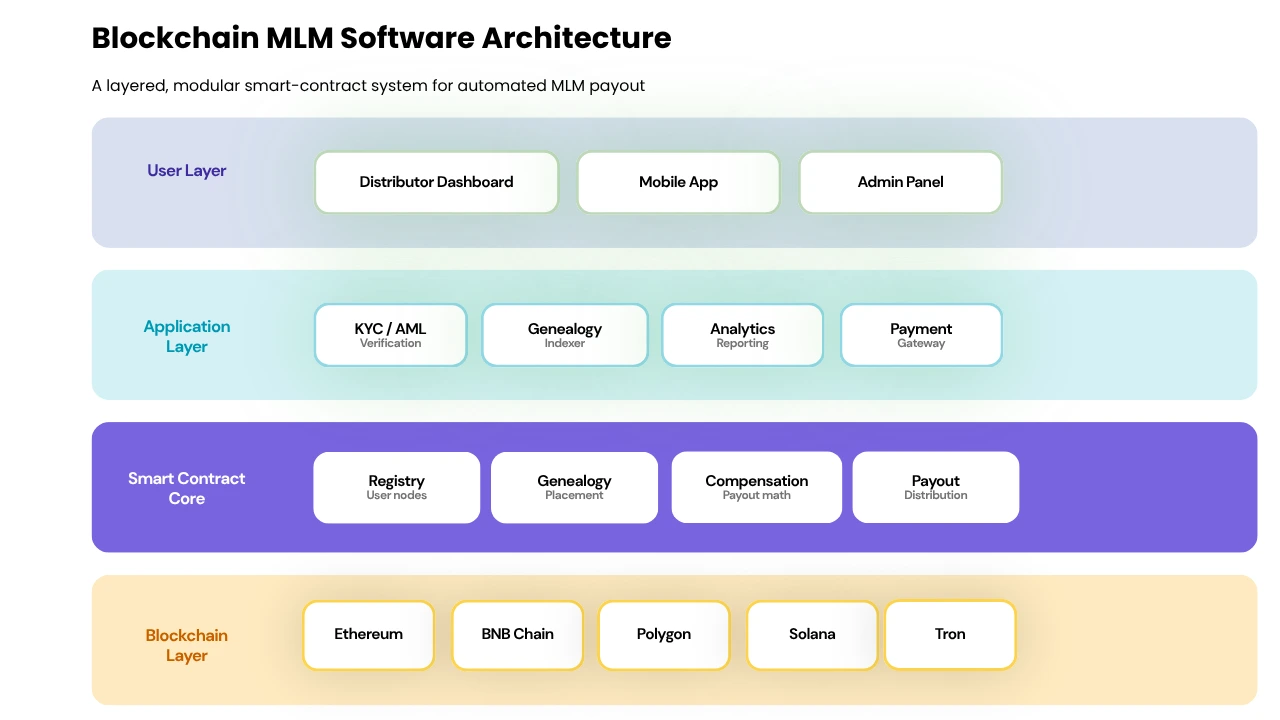
- Genealogy and downline visualization built from on-chain events through an off-chain indexer, so the tree loads fast.
- KYC/AML verification, now effectively mandatory in most serious jurisdictions rather than a nice-to-have.
- Real-time analytics and admin dashboards for network growth, payout configuration, and dispute handling.
- Mobile-first design, since the large majority of distributors log in from a phone.
How Blockchain MLM Software Is Developed: Step by Step
Requirement and Plan Finalization
Lock down the compensation logic first — levels, payout percentages, capping limits, spillover rules, and rank qualifications. Ambiguity here becomes expensive later.
Blockchain and Architecture Selection
Choose the network and design a modular contract structure before writing production code.
Smart Contract Development
Build the core contract that handles registration, referrals, income distribution, and automated payouts, protected against exploits like reentrancy and integer overflow.
Wallet and gateway integration
Connect crypto wallets and a crypto payment gateway so funds move cleanly in and out.
Frontend and Admin Build
Develop the distributor dashboard, onboarding flow, referral tools, and the admin panel for monitoring and control.
Security Audit and testing
Run unit tests across balanced and skewed trees, matrix cycling, and level caps, then commission an independent smart contract audit before mainnet.
Deployment and Support
Launch, run a controlled beta, and provide post-launch support as the network scales.
If you would rather extend your engineering bench than build one, you can hire blockchain developers who have shipped MLM smart contracts before, which shortens the timeline meaningfully.
Choosing the Right Blockchain and Tech Stack
The network you pick shapes your cost, transaction fees, and speed more than almost any other decision.
|
Blockchain |
Best for |
Trade-off |
|---|---|---|
|
Maximum credibility and ecosystem depth |
Higher gas and build cost |
|
|
BNB Chain |
Low fees, mature tooling, fast to build |
Less “premium” brand perception |
|
Cheap, frequent payouts at scale |
Depends on Ethereum ecosystem |
|
|
High throughput, very low fees |
Steeper developer learning curve |
|
|
High-volume, low-fee payouts |
Smaller developer talent pool |
A practical rule: pick the chain where your target distributors already hold crypto. On the stack side, expect Solidity (or Rust for Solana) for contracts, a React or Next.js frontend, Node.js services, and an off-chain indexer for genealogy. If you’re weighing options, our guide on choosing a blockchain platform for your business breaks the decision down further.
Smart Contract Architecture and Security
The stronger builds in 2026 use a modular contract design rather than one giant contract. Responsibilities get split into a registry (user nodes and sponsor relationships), a genealogy module (placement and left/right or matrix positions), and a compensation module (the actual payout math). Separating these makes the system easier to test and lets you upgrade logic through proxy patterns without redeploying everything.
Security is where MLM projects most often get burned. Smart contract exploits have drained hundreds of millions of dollars from crypto platforms — over $300 million was lost to code vulnerabilities in a single year. Non-negotiable protections include reentrancy guards, role-based access control, time-locks on admin functions, multi-signature wallets for withdrawals, and a professional third-party audit before any real money touches the contract. Follow established smart contract security practices and never deploy an unaudited contract to mainnet.
Cost to Develop Blockchain MLM Software
There’s no single price because a crypto MLM platform is an ecosystem, not one product. Cost is driven by compensation plan complexity, blockchain choice, security depth, customization, and where your team sits. Here are realistic 2026 ranges:
|
Build type |
Typical range |
What you get |
|---|---|---|
|
White-label |
$8,000 – $20,000 |
Pre-built platform, single plan, fast branding |
|
MVP / custom starter |
$15,000 – $35,000 |
One compensation plan, standard dashboard, low-fee chain |
|
Mid-tier custom |
$50,000 – $100,000 |
Hybrid plans, custom token, deeper security |
|
Enterprise |
$150,000+ |
Multi-chain, full compliance, advanced analytics |
A few line items people underestimate: an independent security audit adds roughly $5,000–$25,000, and ongoing hosting, upgrades, and support typically run 20–30% of the initial build each year. Building on Ethereum mainnet with custom contracts can add tens of thousands versus deploying on a low-fee chain with proven templates. Hiring a team that has built these systems before — with reusable, pre-audited contract libraries — usually pays for itself by trimming timeline and avoiding costly rebuilds. You can hire dedicated blockchain developers for exactly that reason.
Realistic Development Timeline
A white-label platform can be branded and live in around 4–6 weeks. A focused custom MVP typically takes 3 to 8 weeks depending on plan complexity and whether you need a mobile app. A full custom build with multi-chain support, compliance frameworks, and a native token realistically runs 6 to 12 months. The audit sits after development and before mainnet launch — never skip it to save time.
Regulatory and Compliance Considerations
This is where many crypto MLM projects quietly fail. A large share of countries still lack clear rules for token-based referral programs, and regulators have retroactively applied securities law to platforms that treated referral tokens carelessly. Compliance is not optional overhead; it’s what keeps you operating.
Build in KYC/AML from day one, and align with international AML standards for virtual assets. Be extremely careful with token design — a poorly structured reward token can be classified as a security, so involve legal counsel before launch. In India specifically, direct selling must comply with the Consumer Protection (Direct Selling) Rules, 2021; income that comes primarily from recruitment rather than genuine product sales risks falling foul of the Prize Chits and Money Circulation Schemes (Banning) Act; and crypto gains carry a 30% tax plus 1% TDS on transfers. Covering both global and local rules is something a lot of generic guides skip, and it’s exactly the kind of detail that protects a real business. Our blockchain consulting services can help map the requirements for your target markets.
Honest Risks and Limitations
Blockchain doesn’t magically legitimize an MLM. The sector still carries a reputation problem, and a meaningful share of regulators treat all crypto MLM operations as high-risk, which makes banking and payment partnerships harder to secure. Token volatility can wreck distributor trust unless you settle in stablecoins. Public networks can struggle with the transaction volume large networks generate. And smart contract bugs are permanent once deployed — there’s no “undo.”
None of these are reasons to avoid the model. They’re reasons to build it properly: legitimate product value, conservative token design, a low-fee scalable chain, and a real audit. A platform built on those foundations earns trust the marketing-heavy competitors never do.
Why Build Your MLM Platform With Comfygen
Comfygen is a blockchain and software development company that has shipped crypto and MLM platforms for clients in India and internationally. We treat an MLM build as three problems at once: engineering, economics, and compliance, and we refuse to let any one of them become an afterthought.
Our cryptocurrency MLM software development team encodes your compensation plan into audited smart contracts, integrates secure wallets, and builds the admin and analytics layer you need to actually run the network. When your model calls for its own currency, our crypto token development group handles the token, and teams extending into staking or yield mechanics work with our DeFi development practice. If you would rather scale your own team, you can hire blockchain developers with direct MLM experience.
What sets the work apart is the order of operations: compliance scoping and a security audit gate come before deployment, not after an incident. We build across Ethereum, BNB Chain, Polygon, Solana, and Tron, and we will steer you toward the chain your payout frequency and member geography actually justify. To scope your platform, talk to our team and we will come back with a fixed plan for your requirements.
Conclusion
Blockchain-based MLM software solves the two problems distributors complain about most: slow payouts and opaque commission math. Get the compensation plan right, pick a chain that fits your users, keep token design conservative, take compliance seriously, and audit the contracts before launch. Do those things and you end up with a platform that’s transparent, automated, and genuinely trusted — a real advantage in an industry where trust is the hardest thing to earn.
FAQs
How much does it cost to build blockchain MLM software?
A white-label platform costs $8,000–$20,000, a custom MVP $15,000–$35,000, and enterprise builds $150,000+. Compensation plan complexity, chain choice, and security depth drive the final price.
Which blockchain is best for MLM software?
BNB Chain and Polygon suit frequent low-fee payouts, Ethereum offers maximum credibility, and Solana or Tron handle high-volume networks. Choose the chain where your distributors already hold crypto.
Does cryptocurrency work with binary and matrix plans?
Yes. Binary, matrix, unilevel, board, and hybrid plans all translate into smart contract logic, letting the contract calculate and distribute commissions automatically without manual processing or admin approval.
Is blockchain MLM software legal?
It depends on jurisdiction and structure. It's generally permitted when income comes mainly from genuine product sales rather than recruitment. Build KYC/AML in and consult legal counsel before launch.
How long does development take?
White-label platforms launch in about 4–6 weeks, custom MVPs in 3–8 weeks, and full multi-chain enterprise builds in 6–12 months, with a security audit required before mainnet deployment.

Mr. Saddam Husen, (CTO)
Mr. Saddam Husen, CTO at Comfygen, is a renowned Blockchain expert and IT consultant with extensive experience in blockchain development, crypto wallets, DeFi, ICOs, and smart contracts. Passionate about digital transformation, he helps businesses harness blockchain technology’s potential, driving innovation and enhancing IT infrastructure for global success.