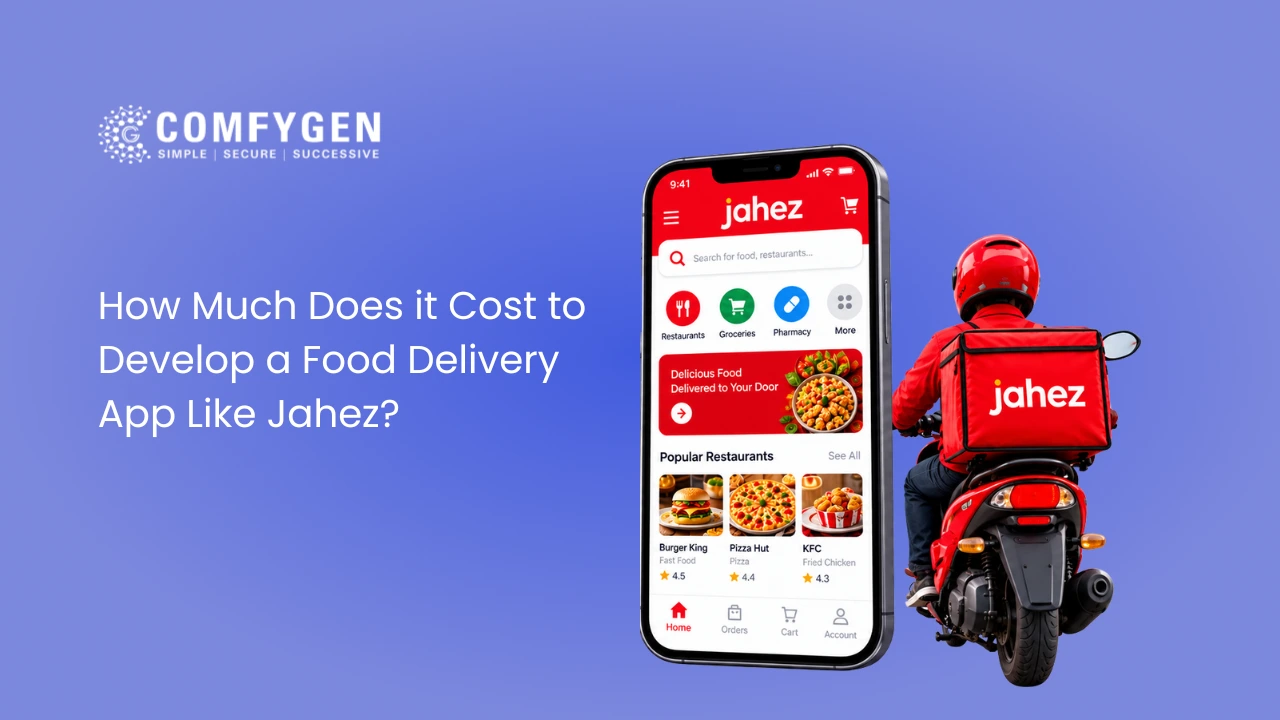





The cost to develop an app like Jahez runs SAR 56,000 to SAR 188,000 or more, which is roughly $15,000 to $50,000 and above. Where you land depends on one decision above all others: whether you launch on a pre-built marketplace platform or build a custom aggregator from scratch. On top of that build, Saudi compliance work adds SAR 30,000 to SAR 90,000, and none of it is optional.
This guide breaks down the app like Jahez development cost in Saudi Riyal rather than dollars, feature by feature. It also covers what most cost guides leave out: Mada integration, ZATCA e-invoicing, PDPL consent flows, Arabic right-to-left design and the commercial licensing you need before launch.
What Does an App Like Jahez Cost to Build?
| Build type | What you get | Cost (SAR) | Approx. USD | Timeline |
| White-label marketplace | Pre-built customer, restaurant and driver apps rebranded as yours, plus an admin dashboard | 56,000 to 94,000 | $15,000 to $25,000 | 3 to 5 weeks |
| Custom MVP | Four apps built to your model, restaurant onboarding, commission engine, live tracking, Mada and multi-payment | 94,000 to 188,000 | $25,000 to $50,000 | 10 to 14 weeks |
| Enterprise aggregator | Multi-city dispatch, AI assignment, POS integrations, own logistics arm | 188,000+ | $50,000+ | 18 to 26 weeks |
| Saudi compliance layer | Mada, STC Pay, ZATCA e-invoicing, PDPL consent flows, Arabic RTL, licensing support | +30,000 to 90,000 | +$8,000 to $24,000 | runs in parallel |
Read those tiers as alternatives, not as a ladder you climb. Each one is a complete, launchable product at a different level of ambition.
Treat the compliance layer as a separate line item too. It applies whichever build type you choose, and it is the line most founders discover late.
Because Jahez is a marketplace rather than a single restaurant chain, most serious builds land in the custom MVP band or above. A genuine aggregator needs restaurant onboarding, per-partner commission logic and vendor dashboards from day one, and those are not features you bolt on later without rework. The feature tables further down show what sits inside each total. They are components of the numbers above rather than costs to add on top of them.
What Makes Jahez Different From a Single-Restaurant App?
Get this distinction right before you look at a single number, because it decides your budget more than your feature wishlist does.
Jahez launched in Riyadh in 2016 and grew into one of the Kingdom’s largest food delivery marketplaces. Hundreds of restaurants list on it, a network of independent drivers fulfils orders, and the company takes a commission on each one. In January 2022 Jahez listed on Nomu, Tadawul’s parallel market, which made it one of the most visible Saudi technology listings of that period.
That model drives four cost centres a single-brand app simply does not have:
- Restaurant onboarding: Self-service signup, menu upload, document verification and approval workflows.
- Commission engine: Per-restaurant rates, tiered deals, automated payouts and reconciliation.
- Vendor dashboards: Every partner needs order management, menu control and their own earnings view.
- Driver supply management: Onboarding, assignment logic, shift handling and driver payouts.
By contrast, a single-brand build like Herfy serves one menu from your own branches, so it skips all four. That is why the same four-app architecture prices differently for the two models even with an identical feature list.
So decide which one you are building first. Then price it.
Why Is Saudi Arabia Worth Building For in 2026?
Smartphone penetration in the Kingdom sits above 95%, the population skews young, and Vision 2030 has pushed digital payment adoption hard through Mada and national wallets. Food delivery is now a default behaviour in Riyadh, Jeddah and Dammam rather than an occasional one.
Globally, the online food delivery market was valued at $319.99 billion in 2025 and is projected to reach $350.63 billion in 2026, growing at roughly 9.58% annually through 2034 (Fortune Business Insights).
For most founders, though, market size matters less than positioning. The Saudi market already has established players, so a new entrant usually wins on a narrower proposition: a specific cuisine category, an underserved city, faster delivery windows, or commission terms that restaurants prefer. Decide what you are better at before you decide what to build.
Which Saudi Requirements Add to Your App Development Cost?
Here is where generic cost guides fall short. Skip these and you risk app store rejection, regulatory fines, or an expensive rebuild six months in.
How Much Does Mada Payment Gateway Integration Cost?
Mada is Saudi Arabia’s national debit network, and a large share of customers pay with it. Visa and Mastercard alone will cost you completed orders. STC Pay and Apple Pay are also widely expected, and cash on delivery still matters in parts of the market. Each gateway is a separate integration with its own certification and testing cycle.
Budget SAR 10,000 to SAR 25,000 for a multi-gateway setup covering Mada, STC Pay, Apple Pay and cards.
Does Your App Need ZATCA E-Invoicing?
If your platform issues tax invoices, and a marketplace taking commission does, ZATCA’s Fatoora rules apply. That means structured invoice formats, QR codes and reporting integration. Building this in from the start costs far less than retrofitting it, so raise it in week one. Confirm the current phase requirements on the ZATCA portal, since the rollout has moved before.
Budget SAR 8,000 to SAR 25,000.
What Does PDPL Compliance Require?
Saudi Arabia’s Personal Data Protection Law governs how you collect, store and process customer data. Your app needs real consent flows, secure storage and data handling that meets SDAIA’s rules. This shapes backend architecture rather than just a privacy policy page.
Budget SAR 6,000 to SAR 20,000.
Is Arabic Support More Than Translation?
Yes. Arabic needs full right-to-left layout support on every screen, including menus, cart flows, maps and receipts. Bilingual Arabic and English is the norm in the Kingdom, and switching between them must not break your layout. Treat it as a design and engineering task from the first wireframe.
Budget SAR 6,000 to SAR 20,000.
What Licensing Do You Need to Operate?
A delivery marketplace needs the right commercial registration and sector approvals, and the requirements differ depending on whether you employ drivers or work with independent contractors. Factor in legal advice, and plan your cloud setup around data residency expectations early, because migrating later is costly.
Budget SAR 5,000 to SAR 15,000 for setup support.
What Features Does a Jahez-Style Marketplace Need?
These are the features that make the app work at launch. Everything in the next table is an upgrade.
| Feature | What it does | Cost (SAR) |
| Registration and login | Phone, email and social sign-in with OTP | 6,000 to 12,000 |
| Restaurant discovery and search | Browse by cuisine, area, rating and delivery time | 10,000 to 20,000 |
| Multi-restaurant menu system | Each partner manages categories, items, prices and images | 14,000 to 30,000 |
| Cart and checkout | Add, edit and confirm orders with address handling | 8,000 to 16,000 |
| Payment gateway (Mada plus cards) | Accept the methods Saudi customers actually use | 10,000 to 25,000 |
| Order management and history | Place orders, track status, reorder past ones | 8,000 to 16,000 |
| Restaurant onboarding workflow | Self-service signup, document checks, approval queue | 14,000 to 32,000 |
| Commission engine | Per-partner rates, automated payouts, reconciliation | 16,000 to 38,000 |
| Driver app with order assignment | Accept, pick up and deliver with navigation | 25,000 to 55,000 |
| Push notifications | Order updates, offers, driver alerts | 4,000 to 9,000 |
| Admin panel | Manage partners, drivers, orders, pricing and disputes | 18,000 to 40,000 |
Launch with this set and you have a functioning marketplace earning commission on real orders.
Make Every Investment Count in Your Food Delivery App
Find out what affects development costs and how to allocate your budget for a reliable, feature-rich food delivery platform.
Get a Development Quote
Which Advanced Features Raise the Food App Like Jahez Development Cost?
| Feature | Value to your business | Cost (SAR) |
| Live GPS tracking | Customers see the driver, so support calls drop | 12,000 to 30,000 |
| AI order assignment | Lower delivery times and better driver utilisation | 20,000 to 50,000 |
| Loyalty and rewards | More repeat orders and higher lifetime value | 15,000 to 35,000 |
| In-app wallet | Faster checkout and prepaid balance | 15,000 to 32,000 |
| Subscription plan | Predictable revenue from free-delivery members | 14,000 to 32,000 |
| Scheduled orders | Captures planned and office-lunch demand | 8,000 to 18,000 |
| Multi-city dispatch zones | Expansion without rebuilding logistics | 18,000 to 45,000 |
| POS integration | Orders land directly in restaurant systems | 20,000 to 55,000 |
| Ratings and reviews | Social proof and quality signals | 8,000 to 18,000 |
| Analytics dashboard | Track orders, partners, peak hours and margins | 14,000 to 32,000 |
You do not need all of these at launch. For a new aggregator, live tracking and a working analytics dashboard usually return the most in the first six months, since one reduces support load and the other tells you which partners to keep.
What Technology Stack Suits a Saudi Food Delivery Marketplace?
| Layer | Common choices |
| Frontend (cross-platform) | Flutter, React Native |
| Frontend (native) | Swift for iOS, Kotlin for Android |
| Backend | Node.js, Python (Django), Laravel |
| Database | PostgreSQL, MongoDB |
| Cloud and hosting | AWS, Google Cloud, Firebase |
| Real-time tracking | Firebase, WebSockets |
| Maps and routing | Google Maps API |
| Payments (Saudi) | Mada, STC Pay, HyperPay, PayTabs, Moyasar, Apple Pay |
| Notifications | Firebase Cloud Messaging |
For most Saudi marketplace builds, Flutter on the front with Node.js on AWS gives fast delivery, lower cost and room to scale. Cross-platform development cuts frontend cost by 30% to 40% compared with building native twice, which matters most across four separate apps.
How Long Does It Take to Build an App Like Jahez?
| Build type | Design | Development | Testing | Total |
| White-label marketplace | 1 week | 2 to 3 weeks | 1 week | 3 to 5 weeks |
| Custom MVP | 2 to 3 weeks | 6 to 9 weeks | 2 weeks | 10 to 14 weeks |
| Enterprise aggregator | 4 to 6 weeks | 12 to 17 weeks | 2 to 4 weeks | 18 to 26 weeks |
Compliance work runs alongside development rather than after it. ZATCA and PDPL requirements shape your backend schema, so they belong in the first sprint rather than the last.
What Does It Cost to Run the App After Launch?
| Cost item | Frequency | Cost (SAR/year) |
| Hosting and cloud | Monthly | 10,000 to 50,000 |
| Bug fixes and updates | Ongoing | 18,000 to 60,000 |
| OS compatibility updates | Yearly | 10,000 to 30,000 |
| Payment gateway fees | Per transaction | 1% to 2.75% per order |
| App Store and Play fees | Yearly / one-time | ~375 (Apple), ~95 (Google) |
| Driver and partner support | Monthly | varies with order volume |
Plan for 15% to 20% of build cost per year. A marketplace sits at the upper end of that range, because you are supporting restaurants and drivers as well as customers.
How Does a Jahez-Style App Make Money?
- Restaurant commission: The core model. A percentage of every order placed through your platform.
- Delivery fees: Charged to the customer, often waived above a minimum basket to lift order value.
- Partner subscriptions: A monthly fee for better placement, analytics or lower commission.
- In-app advertising: Featured listings and sponsored placements for restaurants.
- Customer membership: A paid tier offering free delivery and member pricing.
- Surge and peak pricing: Higher delivery fees during demand spikes.
Most aggregators run three or four of these at once. Commission alone rarely covers unit economics in the first year, so decide early which secondary stream you will build.
How Can You Reduce the Cost to Develop an App Like Jahez?
Start with one city: Multi-city dispatch logic is expensive and pointless before you have density in a single market.
Launch with fewer partners, not fewer features: Twenty strong restaurants with reliable fulfilment beat two hundred that cannot keep up. Partner count costs you operations, not code.
Use cross-platform development: Across four apps, the 30% to 40% frontend saving is significant.
Pick a white-label base if your model is standard: Custom development earns its cost when your commission structure, dispatch logic or vertical is genuinely different. If it is not, a pre-built platform gets you live in weeks.
Build compliance from day one: Retrofitting Mada, ZATCA and Arabic RTL costs considerably more than including them, and every founder who has done it the other way agrees.
Work with a team that has shipped in the Kingdom: Payment certification, Arabic design and ZATCA integration all go faster with someone who has done them before. Ask for case studies, and compare at least three teams before you commit.
Why Build Your Jahez Alternative With Comfygen?
Comfygen has delivered 550+ projects for 400+ clients across 30+ countries since 2019, with a 97% client retention rate. For Gulf food delivery work specifically, the team has shipped marketplace builds with Mada and STC Pay certification, ZATCA-compliant invoicing and Arabic-first interfaces designed right to left from the wireframe stage rather than translated afterwards.
Every build ships four connected products: a customer app, a restaurant app, a driver app and a web admin panel. Projects run in two-week sprints with a working demo at the end of each, and full source code ownership transfers on delivery with no licence fee. Founders scoping a multi-restaurant delivery platform with their own commission structure usually start with a scoping call before any code is written, and teams comparing Gulf markets often look at how the same build prices in AED for a Talabat-style launch alongside the Saudi numbers above.
Frequently Asked Questions
How much does it cost to develop an food delivery app like Jahez?
How long does it take to build an app like Jahez?
What is included in a Jahez clone app development project?
Why does a marketplace cost more than a single-restaurant app?
Do I need Mada support in a Saudi food delivery app?
How much does Mada payment gateway integration cost?
Does my app need ZATCA e-invoicing?
What are the ongoing costs after launch?

Mr. Saddam Husen, (CTO)
Mr. Saddam Husen, CTO at Comfygen, is a renowned Blockchain expert and IT consultant with extensive experience in blockchain development, crypto wallets, DeFi, ICOs, and smart contracts. Passionate about digital transformation, he helps businesses harness blockchain technology’s potential, driving innovation and enhancing IT infrastructure for global success.