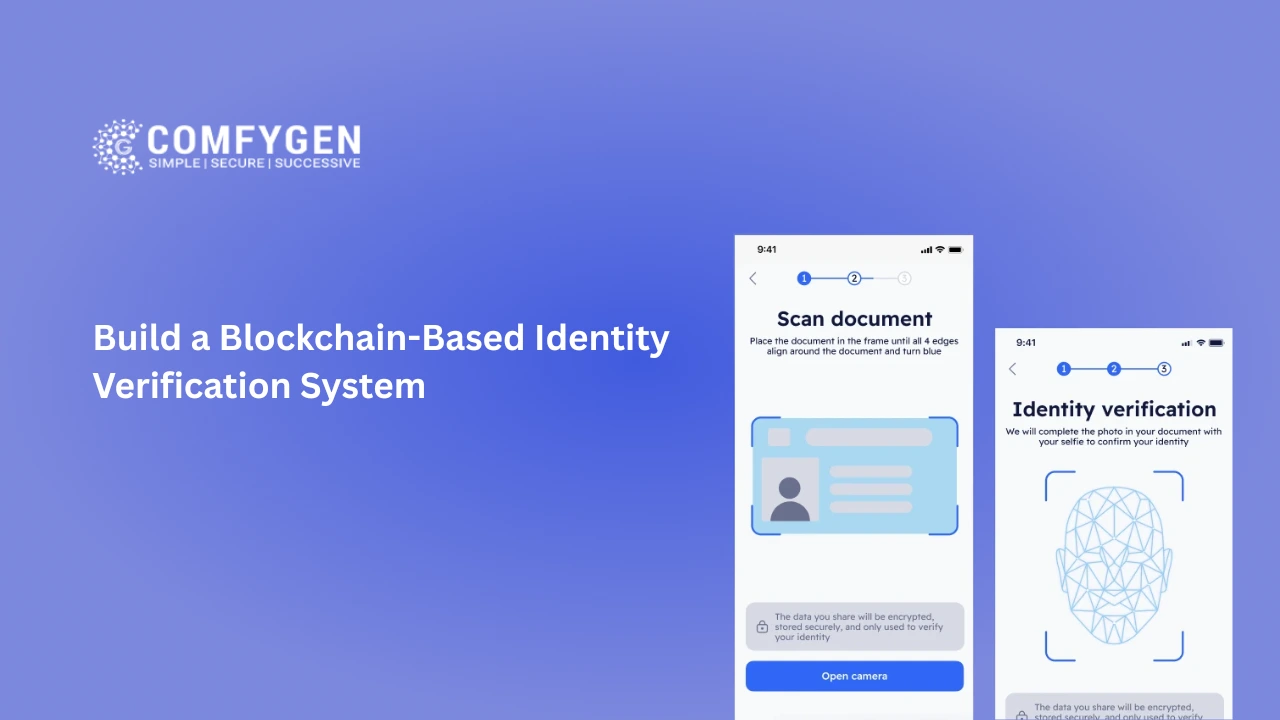





From decentralized identifiers and verifiable credentials to real-world implementation in healthcare, supply chain, and government — everything decision-makers need to evaluate, build, and deploy blockchain identity management systems. Blockchain technology offers a revolutionary solution to these challenges by providing a secure, transparent, and tamper-proof system for managing digital identities. This blog will guide you through the process of building a blockchain-based identity verification system and explain how it enhances security and efficiency in digital identity management.
Why Traditional Identity Systems Are Failing — And Why Blockchain Is the Fix
Identity fraud cost businesses and consumers over $43 billion globally in 2023, and the problem is accelerating. The root cause isn’t a lack of security tools — it’s a fundamental architectural flaw: centralized identity management puts an enormous amount of sensitive personal data in one place, creating a single point of failure that adversaries actively target.
Centralized identity management systems — used by governments, banks, hospitals, and enterprises — store usernames, biometric data, national ID numbers, and financial records in monolithic databases. When those databases are breached, the damage is catastrophic and irreversible. A blockchain-based identity verification system solves this by changing the architecture entirely: instead of one database that can be seized, there is a distributed network where no single actor holds all the keys.
Key Insight
Centralized identity systems have three critical weaknesses: they are a single point of failure, they give users no ownership over their own data, and they require expensive intermediaries (like KYC vendors) to function. Blockchain eliminates all three simultaneously.
How Blockchain-Based Identity Verification Works
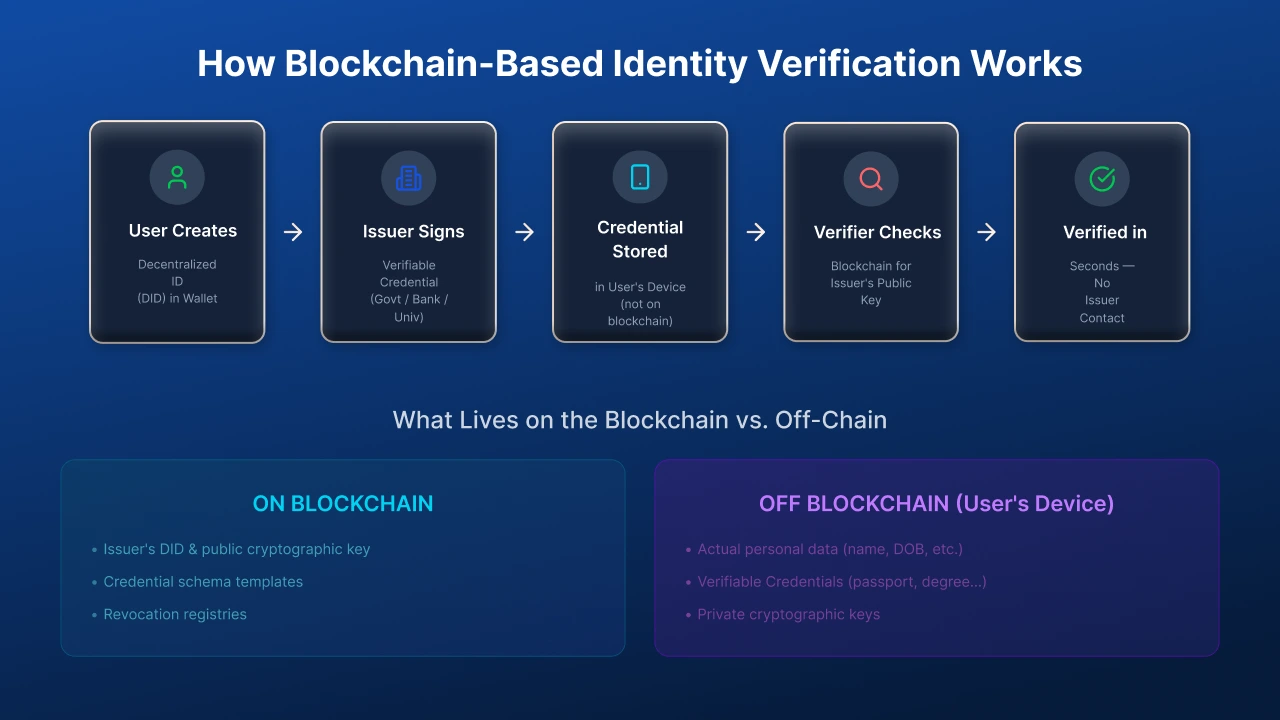
At its core, a blockchain-based identity verification system operates on three interlocking concepts: a distributed ledger, cryptographic proof, and user-controlled credentials. Understanding these is the foundation for everything else.
A blockchain is a shared, append-only ledger replicated across thousands of nodes. Every participant in the network holds an identical copy, and adding a new record requires consensus from the majority of nodes. This means no single entity — not a government, bank, or technology company — can unilaterally alter or delete identity records. The combination of cryptographic hashing and consensus makes the record tamper-evident by design.
Unlike what many people assume, no personal data is ever stored on the blockchain itself. What is stored is the issuer’s public cryptographic key and a DID document. Personal identity data — names, biometrics, dates of birth — lives encrypted on the user’s own device (a digital identity wallet). When a verifier needs to confirm someone’s credential, they check the blockchain only to confirm that the issuer’s signature is legitimate. The verification happens in seconds, without contacting the issuer directly.
Ready to revolutionize identity verification with blockchain?
Decentralized Identifiers (DIDs) & Verifiable Credentials Explained
Decentralized Identifiers are the foundational primitive of blockchain identity management. A DID is a globally unique string — similar to a web URL — that is generated by the user, stored in their wallet, and anchored to a blockchain. Unlike a username or email, a DID is owned by no external party. It cannot be revoked, sold, or censored by a platform. It looks something like this:
did:dock:5FxpTaCE6aH1aEBTwVS5E…qMV2r7s
A DID resolves to a DID Document — a JSON-LD file containing the public key(s) needed for cryptographic verification, service endpoints, and authentication methods. This document is what gets anchored on-chain.
Verifiable Credentials (VCs) are the digital equivalent of physical documents — passports, driver’s licenses, degrees, employment records — that are cryptographically signed by an authoritative issuer. A VC is bound to the holder’s DID and stored in their identity wallet. When a verifier requests proof, the holder presents the VC, and the verifier uses the issuer’s public key (retrievable from the blockchain) to instantly confirm authenticity without any back-and-forth with the issuing organization.
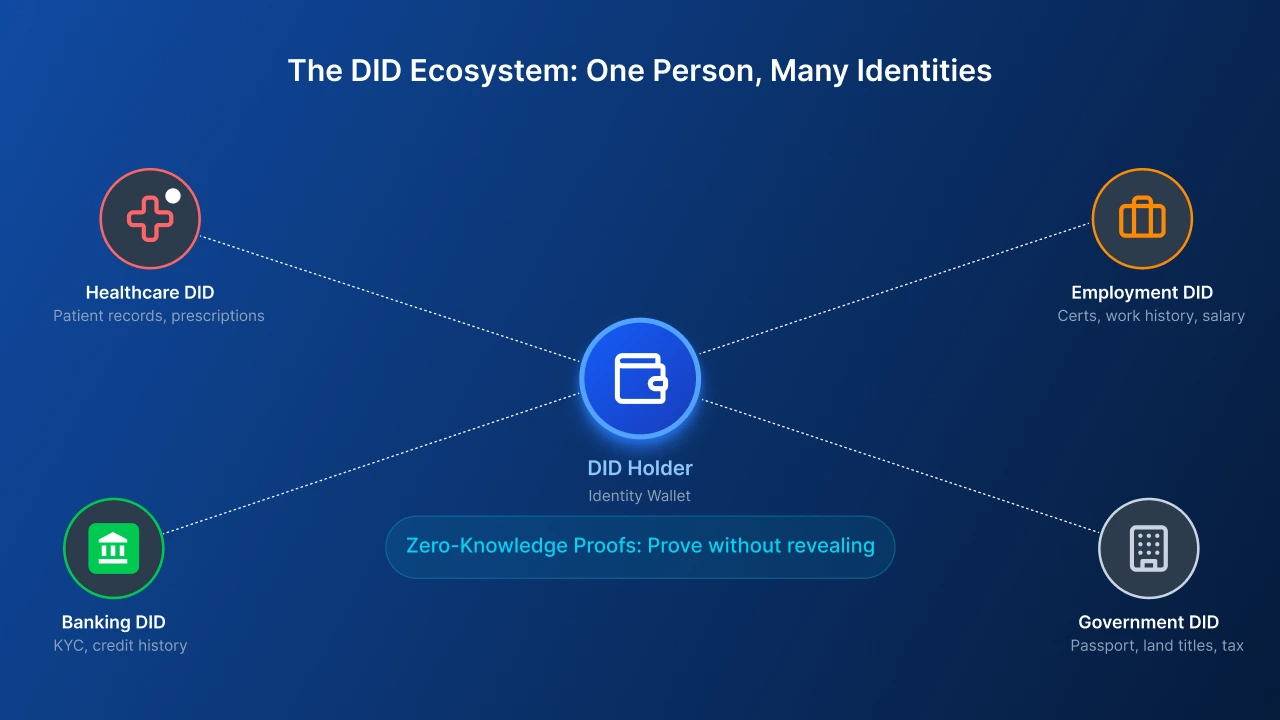
A person can hold as many DIDs as they need — one for healthcare, one for banking, one for government services, one for employment — each compartmentalizing that context’s data. This prevents the correlation attacks that are common with single-account systems. Moreover, with Zero-Knowledge Proofs (ZKPs), a holder can prove a claim (e.g., “I am over 21”) without revealing the underlying data (their actual birthdate). This is mathematically impossible with traditional identity systems.
- W3C DID Standard
- Verifiable Credentials 2.0
- Zero-Knowledge Proofs
- BBS+ Signatures
- Selective Disclosure
- DIDComm Protocol
How Blockchain Technology Enhances Identity Verification
Blockchain provides a unique advantage for identity verification because of its core features:
- Decentralization: Unlike centralized systems, blockchain distributes identity information across a network of computers. This reduces the risk of single points of failure and increases resilience against fraud.
- Immutability: Once data is added to a blockchain, it cannot be altered or deleted. This ensures the integrity of the identity data, providing a secure and reliable record.
- Transparency: Blockchain ensures full transparency in transactions, allowing users to verify the authenticity of their identity without compromising privacy.
These features make blockchain technology an ideal choice for creating secure identity verification systems.
Self-Sovereign Identity: Giving Control Back to Users
Self-Sovereign Identity (SSI) is the philosophical and technical framework that underpins most modern blockchain identity solutions. It asserts that individuals — not corporations or governments — should be the primary custodians of their own identity data.
SSI has three core pillars: the Issuer (e.g., a government agency, university, or bank that signs credentials), the Holder (the individual who receives and stores credentials in their wallet), and the Verifier (any entity that needs to confirm the holder’s claims). No intermediary sits between these three parties — the blockchain replaces the trusted third party.
Why This Matters for Enterprises
For businesses, SSI reduces KYC costs dramatically. Once a user has been verified by one trusted issuer (e.g., a licensed KYC provider), that verified credential can be reused across multiple services — eliminating redundant verification overhead estimated at $1.6B annually in AML/KYC spending globally.
Blockchain Identity System Architecture: What a Production Build Looks Like
Understanding the conceptual model is one thing; knowing what a production-grade blockchain-based identity management system looks like in practice is what separates informed decisions from costly mistakes. Here is the reference architecture Comfygen uses for enterprise deployments.
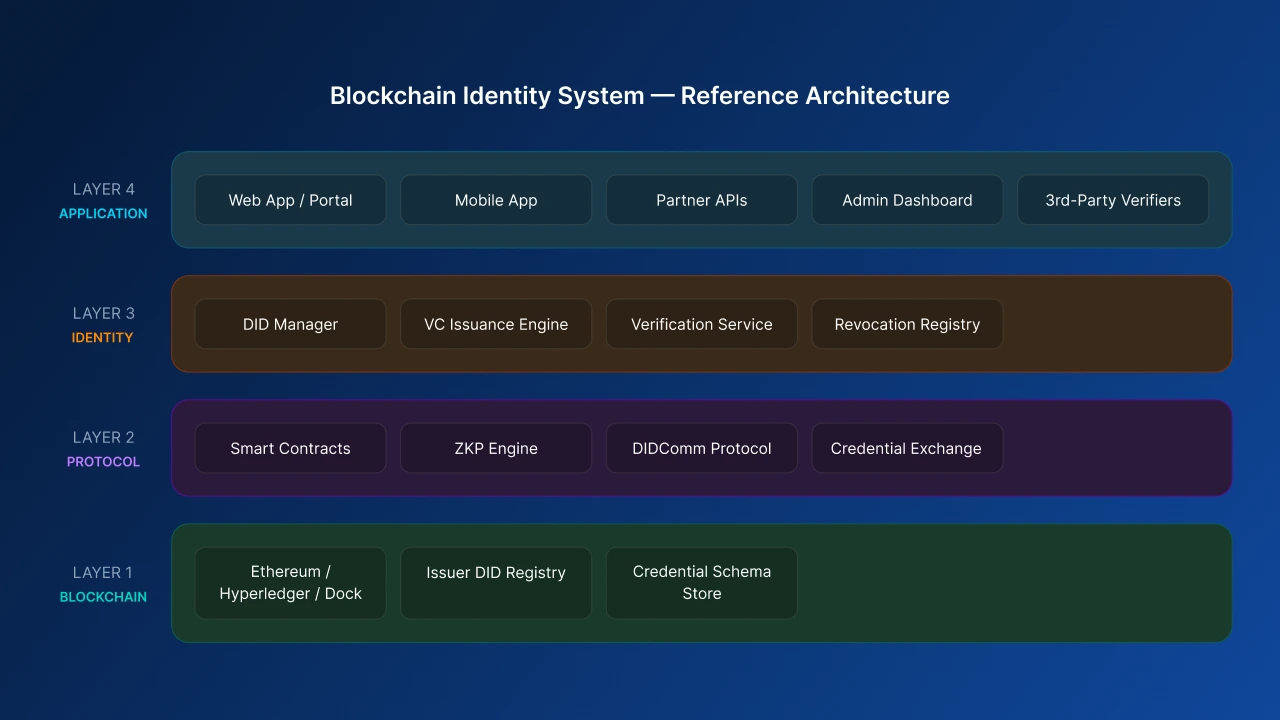
Key Architectural Components
Each layer serves a distinct purpose. The blockchain layer (Layer 1) provides the immutable foundation: DID registries, credential schemas, and revocation lists. Above it, the protocol layer handles the cryptographic machinery — smart contracts automate credential lifecycle, Zero-Knowledge Proof engines enable selective disclosure, and DIDComm handles encrypted peer-to-peer messaging between wallets.
The identity services layer exposes the business logic: a DID manager creates and rotates keys, the VC issuance engine packages and signs credentials, and the verification service handles presentation requests. Finally, the application layer is where your end-users interact — web portals, mobile apps, and third-party integrations all consume the identity services via standard APIs.
Develop a Blockchain-Based Identity Verification System: Step-by-Step Implementation Guide
Building a production-grade blockchain-based identity management system is a multi-phase engineering effort. Here is the implementation roadmap Comfygen follows for enterprise clients.
Define Identity Requirements & Threat Model
Before selecting a blockchain development company, map your identity use cases: who are your issuers, who are your holders, what claims need verification? Identify your threat model — are you defending against external attackers, insider fraud, or both? This step defines your compliance requirements (GDPR, HIPAA, eIDAS) and informs every downstream decision.
Select the Right Blockchain Platform
Ethereum blockchain is the most interoperable choice with the broadest developer ecosystem and ERC-725 identity standard support. Hyperledger Fabric is ideal for permissioned enterprise deployments where all participants are known. Polygon offers Ethereum compatibility at significantly lower gas costs. Dock Network is purpose-built for decentralized identity with native DID and VC support. Your selection should be driven by transaction throughput needs, cost per verification, and whether you need a public or permissioned network.
Implement DID Method & Key Management
Choose or create a DID method (e.g., did:ethr, did:web, did:dock) and design your key management infrastructure. Critically, implement key rotation — users must be able to update their cryptographic keys without losing their DID. Hardware Security Modules (HSMs) should be used for issuer key storage in high-assurance environments.
Build the Verifiable Credential Issuance Pipeline
Design credential schemas aligned with W3C VC 2.0 and schema.org vocabulary for interoperability. Implement the issuance flow: issuer authenticates, signs the VC with their private key, and delivers it to the holder’s wallet. Build status management — credentials need to be revocable when employment ends or a license expires.
Deploy Smart Contracts for Lifecycle Automation
Write and audit smart contracts to handle DID registration, credential schema anchoring, and revocation registry management. Use established contract patterns (OpenZeppelin) and conduct formal security audits before mainnet deployment. Test extensively on testnets.
Build the Identity Wallet Application
The wallet is your user-facing product. It must support DID creation, VC storage, presentation request handling, and offline verification capability. Consider using an open standard like the Universal Wallet 2020 spec for portability. Build with biometric unlock and encrypted local storage.
Integrate Verification APIs & Go Live
Expose verification as an API that verifier applications can integrate via REST or GraphQL. Implement presentation request flows (using DIF Presentation Exchange), handle selective disclosure, and build the verifier dashboard. Run a controlled pilot with real users before full rollout.
Ready to Build Your Blockchain Identity System?
Comfygen’s blockchain team has delivered identity infrastructure for healthcare, fintech, and government clients. Let’s scope your project.
Get a Free Consultation
Real-World Use Cases: Where Blockchain Identity Solutions Deliver the Most Value
The best way to understand the commercial impact of blockchain identity solutions is through specific industry applications. Below we cover the four highest-impact sectors with granular detail that goes well beyond surface-level descriptions.
Blockchain Identity Solutions in Healthcare
Blockchain identity solutions in healthcare address three acute problems simultaneously: patient misidentification (which causes an estimated 250,000 deaths per year in the US alone), credential fraud by medical staff, and HIPAA compliance overhead.
With a blockchain identity system, every patient receives a DID anchored to a permissioned healthcare blockchain. Their health records — across hospitals, laboratories, specialists, and pharmacies — are linked to this DID as Verifiable Credentials. When a patient moves to a new provider, they share their credential directly from their phone — no fax, no physical records transfer, no waiting weeks for records requests. The provider verifies the authenticity cryptographically in seconds.
For medical professionals, credentials issued by licensing boards (e.g., medical licenses, DEA numbers, board certifications) can be anchored as VCs. A hospital’s credentialing department can verify a physician’s entire credential history in minutes rather than the industry-standard 120 days. This directly addresses the $30B+ cost of medical credentialing delays in the US annually.
“The combination of blockchain immutability and verifiable credentials creates an identity infrastructure that is simultaneously more secure, more private, and more efficient than anything that has come before it in healthcare.”
Blockchain Identity Management in Supply Chain: Deep Dive
Blockchain identity management in supply chain works by assigning a DID to every entity in the chain — manufacturers, logistics providers, distributors, and retailers — and to every product batch. As goods move through the chain, each stakeholder adds a Verifiable Credential to the product’s DID: certification of origin, temperature compliance, customs clearance, quality inspection results.
When contamination is detected in a food product, traditional recall processes require discarding entire product lines because origin cannot be traced precisely. With blockchain identity data management, the contaminated batch can be traced to the specific farm, processing facility, and distribution route within minutes — isolating the problem and dramatically reducing recall scope. The World Economic Forum estimates blockchain-based supply chain tracking could recover $31B in value lost to fraud, counterfeiting, and theft annually.
For luxury goods, each product receives a DID at manufacture. The consumer can scan a QR code at point of sale and instantly verify the product’s journey from raw material to store shelf, eliminating the counterfeit market that costs the fashion industry alone over $450B per year.
Managing Government Registries with Blockchain
Government identity applications represent some of the most high-stakes deployments of blockchain technology. Managing government registries with a blockchain-based system transforms processes that currently take weeks of bureaucratic overhead into near-instant digital transactions with cryptographic audit trails.
Land title registration is a particularly compelling use case. In many countries, land title fraud costs billions annually and disproportionately affects vulnerable populations. When land titles are managed on a blockchain, transfer requires multi-party digital signatures (buyer, seller, and registrar), is timestamped immutably, and is immediately visible to all authorized parties. Countries including Georgia, Honduras, and Sweden have piloted blockchain land registries with significant reductions in fraud and processing time.
National digital identity programs — like the EU’s eIDAS 2.0 regulation — are mandating that member states provide citizens with digital identity wallets. Blockchain provides the trust infrastructure for these programs, allowing citizens to use a single verifiable identity across government services, banking, and healthcare without creating a central surveillance database.
Financial Services & KYC Reuse
A KYC verification completed at one bank can be issued as a VC and reused across the financial ecosystem, eliminating $1.6B in annual redundant verification costs while maintaining rigorous compliance standards.
Blockchain Security Architecture & Threat Mitigation
A blockchain-based identity verification system is architecturally more secure than centralized alternatives, but it is not magic. It introduces new attack surfaces that must be understood and mitigated.
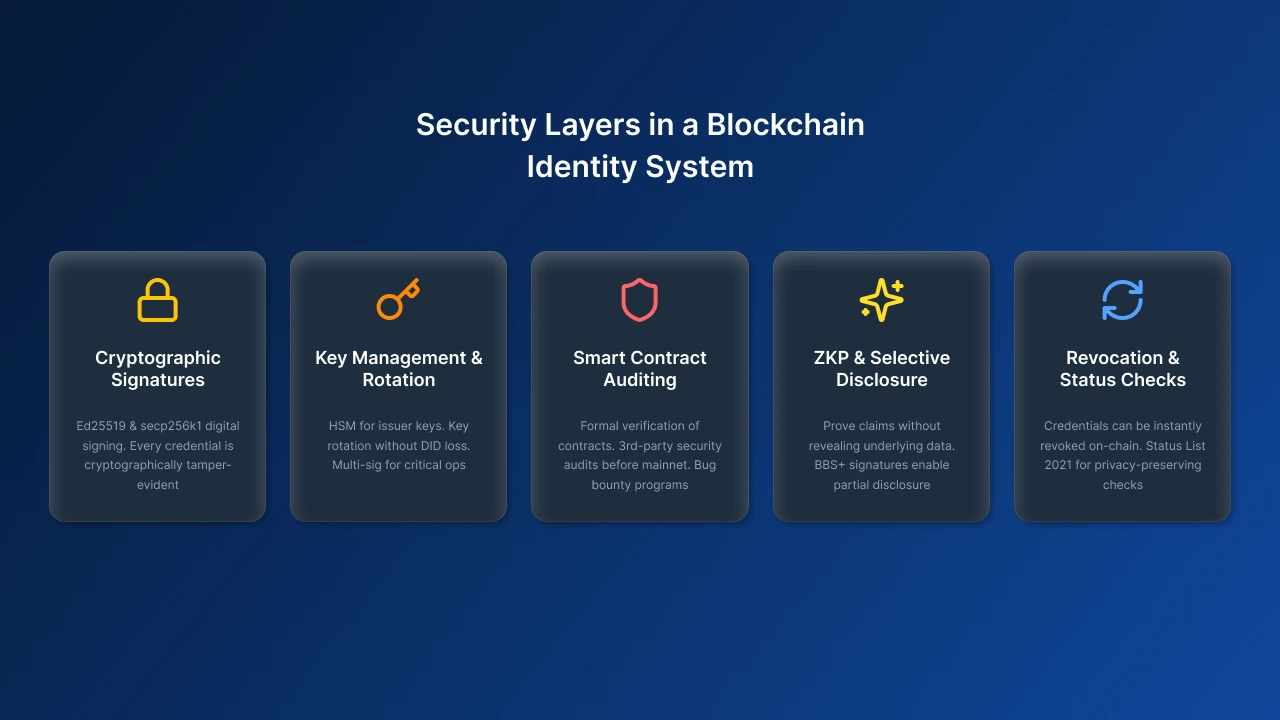
The most common attack vectors in blockchain identity systems are not on the chain itself — they target the edges. Wallet compromise (malware on the user’s device) is the primary risk; mitigation requires biometric authentication, device binding, and wallet backup recovery mechanisms.
Sybil attacks — creating many fake identities — are addressed by requiring issuers to do proper due diligence before signing credentials. Smart contract bugs are mitigated through formal verification, independent audits, and upgrade patterns.
Regulatory Compliance in Blockchain Identity Verification: GDPR, HIPAA, CCPA & eIDAS
Compliance is often cited as a barrier to blockchain adoption, but a properly architected blockchain-based identity management system is actually more compliant than its centralized counterparts.
GDPR compliance is achieved through the fundamental architectural principle that no PII is stored on-chain. The “right to be forgotten” is satisfied because all personal data lives in the user’s wallet — deleting the wallet erases the data. Data minimization is built into the ZKP and selective disclosure capabilities. Consent is cryptographically enforced: a VC cannot be shared without the holder actively presenting it.
HIPAA compliance in healthcare deployments requires that PHI (Protected Health Information) be encrypted at rest and in transit, that access is auditable, and that business associate agreements are in place with all service providers. Blockchain provides the audit trail natively; encryption is handled at the wallet and transport layer.
eIDAS 2.0, the EU’s updated digital identity regulation, explicitly supports decentralized identity wallets and Verifiable Credentials based on W3C standards. Organizations building blockchain identity solutions in Europe should align their implementation with the Architecture Reference Framework published by the EU Digital Identity Wallet Consortium (EUDI).
Blockchain vs. Traditional Identity: Full Comparison
|
Dimension |
Traditional Centralized Identity |
Blockchain-Based Identity
|
|---|---|---|
| Data Storage | Central database (single point of failure) | User’s device; anchors only on blockchain |
| Breach Risk | High — millions of records in one breach | Minimal — attacker must compromise millions of devices |
| User Data Ownership | Platform-controlled; shared without consent | User owns and controls all personal data |
| Verification Speed | Hours to days (manual processes, back-channel calls) | Seconds (cryptographic, no issuer contact needed) |
| KYC Re-verification | Required at every new organization | Verified once, reused everywhere via VC |
| Selective Disclosure | Not possible — share all or nothing | Share only what’s needed (ZKP, BBS+) |
| GDPR “Right to Forget” | Difficult — data scattered across systems | Native — user deletes wallet, data is gone |
| Cross-Border Portability | Jurisdiction-dependent, manual re-verification | Globally verifiable via cryptographic standards |
| Cost (at scale) | $1.6B+ annually in KYC/AML globally | 90%+ cost reduction via credential reuse |
| Audit Trail | Optional, often incomplete | Immutable, complete, cryptographically verifiable |
Challenges & How Serious Teams Overcome Them
Intellectual honesty requires acknowledging that blockchain identity solutions face real implementation challenges. Here is a frank assessment and the mitigation strategies that experienced teams deploy.
Scalability
Public blockchains like Ethereum mainnet can be slow and expensive during congestion. The solution is multi-layered: use Layer 2 solutions (Polygon, Optimism) for transaction-heavy operations, keep on-chain anchors minimal (only DIDs and schemas, not credentials), and consider permissioned chains (Hyperledger Fabric) for enterprise deployments where throughput is critical.
Key Recovery & Loss
If a user loses their private key, they lose access to their DID and all associated credentials. This is the primary UX challenge of self-sovereign identity. Mitigation approaches include social recovery (trusted contacts can co-sign recovery), threshold cryptography (Shamir’s Secret Sharing), and hardware key backup devices. Designing a robust recovery mechanism is arguably the most important UX decision in any SSI implementation.
Interoperability
The fragmented landscape of DID methods and VC implementations creates interoperability risks. Align your implementation with W3C DID Core 1.0 and W3C VC 2.0 standards, use the DIF Universal Resolver for cross-DID-method resolution, and participate in standards bodies (W3C CCG, DIF, IETF) to stay ahead of the curve.
Adoption & Change Management
Even a technically superior system fails without adoption. Deploy blockchain identity as an enhancement to existing workflows, not a replacement requiring users to change everything. Offer traditional identity fallbacks during the transition period. Run pilot programs with motivated early adopters before broad rollout.
The Future of Digital Identity Blockchain
The digital identity blockchain market is at an inflection point. Several converging trends will shape the next five years of development.
AI Agent Identity (KYA — Know Your Agent) is an emerging frontier. As AI agents increasingly take actions on behalf of humans — booking appointments, executing transactions, representing organizations — they need verifiable, auditable identities of their own. Blockchain-based identity frameworks are uniquely positioned to provide this, with AI agents receiving DIDs that constrain what they can and cannot do, and creating an immutable audit trail of every action taken.
Government mandates are accelerating adoption. The EU’s eIDAS 2.0 requires member states to provide every citizen with a digital identity wallet by 2026. The US is piloting mobile driver’s license (mDL) programs across 30+ states. These programs are creating the regulatory framework and public infrastructure that enterprise blockchain identity solutions can build upon.
Biometric-bound credentials are closing the last remaining security gap: proving that the person presenting a credential is the same person who received it. By binding a VC to a biometric hash at issuance, and verifying biometrics at presentation, the system becomes resistant to credential theft and sharing.
The blockchain identity management market is projected to grow at 56.6% CAGR from 2022 to 2030, reaching $17.81B. North America currently leads adoption, but Asia-Pacific is growing fastest, driven by government digital identity initiatives in India, Singapore, and South Korea.
Partner with Comfygen for Your Blockchain Identity Project
Conclusion
Building a blockchain-based identity verification system in 2026 is not only a smart move but a necessary one to address growing concerns about privacy, security, and data integrity. By leveraging blockchain technology, you can create a robust, scalable, and secure identity verification system that empowers users while ensuring compliance with regulations. With the right blockchain platform, smart contracts, and security measures in place, you can build an identity system that meets the needs of tomorrow’s digital world.
Ready to Upgrade Your Identity Infrastructure?
Stop relying on outdated systems that expose your business to fraud and inefficiencies. Whether you’re in healthcare, fintech, or government, blockchain identity solutions can transform how you manage trust and data.
Book Your Free Consultation Now–>
Email: sales@comfygen.com
WhatsApp No.: +91-9587867258
FAQs
What is a blockchain-based identity verification system and how is it different from traditional identity?
A blockchain-based identity verification system stores identity anchors (not personal data) on a distributed ledger and uses cryptographic proofs to verify credentials. Unlike traditional systems that centralize PII in databases controlled by institutions, blockchain identity puts the user in control — their data lives in their own wallet, and verification happens through math, not intermediaries. This eliminates single points of failure, reduces breach risk dramatically, and enables privacy-preserving verification.
What are Decentralized Identifiers (DIDs) and why do they matter?
Decentralized Identifiers are globally unique identifiers created and controlled by the user — not by any platform or authority. Unlike email addresses or usernames that can be revoked by a provider, DIDs are cryptographically owned by the holder. They anchor a DID Document on-chain containing the public keys needed for verification, enabling any party in the world to verify the holder's credentials without contacting a central authority.
Is personal data stored on the blockchain in these systems?
No — and this is a critical design principle. Personally identifiable information is never stored on the blockchain. Only the issuer's public key, DID Document, credential schemas, and revocation registries go on-chain. All personal data stays in the user's encrypted identity wallet on their device. This design satisfies GDPR's data minimization and right-to-be-forgotten requirements.
Which blockchain platform is best for identity management?
It depends on your requirements. Ethereum offers the broadest ecosystem and interoperability; Hyperledger Fabric is preferred for permissioned enterprise deployments with known participants; Polygon gives Ethereum compatibility with lower costs; purpose-built identity chains like Dock offer native DID/VC support with optimized performance. Comfygen recommends evaluating throughput requirements, cost tolerance, interoperability needs, and regulatory constraints before selecting a platform.
How does blockchain identity verification help with GDPR compliance?
Blockchain identity systems are architecturally aligned with GDPR's core principles. No PII on-chain satisfies data minimization. User-controlled credential sharing enforces consent. ZKP and selective disclosure enable purpose limitation. Wallet deletion satisfies the right to be forgotten. And the decentralized architecture reduces the data breach risk that is the most common source of GDPR penalties.
What is the cost of building a blockchain identity system?
Blockchain-based identity management project costs vary widely based on scope, blockchain platform, number of credential types, and integration complexity. A minimum viable blockchain identity implementation for a specific use case (e.g., employee credential verification) typically ranges from $80K–$250K. Enterprise-grade multi-use-case deployments with custom wallet apps and extensive integrations can range from $500K–$2M+. Contact Comfygen for a detailed project scoping session tailored to your requirements.

Mr. Saddam Husen, (CTO)
Mr. Saddam Husen, CTO at Comfygen, is a renowned Blockchain expert and IT consultant with extensive experience in blockchain development, crypto wallets, DeFi, ICOs, and smart contracts. Passionate about digital transformation, he helps businesses harness blockchain technology’s potential, driving innovation and enhancing IT infrastructure for global success.