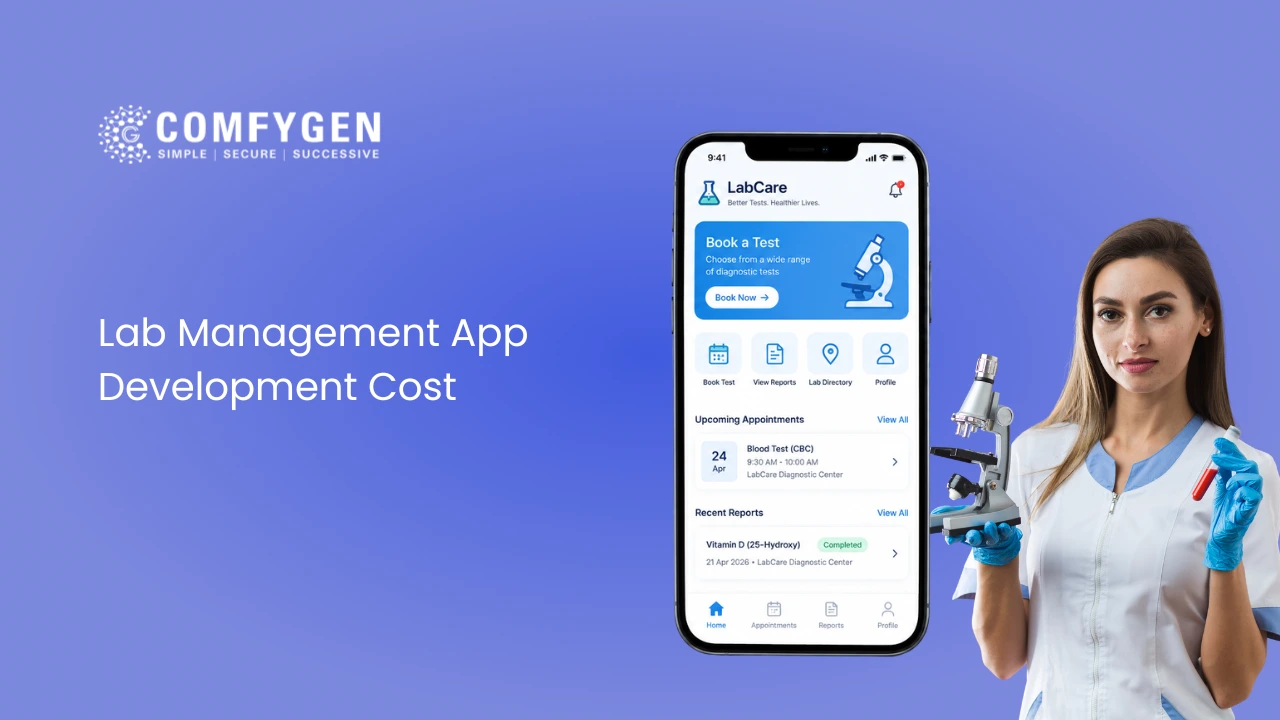





A custom lab management app costs $20,000 to $220,000+ to build. Where you land depends on three things: how many laboratory instruments it has to talk to, which accreditation framework you operate under, and whether it serves one site or several.
| Build tier | Cost | Timeline |
| Basic web LIMS (sample tracking, user roles, inventory) | $20,000 – $45,000 | 2 – 4 months |
| Mid-range (compliance, dashboards, 2–3 instrument interfaces) | $45,000 – $100,000 | 4 – 6 months |
| Advanced (multi-site, mobile, analytics, many instruments) | $100,000 – $220,000 | 6 – 10 months |
| Enterprise lab network | $220,000+ | 10 – 18 months |
These ranges assume an offshore or hybrid team with healthcare delivery experience. A US-based team runs two to three times higher at the same scope.
Before going further, there is a question worth settling first, and most guides on this topic will not answer it honestly because they are published by companies selling a LIMS. That question is whether you should build at all.
These ranges assume an offshore or hybrid team with healthcare delivery experience. A US-based team runs two to three times higher at the same scope.
Before going further, there is a question worth settling first, and most guides on this topic will not answer it honestly because they are published by companies selling a LIMS. That question is whether you should build at all.
Should You Build or Buy a LIMS?
Comfygen does not sell a LIMS product. There is nothing to protect in answering this properly.
For a large share of laboratories, buying is the correct answer, and building would be an expensive mistake.
What Buying a LIMS Actually Costs
The systems most labs end up evaluating are LabWare, Thermo Scientific SampleManager, STARLIMS, CloudLIMS, Labguru and CrelioHealth. Their pricing has become reasonably transparent.
Cloud platforms run roughly $40 to $300 per user per month. On-premise systems run $50,000 to $250,000 upfront on a perpetual licence. Enterprise platforms are quoted around $4,000 to $12,000 per user for licensing, with small and mid-sized deployments commonly landing between $10,000 and $30,000 a year and enterprise deployments above $100,000 a year.
The headline number is rarely the real one. A publicly documented Sedgwick County forensic laboratory procurement recorded software costs of $151,798 for 35 users, with total first-year implementation including services, training and configuration reaching roughly $290,000.
The costs that get added on top:
| Hidden cost | Typical range |
| Data migration from paper, spreadsheets or a legacy system | $5,000 – $25,000 |
| Simple instrument integration | $3,000 – $12,000 each |
| Complex instrument integration | $15,000 – $30,000 each |
| Workflow or report changes after go-live | Vendor-billed, recurring |
| Training and configuration | Often 50% – 100% of licence cost in year one |
Build vs Buy: The Three-Year Cost Comparison
| Cost / Factor | Buy (mid-size cloud LIMS, 25 users) | Build (mid-range custom) |
| Year 1 | $30,000 licence + $40,000 implementation | $70,000 build |
| Year 2 | $30,000 | $12,000 maintenance |
| Year 3 | $30,000 | $12,000 maintenance |
| Change requests | Vendor-billed, recurring | Included in maintenance |
| Three-year total | ~$130,000 | ~$94,000 |
| Ownership | Licence, revocable | Yours |
The crossover point sits at roughly 20 to 25 users, or sooner if your workflow needs customisation the vendor charges for.
When Buying Is the Better Choice
Your lab runs a standard workflow. You have fewer than about 20 users. You need to be operational this quarter. Or you have no internal technical owner. A configured commercial LIMS will beat a custom build on every dimension that matters to you.
When Building Is the Better Choice
Your workflow is the thing that makes you competitive. You need instrument interfaces the vendor does not support. You operate multiple sites with different accreditation scopes. You intend to license the software to other labs. Or you have been quoted repeatedly for customisation and the quotes keep growing.
The signal to watch: if vendor change requests have become a recurring line item in your budget, you are already paying for custom development without owning the result.
Which Types of Labs Need This Software
Demand is not evenly spread, and which category you fall into changes both your feature list and your accreditation scope.
Pathology and diagnostic labs are the largest group by volume, especially in India where private diagnostic chains are consolidating and need multi-site systems. Their priorities are turnaround time, reflex testing logic and integration with hospital and clinic ordering systems.
Pharmaceutical and clinical research labs carry the heaviest regulatory burden through 21 CFR Part 11, and they are the most expensive builds by some margin.
Environmental, food and chemical testing labs operate under ISO/IEC 17025 and care most about method validation records, measurement uncertainty and client reporting portals.
Genomics and biotech labs generate the largest data volumes and need the most storage and pipeline integration, which shifts cost toward infrastructure rather than interface work.
Academic and R&D facilities usually have the loosest compliance requirements and the tightest budgets, which makes them the group most likely to be better served by buying than building.
What Is a Lab Management App (LIMS)?
A lab management app, usually called a Laboratory Information Management System or LIMS, handles the daily operation of a laboratory. Sample registration and tracking, test workflows, inventory, result capture and validation, reporting, and the audit trail that keeps you accreditable.
A related term worth separating: a LIS, laboratory information system, is the clinical variant used in hospital and diagnostic labs, oriented around patient results and orders. A LIMS is oriented around samples and batches, and is what research, environmental, food and industrial labs run. Many projects need elements of both, and knowing which one you are describing changes the quote considerably.
Our laboratory app development work covers clinical and diagnostic labs, biotech and pharmaceutical research, food, chemical and environmental testing, and academic R&D facilities.
Instrument Interfacing: The Biggest Cost Variable
Most cost guides bury this under integrations. It deserves its own section, because it is usually the largest single variable in a lab software budget and the one most often underestimated.
Every analyser, spectrometer, sequencer and chromatograph in your lab speaks its own dialect. Some support HL7. Many older instruments use ASTM E1381 and E1394 serial protocols. Some output nothing but a proprietary file format dropped onto a shared drive.
| Interface type | Cost per instrument | Why |
| Modern instrument, HL7 or REST API | $3,000 – $8,000 | Documented protocol, straightforward mapping |
| Serial or ASTM protocol | $6,000 – $15,000 | Older standard, physical connectivity, more testing |
| Proprietary or file-drop output | $12,000 – $30,000 | Reverse engineering, custom parser, fragile |
| Bidirectional (orders down, results up) | Add 50% – 80% | Order routing and error handling in both directions |
Three things change the estimate. Whether you need results only or full bidirectional order transmission. Whether identical instrument models can share one interface. And whether the manufacturer will release protocol documentation, which some will not without a support contract.
The budgeting advice that saves the most money: count your interfaces, not your instruments. Eight analysers from two manufacturers is usually two interfaces, not eight. That distinction alone often moves a quote by $40,000.
Accreditation and Compliance Costs by Framework
Which framework you operate under changes the build materially, because each one dictates what has to be recorded, validated and provable.
| Framework | Applies to | What it adds to the build |
| CLIA | US clinical and diagnostic labs | Personnel qualification tracking, proficiency testing records, quality control logging |
| ISO 15189 | Medical laboratories, international | Quality management documentation, competence records, traceability |
| ISO/IEC 17025 | Testing and calibration labs | Method validation records, measurement uncertainty, equipment calibration history |
| FDA 21 CFR Part 11 | Regulated pharma and clinical research | Electronic signatures, immutable audit trails, system validation documentation |
| HIPAA | Any US lab handling patient results | Encryption, access control, BAAs, PHI audit logging |
| NABL | Indian accredited laboratories | ISO 15189 or 17025 alignment plus NABL-specific documentation |
| GDPR | Labs handling EU personal data | Consent, minimisation, erasure, breach notification |
21 CFR Part 11 is the expensive one: Electronic signature infrastructure, tamper-evident audit trails and full system validation documentation typically add $15,000 to $40,000 and several weeks of timeline. If you are in regulated pharma, establish this at the start, because retrofitting validation is close to a rebuild.
Compliance work generally lands at 20% to 30% of the total build, which is consistent with what compliance adds across healthcare software more broadly.
Lab Management App Cost by Module
| Module | Cost | What it covers |
| User roles and secure login | $2,000 – $6,000 | Role-based access, MFA, session control |
| Sample registration and accessioning | $5,000 – $14,000 | Barcode generation, label printing, batch intake |
| Chain of custody tracking | $6,000 – $16,000 | Custody transfer records, tamper-evident logging |
| Test workflow management | $8,000 – $22,000 | Worklists, assignment, turnaround monitoring |
| Result entry and validation | $8,000 – $25,000 | Manual and instrument entry, multi-level approval |
| Reference ranges and reflex testing | $6,000 – $18,000 | Range logic by demographic, automatic follow-on tests |
| Inventory and reagent management | $5,000 – $14,000 | Stock, expiry, lot tracking, reorder alerts |
| Report generation and delivery | $5,000 – $15,000 | Templated PDFs, secure delivery, client portal |
| Audit trail and compliance logging | $8,000 – $20,000 | Immutable logs, accreditation reporting |
| Analytics dashboard | $6,000 – $18,000 | Turnaround times, throughput, QC trends |
| Mobile access for lab staff | $10,000 – $28,000 | Cross-platform app for on-floor entry and review |
Reference ranges and reflex testing are the two modules clients most often forget to specify and most often need. Reflex logic, where an abnormal result automatically triggers a follow-on test, sounds trivial and is one of the more intricate rule engines in lab software.
Five More Factors That Change the Price
1. Number of sites: Multi-site adds centralised administration, site-level permissions and cross-site reporting. Budget 30% to 50% over a single-site build.
2. Legacy data migration: Moving from paper, spreadsheets or an old system runs $5,000 to $25,000 depending on volume, format consistency and how much historical validation is required.
3. Hosting model: Cloud on AWS or Azure folds infrastructure into an operating cost. On-premise shifts cost and staffing onto your lab, and some accreditation scopes or client contracts require it.
4. Client portal: If external clients submit samples and collect results, that is effectively a second product with its own authentication and access model. Add $15,000 to $40,000.
5. Platform coverage: Web-only is right for most labs, since the work happens at benches with fixed workstations. Mobile earns its cost for field sampling, environmental testing and multi-site supervision.
Lab Management App Development Cost in India
For labs building in or for the Indian market, the numbers in rupees:
| Build tier | Cost |
| Basic web LIMS | ₹17 lakh – ₹38 lakh |
| Mid-range with compliance and instrument interfacing | ₹38 lakh – ₹85 lakh |
| Advanced multi-site | ₹85 lakh – ₹1.85 crore |
| Enterprise lab network | ₹1.85 crore+ |
Building in India costs 60% to 75% less than an equivalent US team at the same scope, because the rates differ and the hours do not.
Two costs do not scale down with the rate. NABL documentation requirements stay the same wherever the code is written, since the work is procedural rather than geographic. And rework costs the same multiple everywhere, which is why a partner with actual laboratory delivery experience is cheaper at a higher hourly rate than one without.
How Long Does It Take to Build a LIMS?
| Phase | Timeframe |
| Requirement analysis and workflow mapping | 2 – 3 weeks |
| Compliance and validation architecture | 2 – 3 weeks |
| Wireframing and UI/UX design | 2 – 3 weeks |
| Backend and frontend development | 8 – 14 weeks |
| Instrument interfacing | 3 – 8 weeks, usually parallel |
| QA, validation and user acceptance testing | 3 – 5 weeks |
| Deployment and support | 1 – 2 weeks |
Compliance architecture sits second for the same reason it does in any regulated build. Retrofitting an audit trail or an electronic signature framework after the data model exists costs several times what building it in does.
Five Ways to Reduce Your LIMS Development Cost
1. Start web-only: Most lab work happens at fixed workstations. Mobile can wait for phase two.
2. Count interfaces, not instruments: Consolidating identical models onto one interface is the single largest saving available in most lab builds.
3. Phase your instrument connections: Connect your three highest-volume analysers first and add the rest once the core system is proven.
4. Start with results-only interfacing: Bidirectional order transmission adds 50% to 80% per instrument and most labs do not need it in release one.
5. Settle your accreditation scope before development: Building to 21 CFR Part 11 when ISO 17025 is sufficient wastes money in one direction. Discovering you needed it in month five is worse in the other.
Building Your Lab Management App With Comfygen
Comfygen has been building healthcare app and laboratory software since 2019, with 550+ projects delivered to 400+ clients across 30+ countries and 97% client retention.
Our laboratory app development team handles instrument interfacing over HL7 and ASTM protocols, accreditation-ready audit trails, and integration with hospital systems where diagnostic labs need results flowing into an EHR. For Indian laboratories we handle NABL documentation requirements directly rather than subcontracting them.
A 30-minute discovery call gets you a fixed-price breakdown against your instrument list and accreditation scope rather than a range.
FAQs
How much does it cost to develop a lab management app?
Is it cheaper to build a LIMS or buy one?
How much does instrument interfacing cost?
How much does pathology lab software cost in India?
What is the difference between a LIMS and a LIS?
Does a lab management app need to be HIPAA compliant?
How long does it take to build a lab management app?
Can a lab management app connect to hospital systems?

Mr. Saddam Husen, (CTO)
Mr. Saddam Husen, CTO at Comfygen, is a renowned Blockchain expert and IT consultant with extensive experience in blockchain development, crypto wallets, DeFi, ICOs, and smart contracts. Passionate about digital transformation, he helps businesses harness blockchain technology’s potential, driving innovation and enhancing IT infrastructure for global success.