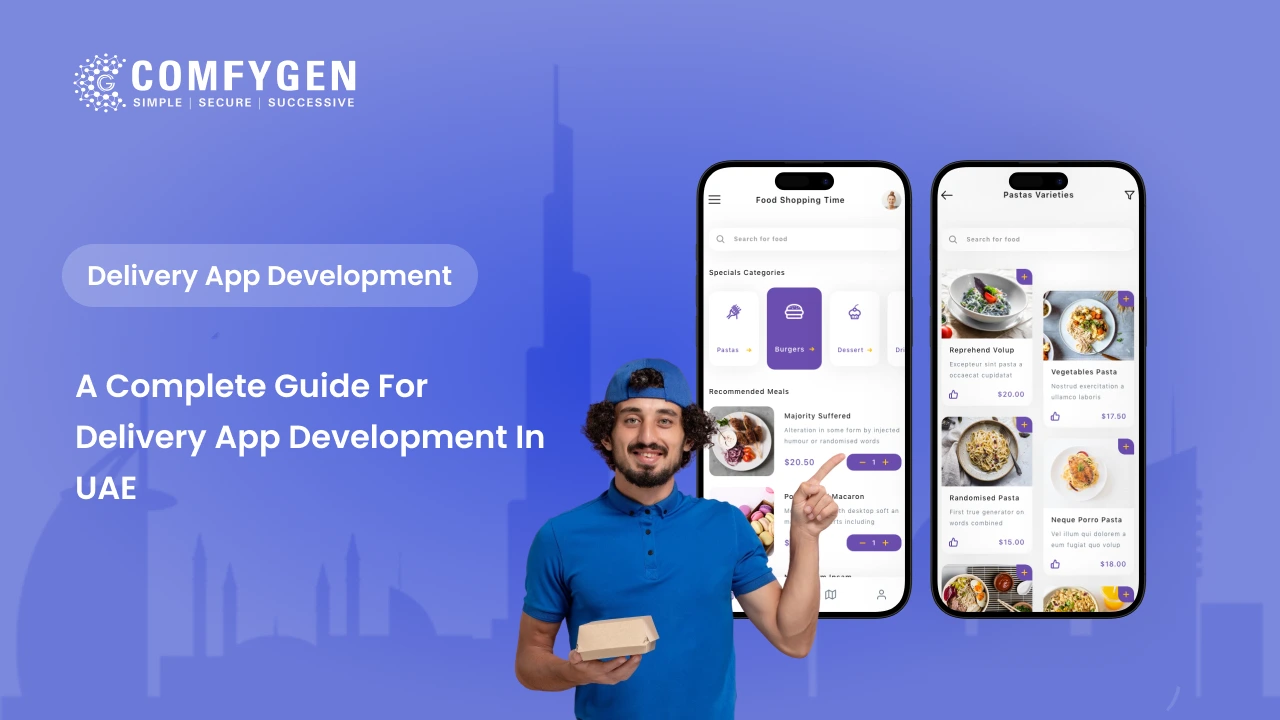





Delivery app development in the UAE needs three things. First, a trade licence that covers delivery activity. Second, an app built for local habits, which means Arabic, Apple Pay, cash on delivery and Emirates ID checks. Third, a rider setup that follows local permit rules. Development usually costs AED 37,000 to AED 370,000 (about USD 10,000 to USD 100,000), and a first version takes 8 to 12 weeks. In addition, company setup and licensing add roughly AED 20,000 to AED 30,000.
This guide covers the parts that generic app guides skip. As a result, you can plan licensing, payments, Arabic support and rider permits before you spend on development.
Why the UAE Is a Strong Market for Delivery Apps
The UAE has high smartphone use, dense city living and customers who order everything from groceries to pharmacy items on their phones. Moreover, Dubai and Abu Dhabi have apartment-heavy neighbourhoods, so delivery distances stay short and unit economics work better.
However, the market is competitive. Therefore, a new app needs a clear reason to exist.
| App | Focus | What a New App Can Do Differently |
| Talabat | Food, groceries, pharmacy | Serve a niche the big apps handle poorly, like specialist diets or B2B supplies |
| Careem (Careem Everything App) | Rides, food, deliveries, payments | Focus on one service and do it faster in one emirate |
| Deliveroo | Restaurant food | Own your own brand and margin instead of paying commissions |
| Noon Minutes | Quick grocery delivery | Serve towns and communities outside the main hubs |
| InstaShop | Supermarket and pharmacy delivery | Offer subscriptions, like weekly groceries or daily water |
| Smiles | Deals and delivery | Build for a single retail chain’s own customers |
Many UAE restaurants and retailers now build their own app for exactly this reason. Commission on aggregator apps eats a large part of each order, and your own app keeps both the margin and the customer data.
UAE Delivery App Market Size and Growth
Before you budget, look at what the numbers say. The UAE delivery market is growing steadily across food, grocery and quick commerce.
| Metric | Figure |
| UAE online food delivery market, 2024 | USD 720.7 million, forecast to reach USD 1,799.1 million by 2033 at a 10.2% CAGR |
| UAE online food delivery revenue by 2030 | USD 3,961.4 million, growing at 7.4% CAGR from 2025 |
| Delivery inside UAE foodservice | Fastest-growing service type, at an 18.65% CAGR through 2031, while dine-in held 55.05% of the market in 2025 |
| Middle East and Africa online grocery delivery | USD 20.13 billion in 2026, forecast to reach USD 34.59 billion by 2031 at an 11.43% CAGR |
However, treat these figures as a range rather than a single truth. Research firms count different things, since some measure platform commission revenue while others measure the total value of orders placed. In short, the growth direction is consistent, even though the absolute numbers differ.
Two points matter more than the headline size. First, delivery is growing much faster than dine-in, so restaurants without a delivery channel keep losing share. Second, grocery and quick commerce are growing faster than food across the region, which is why dark stores keep opening in Dubai and Abu Dhabi.
Licences You Need for a Delivery App in the UAE
Rules differ by emirate, so confirm with a local consultant before you spend. As a general path in Dubai:
Choose Mainland or Free Zone
Mainland companies, licensed by Dubai’s Department of Economy and Tourism, can deliver anywhere in the emirate and trade directly with the local market. Free zone companies get tax and ownership benefits, but delivering to mainland customers usually needs a local agent or extra approvals.
Get a Trade Licence for Your Activity
A delivery services licence is separate from an e-commerce licence. Approximate cost is AED 8,000 to AED 15,000, and total setup usually runs AED 20,000 to AED 30,000 including visas and fees.
Add Activity-Specific Approvals
Food delivery needs food safety approvals through Dubai Municipality, and every restaurant you list must hold a valid food licence. Medicine delivery must go through pharmacies licensed by the Ministry of Health and Prevention or the Dubai Health Authority. Alcohol delivery is tightly restricted and allowed only through licensed sellers, with ID checks at the door.
Register for VAT
The UAE charges 5% VAT, and your app must show correct VAT on customer invoices and vendor payouts.
Sort out Rider Permits
Delivery riders in Dubai need proper work permits and licensed vehicles, and there are specific rules for delivery motorcycles and e-bikes. Many startups solve this by working with a licensed delivery manpower supplier instead of hiring riders directly at launch.
Features Your UAE Delivery App Actually Needs
Beyond the standard customer, rider, vendor and admin apps, a delivery app in the UAE needs the following.
Arabic and Right-to-Left Design for a UAE Delivery App
Arabic support means more than translation. The whole layout flips: menus, back buttons, progress bars, order timelines and maps controls all move to the other side. Numbers, prices and delivery times need careful formatting, and text length changes button sizes. Plan RTL from the design stage, because retrofitting it later costs far more.
Local Payment Methods for Delivery App Development in Dubai
- Cards and wallets: Visa, Mastercard, Apple Pay and Google Pay are widely used.
- Local gateways: Telr, PayTabs, Network International, Checkout.com and Stripe all operate in the region and support AED settlement.
- Cash on delivery: Still common, especially for groceries and larger orders. Riders need a cash log in the app.
- Buy now, pay later: Tabby and Tamara are popular for higher-value orders.
Emirates ID and Age Verification
Alcohol orders and some pharmacy items need ID checks at the door. Build an ID capture and verification step into the rider app from the start if you plan to serve these categories.
Address Handling Without Postcodes
UAE addresses often rely on building names, villa numbers and landmarks. Map-pin dropping, saved addresses with building notes and Makani number support make deliveries far more reliable than a text address field.
Multi-Emirate Zones
Delivery rules, traffic and distances differ between Dubai, Abu Dhabi, Sharjah and the northern emirates. Your admin panel needs zone-level settings for fees, delivery windows and active vendors.
Prayer Times, Ramadan and Peak Hours
Order patterns shift during Ramadan, with heavy demand around iftar. Scheduling, pre-orders and surge staffing matter more in the UAE than in most markets.
Build Your UAE Delivery App With Comfygen
Turn your delivery business idea into a scalable UAE-ready app with powerful ordering, tracking, payment, and management features.
Get a Free Consultation
Data Protection Rules for a Delivery App in the UAE
The UAE’s federal Personal Data Protection Law sets rules for collecting and processing personal data, including customer addresses and location. Some free zones, such as the DIFC and ADGM, have their own data protection laws. Your app needs clear consent screens, a privacy policy in English and Arabic, and a way for users to delete their account and data. Serving customers in Europe adds GDPR obligations on top.
Delivery App Development Cost in the UAE
Most UAE businesses build with an offshore team, usually in India, and manage the project from Dubai. That’s why costs vary so widely.
| Build Level | What’s Included | Cost (USD) | Cost (AED, approx.) | Time |
| MVP | Customer app, rider app, basic admin | $10,000 to $25,000 | AED 37,000 to 92,000 | 8 to 12 weeks |
| Mid-level | Adds vendor panel, Arabic, offers, analytics | $25,000 to $50,000 | AED 92,000 to 184,000 | 3 to 5 months |
| Advanced | Adds AI dispatch, multi-emirate zones, integrations | $50,000 to $100,000+ | AED 184,000 to 370,000+ | 6+ months |
Who builds it changes the price most. A Dubai-based agency typically charges $80 to $200 an hour. An Indian team charges $20 to $50 for similar work, which is why many UAE founders hire offshore and keep a local project owner. The same features and factors drive the budget everywhere, and they’re set out in full in this breakdown of delivery app costs.
Budget for the UAE-only extras:
- Company setup and trade licence: AED 20,000 to AED 30,000 (approximate)
- Arabic content, translation and RTL testing
- Local payment gateway setup fees and per-transaction charges
- Rider onboarding, permits or a manpower supplier contract
- VAT-compliant invoicing in your accounting setup
How to Start Delivery App Development in the UAE: Step by Step
Follow these seven steps in order. Each one removes a risk that delays UAE launches.
Step 1: Choose One Emirate and One Delivery Category
Dubai food delivery and Abu Dhabi grocery are different launches. Pick one emirate and one category first, then prove demand before you expand anywhere else.
Step 2: Register Your Company and Trade Licence
Apply for a trade licence covering delivery activity, and start now, because approvals take weeks. Meanwhile, your design team can work in parallel without waiting.
Step 3: Sign Up Restaurants, Stores or Pharmacies
Vendors are harder to win than customers. Therefore, sign enough restaurants, stores or pharmacies to give real choice inside your launch zone before development finishes.
Step 4: Build the MVP With Arabic From Day One
Build the customer, rider and admin apps with Arabic and right-to-left layouts included. Otherwise, adding Arabic later means redoing screens and paying twice for one feature.
Step 5: Connect Local Payments and Test Every Refund
Connect a local gateway such as Telr or PayTabs, add Apple Pay and cash on delivery, then test failed payments and refunds thoroughly before launch week.
Step 6: Arrange Riders, Permits and Vehicles
Confirm rider permits, licensed vehicles, insurance and payout terms before launch week. Alternatively, contract a licensed manpower supplier, which many UAE startups prefer in month one.
Step 7: Soft Launch Your UAE Delivery App in One Area
Run live orders in one community for two to four weeks, fix problems daily, and expand only once delivery times stay inside your promise consistently.
Meanwhile, the steps that apply in every market, from app store approval to first-90-day metrics, sit in the wider delivery app launch checklist.
Which Type of Delivery App Suits Your UAE Business?
- Restaurants and cloud kitchens usually build food ordering and delivery apps to cut aggregator commissions on repeat customers.
- Supermarkets and dark stores need grocery delivery platforms with slot booking and substitutions, or a quick commerce setup for 15-minute delivery.
- Pharmacies need medicine delivery apps with prescription upload and licensed pharmacy checks.
- Courier and logistics firms need parcel delivery apps with pickup scheduling and proof of delivery.
- Businesses planning several categories often build a multi-service delivery platform with one login and one rider fleet.
Working With an Offshore Team on Your UAE Delivery App
Most UAE clients pick an Indian development partner for cost, then worry about time zones and communication. In practice:
- Time zones overlap well. India is 1.5 hours ahead of the UAE, so a full working day is shared.
- Ask for a named project manager in your working hours, with a demo of working software every two weeks.
- Insist on source code ownership in the contract, plus access to the code repository from week one.
- Check your Arabic experience. Ask to see a live app with a right-to-left layout, since this is where inexperienced teams struggle most.
Comfygen has delivered 550+ projects for 400+ clients across 30+ countries since 2019, including delivery platforms for clients in the Gulf. Teams work in UAE hours, and every project starts with a scoping session that maps your category, licences, budget and launch date. You can talk to the delivery team about your UAE launch before committing to a build.
Frequently Asked Questions
How much does it cost to develop a delivery app in the UAE?
Do I need a licence to run a delivery app in Dubai?
How long does it take to build a delivery app in the UAE?
Does my UAE delivery app need Arabic?
Which payment methods should a UAE delivery app support?
Should I hire a Dubai agency or an offshore team?

Mr. Saddam Husen, (CTO)
Mr. Saddam Husen, CTO at Comfygen, is a renowned Blockchain expert and IT consultant with extensive experience in blockchain development, crypto wallets, DeFi, ICOs, and smart contracts. Passionate about digital transformation, he helps businesses harness blockchain technology’s potential, driving innovation and enhancing IT infrastructure for global success.