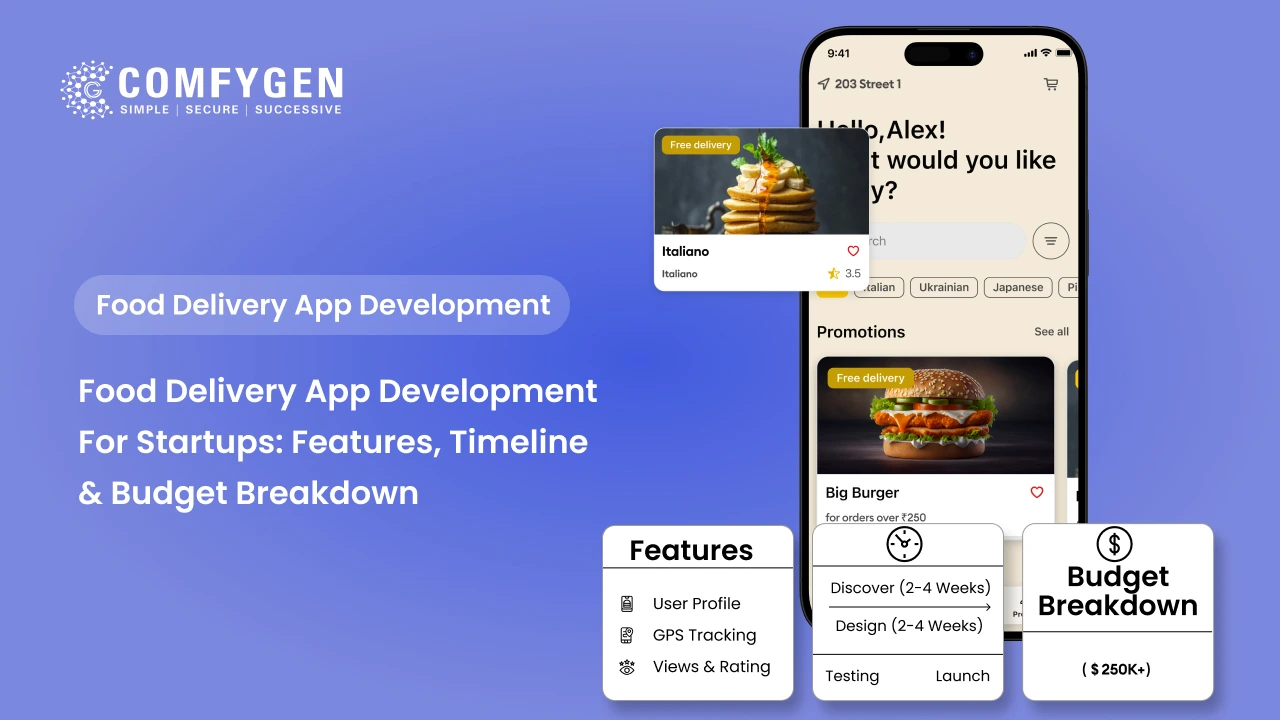





Food delivery app development for startups costs $15,000 to $25,000 with a white-label platform, or $25,000 to $50,000 with a custom MVP. The build is rarely what kills these companies. Running out of money before order volume proves the model is.
This guide covers budget tiers, what each one buys, how to plan runway around a build, and the traction numbers investors look for. It assumes you already know what you’re building. If you don’t, picking a business model and validating demand comes first, and creating a food delivery app starts at that point rather than at the budget.
What Each Budget Gets You
Food delivery startup costs fall into three bands. What separates them is time to market, not quality.
| Budget | What you get | Time to live | Best for |
| $15,000 to $25,000 | White-label platform rebranded as yours, all four apps, admin dashboard | 2 to 4 weeks | Proving demand in one area before committing capital |
| $25,000 to $50,000 | Custom MVP built to your model, live tracking, multi-payment, admin panel | 8 to 12 weeks | An operating model a pre-built platform can’t accommodate |
| $50,000+ | Multi-vendor marketplace, AI features, commission engine, multi-city | 16 to 24 weeks | Funded companies opening several markets at once |
Most pre-seed startups should be in the first band. The white-label route gets you taking real orders inside a month for the price of two months of one developer’s salary. If demand doesn’t materialize, you’ve lost $20,000 instead of $50,000 and four months.
The argument for going custom at pre-seed is narrow: your operating model genuinely doesn’t fit a marketplace or single-restaurant template. Subscription tiffin services, campus-only platforms and B2B catering often qualify. “We want it to feel different” does not.
Costs Founders Forget to Include
The build quote is not the budget. Four items land after signing:
App store fees: Google charges $25 once. Apple charges $99 every year.
API usage: Maps, payment gateways and push notifications bill on volume. These are near zero at launch and grow directly with orders, which means they’re invisible exactly when you’re modeling costs.
Maintenance: 15% to 20% of build cost annually, permanently. A $30,000 build carries $4,500 to $6,000 a year before you add a single feature.
The operations you’re actually funding: Driver payments, restaurant onboarding, customer acquisition and support. In most food delivery startups these dwarf the software cost within three months of launch.
That last one is the important one. Founders routinely raise enough to build the app and not enough to run it.
How to Plan Your Runway
A food delivery app MVP budget is not the same thing as a launch budget. The build is one line out of six.
A workable pre-seed plan for a single-market launch:
| Line | Amount | Notes |
| Platform build (white-label) | $20,000 | Live in a month |
| First 6 months maintenance and hosting | $5,000 | Includes API usage as volume grows |
| Restaurant onboarding | $3,000 | Photography, menu setup, account management |
| Driver acquisition and float | $8,000 | Depends heavily on whether restaurants self-deliver |
| Customer acquisition, 6 months | $15,000 | Local marketing, offers, referral credit |
| Founder and ops salary buffer | Varies | The line most often left out |
The software is roughly a quarter of what you need. Budget accordingly, and be honest about the salary line rather than assuming founders work unpaid indefinitely.
Sequence matters more than total: Spending $50,000 on a custom build leaves nothing for the six months of customer acquisition that tell you whether the model works. Spending $20,000 on white-label leaves $30,000 to actually run the business.
Build Less, Launch Sooner
The most common way a startup overspends is building version three first. A launch-ready platform needs roughly 18 features across four apps: browse, customize, checkout, pay and track on the customer side; accept, queue and toggle availability for restaurants; notify, navigate and update for drivers; and a live order view with manual intervention in admin.
Ratings, loyalty, promo engines, AI recommendations and dynamic pricing all wait. Every feature you cut is a week of runway you keep, and sorting food delivery app features into launch, month-six and year-two tiers is the cheapest thing you can do before signing a scope.
AI features in particular are worth understanding as a timing question rather than a budget one. Recommendation engines need order history to work, and on launch day you have none.
What Investors Actually Look At
At seed stage, food delivery startup funding turns on traction rather than technology. Nobody writes a check because the app is well built.
Traction, not technology. Nobody funds a food delivery startup because the app is well built.
The numbers that matter at seed stage:
Repeat order rate: The single most predictive metric in this category. If customers don’t order a second time, nothing else about the business works. Track it from your first week.
Average order value and contribution margin per order: Revenue per order minus food cost, driver cost and payment fees. If this is negative at fifty orders a day, scale makes it worse rather than better.
Order density: Orders per square kilometer per hour. Delivery economics are almost entirely a density problem, which is why campus, gated-community and single-neighborhood plays work when city-wide ones don’t.
Restaurant retention: How many of the restaurants you onboarded in month one are still active in month four.
Customer acquisition cost against 90-day value: If CAC exceeds what a customer is worth in three months, paid growth doesn’t work yet.
You can produce all five of these from a $20,000 white-label platform. None of them require a custom build.
One Question That Decides Your Build
Does your operating model fit a pre-built platform?
If yes, launch white-label, run for six months, gather the five metrics above, and use them to raise. Then build custom with money you raised on evidence rather than on a deck.
If no, and you can articulate specifically why, a custom MVP at $25,000 to $50,000 is justified. Be genuinely honest here, because “we’re different” costs $30,000 and four months to be wrong about.
How to Pick a Development Partner
Cheap and wrong is more expensive than the alternative. Five things to confirm before signing:
Ask for downloadable apps: Play Store and App Store links you can open, not screenshots.
Check all four apps are in scope: A customer-app-only quote looks 60% cheaper and isn’t comparable.
Get source code ownership in writing: Full IP assignment, no license fee, no hosting lock-in. A startup that doesn’t own its code has a serious problem at diligence.
Agree a named support window: Warranty period, bug-fix turnaround, OS update policy, all in writing.
Insist on sprint-based delivery: Working builds every two weeks. A vendor who disappears for eight weeks removes every chance you had to correct course, and correcting course is most of what an early-stage build is for.
Running those five questions past six or eight food delivery app development companies will narrow the list to three inside a week, and the ones who can’t answer in writing drop out on their own.
Why Work With Comfygen
Comfygen has delivered 550+ projects for 400+ clients across 30+ countries since 2019, with a 97% client retention rate, including a large number of first builds for early-stage companies.
Pricing is published rather than quote-only, which matters when you’re modeling runway. Every build ships all four apps, projects run in two-week sprints with a working demo at the end of each, and full source code ownership transfers at delivery with no ongoing license fee. Founders scoping a custom food ordering platform against a fixed budget usually start with a call to work out whether white-label or custom is the right call before anything gets built.
Frequently Asked Questions
What should a food delivery app MVP budget cover?
The build itself, six months of maintenance and hosting, restaurant onboarding, driver acquisition, six months of customer acquisition, and a salary buffer. Software is typically about a quarter of the total.
How much does a food delivery app cost a startup?
$15,000 to $25,000 for a white-label launch, $25,000 to $50,000 for a custom MVP. Most pre-seed startups should start in the first band.
Should a startup build custom or use white-label?
White-label unless your operating model genuinely can't fit a pre-built platform. It gets you taking real orders in a month and leaves budget for the six months of operations that actually prove the model.
What else should I budget beyond the build?
Maintenance at 15% to 20% of build cost yearly, API usage that grows with orders, app store fees, restaurant onboarding, driver acquisition and customer acquisition. Software is typically about a quarter of what a first-year launch needs.
What metrics do investors look at?
Repeat order rate, contribution margin per order, order density, restaurant retention, and customer acquisition cost against 90-day value. All five can be produced from a white-label platform.
How long until a startup can take its first order?
Do I need my own delivery fleet at launch?
What's the most common startup mistake here?
Do I own the source code?

Mr. Saddam Husen, (CTO)
Mr. Saddam Husen, CTO at Comfygen, is a renowned Blockchain expert and IT consultant with extensive experience in blockchain development, crypto wallets, DeFi, ICOs, and smart contracts. Passionate about digital transformation, he helps businesses harness blockchain technology’s potential, driving innovation and enhancing IT infrastructure for global success.