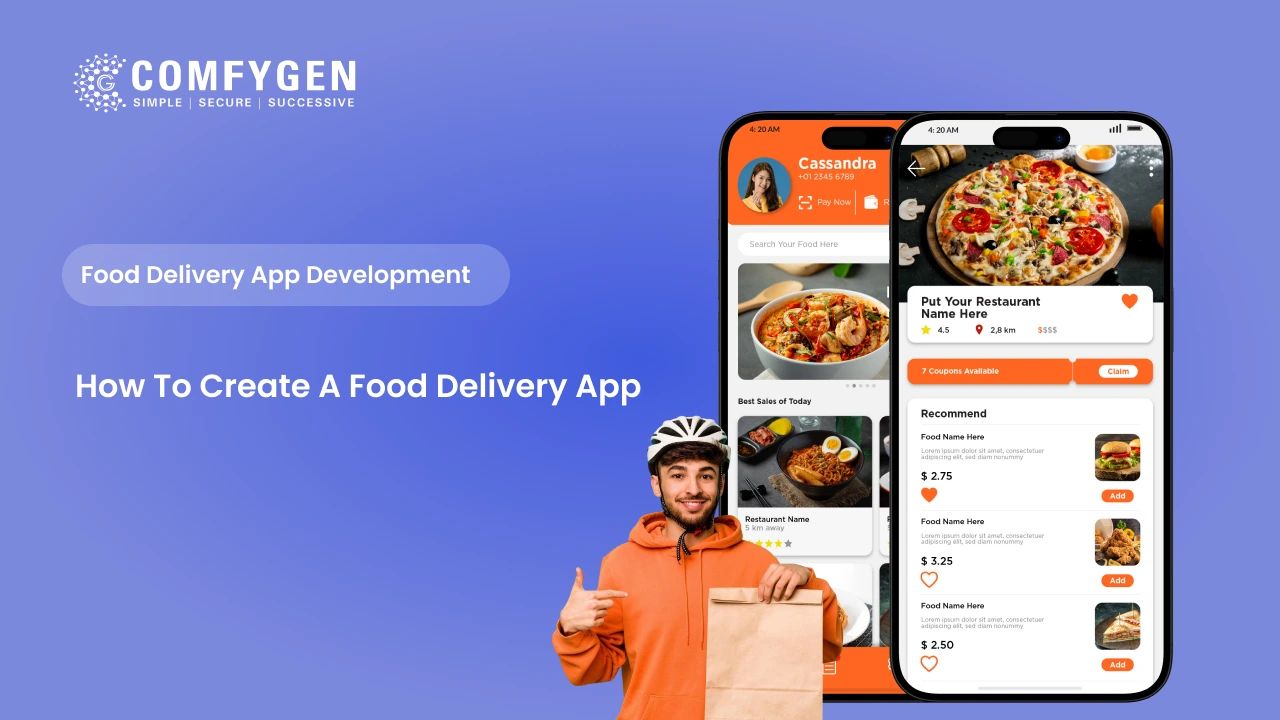





To create a food delivery app you’ll need to validate demand, settle on a business model, define your features, pick a technology stack, build over roughly 8 to 12 weeks, and launch somewhere small before you go wide. Custom food delivery app development cost lands between $25,000 and $50,000 for an MVP. A white-label launch starts at $15,000.
That’s the short version. The rest of this guide covers the full food delivery app development process, and it spends more time on the decisions that come before development than most guides do. There’s a reason for that. In our experience the projects that go wrong rarely go wrong during the coding. They go wrong months earlier, when nobody stopped to check whether anyone actually wanted the thing.
Before you build: does anyone want this?
In most countries, two platforms already own the food delivery market. Copying them almost never works. What does work is finding something they handle badly and doing that one thing properly.
A few angles worth considering:
- One city, or even one neighborhood: The big platforms optimize nationally, which means they’re mediocre everywhere and excellent nowhere. Someone who knows every restaurant within two miles can beat them on both selection and delivery time.
- A specific cuisine or dietary need: Halal, Jain, vegan, regional specialties. Search on the big apps handles this poorly, and people who care about it care a lot.
- A closed community: Campuses, office parks, gated townships. When every drop is within a kilometer, the delivery math changes completely.
- Subscriptions: Tiffin services and weekly meal plans simply don’t fit a per-order marketplace.
- Your own restaurant: If you’re handing an aggregator 15% to 30% of every order, an owned app is a way to stop doing that with your regulars.
A two-week test that costs almost nothing
Before you commit to full food delivery mobile app development, try this:
- Set up an ordering page, a WhatsApp Business number, or honestly even a Google Form.
- Take 20 to 50 real orders by hand.
- Track three things: how many people come back for a second order, what the average order is worth, and what it genuinely costs you to deliver one.
If nobody orders twice, no app is going to fix that. And if the numbers don’t work across 50 orders, they won’t magically start working at 5,000. Two weeks and almost no money buys you the most useful information you’ll get in the entire project.
Is the market still worth entering?
The global online food delivery market was valued at $319.99 billion in 2025 and is projected to reach $350.63 billion in 2026, growing at roughly 9.58% a year through 2034 (Fortune Business Insights).
If you own a restaurant, though, market size isn’t really the argument. Margin is. DoorDash publishes delivery commissions of 15% on Basic, 25% on Plus and 30% on Premier (DoorDash Merchant Pricing). On a $40 order at 25%, ten dollars walks out the door before you’ve paid for food, packaging or labor. An owned app moves your repeat customers off that fee, and it keeps the customer data with you instead of the marketplace.
Food delivery app business model: pick this first
Your model determines your features, your logistics, your revenue and how complicated the build gets. Sort it out before you speak to a mobile app developer, because changing your mind later is expensive.
Aggregator model
You list restaurants. Customers browse, order and pay in your app. The restaurants cook and deliver.
This is the easiest version to build, since there’s no fleet to manage. It’s also the hardest to grow, because you need enough restaurants to be worth downloading and enough customers to be worth joining, and neither side wants to arrive first.
Order and delivery model
You list the restaurants and handle delivery yourself, either with your own riders or a third-party fleet.
Swiggy, DoorDash and Uber Eats all work this way. There’s more to build here (a delivery driver app, plus the dispatch logic behind it) but you control delivery quality, and you earn on delivery fees rather than commission alone.
Integrated model
One business does the ordering, the cooking and the delivery. Restaurant chains and cloud kitchens run this way.
It’s the simplest platform to build and by far the easiest economics to follow, since there’s no two-sided marketplace to keep balanced. If you already own the kitchens, start here. Once you’re running more than one virtual brand out of the same space you’ll want proper cloud kitchen management software sitting behind it.
Food delivery app monetization: where the money comes from
Work this out early, because it changes what the app has to do.
Commission from restaurants
Commission from restaurants is the main revenue line for most marketplaces, typically 15% to 25% per order in India. Building an owned app for your own restaurant? Then this line doesn’t exist for you, which is rather the point of building one.
Delivery fees
Delivery fees get charged to the customer and usually scale with distance or order value. They cover rider costs, and in dense areas they can turn a small profit on their own.
Subscriptions
Subscriptions trade free delivery and member pricing for a monthly fee. Good recurring revenue, noticeably better retention, but you need enough order frequency before it’s worth offering.
In-app advertising
In-app advertising means restaurants paying for placement in search or on your home screen. It only works once you have real volume, so treat it as a version-three idea rather than a launch feature.
Premium services
Premium services covers priority delivery at peak times, scheduled orders, catering bookings and similar add-ons.
Most platforms end up running two or three of these together. Commission on its own rarely covers what riders cost you.
Turn Your Food Delivery App Idea Into Reality
Follow the right strategy, technology, and development process to launch a successful food delivery app
Build Your App
Features to include in a food delivery app
Here’s the thing most first-time founders miss: a working platform isn’t one app. It’s four, and each one has a completely different job. Mixing up which feature belongs where is the most common planning mistake we see.
Customer food delivery app features
- Restaurant browsing, search and filters
- Menus with photos, prices and item customization
- Cart and checkout with payment gateway integration
- Real-time order tracking, with the driver visible on a map
- Order history and one-tap reorder
- Push notifications for order status, offers and delivery updates
- Ratings and reviews
Restaurant partner app features
- Order acceptance and kitchen queue management
- Menu and pricing control, including availability toggles for sold-out items
- An order-ready notification that triggers driver pickup
- Sales and order analytics
- Payout and settlement view
Some teams call this the restaurant management app. Same product under a different name. Whatever you call it, this is the software your restaurant partners will be tapping at during a Friday night rush, so it needs to be fast and hard to get wrong.
Food delivery driver app features
- Order and pickup notifications
- Turn-by-turn navigation to the restaurant, then to the customer
- GPS integration for live location sharing
- Earnings and delivery history
- Status updates for picked up, en route and delivered
Admin panel features
- Live view across every order, restaurant and driver
- Restaurant onboarding and approval
- Commission and payout management
- Analytics dashboard
- Support and dispute handling
One feature worth calling out separately is real-time order tracking. Customers stopped treating it as a nice extra years ago and now simply expect it. It also happens to be one of the pricier parts of the build, because it needs GPS integration working correctly across all four apps at the same time.
Technology stack for food delivery app development
The right stack depends on your team, your timeline and your budget. That said, most platforms end up in roughly the same place:
| Layer | Common choices |
| Customer and restaurant apps | React Native or Flutter for cross-platform, Swift and Kotlin for native |
| Driver app | Same cross-platform stack, built for lightweight background GPS use |
| Backend | Node.js, Python (Django) or Java (Spring Boot) |
| Database | PostgreSQL or MongoDB |
| Real-time layer | WebSockets or Firebase Realtime Database for live tracking and order status |
| Maps and location | Google Maps Platform |
| Payments | Stripe, Razorpay or a regional gateway |
| Notifications | Firebase Cloud Messaging |
| Hosting | AWS, Google Cloud or Azure |
React Native and Flutter both cover the customer, restaurant and driver apps from a single codebase. That’s why most food delivery mobile app development projects pick one of the two rather than building everything natively twice over.
Food delivery app backend and API integration
The backend is where order state lives, and it’s the part that decides whether your platform survives a dinner rush or falls over during it. It routes orders between four parties, assigns drivers, keeps menus and stock in sync, calculates commission and produces your reporting.
Expect it to eat 35% to 45% of your total build cost. Teams that have only built listing apps almost always underestimate this, and the reason is worth understanding: a food app’s backend holds live, constantly changing state. It isn’t just serving records from a database.
Food delivery app API integration covers everything you’re pulling in from outside. Maps and geocoding, SMS, push notifications, email, analytics. Payment gateway integration alone usually adds $1,500 to $4,000 depending on how many providers and payment methods you support. Split payments are the piece people underestimate most often, because paying a restaurant its share and a driver theirs out of a single customer transaction is genuinely fiddly to get right.
Food delivery app UI UX
Design runs $3,000 to $7,000 for a custom MVP, covering wireframes, clickable prototypes and final screens across all four apps.
Cutting the design budget is tempting and it usually backfires. Food ordering is a high-frequency, low-patience interaction. Someone hungry at 8pm who can’t find what they want and check out inside a minute will close your app and open the one that lets them.
Get designs approved before development starts. Changing a screen in Figma takes an hour. Changing it after it’s been built takes a week.
The food delivery app development process, stage by stage
1. Discovery and scoping (1 to 2 weeks)
Agree on what’s being built before anyone opens a code editor. A written feature list, the technology stack, a timeline, a fixed scope. Vague scope is the single most expensive problem in software, and this is the stage where it’s free to fix.
2. UI/UX design (2 to 3 weeks)
Wireframes and clickable prototypes for every screen, signed off before development begins.
3. Development in sprints (6 to 10 weeks)
Work should run in two-week sprints with something you can actually open at the end of each one. If your vendor vanishes for eight weeks and reappears with a finished app, every chance you had to steer it went with them.
Four products get built here: the customer app, the restaurant partner app, the delivery driver app and the admin panel. Design and development overlap across them, which is how 14 weeks of work still ships in 10.
4. Integration
Payments, maps, notifications and SMS get connected. If your kitchen runs a POS system, this is where it gets wired in.
Worth flagging early: some POS platforms won’t open an API until they’ve approved you as a partner. That approval can take two to four weeks on its own. Raise it in week one, not week eight, or it becomes the thing holding up your launch date.
5. Testing (1 to 2 weeks)
Functional testing, load testing at your expected peak, payment testing with real transactions, and location testing on actual roads rather than a simulator. Lunch and dinner rushes are the only traffic patterns that really matter, so test against those specifically rather than against average load.
6. Launch
Store submission for Android and iOS, server setup, monitoring. Apple review takes a few days and often rejects on first submission, so leave room for that instead of promising restaurants a date you can’t hold.
Ready to Create Your Food Delivery App?
Get expert support to transform your food delivery concept into a scalable, feature-rich mobile application
Get Started Today
Steps to create a food delivery app: what to build first
The most reliable way to overspend is to build version three before version one exists. Ship this, and nothing beyond it:
Version one
- Browse restaurants and menus
- Place an order and pay
- Real-time order tracking
- Restaurant accepts, prepares, marks ready
- Driver accepts, navigates, delivers
- Admin can see and manage all of it
Version two
- Ratings and reviews
- Promotions, coupons, loyalty
- Scheduled and repeat orders
- Analytics dashboards
- POS integration, if you didn’t already need it
Version three
- AI recommendations and demand forecasting
- Dynamic pricing
- Subscriptions
- Multi-city and multi-language
AI belongs in version three for a practical reason rather than a budget one. Recommendation engines need order history to function, and on launch day you have none, so you’d be paying for something that can’t work yet. It’s still worth understanding what AI actually does for a food delivery app before you plan that far out, if only so you build the data collection correctly from day one.
How to build a food delivery app like Uber Eats, DoorDash, Zomato or Swiggy
Plenty of founders start by asking how to create a food delivery app like one specific platform. The honest answer is that all four run some version of the order-and-delivery model above, and the differences live in the details rather than the architecture.
Uber Eats and DoorDash
Uber Eats and DoorDash both depend on dense driver networks and dynamic delivery pricing that shifts with distance and demand. Building toward that model means getting the driver app and dispatch logic right early, because at that point the delivery experience more or less is the product. The dispatch and fleet layer is also where a build like DoorDash, Uber Eats or Gopuff starts getting complicated.
Zomato
Zomato mixes delivery with restaurant discovery, reviews and, in some markets, table reservations. That means a much heavier customer-side app: real search, real content, real review infrastructure. The cost of building a Zomato-style platform runs higher for exactly that reason.
Swiggy
Swiggy layers instant grocery and courier services onto the same driver network it uses for food. That’s an expansion play, not a starting point. Build the food delivery core properly and it can grow in that direction later, once volume supports it.
None of the four are worth cloning feature-for-feature on day one. Every one of them began by doing a single thing well in a single market and expanding from there. That part is worth copying.
Choosing a development partner
Five questions that tell you most of what you need to know:
Can I download two food apps you’ve built? Not screenshots. Not a case study PDF. Play Store and App Store links you can open on your own phone. A live app with real reviews tells you more than any portfolio page.
Which POS systems have you integrated, and what went wrong? POS work is where food projects overrun. A team that names specific systems and describes a problem they had to solve has done this before. A team that tells you it’s straightforward has not.
Are all four apps included in this quote? A customer-app-only quote reads about 60% cheaper than a complete one. It isn’t cheaper, it’s just smaller, and comparing the two side by side is how founders end up 40% over budget.
Is source code ownership written into the contract? Full IP assignment, no ongoing license fee, no hosting lock-in. Get it in writing before you sign anything.
What’s the support window? Warranty period, bug-fix turnaround time, OS update policy. All three in the contract. An email saying “don’t worry, we’ll look after you” is not a support window.
Warning signs
- Screenshots only, no downloadable apps
- A fixed price quoted before any discovery call
- Reluctance to confirm IP ownership before contract
- Rates well below the market floor with no explanation
- No named support window
Pre-launch checklist
- Payment gateway tested with real money, including a refund
- GPS integration tested on real roads, not a simulator
- Load tested at expected peak volume
- Restaurant staff trained on the restaurant partner app
- Drivers onboarded and trained on the delivery driver app
- Refund and cancellation policy written and published
- Support channel staffed for launch week
- Privacy policy and terms live
- Store listings written, with screenshots and keywords
- Analytics and crash reporting installed before launch, not after
Then launch small. One neighborhood, ten restaurants or so, five drivers. Whatever breaks at fifty orders a day will break far more expensively at five hundred, so you want to find it now.
Food delivery app development cost
Custom food delivery app development cost runs $25,000 to $50,000 for an MVP over 8 to 12 weeks. A white-label launch is $15,000 to $25,000 and goes live in 2 to 4 weeks. A full multi-vendor platform with AI features starts around $50,000 and takes 16 to 24 weeks.
What moves the number is how many of the four apps you build, whether you go native or cross-platform, and how much real-time infrastructure your model needs. The full food delivery app development cost breakdown covers how those add up phase by phase, along with the add-on cost of AI features and the expenses most founders don’t see coming.
Food delivery app maintenance
Launch isn’t the finish line, and budgeting as though it is catches a lot of people out. Set aside 15% to 20% of your build cost every year for maintenance. That covers OS updates, payment provider API changes, security patches, and the bugs your users will find in edge cases no test suite thought to check.
Food delivery app maintenance also means planning for seasonal load. Order volume on a festival weekend can run several times a normal day. Infrastructure that handles a Tuesday lunch perfectly well can fall over on New Year’s Eve, and it will if nobody load tested for it.
Food delivery app development for startups
Startups rarely need the enterprise tier on day one, whatever the pitch deck says. A white-label launch or a lean custom MVP proves the model in one city for $15,000 to $25,000, and the multi-vendor, multi-city version can wait until order volume actually justifies it.
The founders who overspend earliest are almost always the ones who built version three’s feature list before version one had a single paying customer. Getting that trade-off right is most of what separates a food delivery app built for a startup budget from one that runs out of money at 70% complete.
How Comfygen helps
Comfygen has delivered 550+ projects for 400+ clients across 30+ countries since 2019, with a 97% client retention rate. On-demand delivery app is the core of that work, covering restaurant ordering, cloud kitchens, grocery and hyperlocal platforms.
Every build ships all four apps. Projects run in two-week sprints with a working demo at the end of each, and full source code ownership transfers at delivery with no license fee attached. Founders who want to scope a custom food ordering platform around their own operating model usually start with a call before any code gets written.
Frequently asked questions
How do I create a food delivery app?
How much does it cost to create a food delivery app?
What features should a food delivery app have?
What technology stack should I use?
How long does the food delivery app development process take?
Do I need my own delivery fleet?
How much does food delivery app maintenance cost?
Is food delivery app development a good fit for startups?

Mr. Saddam Husen, (CTO)
Mr. Saddam Husen, CTO at Comfygen, is a renowned Blockchain expert and IT consultant with extensive experience in blockchain development, crypto wallets, DeFi, ICOs, and smart contracts. Passionate about digital transformation, he helps businesses harness blockchain technology’s potential, driving innovation and enhancing IT infrastructure for global success.