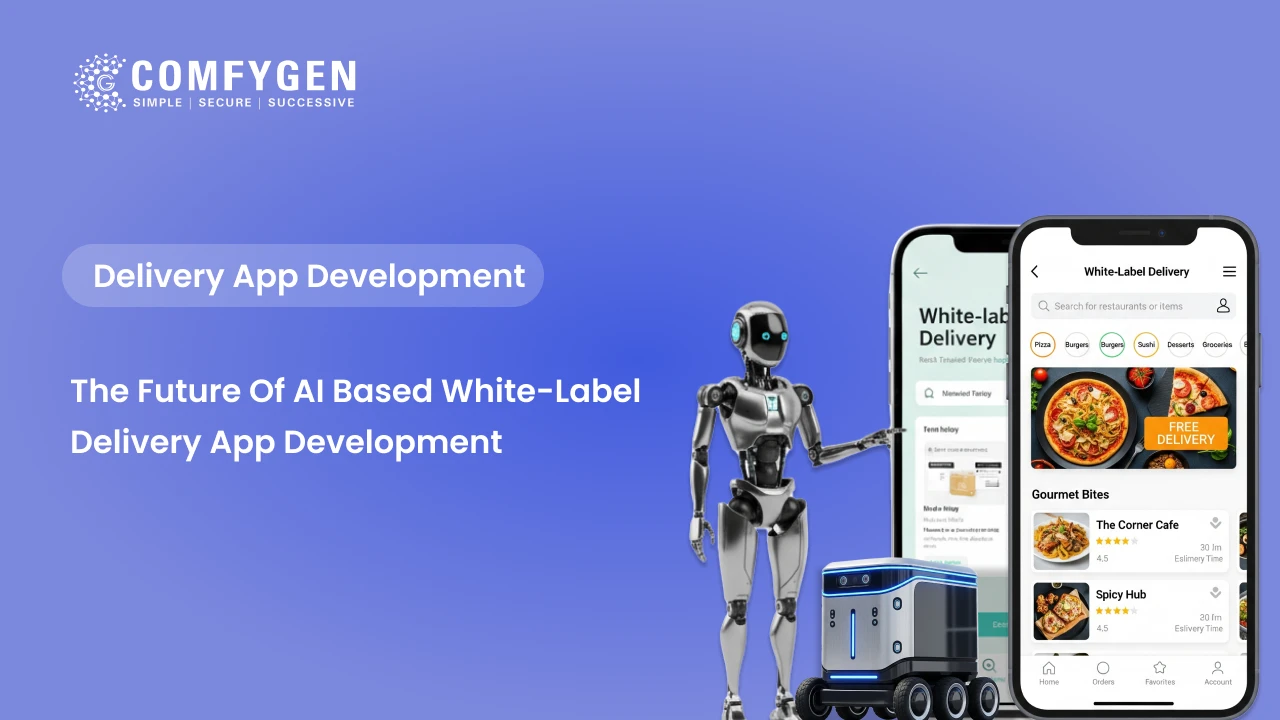





A white label delivery app is a ready-built platform that you rebrand with your own logo, colours and app store listing. As a result, you can launch in weeks rather than months. It usually costs $5,000 to $30,000 up front, plus monthly licence or per-order fees. It is the right choice for testing a market or running under about 1,500 to 2,000 orders a month. Past that, per-order fees and feature limits usually make a custom build cheaper and more flexible.
Below, this guide covers what you get, what it really costs over three years, where white label stops working, what “AI-powered” usually means in these products, and how to move to a custom platform without losing your data.
What You Get in a White Label Delivery App Package
In most cases, a white label package includes four parts, already built and tested:
- Customer app for Android and iOS with your branding
- Rider app with navigation and proof of delivery
- Vendor or store panel for accepting and preparing orders
- Admin dashboard for zones, commissions, offers and reports
Usually, you also get standard payment gateway support, live tracking, push notifications and basic reports. Your logo, colours, app name, service categories and delivery zones are configurable. However, the underlying code stays shared with every other business on the same platform.
White Label Delivery App vs Custom Build: An Honest Comparison
| Factor | White Label | Custom Build |
| Launch time | 2 to 6 weeks | 8 to 12 weeks for an MVP |
| Upfront cost | $5,000 to $30,000 | $10,000 to $100,000+ |
| Ongoing fees | Monthly licence, sometimes per-order fees | Hosting and maintenance only |
| Source code ownership | Rarely | Yes |
| Workflow changes | Limited to what the platform allows | Anything you need |
| Integrations | Only what the vendor supports | Any system with an API |
| Data ownership | Depends on the contract | Full |
| Risk | Vendor raises prices, changes terms or shuts down | You carry the build cost |
Choose white label when: you are testing a new city or category, you have under roughly 1,500 to 2,000 orders a month, your workflow is standard, and speed matters more than control.
Choose custom when: you have unusual rules (cold chain, hub transfers, B2B invoicing, cash reconciliation), you need ERP or POS integration, your order volume is growing past a few thousand a month, or the platform is your business rather than a side channel.
The Real White Label Delivery App Cost Over Three Years
Upfront price is the wrong comparison. Instead, work out the total over three years, because that is roughly how long a delivery platform runs before a rebuild.
| Cost Line | White Label | Custom |
| Upfront build or licence | $5,000 to $30,000 | $10,000 to $100,000+ |
| Monthly licence or platform fee | $200 to $2,000 | None |
| Per-order or per-rider fees | Common | None |
| Maintenance | Included, or a support plan | 15% to 20% of build cost a year |
| Hosting, maps, SMS | Sometimes included | Paid directly, usually cheaper |
| Customisation requests | Charged per change | Part of your own roadmap |
A simple test: add your expected monthly platform fees, multiply by 36, and add the upfront licence. If that total is close to a custom quote, custom is usually better value, because you also own the code and can change anything. The feature-by-feature detail behind a custom quote sits in this breakdown of delivery app costs.
Where a White Label Delivery App Limits You
- Workflow ceilings. If your business needs a step the platform does not have, such as a two-stage handover between hubs, you either pay for a custom module or change how you operate.
- Integration gaps. Connecting to your ERP, POS or warehouse system depends entirely on what the vendor supports.
- Shared release cycles. Bug fixes and new features arrive when the vendor ships them.
- App store duplicate risk. Apps built from the same template can look near-identical, and app stores sometimes reject or remove copies. Ask the vendor how many live apps share your build and how much of the UI you can change.
- Branding depth. Colours and logos are easy. Changing screen flow, wording and layout is usually not.
- Price changes. Licence fees can rise at renewal, and per-order fees grow with your success.
What “AI-Powered” Really Means in a White Label Delivery App
Many white label products advertise AI. Some of it is real and useful. However, some of it needs data that you do not have yet.
Usually real and ready on day one:
- Route planning through a maps API
- Distance and traffic-based ETAs
- Rule-based rider assignment
- A chatbot answering order status questions
Needs your own order history before it works:
- Machine-learning ETAs that learn prep times per store
- Demand forecasting for rider shifts
- Personal recommendations based on buying patterns
- Fraud detection tuned to your customers
Shared platforms sometimes train models across all their clients. As a result, your app can start smarter, although that raises fair questions about your data. Ask the vendor two things: whether your order data is used to train models for other clients, and whether you can export that data when you leave. The way each of these features actually works, and the order to add them in, is covered in detail for AI features in delivery apps.
White Label Contract Terms to Check Before You Sign
- Data export: Can you export customers, orders, vendors and riders in a usable format, at any time?
- Fee structure: Fixed monthly, per order, per rider, or a share of revenue? Model it at 10x your current volume.
- Price increase terms: How much notice, and how much can fees rise at renewal?
- Customisation costs: What is the hourly rate for changes, and who owns custom modules you pay for?
- Uptime and support: Response times for critical problems, especially during peak hours.
- App store accounts: Are the apps published under your developer account or the vendor’s? Yours is far better.
- Exit terms: Notice period, and what happens to your live orders and data on the last day.
How to Move From a White Label Delivery App to Custom
Many businesses start on white label, then move to custom once volume grows. Therefore, plan the move before you need it:
- Keep your own data copy: Export customers, orders and vendors monthly from day one.
- Own the app store accounts: Publishing under your own developer account means you can update the app in place instead of asking customers to download a new one.
- Own your domain and tracking pages: Customers should never see the vendor’s domain.
- Build the custom platform in parallel: Run both for a few weeks in one zone before switching.
- Migrate in stages: Move riders first, then vendors, then customers, so problems stay small.
- Keep the same app name and icon: A quiet switch keeps your reviews and downloads.
A custom platform also lets you design around your own model, whether that is an aggregator, a single-brand app or a multi-service delivery platform with one rider fleet across categories.
A Middle Path: A Custom Delivery App on a Proven Base
Fortunately, there is an option between the two. Some development teams build your platform on a proven code base they have shipped before. Next, they customise it for your workflow and hand over full source code. In short, you get much of the speed of white label, plus the ownership of a custom build.
Comfygen builds delivery applications this way, including white label mobile app development for businesses that want speed and their own code. Since 2019, the team has delivered 550+ projects for 400+ clients in 30+ countries, with 97% client retention, across food, grocery, medicine, courier and quick commerce delivery apps. If you are weighing a ready-made platform against a custom build, you can get a side-by-side estimate from the delivery team before signing anything.
Frequently Asked Questions
What is a white label delivery app?
How much does a white label delivery app cost?
Is a white label delivery app better than a custom app?
Do I own the code in a white label delivery app?
Can I switch from a white label app to a custom app later?
Are AI features in white label delivery apps real?

Mr. Saddam Husen, (CTO)
Mr. Saddam Husen, CTO at Comfygen, is a renowned Blockchain expert and IT consultant with extensive experience in blockchain development, crypto wallets, DeFi, ICOs, and smart contracts. Passionate about digital transformation, he helps businesses harness blockchain technology’s potential, driving innovation and enhancing IT infrastructure for global success.