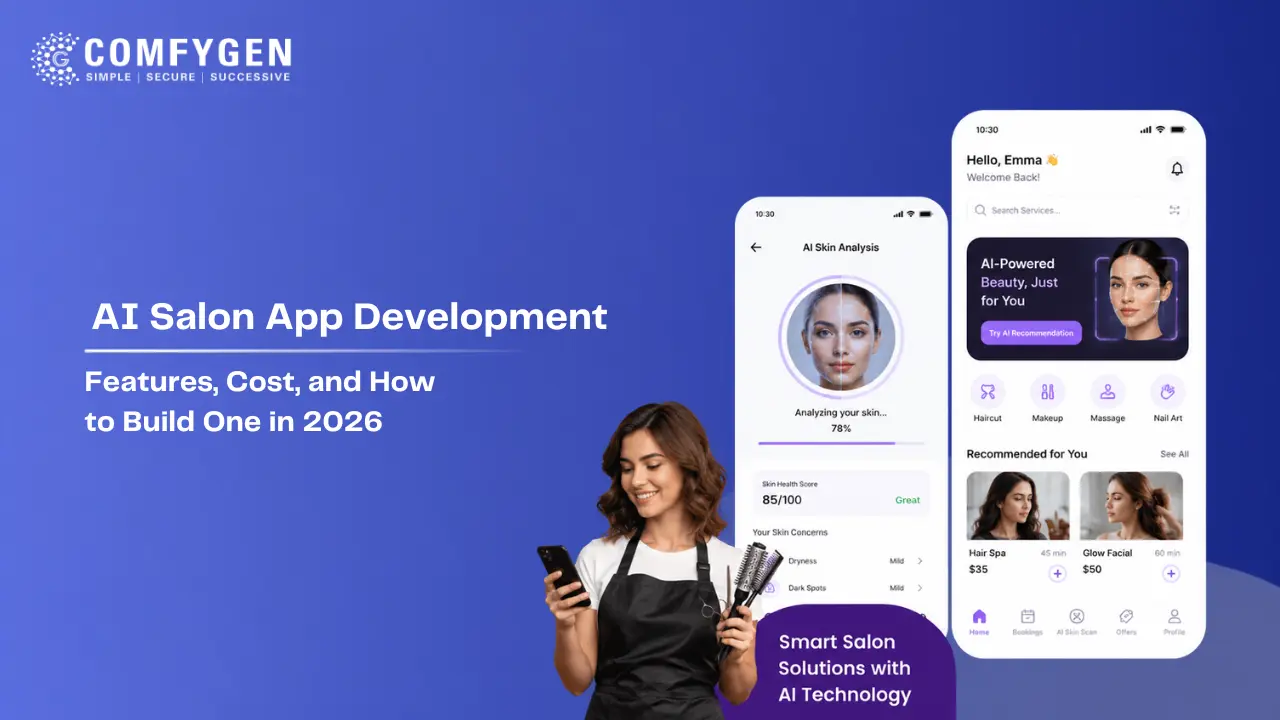





AI salon app development involves building booking and management solutions that use artificial intelligence to support smart scheduling, personalized recommendations, customer engagement, inventory insights, and business automation. The development cost depends on the scope, platforms, AI features, and integrations required. When implemented around real business needs, AI-powered features can help salons automate routine tasks, gain useful operational insights, and create more personalized customer experiences.
That’s the short version. Below is the full picture: what these apps actually do, which AI features move the needle, what they cost, and how the build works.
Why salons are moving to AI apps now
The numbers make the case on their own. The salon booking software market sits at around $590 million in 2025 and is on track to pass $1 billion by 2034, according to Market Growth Reports. Roughly 42% of salon software launched recently ships with some form of AI built in, mostly to cut no-shows and fill schedule gaps. And about 65% of salon bookings now happen on a phone, not over the counter.
Client behavior explains the shift. Boulevard’s 2026 salon data shows that nearly half of all bookings, somewhere between 46% and 50%, happen when the salon is closed. If your booking runs through phone calls during business hours, you’re losing every one of those. Boulevard also found that clients who first book online return roughly twice as often as walk-ins, so digital booking isn’t just convenient; it’s a retention lever.
Then there’s the AI-specific edge. Zenoti’s 2025 benchmark report named AI receptionist tools, the ones that catch missed calls and book appointments 24/7, as the most-adopted AI use case in salons last year. AI adoption is becoming an area of interest for salons looking to automate routine tasks and deliver more personalized digital experiences. The business impact depends on how the technology is implemented and whether it addresses real operational needs. In India specifically, AI skin analysis, virtual consultations, and app-based booking are already reshaping how salons compete, which matters if you’re building for that market.
What AI salon app development actually includes
A generic booking app just takes appointments. An AI salon app does the thinking around them. Here’s what a modern build usually covers.
- Smart appointment booking. The app reads staff availability, service duration, and buffer times, then offers slots that keep the calendar tight instead of leaving 20-minute dead gaps. It can auto-reschedule when someone cancels and pull the next likely client into the open slot.
- No-show prediction. The model scores each booking on the odds it gets skipped, based on history, lead time, and service type. High-risk bookings trigger extra reminders or a deposit prompt. AI-assisted reminders can help businesses identify booking patterns and improve how they communicate with customers about upcoming appointments.
- Virtual try-on and AR previews. Clients see a haircut, color, or nail style on themselves before they commit. This cuts consultation time and reduces the “that’s not what I wanted” conversation after the service.
- AI skin and hair analysis. The camera reads skin type or hair condition and suggests treatments, which doubles as an upsell engine. This is a big draw in premium and clinic-style salons.
- Personalized recommendations. The app studies each client’s past services, spend, and timing, then nudges them toward relevant add-ons and rebooking windows. Machine learning does the pattern-spotting a busy front desk can’t.
- Predictive inventory. Product usage gets forecast against booking volume, so the app flags reorders before you run out of a shade mid-week and stops cash sitting in overstock.
- Dynamic pricing. Service rates flex by demand, time of day, and slot scarcity. Off-peak Tuesday mornings get a small discount to fill; Saturday prime slots hold full price.
- AI chatbots and voice booking. A conversational assistant answers questions, books appointments, and confirms details without a human, which is what recovers those after-hours and missed-call bookings.
Key Benefits of AI-Powered Salon App Development
AI-powered salon applications are transforming the beauty industry in various ways (automated processes, enhanced customer experiences, improved business efficiency). These advanced features integrated apps, making salon business customer-centric by easing their salon appointment booking, service availability, beauty suggestions, etc. Some other key benefits are described below:
AI-Driven Appointment Booking System
With AI-driven salon appointment apps, customers can easily book appointments with no manual errors.
These apps can:
- Provide real-time availability updates to customers.
- Send automated reminders to reduce no-shows.
- Use AI-powered analytics to predict peak hours and optimize staff allocation.
Virtual Beauty Consultations
AI-driven virtual beauty assistants to provide personalized skincare, makeup, and hairstyle tips based on customers’ preferences:
- AI-based facial recognition analyzes skin type and hair condition.
- Customers can try different looks before booking a service.
- Increases customer engagement and boosts appointment bookings.
Personalized Customer Experience
Based on customers’ preferences and history, AI enhances customers’ satisfaction with tailored services, such as:
- Tracks customer preferences for customized service recommendations.
- Uses AI-based predictive analysis to suggest treatments based on past visits.
- Improves loyalty and customer retention by making salon visits more personalized.
Smart Inventory Management
Salon businesses automated inventory monitoring to prevent stockouts and manage products in stock:
- Predicts product demand based on customer usage patterns.
- Sends automated alerts for low-stock items.
- Reduces waste and prevents overstocking, optimizing business profitability.
AI-Powered Marketing Automation
Targeted promotions and personalized campaigns through AI app development in beauty & salon applications to improve marketing strategies:
- Sends automated, AI-generated promotions based on customer behavior.
- Optimizes email, SMS, and social media marketing for higher engagement.
- Increases customer loyalty through personalized discounts and loyalty programs.
Enhanced Customer Retention with AI-Powered Chatbots
AI-powered chatbots provide instant support, resolving customer queries 24/7.
- Handles appointment bookings and cancellations via chat.
- Provides personalized beauty advice based on AI analysis.
- Boosts customer satisfaction by ensuring quick response times.
Data-Driven Business Insights & Decision Making
AI analyzes customer data to help salon owners make informed business decisions.
- Tracks customer preferences, service demand, and sales trends.
- Uses AI-based reports to improve pricing strategies.
- Enhances salon profitability by identifying high-performing services.
Seamless Payment & Billing Process
AI-powered billing automates secure and hassle-free payments for salon customers.
- Integrates multiple payment options like UPI, cards, and wallets.
- Reduces billing errors and automates invoice generation.
- Enhances customer experience with fast, one-click checkout.
Integration with Augmented Reality (AR) for Virtual Try-Ons
AI and AR enable customers to preview hairstyles, makeup, and skin treatments virtually.
- Provides a realistic view of how services will look before booking.
- Increases confidence in choosing salon treatments.
- Encourages higher engagement and more bookings.
Which salon software has built-in AI features?
This is one of the most common questions salon owners ask, so here’s a direct answer. Most established platforms, Zenoti, Vagaro, Mindbody, Fresha, GlossGenius, and Booksy among them, now offer some AI, usually around automated reminders, missed-call recovery, or basic marketing. Zenoti’s AI concierge for missed calls is one of the more advanced examples on the market.
The catch with off-the-shelf software is that you rent someone else’s feature set. You can’t add a skin-analysis flow your clinic needs, you can’t own the client data outright, and you pay a monthly fee forever. A custom AI salon app flips that. You choose exactly which AI features go in, you own the code and the data, and there’s no per-seat subscription eating your margin as you grow.
So the honest answer to “which salon software has the best AI features” depends on what you’re optimizing for. If you want fast and cheap, a SaaS platform works. If you want a product built around your specific services, your brand, and your data, a custom salon app builder is the better call.
AI salon app cost: what to expect
The cost of developing an AI-powered salon app depends on how AI is used within the platform. Core booking and management features generally require less development effort, while advanced capabilities such as personalized recommendations, predictive analytics, or intelligent automation can increase the overall project scope. Rough ranges based on real project scoping:
- Basic AI app (smart booking, reminders, one AI feature like a chatbot): $10,000 to $25,000
- Mid-tier app (booking, no-show prediction, recommendations, AR try-on, admin dashboard): $25,000 to $50,000
- Advanced platform (full AI suite, skin analysis, dynamic pricing, multi-location, aggregator model): $50,000 to $100,000+
Timeline usually lands between three and seven months. For a full breakdown of what drives these numbers up or down, our detailed salon app pricing guide walks through every cost factor line by line.
One thing worth saying plainly: the cheapest quote rarely wins. An AI feature that’s trained badly or bolted on as an afterthought does more harm than no AI at all. Budget for the features that actually change your booking numbers and skip the rest.
How to build an AI salon app: the process
A custom build isn’t a mystery box. Here’s how a project typically runs at Comfygen.
- Discovery and feature mapping. The team learns your salon model- single location, chain, or aggregator- and picks the AI features that fit your revenue goals. This is where you decide what’s core and what’s phase two.
- UX and UI design. Wireframes and a clickable prototype come before a single line of code, so you see the flow and approve it early.
- AI model selection. Some features use ready-trained models (chatbots, image recognition for try-on). Others, like no-show prediction, need a model trained on booking data. The team picks the right approach per feature.
- Development. Front end, back end, and the admin panel get built in sprints, with something you can test at the end of each one.
- Testing and QA. Every booking path, payment flow, and AI output gets checked before launch, including edge cases that break lazy apps.
- Launch and support. The app ships to the App Store and Play Store, and post-launch support keeps it stable while real usage rolls in.
Tech Stack for AI-Powered Salon App Development
Choosing the right technology stack determines how scalable, secure, and maintainable your app will be.
- Frontend (Mobile): Flutter or React Native for cross-platform efficiency; Swift (iOS) and Kotlin (Android) for native performance.
- Backend: Node.js, Python (Django/FastAPI), or Ruby on Rails.
- Database: PostgreSQL or MongoDB for primary data; Redis for caching.
- AI and Machine Learning: TensorFlow, PyTorch, OpenAI API, Google Cloud Vision, AWS Rekognition for facial analysis and recommendation engines.
- AR Integration: ARKit (iOS), ARCore (Android), or Banuba/DeepAR SDKs for virtual try-on features.
- Cloud Hosting: AWS, Google Cloud Platform, or Microsoft Azure.
- Payment Gateways: Stripe, Razorpay, PayPal, Square — with UPI and digital wallet support for regional markets.
- Real-Time Communication: Firebase, Twilio, or Socket.io for notifications, chat, and live updates.
- Analytics: Mixpanel, Google Analytics for Firebase, or custom dashboards built on Looker or Power BI.
Why choose Comfygen for AI salon app development
Comfygen has been building mobile apps since 2019, with 550+ projects delivered for 400+ clients across 30+ countries. The team holds a 97% client retention rate, which in plain terms means most clients come back for the next build.
For salon and beauty projects specifically, the team has shipped booking apps, on-demand beauty platforms, and AI-driven features across both startup MVPs and multi-location systems. You get developers who’ve solved the booking-logic and no-show problems before, not a team learning on your budget. Every build ships with the source code in your name and support that doesn’t vanish at launch.
Final Verdict
We have explained many reasons and how they are driving AI-powered salon app development. With the increased revolutionary market trends, salons need automation, personalized services, and data-driven decision-making in their business.
The AI-empowerment of appointment scheduling, virtual beauty assistant, AI chatbots, online consultations, automated marketing strategies, and smart inventory management is proving to be business efficiency, enhanced customer satisfaction, and promising revenues.
However, AI & AR integration in salon apps improves hyper-personalized experiences via customers’ online preview services before actual bookings. Chatbots and predictive analytics in AI-powered salon apps ensure businesses beat the competition.
As AI evolves, the future of salon management lies in intelligent automation, real-time personalization, and enhanced customer engagement. Businesses that embrace AI-driven salon solutions will experience higher efficiency, increased profitability, and long-term brand growth. Therefore, investing in AI-powered salon app development is a necessity for a strong business establishment.
Frequently Asked Questions
What is AI salon app development?
How much does an AI salon app cost?
Which salon software has the best AI features?
How long does it take to build an AI salon app?
Can AI reduce salon no-shows?
Do I need a custom app or is SaaS enough?

Mr. Saddam Husen, (CTO)
Mr. Saddam Husen, CTO at Comfygen, is a renowned Blockchain expert and IT consultant with extensive experience in blockchain development, crypto wallets, DeFi, ICOs, and smart contracts. Passionate about digital transformation, he helps businesses harness blockchain technology’s potential, driving innovation and enhancing IT infrastructure for global success.