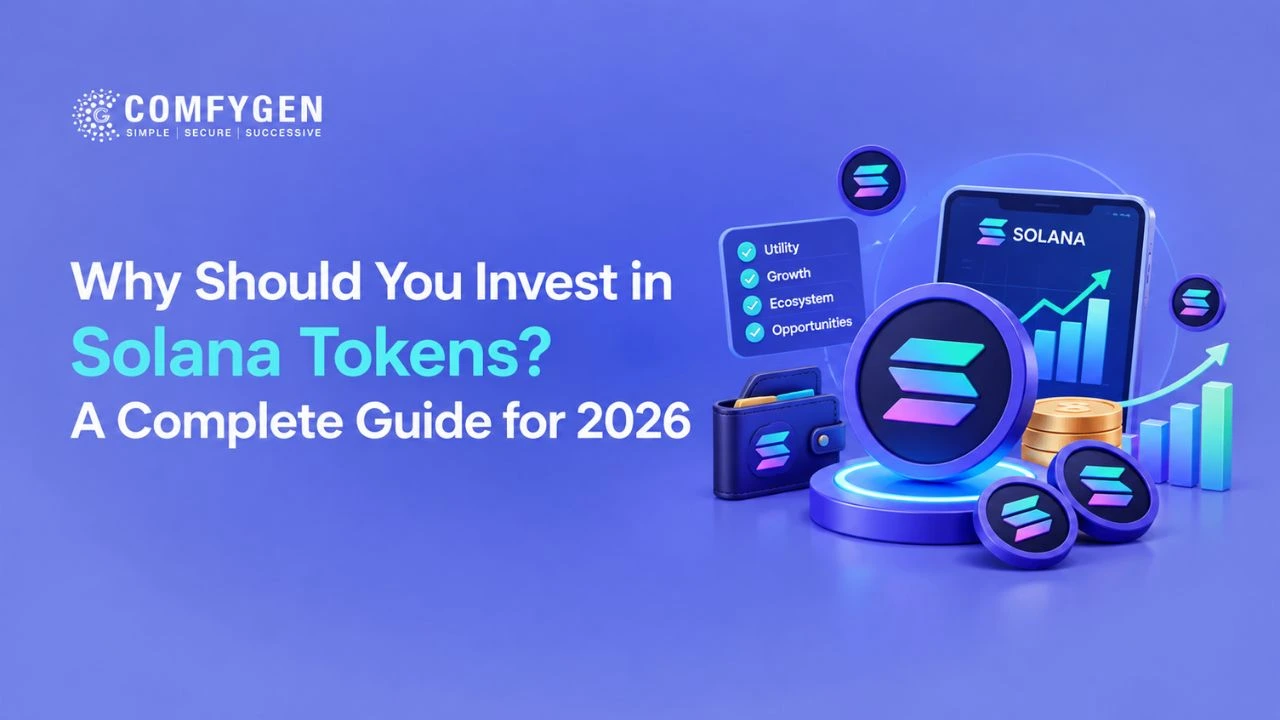





Blockchain technology has created new ways for businesses, developers, and users to create and exchange digital assets. Among the blockchain networks available today, Solana has attracted significant attention of business due to its transaction speed, network architecture, and growing ecosystem.
Solana tokens are digital assets used across a range of Web3 applications, including decentralized finance (DeFi), gaming, payments, communities, governance, and other blockchain-based use cases.
So, why investors and businesses paying attention to Solana-based assets in 2026? What makes the Solana ecosystem attractive, we will go throuh in this article.
What Is Solana?
Solana is a blockchain platform designed to support decentralized applications, digital assets, smart contracts, and other Web3 use cases.
Unlike traditional financial systems, blockchain networks allow transactions and digital assets to operate through decentralized infrastructure. Solana was designed with a focus on processing transactions efficiently while keeping network costs relatively low.
The Solana ecosystem supports applications across areas such as:
- Decentralized finance
- Gaming
- NFTs and digital collectibles
- Payments
- Web3 applications
- Decentralized exchanges
- Tokenized assets
- Community and governance projects
The network’s technical architecture is one reason developers consider Solana for applications that need frequent on-chain activity.
What Is a Solana Token?
A Solana token is a digital asset created on the Solana blockchain.
These tokens can serve different purposes depending on the project behind them. A token could represent access to a service, voting rights in a decentralized organization, an in-app asset, a payment mechanism, or another form of digital utility.
Solana’s token ecosystem includes assets built using Solana’s token infrastructure, commonly associated with SPL tokens.
The important point is that not every Solana token has the same purpose or value.
Two tokens can exist on the same blockchain but have completely different:
- Use cases
- Token supplies
- Distribution models
- Development teams
- Communities
- Liquidity
- Market demand
- Security risks
Therefore, evaluating the individual project is important before considering an investment.
What is SOL
SOL is the native cryptocurrency of the Solana blockchain.
It plays an important role in the network and can be used for purposes such as:
- Paying transaction fees
- Supporting network operations
- Staking
- Participating in the Solana ecosystem
- Transferring value between users
SOL and Solana tokens should not be treated as the same asset.
This guide explains the potential benefits, evaluation factors, and business opportunities surrounding Solana tokens in simple terms.
Important: Cryptocurrency investments are highly volatile and can result in significant losses. This article provides general educational information and should not be considered financial or investment advice.
Solana Token vs SOL: What Is the Difference?
This is one of the most important concepts for beginners.
| Feature | SOL | Solana Token |
| What is it? | Native cryptocurrency of Solana | Digital asset created on Solana |
| Main purpose | Network fees, staking and ecosystem functions | Depends on the project |
| Issuer | Native asset of the Solana network | Usually created by a project or organization |
| Utility | Supports Solana network operations | May provide utility, governance, rewards, payments or other functions |
| Value | Determined by market demand and other factors | Depends on the specific project’s demand, utility and market conditions |
| Risk | Cryptocurrency market and network risks | Cryptocurrency, project, tokenomics and smart-contract risks |
Understanding this difference can prevent one of the most common beginner mistakes: assuming that investing in any Solana-based token is equivalent to investing in SOL.
Why Are Solana Tokens Attracting Attention of Customers?
Interest in Solana-based assets is connected to several characteristics of the ecosystem. These characteristics do not guarantee that any particular token will increase in value, but they help explain why developers, businesses, and investors continue to examine the network.
1. Solana Supports High-Activity Applications
Some blockchain applications need to process many transactions and user interactions.
Solana’s architecture is designed to handle high transaction activity, making the network suitable for applications such as decentralized exchanges, games, payment systems, and other Web3 platforms.
For token projects, the underlying network matters because users need an infrastructure through which they can transfer and use their assets.
2. Transaction Costs Can Be Relatively Low
Transaction fees are an important consideration for blockchain applications.
When users frequently interact with a token or decentralized application, high transaction costs can make the experience less practical.
Solana has generally been known for relatively low transaction fees compared with some other major blockchain networks. This can make it attractive for applications where users need to perform frequent transactions.
However, network conditions can change, so users should check current transaction costs rather than relying on historical figures.
3. Growing Web3 Ecosystem
A blockchain becomes more useful when developers and users build applications around it.
Solana has developed an ecosystem covering areas such as:
- DeFi
- NFT marketplaces
- Gaming
- Decentralized exchanges
- Wallets
- Payment applications
- Infrastructure tools
- Consumer Web3 applications
A broader ecosystem can create more opportunities for tokens to have practical uses within applications.
4. Multiple Token Use Cases
A Solana token does not have to serve only one purpose.
Depending on the project, a token may be designed for:
Utility:
Users may need the token to access particular features or services.
Governance:
A token can provide voting rights within a decentralized project, depending on its governance model.
Payments:
Projects can use tokens to facilitate payments within their ecosystem.
Gaming:
Tokens can represent in-game assets, rewards, or other digital items.
Community participation:
Some projects use tokens to coordinate participation within online communities.
This flexibility gives businesses and developers different options when designing a blockchain-based product.
5. Token Creation Can Support New Business Models
Blockchain tokens allow businesses to explore models that are difficult to implement through traditional databases alone.
For example, a Web3 platform could create a token that gives users access to particular features or rewards participation within its ecosystem.
However, creating a token does not automatically create demand.
The token needs a clear purpose, appropriate tokenomics, reliable technology, and a product or ecosystem that gives users a reason to interact with it.
What Are the Potential Benefits of Investing in Solana Tokens?
The potential reasons for considering Solana-based assets depend heavily on the individual project.
Here are some factors investors may examine.
Access to the Solana Ecosystem
Holding a token associated with a project built on Solana can provide exposure to a particular part of the broader Solana ecosystem.
For example, one project may focus on DeFi while another may focus on gaming or payments.
The potential opportunity therefore comes not simply from the blockchain itself but from the project and use case built around the token.
Exposure to Web3 Projects
Web3 continues to create new approaches to digital ownership, decentralized applications, payments, and online communities.
Solana is one of the networks being used to build these applications.
Investors interested in specific Web3 sectors may therefore research Solana-based projects as part of their broader cryptocurrency research.
Utility-Based Token Models
Some tokens are designed around actual utility rather than existing only as speculative assets.
A token may be connected to:
- Platform access
- Governance
- Rewards
- Digital goods
- Payments
- DeFi services
- Gaming ecosystems
The strength of that utility depends on whether users actually need or want the service.
Potential for Ecosystem Growth
If an ecosystem attracts more developers, applications, users, and liquidity, the environment around its projects can change.
However, ecosystem growth should not be interpreted as a guarantee that an individual token will increase in price.
Each project still needs to be evaluated independently.
How Businesses Can Create a Solana Token
Solana is not only relevant to investors. It can also be useful for businesses exploring blockchain-based products.
A company may consider creating a Solana token for a particular business or Web3 use case.
A typical development process may include:
Before development begins, businesses should clearly define why the token is needed.
For example, a project could use a token for platform rewards, governance, payments, digital assets, or access to specific services.
The technical implementation should then be designed around that use case.
Build a Solana Token With Comfygen
If your business is planning to launch a token on Solana, Comfygen can help turn the concept into a working blockchain product.
Our Solana token development services can cover the technical requirements involved in creating and launching a custom token, based on the project’s use case and business requirements.
The development approach can include token planning, token creation, testing, security checks, deployment, wallet integration, and other required Web3 functionality.
Whether you are planning a utility token, governance token, payment token, gaming asset, or another Solana-based digital asset, the first step is to define its purpose and technical requirements clearly.
Talk to Comfygen about your Solana token development project.
Final Thoughts
Solana has become an important part of the broader Web3 ecosystem, and its blockchain infrastructure supports a wide range of applications and digital assets.
For investors, however, the fact that a token is built on Solana should not be the only reason to consider it. The project’s utility, tokenomics, technology, team, liquidity, security, adoption, and risks deserve careful research.
For businesses, Solana can provide an infrastructure option for creating custom tokens and blockchain applications. The right approach starts with a clear use case and then connects the business model, token economics, technical architecture, and security requirements.
If you are considering a Solana token project, understanding the technology and defining the token’s purpose should come before development or investment decisions.
FAQ’S
What is a Solana token?
A Solana token is a digital asset created and operated on the Solana blockchain. It can be designed for utility, governance, payments, gaming, rewards, or other Web3 applications.
Is SOL the same as a Solana token?
No. SOL is Solana's native cryptocurrency and is used for network-related functions such as transaction fees and staking. Other Solana tokens are separate digital assets created on the network.
Why are Solana tokens popular?
Solana tokens attract attention because they operate within an ecosystem known for high transaction capacity, relatively low transaction costs, and a broad range of Web3 applications. Popularity does not guarantee the success or value of an individual token.
Can businesses create their own Solana token?
Yes. Businesses and development teams can create tokens on the Solana blockchain for different use cases. The technical design depends on the project's requirements, token utility, tokenomics, and planned integrations.

Mr. Saddam Husen, (CTO)
Mr. Saddam Husen, CTO at Comfygen, is a renowned Blockchain expert and IT consultant with extensive experience in blockchain development, crypto wallets, DeFi, ICOs, and smart contracts. Passionate about digital transformation, he helps businesses harness blockchain technology’s potential, driving innovation and enhancing IT infrastructure for global success.